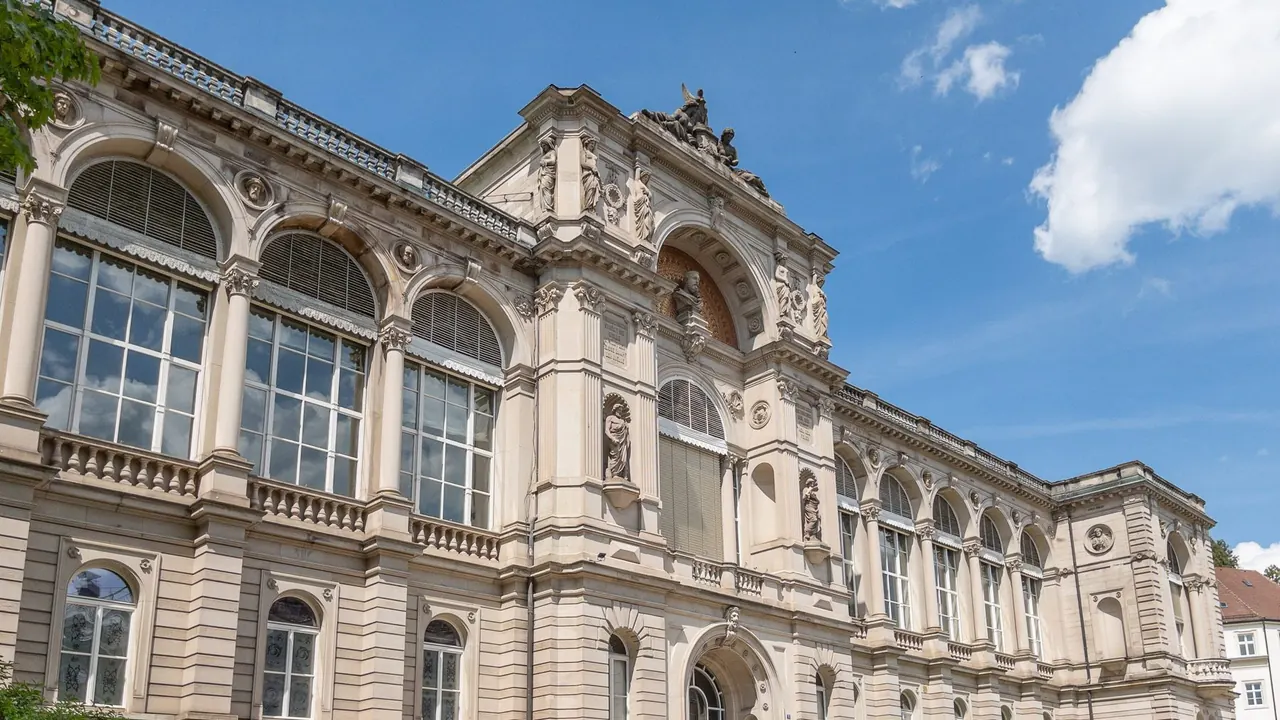
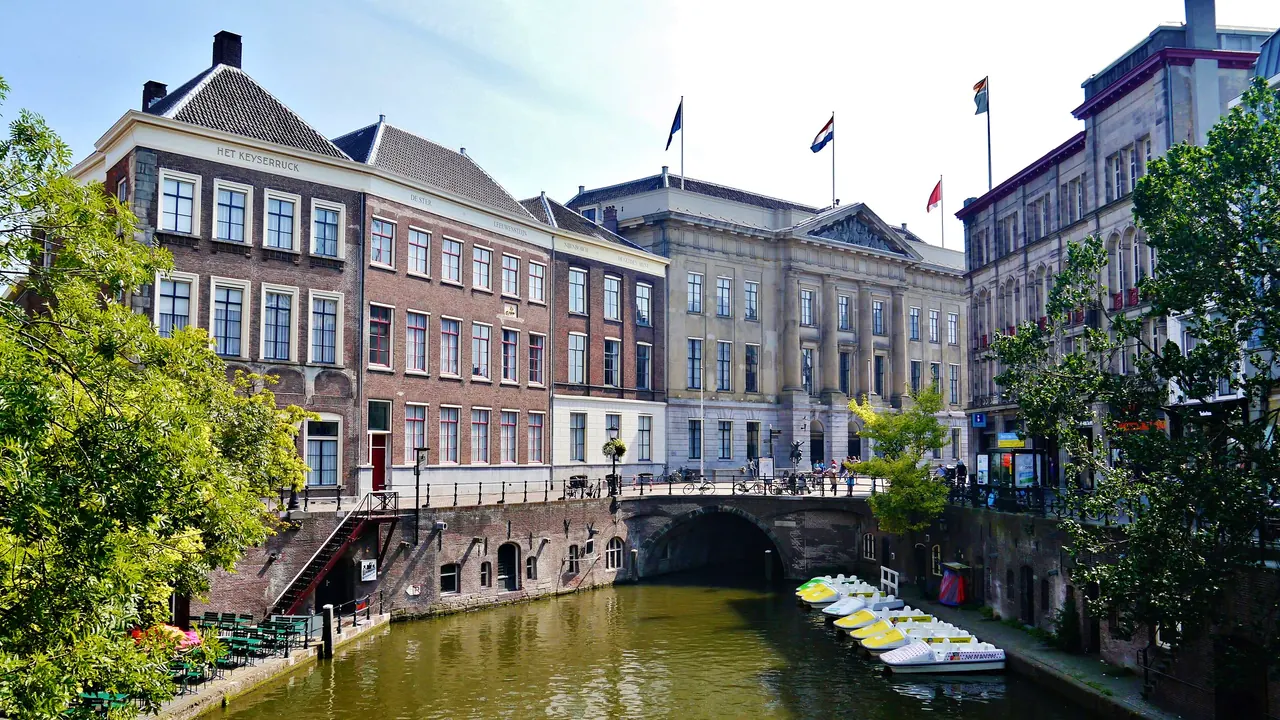
Photos: Baden-Baden by Kent Wang, CC BY-SA 2.0, cropped; Utrecht by Zairon, CC BY-SA 4.0, cropped.
Baden-Baden or Utrecht?
Our verdict in twelve categories, each scored against the same fixed benchmark cities, and the climate month by month, so you can choose for your trip.
Choose Baden-Baden for
- wellness
- nature and the outdoors
- food and drink
Baden-Baden is the choice for a slow, restorative stay. The thermal baths are the whole point of the town, the Black Forest begins at its edge, and the evenings are quiet and well dressed, with a casino, wine taverns and concerts at the Festspielhaus. It suits couples and older travellers who want to rest, walk in the forest and eat well, and who don't mind hiring a car for Alsace and the high ridges.
Choose Utrecht for
- nightlife
- getting around
- shopping
Utrecht gives you more to do. Its medieval centre and canal wharves stay lively on weeknights thanks to a large student population, children are welcome everywhere, and the station at the edge of the old town puts Amsterdam, Rotterdam and Delft within easy reach by train. It is the better base for travellers who want to see a lot of a country without a car, or a family looking for an easy city break.
Scoreboard
Twelve categories on one fixed scale from 0 to 100. The shaded stretch is the gap between the two.
Your match
Pick a travel style or drag the sliders, and both match scores follow your weighting.
Wins on wellness and nature and the outdoors with your weighting.
Wins on nightlife and getting around with your weighting.
What matters to you?
Category by category
What the scores mean for a trip.
Beaches & swimming
Neither place is for a beach trip, but Utrecht does a little better on a hot day. There are recreation lakes on the edge of the city, the Loosdrecht lakes are just to the north, and real sand at Zandvoort or Scheveningen is about an hour away by train.
Baden-Baden's alternatives are the gravel-pit lakes on the Rhine plain and the town's outdoor pools. In this town, water means warm thermal bathing, not swimming outdoors.
Food & drink
The two are broadly level for eating, but in different ways. Baden-Baden has a real regional kitchen, with Flammkuchen, venison and Black Forest gateau, a French influence from across the Rhine, and Riesling and Pinot Noir from the Rebland villages just outside town. Some of Germany's most celebrated restaurants are a drive away in the hills.
Utrecht has no cuisine of its own and makes up for it with setting and variety: meals on the wharves of the Oudegracht at water level, Indonesian and Surinamese cooking, and cheap student cafés. In the evening the choice is between wine and Belgian beer.
Culture & sights
Utrecht has more to see. Its medieval centre is among the best preserved in the Netherlands, with the free-standing Dom Tower to climb, the unusual two-level Oudegracht, and small but good museums such as the Centraal Museum and the Rietveld Schröder House. It fills two or three days comfortably.
Baden-Baden's interest is the Belle Époque town as a whole: the Kurhaus, the Trinkhalle colonnade, Lichtentaler Allee and the villas on the hillsides, with Roman baths underneath and the Frieder Burda collection for modern art. It is charming but covered in a day or two.
Nightlife
Utrecht is far livelier after dark. Students fill the bars around the Neude and Janskerkhof even on weeknights, and summer evenings are spent drinking at the canal edge. The clubs are few, but Amsterdam is a short train ride away.
Baden-Baden's evenings are formal and early. The night out is the gilded casino in the Kurhaus, with a dress code, followed by a hotel bar or a glass of local wine. Anyone looking for a late night has to go to Karlsruhe or Strasbourg.
Nature & outdoors
Baden-Baden has much the better outdoors. The northern Black Forest starts at the edge of town. You can ride the Merkur funicular for views to the Vosges, or follow trails from the Battert cliffs into fir forest. The High Road climbs past the Mummelsee to moorland above 1,100m, with mountain biking and some winter skiing.
Utrecht's countryside is flat and gentle, and you see it by bike: along the Vecht past country estates and windmills, through polders, or over the heath and low wooded ridges of the Heuvelrug. The Loosdrecht lakes add sailing and canoeing.
Day trips
Both are excellent bases, and Utrecht has the edge because everything is so easy to reach. It sits at the centre of the Dutch rail network, with Amsterdam under half an hour away and Rotterdam, The Hague, Delft, Leiden and Gouda all close, so you can see most of the country without changing hotel or hiring a car.
Baden-Baden's day trips are just as good, and they cross a border: Strasbourg and the Alsace wine villages, Heidelberg's castle, Freiburg's minster and the UNESCO cathedral at Speyer. The difference is that the Alsace and Black Forest trips work far better with a car.
Good for families
Utrecht is the easier city with children. The national Railway Museum is one of the best children's museums in the country, Miffy has her own museum for toddlers, and in Dutch culture children are welcome everywhere. The only thing to watch is the stream of bikes.
Baden-Baden is safe and calm, and the funicular and forest paths go down well, but the town is built around adults. The Friedrichsbad does not admit young children. Families usually spend their days at Europa-Park, about an hour south, or at the zoo in Karlsruhe.
Getting around
Utrecht is simpler. You step out of Utrecht Centraal straight into the old town, the main sights are a short walk away on flat streets, and the same tap-in card works on the trains, buses and trams. Rental bikes cover the rest, and a car is only a nuisance.
In Baden-Baden the compact centre is pleasant to walk, though some streets are steep. The station is a few kilometres out in Oos and connected by bus, and the wine villages, the High Road and Alsace are much easier by car.
Shopping & style
Utrecht has more to browse. Independent fashion, design and book shops line the Oudegracht wharves and lanes like the Twijnstraat, Hoog Catharijne has the chains, and there are markets for flowers, textiles and Dutch cheese. What is missing is luxury labels.
Baden-Baden has the opposite: a small, polished cluster of jewellers, watchmakers and boutiques on Sophienstraße and Lange Straße for its wealthy spa guests, and no markets or department stores. Beyond those, it is cuckoo clocks and local wine.
Affordability
Both are expensive, and the costs fall in different places. In Baden-Baden it is the grand hotels and the fee for every visit to the baths, though guesthouses, bakeries and wine taverns are reasonable.
In Utrecht it is mainly the bed: central rooms are scarce. After that, walking or a rental bike costs little, museum fees are modest, and student lunch cafés keep daily spending down.
Live music & performing arts
Both have strong music for their size, but of different kinds. Baden-Baden is about classical music and opera. The Festspielhaus, one of Germany's largest concert halls, brings international orchestras and productions, and the town also has the philharmonic in the Kurhaus, a jewel-box theatre and the legacy of Brahms.
Utrecht has a wider range under one roof at TivoliVredenburg, where classical, pop, jazz and experimental acts share the halls. The Festival Oude Muziek is a major draw for early music. It has no opera house, though, and most of its theatre is in Dutch.
Wellness & relaxation
This is where the two differ most. Baden-Baden exists for its hot springs. You can take the silent, unclothed circuit of the domed Friedrichsbad or spend the afternoon in Caracalla's indoor and outdoor thermal pools and sauna area, and the whole town slows to the same pace.
Utrecht has no bathing tradition. The nearest equivalent is a Dutch sauna complex in the green belt outside the city, and otherwise unwinding means a quiet evening on the canal wharves or an hour in the Pandhof cloister garden.
When should you go?
Pick your month. The climate figures are measured averages, not a forecast.
Baden-Baden in July
Utrecht in July
Daytime high, °C
Rainfall in the month, mm
Temperature and rainfall are climate normals, averaged over the years shown. Baden-Baden: 1991-2020 normals, Baden-Baden-Geroldsau (3.9 km from centre). Utrecht: 1991-2020 normals, De Bilt (4.3 km from centre).
Winters are almost the same in both, with highs around 6°C and short, grey days, so neither is at its best from November to February. The difference shows in summer. Baden-Baden is warmer, reaching about 25°C in July and August, and sunnier, which suits long forest walks and afternoons in the outdoor pools at Caracalla. Utrecht peaks a little cooler at around 23°C, which is comfortable for cycling and sitting out on the canal terraces, but the North Sea within reach only warms to about 19°C in August, so a beach day there is bracing.
Rain falls steadily in Baden-Baden all year, with no clearly dry month, so be ready for showers whenever you go. Utrecht is drier overall and driest in spring, with only 42mm in April, which makes April to June a good time for its cycling country. Baden-Baden comes into its own from May to September and again in October, when the autumn colour is out in the Black Forest. The baths keep it worth visiting in the colder months too.
Which traveller are you?
On a relaxing and wellness trip, Baden-Baden wins easily. The Friedrichsbad's silent sequence of hot rooms and the large thermal pools at Caracalla are the reason the town exists. Utrecht offers suburban sauna complexes and calm cloister gardens, but nothing comparable.
For a food and nightlife trip, Utrecht is better. Food is roughly level, with Baden's wine taverns against Utrecht's canal-side terraces and Surinamese kitchens, but Utrecht's student bars fill the centre most nights, while Baden-Baden is quiet by late evening apart from its casino.
For an outdoors trip, choose Baden-Baden. Fir forest, the Battert climbing cliffs and trails up to the Hornisgrinde moorland begin right outside town, with skiing in winter. Utrecht's flat polders and low Heuvelrug ridges are made for gentle cycling, not proper hiking.
Before you go
| Measure | Baden-Baden | Utrecht |
|---|---|---|
| Official language | German | Dutch |
| Currency | Euro (EUR) | Euro (EUR) |
| Sockets | CF230 V, 50 Hz | CF230 V, 50 Hz |
| Driving side | Right | Right |
| Time zone | UTC+1, UTC+2 in summer | UTC+1, UTC+2 in summer |
| Emergency number | 112 | 112 |
| Elevation | 181 m | 5 m |
| Main airport | Karlsruhe Baden-Baden Airport (FKB)12 km from centre43 non-stop destinations | Amsterdam Airport Schiphol (AMS)34 km from centre287 non-stop destinations |
| Public holidays this year | 12 days | 11 days |
By the numbers
| Measure | Baden-Baden | Utrecht |
|---|---|---|
| City population | 56,952 | 359,370 |
| People per km² | 406 | 3,619 |
| Museums within 10 km | 11 | 28 |
| UNESCO World Heritage sites within 50 km | 2 | 5 |
| Swim season, months above 21 °C | - | None |
Where else could you go?
Every comparison below shares a destination with this one, so you can follow Baden-Baden or Utrecht somewhere new.