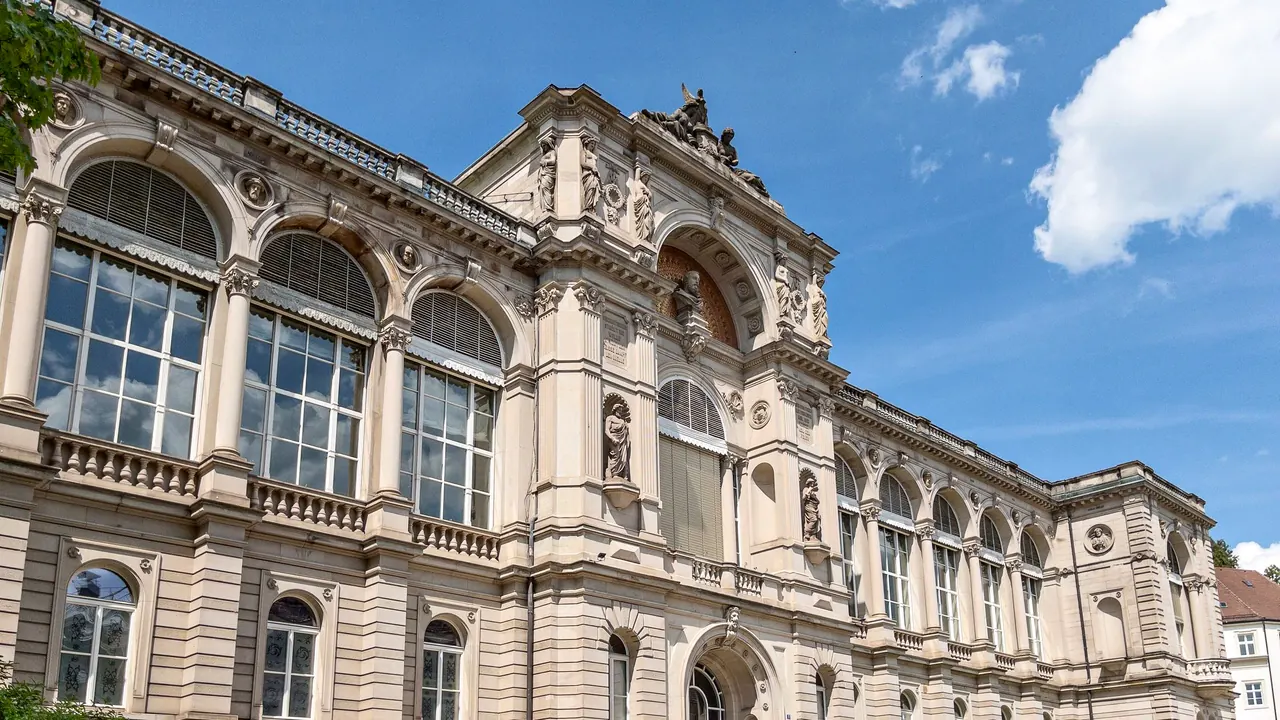
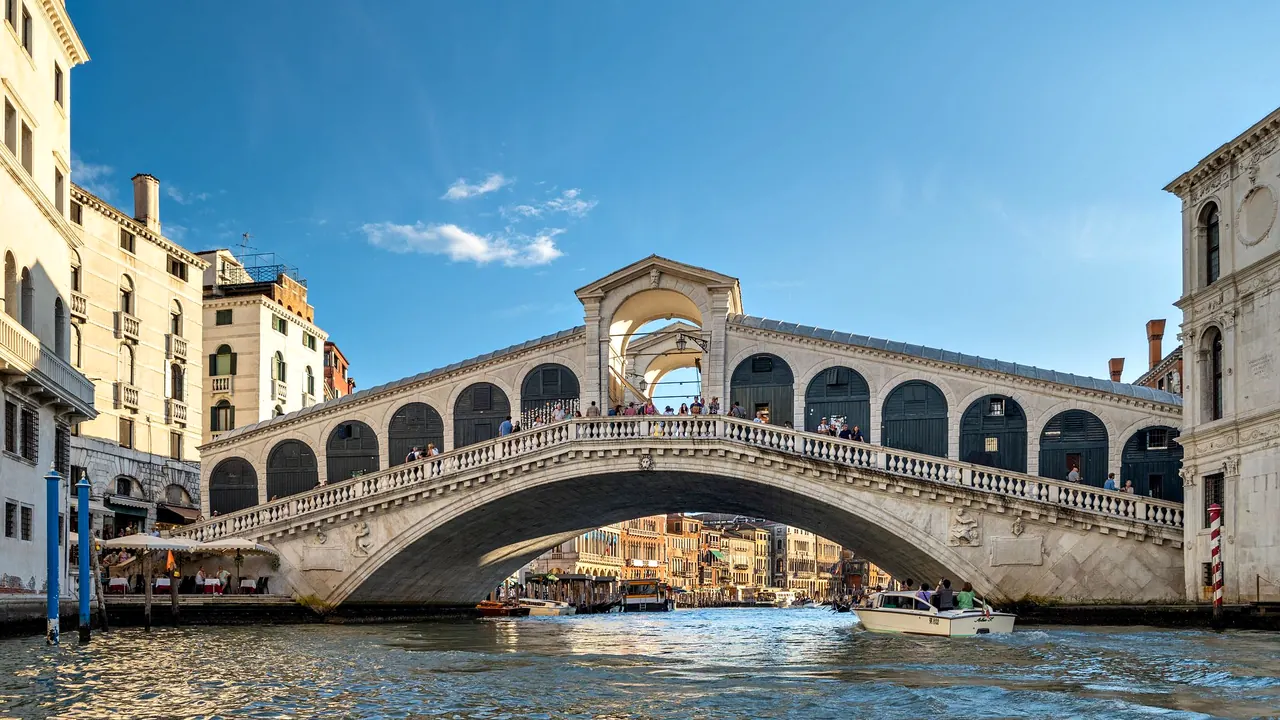
Photos: Baden-Baden by Kent Wang, CC BY-SA 2.0, cropped; Venice by David Vives, Pexels License.
Baden-Baden or Venice?
Our verdict in twelve categories, each scored against the same fixed benchmark cities, and the climate month by month, so you can choose for your trip.
Choose Baden-Baden for
- wellness
- nature and the outdoors
- prices
Baden-Baden is the choice for a slow, restorative stay. Its whole purpose is taking the waters, in the domed Friedrichsbad and the Caracalla pools, and the Black Forest begins at the edge of town for long walks between bathing sessions. It is a little less costly than Venice and much calmer. It also works as a base for Strasbourg, Alsace and Heidelberg.
Choose Venice for
- beaches
- culture and sights
- shopping
Venice rewards travellers who want to look and learn. The art and architecture run far deeper than anything in the German spa town, from the Basilica of San Marco to Titian in the Frari. Add cicchetti in the bacari, craft workshops, a sandy beach on the Lido and easy trains to Padua and Verona, and you have a busier, richer trip, though a pricier one and rarely a quiet one around the main sights.
Scoreboard
Twelve categories on one fixed scale from 0 to 100. The shaded stretch is the gap between the two.
Your match
Pick a travel style or drag the sliders, and both match scores follow your weighting.
Wins on wellness and nature and the outdoors with your weighting.
Wins on beaches and culture and sights with your weighting.
What matters to you?
Category by category
What the scores mean for a trip.
Beaches & swimming
Baden-Baden has no sea at all. A hot summer day means a lake in a flooded gravel pit on the Rhine plain or an outdoor pool.
Venice has the Lido, kilometres of sand on the open Adriatic with gentle, shallow water that suits children, plus the wilder Pellestrina beyond it. Few visitors give it more than an afternoon, but the option is there.
Food & drink
Venice has the more distinctive food, built around the bacari: cicchetti at the counter with a spritz, and lagoon cooking from the Rialto market such as cuttlefish risotto and sarde in saor. You need to avoid the picture-menu places around San Marco.
Baden-Baden is more about wine than restaurants. The Riesling and Pinot Noir taverns of the Rebland villages make a good evening out, and the hearty Baden cooking has a French touch. In town, the choice is mostly hotel dining and cafés serving cake and coffee.
Culture & sights
In Baden-Baden the attraction is the nineteenth-century resort as a whole. You can see it in the gilded casino rooms of the Kurhaus, the colonnaded Trinkhalle, the hillside villas above the Lichtentaler Allee and the Roman bath ruins under the old town. The Museum Frieder Burda and the Kunsthalle add solid modern art, and the Brahms house and the Russian church complete a short, satisfying round that a weekend covers comfortably.
Venice works on another scale entirely. Its canals, palaces and churches form one continuous historic city without a car in it. The painting runs from Titian in the Frari to Tintoretto covering the walls of San Rocco, with the Accademia, the Guggenheim and the Biennale on top of that. Someone who loves art could stay well over a week and still leave much unseen.
Nightlife
Neither town is for late nights, but Venice has the livelier early evening. Aperitivo crowds fill the bacari along the Fondamenta della Misericordia, and students keep Campo Santa Margherita busy after dark. Baden-Baden's evening is dressing up for the casino in the Kurhaus or a quiet hotel bar, with the streets empty well before midnight.
Nature & outdoors
Baden-Baden has much more for walkers. The Merkur funicular and the Battert cliffs lead straight onto forest trails, and the Black Forest High Road climbs past the Mummelsee to moorland above 1,100m, with mountain biking and some winter skiing.
In Venice, the outdoors means the flat lagoon: kayaking or rowing among the salt marshes near Torcello to see herons and flamingos, and cycling along the Pellestrina sea walls. For real hills you need a long trip to the Dolomites.
Day trips
Baden-Baden has a strong spread of outings. Heidelberg's castle and Freiburg's minster are each about an hour by train, the baroque palaces at Rastatt and Karlsruhe are closer still, and Speyer's cathedral and the monastery at Maulbronn are about an hour by road. Strasbourg is also about an hour away, just over the French border, but the Alsace wine route beyond it and the small Black Forest towns are far easier with a car.
Venice comes out ahead because nearly everything runs on fast trains from Santa Lucia. Padua is half an hour away, with Vicenza and Verona further along the same line. Some of its best outings need no train at all: Murano, Burano and Torcello are a boat ride across the lagoon.
Good for families
Neither is designed for children, and they fall short in different ways. Baden-Baden is easy and safe for pushchairs on the flat Allee, but its signature bath does not admit young children, so families end up driving to Europa-Park.
Venice delights children with boats, Murano glassblowing and the Lido sand. In return, the stepped bridges and packed summer routes wear parents out.
Getting around
Both are towns for walking, and Venice edges ahead because everything is within a forty-minute walk and vaporetti cover the rest. The cost is hundreds of stepped bridges and crowded boats. Baden-Baden's centre is compact but hilly, its station is a bus ride out, and the forest and Alsace really need a car.
Shopping & style
Venice offers more, mainly crafts made on the spot: Murano glass, Burano lace, papier-mâché masks, marbled paper and furlane slippers, with fashion names along the Mercerie. You do need to tell real workshops from imported copies.
Baden-Baden's Sophienstraße and Lange Straße suit a slow browse among jewellers, watchmakers and delicatessens. Beyond cuckoo clocks and wine there is little else.
Affordability
Both are expensive, and Venice more so. Hotels in the historic centre, water transport and entry to churches all add up, and savings depend on eating cicchetti standing at the counter or staying in Mestre. Baden-Baden's grand hotels and bath fees are costly too, but simple guesthouses, wine taverns and cheap buses are easier to fall back on.
Live music & performing arts
Both are serious places for classical music, in different ways. Baden-Baden's Festspielhaus is one of Germany's largest halls and brings in international orchestras and soloists, carrying on the tradition of Brahms and Clara Schumann. Venice has La Fenice, where Verdi and Rossini held premieres, the Biennale's contemporary festivals, and Vivaldi in candlelit churches most evenings.
Wellness & relaxation
This is Baden-Baden's whole reason to exist. You can follow the Friedrichsbad's silent sequence of hot rooms and pools, swim in Caracalla's indoor and outdoor thermal pools, and spend the rest of the day at an unhurried pace.
Venice has only hotel spas. The nearest true thermal baths are an hour away at Abano Terme, and its calm comes from early mornings in Castello or on Giudecca.
When should you go?
Pick your month. The climate figures are measured averages, not a forecast.
Baden-Baden in July
Venice in July
Daytime high, °C
Rainfall in the month, mm
Temperature and rainfall are climate normals, averaged over the years shown. Baden-Baden: 1991-2020 normals, Baden-Baden-Geroldsau (3.9 km from centre). Venice: 1991-2020 (sunshine 1971-2000, rainfall 1981-2010) normals, Venezia / Tessera (6.7 km from centre).
Baden-Baden is wet all year, with over 100mm of rain in most months, so pack for showers whatever the season. Late spring to early autumn is the time to go: summer highs reach about 25°C, the days are long and sunny, and the forest trails and wine villages are at their best. The warmth is pleasant rather than tiring. Winter is cold, dark and grey, best spent in the thermal baths.
Venice is drier and warmer. July reaches about 29°C, which with the humidity makes walking the alleys hard work at midday. By August the Adriatic off the Lido is at about 26°C, ideal for a beach afternoon from June to September. Spring and September are the most comfortable months for sightseeing. October is the wettest month at about 93mm, and the winter months are cool but still brighter than in Baden-Baden.
Which traveller are you?
On a relaxing and wellness trip, Baden-Baden is the clear pick. The Roman-era springs feed the silent ritual of the Friedrichsbad and the Caracalla saunas, and the whole town keeps a slow pace. In Venice, calm depends on avoiding the crowds.
For a culture and arts trip, Venice wins easily. San Marco, the Doge's Palace, the Accademia, Tintoretto's Scuola Grande di San Rocco and the Biennale could fill a week. Baden-Baden's Belle Époque spa quarter and its two museums take a day or two.
On a beach and sun trip, only Venice works. The Lido's fine sand and warm, shallow Adriatic water are a short boat ride from San Marco. Baden-Baden is inland, and in summer its swimming means gravel-pit lakes and outdoor pools.
Before you go
| Measure | Baden-Baden | Venice |
|---|---|---|
| Official language | German | Italian |
| Currency | Euro (EUR) | Euro (EUR) |
| Sockets | CF230 V, 50 Hz | CFL230 V, 50 Hz |
| Driving side | Right | Right |
| Time zone | UTC+1, UTC+2 in summer | UTC+1, UTC+2 in summer |
| Emergency number | 112 | 112 |
| Elevation | 181 m | 2 m |
| Main airport | Karlsruhe Baden-Baden Airport (FKB)12 km from centre44 non-stop destinations | Venice Marco Polo Airport (VCE)7 km from centre103 non-stop destinations |
| Public holidays this year | 12 days | 13 days |
By the numbers
| Measure | Baden-Baden | Venice |
|---|---|---|
| Population | 56,952 | 250,369 |
| People per km² | 406 | 602 |
| Museums within 10 km | 11 | 52 |
| UNESCO World Heritage sites within 50 km | 3 | 5 |
| Swim season, months above 21 °C | - | 4 months |
Where else could you go?
Every comparison below shares a destination with this one, so you can follow Baden-Baden or Venice somewhere new.
- Paduavs Venice
- Strasbourgvs Baden-Baden
- Stuttgartvs Baden-Baden
- Heidelbergvs Baden-Baden
- Freiburgvs Baden-Baden
- Piranvs Venice