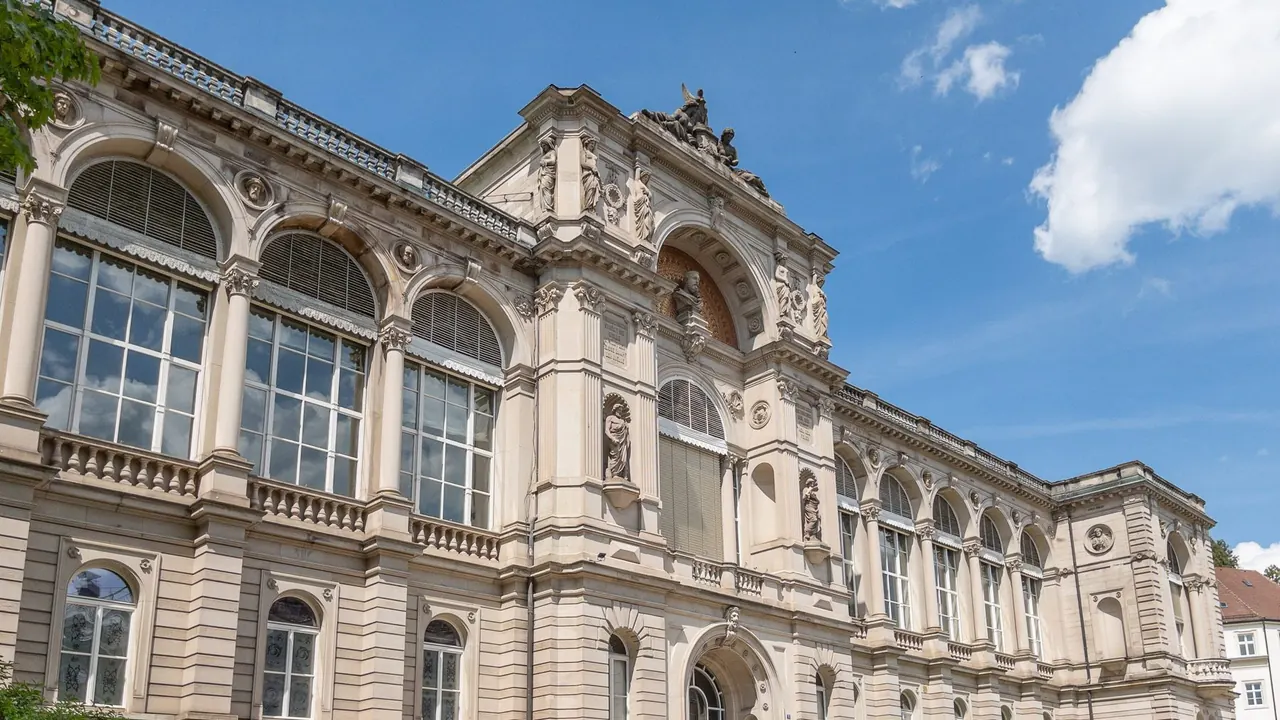
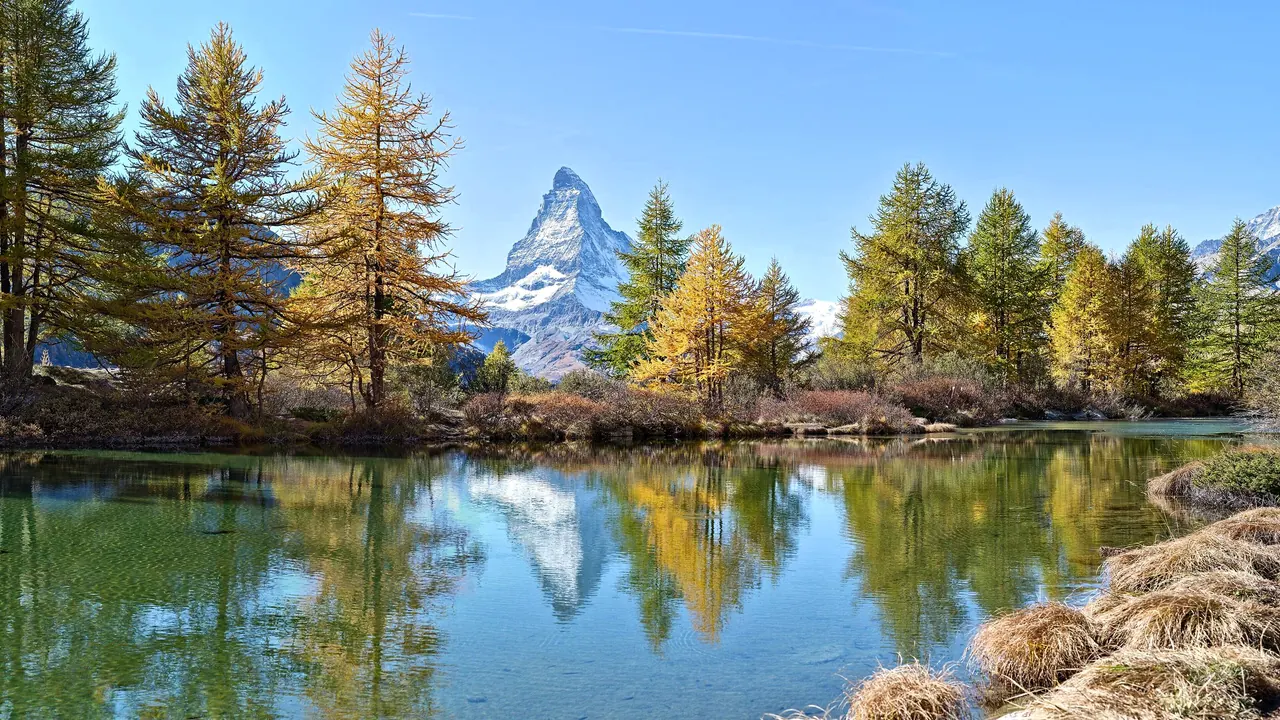
Photos: Baden-Baden by Kent Wang, CC BY-SA 2.0, cropped; Zermatt by Roy Egloff, CC BY-SA 4.0, cropped.
Baden-Baden or Zermatt?
Our verdict in twelve categories, each scored against the same fixed benchmark cities, and the climate month by month, so you can choose for your trip.
Choose Baden-Baden for
- wellness
- day trips
- live music and the arts
Baden-Baden is the choice for a slow, restorative stay with some refinement around it. Its thermal baths are the reason to go. The Belle Époque spa town, the Festspielhaus concerts and easy outings to Strasbourg, Heidelberg and the Alsace villages add variety to a week without much effort. It also suits travellers who want comfort but would rather not pay Alpine prices.
Choose Zermatt for
- nature and the outdoors
- getting around
- nightlife
Zermatt is for people who come for the mountains themselves. The Matterhorn rises above a car-free village, and lifts climb to glaciers, trails and pistes in every direction. That gives skiers, hikers and climbers something Baden-Baden's wooded hills cannot. Culture, concerts and side trips are thin and the costs are steep, so it is best for an active trip spent mostly outdoors.
Scoreboard
Twelve categories on one fixed scale from 0 to 100. The shaded stretch is the gap between the two.
Your match
Pick a travel style or drag the sliders, and both match scores follow your weighting.
Wins on wellness and day trips with your weighting.
Wins on nature and the outdoors and getting around with your weighting.
What matters to you?
Category by category
What the scores mean for a trip.
Beaches & swimming
Neither place is worth visiting for outdoor swimming. Baden-Baden at least has warm summers, so the gravel lakes of the Rhine plain and the outdoor pools are pleasant on a hot afternoon, and the rest of its bathing happens indoors in thermal water. In Zermatt the glacial tarns are for photographing the Matterhorn, not for swimming, and a swim means a hotel pool.
Food & drink
Both eat well for small places, but in different settings. Baden-Baden draws on the wider Baden region, with Flammkuchen, venison and Black Forest gateau, a French touch from across the Rhine, and Riesling and Pinot Noir from the Rebland villages, drunk in their own wine taverns.
Zermatt's best meals are up the mountain: long terrace lunches in the chalets around Findeln and Furi, with raclette, air-dried beef and Valais wines such as Petite Arvine. The choice is narrower, cheap meals are harder to find, and many kitchens close between seasons.
Culture & sights
Baden-Baden is the stronger sightseeing destination by a long way. The nineteenth-century spa town is itself the attraction, from the gilded Kurhaus and the colonnaded Trinkhalle to the hillside villas. There are Roman bath ruins below the old town, and the Museum Frieder Burda and the Kunsthalle for art.
Zermatt's heritage is narrow and tied to the mountain: the Matterhorn Museum on the first ascent of 1865, the mountaineers' cemetery and the old larch-wood barns of the Hinterdorf. That makes a good morning, and after that the day belongs to the peaks.
Nightlife
Zermatt has the livelier evenings, at least in winter. The après-ski bars on the runs into the village fill from late afternoon, and a few small clubs on the main street stay open past midnight. In summer it goes quiet early, as hikers turn in before dawn starts.
A night out in Baden-Baden means dressing up: the casino in the Kurhaus, then a hotel or wine bar, with the streets calm by late evening. For dancing, people go to Karlsruhe or Strasbourg.
Nature & outdoors
Both have landscape on the doorstep, but Zermatt's is on another scale. The Matterhorn, the Gorner Glacier and a ring of four-thousand-metre peaks are reached by lifts climbing above 3,800m. There is skiing across into Italy and some glacier pistes stay open in summer, and trails such as the Five Lakes walk pass marmots and ibex.
Baden-Baden has gentler country: the Merkur funicular, the Battert cliffs, the Panoramaweg through the vineyards and the Black Forest High Road up to the Hornisgrinde. It is lovely for walking and mountain biking, at its best in autumn colour, but these are wooded hills rather than high mountains.
Day trips
Baden-Baden is far better placed for days out. Strasbourg is about an hour away, and the Alsace wine route, Colmar, Heidelberg, Freiburg and the UNESCO sites at Speyer and Maulbronn are all realistic day trips, especially with a car.
From Zermatt every outing starts with the train down the valley. That makes Sion's castle hills or Brig's Stockalper Palace a fair effort, and Bern only just fits into a day. Most visitors spend their spare days on another mountain instead.
Good for families
Both are calm and safe with children, though families use them differently. Baden-Baden works mainly as a quiet base. Young children are not admitted to the Friedrichsbad, so days go to the Merkur funicular, the forest paths and above all Europa-Park, about an hour south.
In Zermatt families spend their days in the valley itself, with car-free streets, ski schools and nursery slopes at Sunnegga, and marmots and cog railways in summer. Rainy days are hard to fill, though, and the thin air at the highest viewpoints can be too much for small children.
Getting around
Zermatt is the simpler place once you have arrived. The car-free village is a compact strip you can walk end to end. Electric taxis and a chain of railways and gondolas from the centre carry you into the mountains, though leaving the valley takes over an hour by train.
Baden-Baden's centre is also walkable, if hilly. But the station is a bus ride out in Oos, and the Black Forest High Road, the wine villages and Alsace are much easier with a car.
Shopping & style
Neither is a shopping destination, but Baden-Baden is the better place to browse. Sophienstraße and Lange Straße have jewellers, fashion boutiques and delicatessens suited to an unhurried stroll, and Strasbourg is close for anything more.
Zermatt has a single main street of watch boutiques and souvenir shops. Its real strength is ski and mountaineering gear, worth knowing if you need equipment.
Affordability
Both are expensive, but Zermatt costs a good deal more. In Baden-Baden the grand hotels and spa fees add up, yet simple guesthouses, bakeries and wine taverns are reasonably priced for Germany, and buses are cheap.
In Zermatt even plain rooms, terrace lunches and the lift tickets every visitor needs cost far more than in most of Europe. Self-catering and sleeping down the valley in Täsch help, but you still need a generous budget.
Live music & performing arts
Baden-Baden has a real musical life for its size. The Festspielhaus, built into the old railway station, brings international orchestras and opera. The town's philharmonic plays in the Kurhaus, and the small nineteenth-century theatre adds drama, in a town where Brahms and Clara Schumann worked.
Zermatt has no theatre or concert hall. Outside Zermatt Unplugged in spring and the chamber music festival in late summer, live music rarely goes beyond a band in an après-ski bar.
Wellness & relaxation
Wellness is what defines Baden-Baden. Hot springs rise beneath the old town, and a stay centres on the silent, domed Friedrichsbad and the pools and saunas of Caracalla, with the rest of the day kept slow.
Zermatt relaxes you in a different way, with excellent hotel spas, some open to day visitors, clean air and no traffic noise. There is no thermal bathing, though, and in the busiest weeks the mood is more active than restful.
When should you go?
Pick your month. The climate figures are measured averages, not a forecast.
Baden-Baden in July
Zermatt in July
Daytime high, °C
Rainfall in the month, mm
Where the figures come from
Zermatt has no weather station within reach, so its figures come from a gridded climate model rather than a measured record, and read a broad area rather than the city itself.
Temperature and rainfall are climate normals, averaged over the years shown. Baden-Baden: 1991-2020 normals, Baden-Baden-Geroldsau (3.9 km from centre). Zermatt: 1991-2020 normals, TerraClimate 4 km grid at the town, no weather station within 90 km.
Baden-Baden has a long, mild season on the edge of the Rhine plain. From May to September the afternoons are comfortable for walking the Lichtentaler Allee and the forest trails. July and August reach about 25°C and get the most sun, around 243 hours in July. Rain is spread through the year rather than falling in one wet season, so a shower is possible in any month. Winters are grey and chilly but rarely harsh, which suits a visit built around the warm baths.
Zermatt has two separate seasons. From December to March daytime highs sit at or below freezing, around -2°C in midwinter, which is what the ski slopes need. Summer is short and cool, with highs of only about 14°C in July and August even down in the village. That is good weather for hiking but never for the beach. November is the wettest month at about 130mm.
Which traveller are you?
For a relaxing and wellness trip, Baden-Baden is the clear pick. The Friedrichsbad and Caracalla draw on hot springs the Romans used, and the whole town keeps a slow pace around them. Zermatt has fine hotel spas but no thermal bathing tradition.
On an outdoors trip, Zermatt wins easily. Lifts and cog railways run from the village to glaciers, four-thousand-metre peaks and hundreds of kilometres of marked trails, with skiing in winter. Baden-Baden's Black Forest walks are pleasant, but they cross wooded upland rather than high mountains.
For a culture and arts trip, choose Baden-Baden. The Kurhaus, the Trinkhalle and the Museum Frieder Burda fill a couple of days, and the Festspielhaus brings in international orchestras and opera. Zermatt's heritage, a mountaineering museum and a climbers' cemetery, fills a morning.
Before you go
| Measure | Baden-Baden | Zermatt |
|---|---|---|
| Official language | German | French, German, Italian, Romansh |
| Currency | Euro (EUR) | Swiss Franc (CHF) |
| Sockets | CF230 V, 50 Hz | CJ230 V, 50 Hz |
| Driving side | Right | Right |
| Time zone | UTC+1, UTC+2 in summer | UTC+1, UTC+2 in summer |
| Emergency number | 112 | 112 |
| Elevation | 181 m | 1,624 m |
| Main airport | Karlsruhe Baden-Baden Airport (FKB)12 km from centre43 non-stop destinations | Geneva International Airport (GVA)128 km from centre150 non-stop destinations |
| Public holidays this year | 12 days | 9 days |
By the numbers
| Measure | Baden-Baden | Zermatt |
|---|---|---|
| City population | 56,952 | 6,023 |
| People per km² | 406 | 25 |
| Museums within 10 km | 11 | 2 |
| UNESCO World Heritage sites within 50 km | 3 | 2 |
Where else could you go?
Every comparison below shares a destination with this one, so you can follow Baden-Baden or Zermatt somewhere new.
- Strasbourgvs Baden-Baden
- Chamonixvs Zermatt
- Stuttgartvs Baden-Baden
- Interlakenvs Zermatt
- Heidelbergvs Baden-Baden
- Freiburgvs Baden-Baden