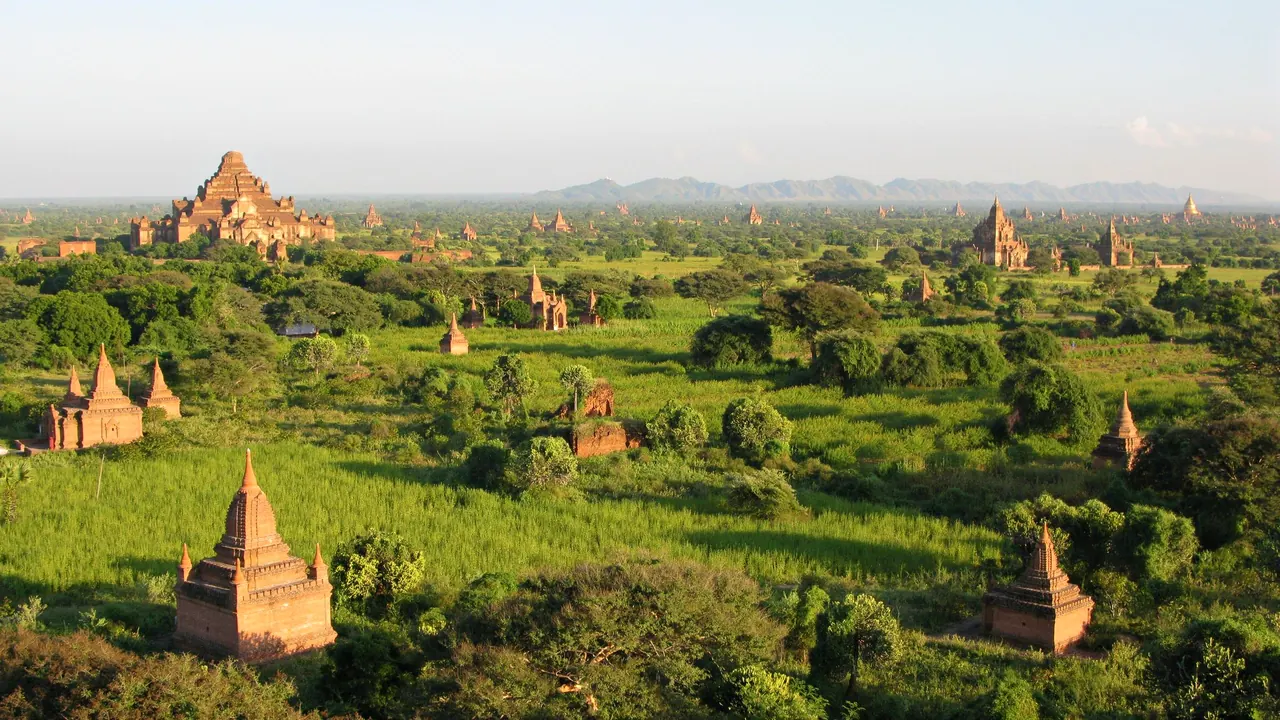
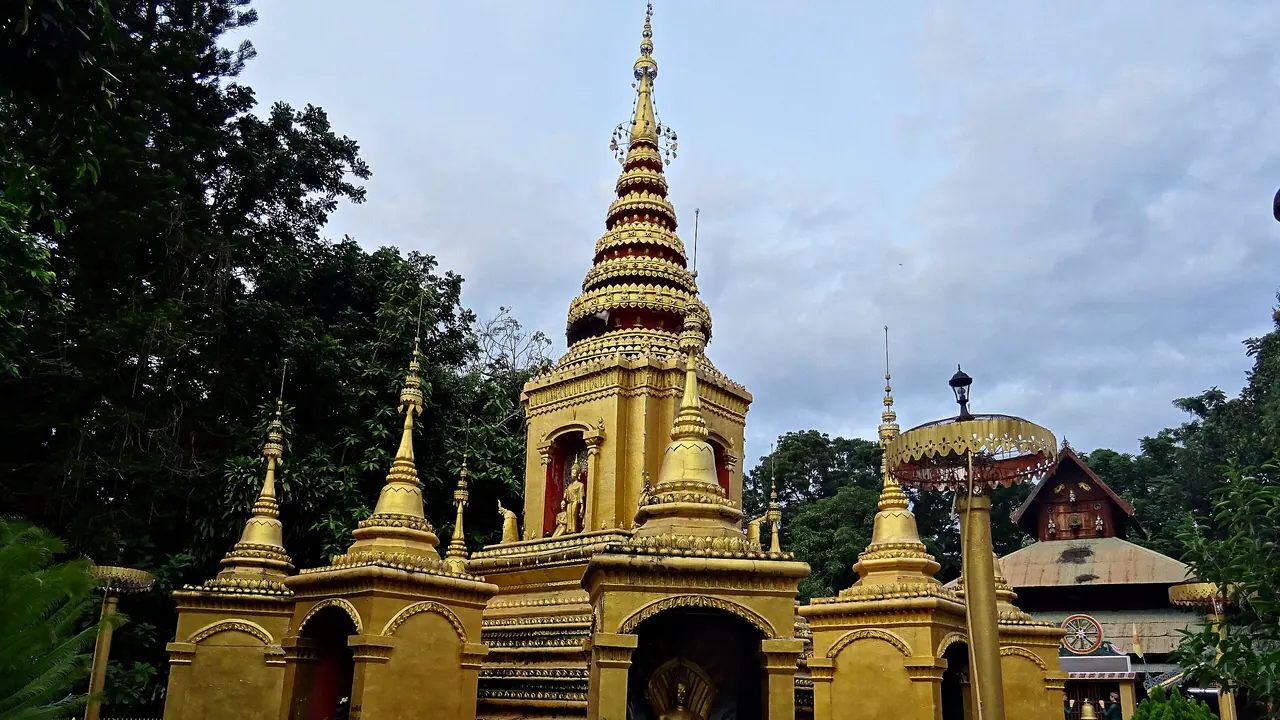
Photos: Bagan by Vyacheslav Argenberg, CC BY 4.0, cropped; Pai by Christophe95, CC BY-SA 4.0, cropped.
Bagan or Pai?
Our verdict in twelve categories, each scored against the same fixed benchmark cities, and the climate month by month, so you can choose for your trip.
Choose Bagan for
- culture and sights
- day trips
- shopping
Bagan is the choice for a traveller who wants to see one of Asia's great monument landscapes: thousands of brick temples left by the Pagan kings across a plain beside the Irrawaddy, explored by e-bike from sunrise to sunset. It suits people who are happy with early nights and simple Burmese food, and who want a trip with one clear purpose. Mount Popa and Salay are good outings when the temples have been seen.
Choose Pai for
- wellness
- nature and the outdoors
- nightlife
Pai rewards people who want to slow down in green hill country rather than work through a list of sights. Its valley of rice fields, waterfalls, canyon walks and hot springs is the draw. Add cheap massage, yoga retreats and a sociable backpacker evening, and it suits a longer, looser stay. The trade-off is that there is little history to see and few places worth reaching beyond the valley.
Scoreboard
Twelve categories on one fixed scale from 0 to 100. The shaded stretch is the gap between the two.
Your match
Pick a travel style or drag the sliders, and both match scores follow your weighting.
Wins on culture and sights and day trips with your weighting.
Wins on wellness and nature and the outdoors with your weighting.
What matters to you?
Category by category
What the scores mean for a trip.
Beaches & swimming
Neither is a place for a beach trip. Bagan lies on the plains of central Myanmar and Pai in a mountain valley in northern Thailand, and both are a long way from the sea.
The difference is in what water they do have. Bagan's silty Irrawaddy is for boat trips, not swimming, so a hotel pool is the only option. Pai at least lets you float down its river on an inner tube or splash in waterfall pools such as Mo Paeng.
Food & drink
Pai eats somewhat better, thanks to its evening walking street. The stalls sell khao soi, Shan dishes and grilled skewers, cafés cater to long-stay travellers with vegetarian plates and good coffee, and Santichon adds Yunnanese noodles and tea.
Bagan's best meals feel more local. There are Burmese curry spreads with their crowd of side dishes, tea-leaf salad, and mohinga in the tea shops. But the restaurants are spread across three separate settlements and many tourist menus are the same, so you have less choice.
Culture & sights
This is the widest gap between the two. Bagan is one of the great sights of Asia: a plain of temples, stupas and monasteries from the Pagan empire. The gilded Shwezigon and the white Ananda are the best known, and countless smaller shrines with faded murals stand along the dirt tracks. Climbing is restricted and some restoration after the 2016 earthquake was heavy-handed, but it still fills several days.
Pai has nothing on that scale. The white Buddha of Wat Phra That Mae Yen, a few Shan-influenced temples, the old iron bridge and Santichon village make a pleasant half day. People go there for the valley, not the sights.
Nightlife
Pai has a real evening scene and Bagan does not. After the night market, Pai's reggae bars and fairy-lit garden bars fill with young backpackers until around midnight. It is friendly and easy-going, but there are no clubs or cocktail bars.
In Bagan the day starts before dawn for the temples. Evenings end with dinner and a beer on Nyaung U's restaurant strip, and the town is quiet by ten.
Nature & outdoors
Scenery is the whole of Pai's appeal. The valley's rice fields lie beneath forested hills, with Pai Canyon for a sunset walk, Pam Bok and Mo Paeng waterfalls close by, and viewpoints where mist settles in the morning. Rafting in the wet season and the cave of Tham Lod, about an hour away, add more.
Bagan's landscape is a flat, dry plain of scrub, palms and peanut fields beside the Irrawaddy. Most of its beauty comes from the temples on it, seen from a balloon at dawn or a boat at sunset. For hills and forest walks you have to go out to Mount Popa.
Day trips
Bagan has the better choice of outings. Mount Popa, with the Taung Kalat monastery on its volcanic plug and hundreds of barefoot steps to the top, makes a memorable day. Salay's carved teak monastery is a quiet half day, and Pakokku across the river shows you a working market town.
Pai is more cut off. Soppong and the Lahu and Lisu villages around it are about an hour away along the mountain road. Chiang Mai and Mae Hong Son are around three twisting hours away, so most visitors move on to them rather than going and coming back in a day.
Good for families
Neither is made for children, but Pai is the easier of the two. Waterfalls, hot springs, farm visits, gentle tubing and the night market give young visitors some variety, though the winding road in makes many of them carsick.
Bagan asks more of a family. The sights are one brick temple after another, distances across the hot, dusty plain are long, and medical care is basic. Older children who enjoy horse carts, a balloon flight and a bit of history get the most out of it.
Getting around
Both are explored by scooter, neither has public transport a visitor would use, and walking only covers a small area in each. The difference is the terrain. Bagan is flat, with sandy tracks linking Nyaung U, Old Bagan and New Bagan. An e-bike is the classic way round, with horse carts and drivers hired by the day for the rest.
Pai's small centre takes minutes to walk, but the canyon, waterfalls and springs are reached on hill roads where beginners often crash. For anyone not used to riding, a hired songthaew or a tour is the safer way.
Shopping & style
Bagan has the more distinctive craft. It is the centre of Burmese lacquerware, and in the workshops of Myinkaba you can watch bowls and boxes being built up layer by layer before you buy. Sand paintings at the temples and longyi cloth at Nyaung U market add to the choice.
Pai's shopping is the walking street's stalls of cotton trousers, woven bags, hill-tribe textiles and jewellery. It is fun to browse, but the same things turn up from stall to stall. In both places, anything beyond crafts and souvenirs means another city.
Affordability
Both are very cheap, and a long stay costs little in either. What differs is where the money goes. In Bagan the big extras are the archaeological zone fee for foreigners and the dawn balloon flights, and staying in Nyaung U keeps costs lowest.
In Pai most sights are free or nearly so, and bungalows and night-market meals cost so little that people stay for weeks. Its tourist centre is dearer than ordinary northern Thai towns, though, especially at the busy new year.
Live music & performing arts
Neither has theatres or concert halls, but Pai has live music most nights: acoustic sets and blues, reggae and jazz jams in bars. The quality is uneven, but it is easy to come across over a drink.
Bagan's performances are traditional and put on for visitors: marionette shows and dance at dinner restaurants. If your dates coincide with a pagoda festival, such as the one at Ananda Temple, you may also see an all-night zat pwe of music, dance and comedy.
Wellness & relaxation
Pai is made for unwinding in a way Bagan is not. A soak in the warm springs at Tha Pai in the cool morning air, followed by a Thai massage in town, sets the rhythm. Retreats on the outskirts last anything from a day to several weeks, and the spring haze is the main drawback.
Bagan is calm too, but rest there is mostly a midday break from the heat. You spend it by the pools and gardens of the riverside resorts or having a Burmese massage, while dust and touts at the busier temples break the peace.
When should you go?
Pick your month. The climate figures are measured averages, not a forecast.
Bagan in July
Pai in July
Daytime high, °C
Rainfall in the month, mm
Where the figures come from
Bagan has no weather station within reach, so its figures come from a gridded climate model rather than a measured record, and read a broad area rather than the city itself.
Pai's temperatures are measured 64 km from the centre, at Mae Hong Son.
Pai's station stands 242 m below the city centre, so the centre is likely a little cooler than the figures say.
Pai has no rain gauge within 25 km of the centre, so its rainfall comes from a gridded climate dataset read at the city rather than from a gauge further away.
Pai's sunshine is measured 86 km from the centre, at Chiang Mai.
Temperature and rainfall are climate normals, averaged over the years shown. Bagan: 2001-2020 normals, NASA POWER reanalysis grid, no weather station within 90 km. Pai: 1971-2000 (sunshine 1991-2020, rainfall 1991-2020) normals, Mae Hong Son (63.7 km from centre).
The two keep a similar calendar through the cooler half of the year. In both, November to February is the best time to go. It is dry, with highs around 30°C, which is comfortable for cycling between temples in Bagan or riding out to the waterfalls around Pai. From March the heat builds in both, reaching 39°C in Bagan in April, when midday on the open plain is punishing. Pai is just as hot then, and the hills disappear in smoke from field burning.
The rainy season is where they differ. Bagan lies in Myanmar's dry zone, and even its wettest month brings only about 71mm, so June to October there is hot but seldom washed out. Pai gets the full monsoon, with around 230mm in August and less than half the sunshine of its winter months. That means muddy tracks, though it is also the season for rafting on the river.
Which traveller are you?
On a culture and arts trip, Bagan is the clear pick. Its plain of more than two thousand temples, from the Ananda to Dhammayangyi, can fill several days of exploring. Pai's hilltop Buddha, few temples and Yunnanese village take about half a day.
For an outdoors trip, Pai has much more to offer. It has a green valley ringed by forested hills, the eroded ridges of Pai Canyon, several waterfalls, treks to hill-tribe villages and the cave of Tham Lod. Bagan's dry plain is mostly for cycling between monuments.
On a relaxing and wellness trip, Pai wins easily. Natural hot springs, massage shops on every street, yoga and meditation retreats and long afternoons in a hammock set the pace. In Bagan, rest mostly means the resort pool between hot, dusty temple visits.
Before you go
| Measure | Bagan | Pai |
|---|---|---|
| Official language | Burmese | Thai |
| Currency | Kyat (MMK) | Baht (THB) |
| Sockets | CFG230 V, 50 Hz | ABCF220 V, 50 Hz |
| Driving side | Right | Left |
| Time zone | UTC+6:30 | UTC+7 |
| Emergency number | Police 199, ambulance 192, fire 191 | Police 191, ambulance 1669, fire 199 |
| Elevation | 75 m | 509 m |
| Main airport | Bagan Airport (NYU)7 km from centre | Chiang Mai International Airport (CNX)86 km from centre28 non-stop destinations |
By the numbers
| Measure | Bagan | Pai |
|---|---|---|
| City population | 22,000 | 3,598 |
| Museums within 10 km | 1 | 0 |
| UNESCO World Heritage sites within 50 km | 1 | 0 |
Where else could you go?
Every comparison below shares a destination with this one, so you can follow Bagan or Pai somewhere new.