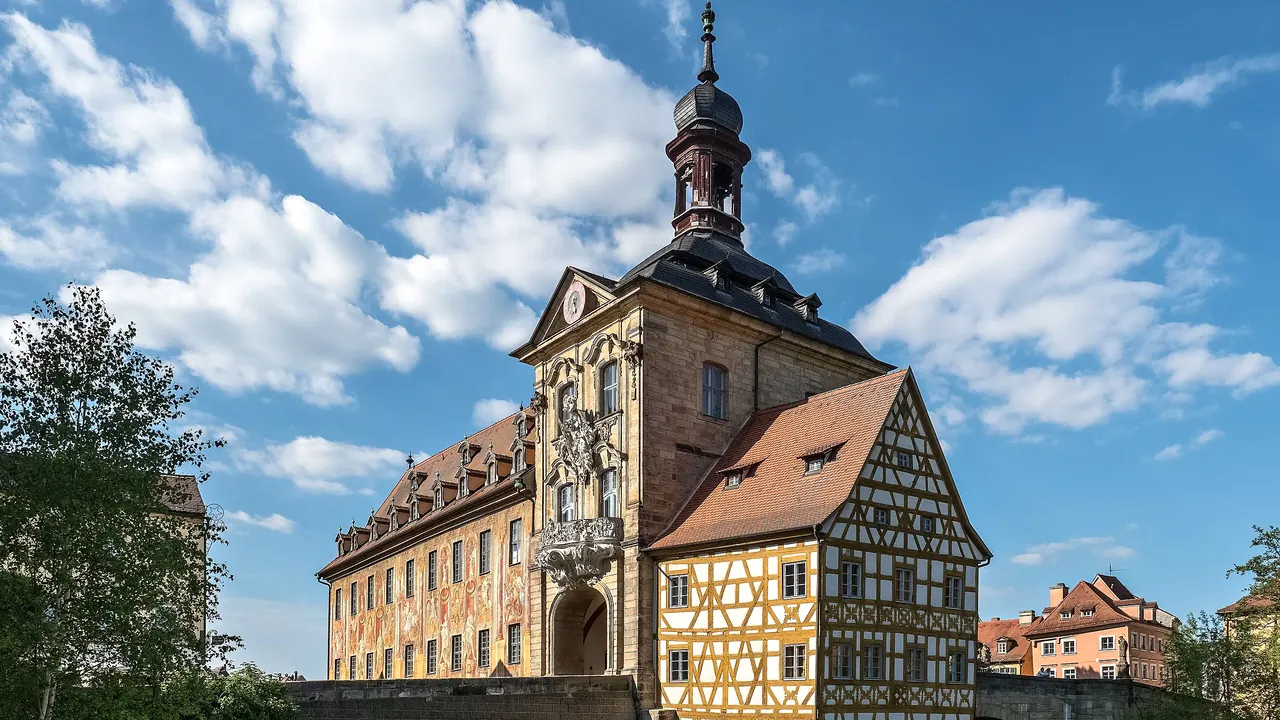
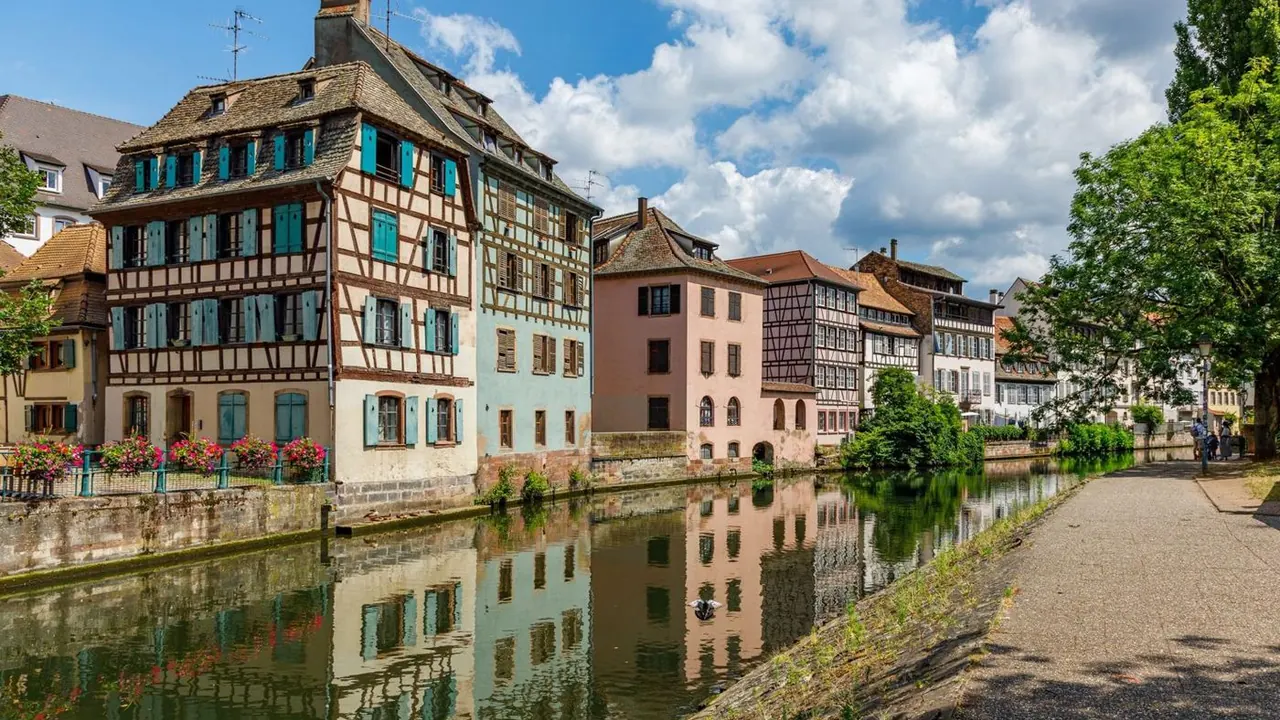
Photos: Bamberg by Ermell, CC BY-SA 4.0, cropped; Strasbourg by Edoardo Colombo, Pexels License.
Bamberg or Strasbourg?
Our verdict in twelve categories, each scored against the same fixed benchmark cities, and the climate month by month, so you can choose for your trip.
Choose Bamberg for
- prices
Bamberg suits travellers who want a small, walkable old town with a slower pace and a lower bill. It is the better pick for anyone drawn by beer, since its brewery taverns, smoked Rauchbier and hillside beer cellars are the reason to come. It also makes a sound base for Nuremberg, Würzburg and Bayreuth. Expect quiet evenings, small museums and little laid on for children.
Choose Strasbourg for
- families
- shopping
- live music and the arts
Strasbourg offers more on almost every other front. It has proper museums and an opera house, a winstub table with Alsace wine, and trams and cycle lanes that make the flat centre easy. Day trips run in two directions, to the Alsace wine villages on one side and the Black Forest on the other. Families, arts lovers and anyone wanting a fuller week will get more out of it, though it costs somewhat more.
Scoreboard
Twelve categories on one fixed scale from 0 to 100. The shaded stretch is the gap between the two.
Your match
Pick a travel style or drag the sliders, and both match scores follow your weighting.
Wins on prices with your weighting.
Wins on families and shopping with your weighting.
What matters to you?
Category by category
What the scores mean for a trip.
Beaches & swimming
Neither city is anywhere near the sea, so swimming means fresh water in summer. Bamberg has a traditional river bathing spot in the Hain park on the Regnitz, along with gravel-pit lakes at the edge of town. Strasbourg swims in a ring of lifeguarded gravel-pit lakes such as the Baggersee, which you can reach by tram. Its river is not an option, because the Rhine is unsafe for swimming.
Food & drink
Bamberg's food culture is mostly about beer. The town has a remarkable density of small breweries, smoky Rauchbier is the local speciality, and Schäufele with dumplings is the standard plate, eaten in old taverns or the summer beer cellars. It is satisfying but narrow, with little fine dining and few foreign cuisines.
Strasbourg has the broader table. Alsace mixes French and German cooking, from choucroute and baeckeoffe to tarte flambée and foie gras. Winstubs pour Riesling from nearby vineyards, and there is a real fine-dining tier. The one thing to avoid is the tourist menus around the cathedral.
Culture & sights
The two are close in what they offer but different in kind. Bamberg is a townscape to wander. The whole old town is UNESCO-listed, its seven hills are crowned by churches, and the Old Town Hall stands on an island in the Regnitz below the four-towered cathedral. Its museums are small.
Strasbourg pairs its historic centre with real collections. There is the pink sandstone cathedral with its astronomical clock, Petite France and the German-built Neustadt. On top of that come the three museums in the Palais Rohan, a large modern art museum and the European institutions. In Strasbourg you will spend more time indoors with art.
Nightlife
Both cities go quiet early, but Strasbourg has a little more going on. The student bars of Krutenau and around Place Saint-Étienne stay busy, and summer terraces along the quays stay full into the evening. In Bamberg the evening is spent in brewery taverns and beer cellars, with student bars in the Sand quarter during term. For clubbing, people take the train to Nuremberg.
Nature & outdoors
Bamberg's countryside is gentle. The limestone valleys, rock towers and caves of Franconian Switzerland start less than an hour east, the Steigerwald's beech forests lie to the west, and there are cycle paths along the Main and walks from one village brewery to the next.
Strasbourg has bigger hills within reach on both sides. The Vosges rise to the west above the vineyards, with castle ruins and the Mont Sainte-Odile ridge, and the Black Forest to the east has higher ridges for serious hiking. The flat Rhine plain also makes it one of the best cycling cities in France.
Day trips
Both are good bases, but Strasbourg reaches into two countries. Colmar and the Alsace wine route with Riquewihr and Haut-Koenigsbourg lie to the south, and Baden-Baden, Freiburg and Heidelberg are across the Rhine. Basel and Nancy are also within range. For the wine villages, though, a car or a bike helps.
Bamberg's trips stay within Franconia, and they are all easy by train. Nuremberg, Würzburg's Residence, Coburg and Bayreuth are each about an hour away, and the baroque Vierzehnheiligen basilica is closer still.
Good for families
Strasbourg is far better set up for children. The flat, car-free centre suits pushchairs, boat trips loop round the Grande Ile, and the Orangerie has storks, playgrounds and rowing boats. Le Vaisseau is built for young visitors, and Europa-Park is about an hour across the border.
Bamberg is safe and relaxed, and its beer gardens welcome families, with children playing between the tables. Beyond the Hain park playgrounds, boat hire on the Regnitz and a leisure pool with slides, though, there is little for children, and the cobbled climb to the cathedral is hard work with a pushchair.
Getting around
You can walk around both centres, but Strasbourg is easier. It is flat and mostly pedestrianised, trams run out to the station and across the Rhine to Kehl, and separated cycle lanes make a bike the quickest way to get about. Bamberg's sights are only minutes apart, but the cobbled climbs to the cathedral and Michaelsberg are steep, the station is a fair walk out, and buses fill the gaps.
Shopping & style
Strasbourg gives shopping more room. There are chain stores and a large department store around Place Kléber, independent delicatessens near the cathedral, and Soufflenheim pottery and printed linens to take home. Its Christmas market, one of the oldest in Europe, makes December the high point.
In Bamberg, shopping fills an hour between sights. It comes down to high-street names on Lange Strasse, produce from the market gardens, bottled smoked beer from the breweries and a few antique dealers near the cathedral.
Affordability
Bamberg is the easier place on the wallet. Beer is cheap, a tavern dinner of pork and dumplings costs less than in a big city, and rooms are moderately priced for most of the year, apart from weekends and the Christmas season.
Strasbourg is fairly priced for a French regional city, and the winstub meals, wine by the pichet and trams are all good value. Rooms are the expensive part, and prices climb sharply during the Christmas market and the European Parliament sessions.
Live music & performing arts
Strasbourg has the fuller arts calendar. The Opéra national du Rhin, a philharmonic orchestra and the Théâtre National de Strasbourg, one of France's leading stages, perform through the season, and the Musica festival makes the city a centre for contemporary music every autumn.
Bamberg's strength is a single institution, the Bamberg Symphony, an orchestra with an international name. Add drama at the ETA Hoffmann Theatre and organ concerts in the cathedral, but there is no opera company. For opera, people go to Bayreuth.
Wellness & relaxation
Strasbourg has a bathing tradition of its own in the Bains municipaux, a tiled early twentieth-century bathhouse with a hammam and saunas. The Friedrichsbad and Caracalla baths at Baden-Baden are under an hour away. Bamberg relaxes you mainly through its slow pace and shady beer gardens. For thermal water, the brine pools at Bad Staffelstein are about half an hour away by train.
When should you go?
Pick your month. The climate figures are measured averages, not a forecast.
Bamberg in July
Strasbourg in July
Daytime high, °C
Rainfall in the month, mm
Temperature and rainfall are climate normals, averaged over the years shown. Bamberg: 1991-2020 normals, Bamberg (2.8 km from centre). Strasbourg: 1991-2020 normals, Strasbourg (9.1 km from centre).
The two climates are close. Both are cold and grey from November to February, with highs around 4°C to 6°C and short days, so winter visits are about warm taverns rather than long walks. Both warm up in May and peak in July and August at about 26°C, which is warm enough for an afternoon at the lakes without being too hot for sightseeing. Summer is also when the most rain falls. Bamberg's wettest month is July, while Strasbourg gets more of its rain earlier, in May.
Strasbourg stays a little milder at both ends of the season. It is a couple of degrees warmer in spring and early autumn and has slightly more sunshine in March and September, so a late September visit there feels more like summer than it does in Bamberg. For walking either town, May, June and September are the most comfortable months.
Which traveller are you?
On a family trip with children, Bamberg works for a few slow days of park, river and beer garden, but there is not much else for young visitors and the hills tire small legs. Strasbourg can fill a whole week, with easy days in town and bigger outings into the region.
For a trip on a tight budget, Bamberg lets you live well on little. Dinner is a tavern meal rather than a restaurant bill, you can walk everywhere, and the regional trains replace paid tours. Strasbourg's streets and cathedral cost nothing, but your room takes a bigger share of the money.
On a culture and arts trip, Bamberg suits a traveller happy to read a town through its streets and churches, with a concert by its well-known orchestra as the evening highlight. Strasbourg makes for a fuller itinerary, with museum mornings and evenings at the opera or theatre in a city shaped by both France and Germany.
Before you go
| Measure | Bamberg | Strasbourg |
|---|---|---|
| Official language | German | French |
| Currency | Euro (EUR) | Euro (EUR) |
| Sockets | CF230 V, 50 Hz | CE230 V, 50 Hz |
| Driving side | Right | Right |
| Time zone | UTC+1, UTC+2 in summer | UTC+1, UTC+2 in summer |
| Emergency number | 112 | 112 |
| Elevation | 262 m | 132 m |
| Main airport | Nuremberg Airport (NUE)46 km from centre56 non-stop destinations | Strasbourg Airport (SXB)10 km from centre43 non-stop destinations |
| Public holidays this year | 12 days | 11 days |
By the numbers
| Measure | Bamberg | Strasbourg |
|---|---|---|
| City population | 77,218 | 293,771 |
| People per km² | 1,414 | 3,752 |
| Museums within 10 km | 11 | 21 |
| UNESCO World Heritage sites within 50 km | 1 | 3 |
Where else could you go?
Every comparison below shares a destination with this one, so you can follow Bamberg or Strasbourg somewhere new.
- Baden-Badenvs Strasbourg
- Nurembergvs Bamberg
- Colmarvs Strasbourg
- Freiburgvs Strasbourg
- Rothenburg ob der Taubervs Bamberg
- Stuttgartvs Strasbourg