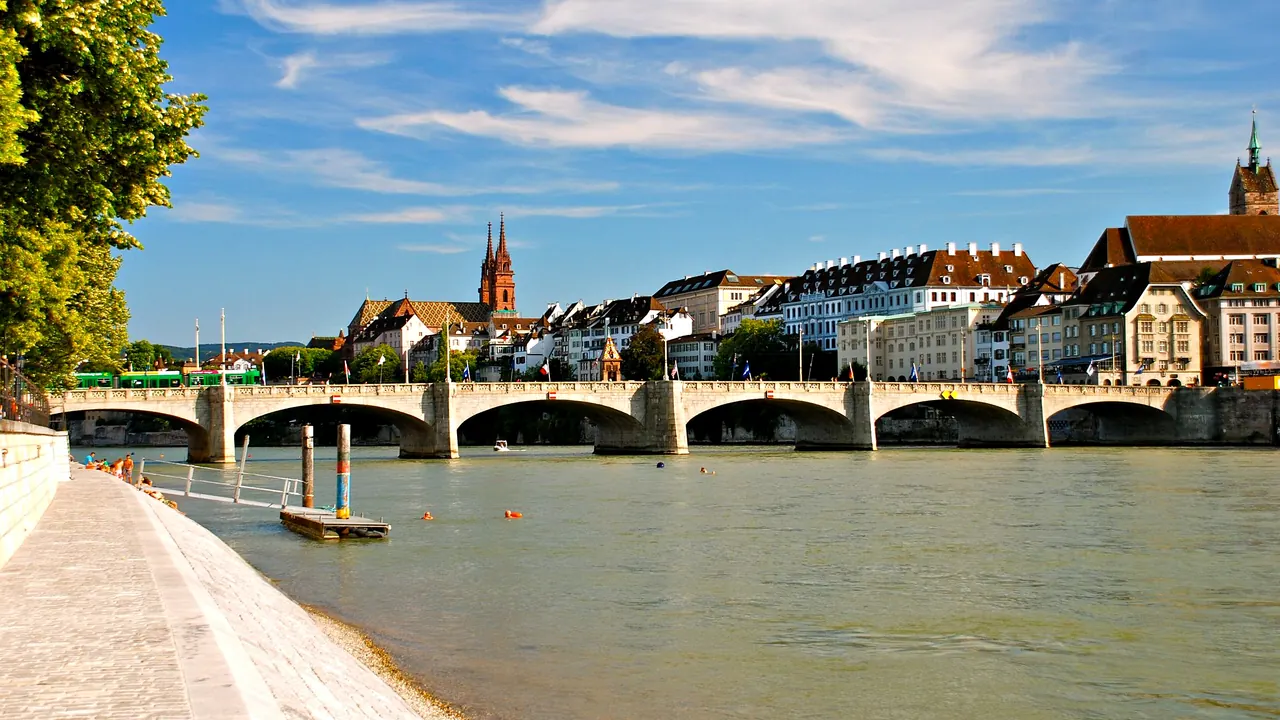
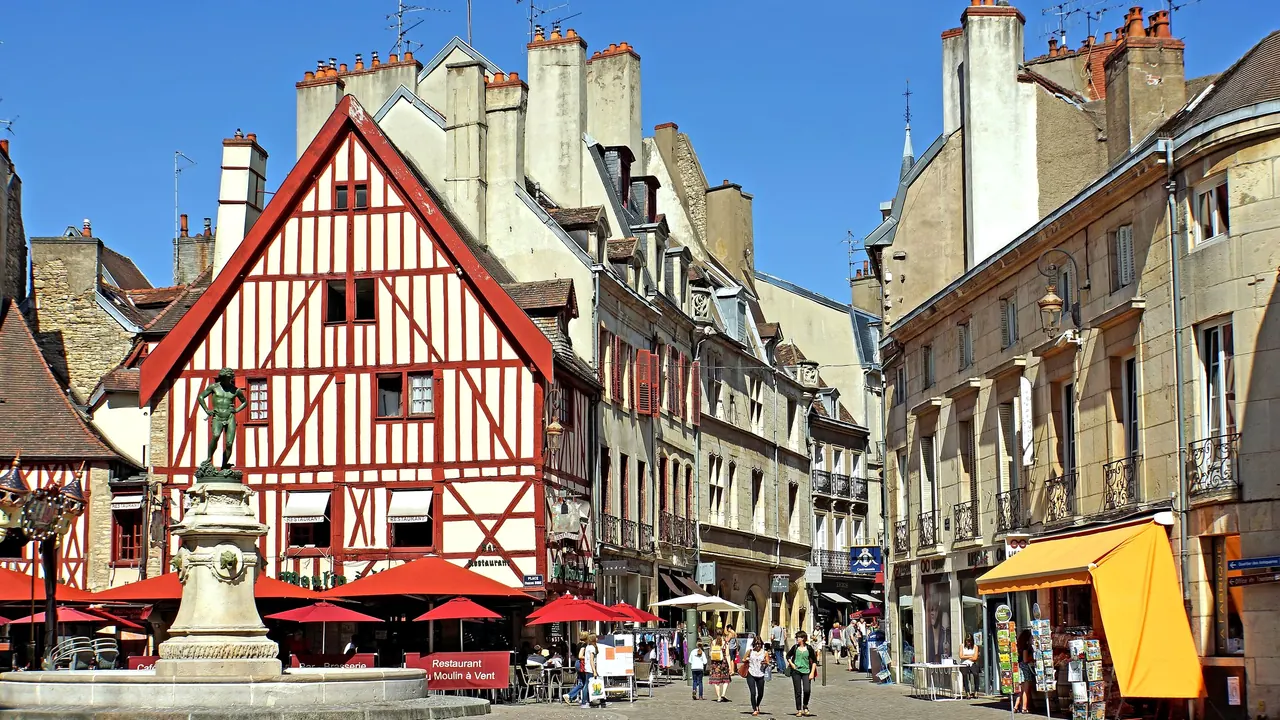
Photos: Basel by Lucazzitto, CC BY-SA 3.0, cropped; Dijon by Dennis G. Jarvis, CC BY-SA 2.0, cropped.
Basel or Dijon?
Our verdict in twelve categories, each scored against the same fixed benchmark cities, and the climate month by month, so you can choose for your trip.
Choose Basel for
- beaches
- wellness
- families
Basel is the better choice for travellers who want a lot within easy reach and the means to pay for it. Its museums run from Holbein at the Kunstmuseum to the Fondation Beyeler and the Vitra campus, Theater Basel and the Stadtcasino fill the evenings, and fast trains go to three countries from one station. Families and people who would rather not drive will find it the easier of the two.
Choose Dijon for
- prices
- food and drink
Dijon rewards people who travel to eat and drink. It sits at the head of the Burgundy wine country, with Les Halles at its centre and the Grands Crus villages starting at the edge of town. It costs far less than Basel, its old centre around the ducal palace is small and pleasant to walk, and it suits a slow, well-fed few days more than a busy programme.
Scoreboard
Twelve categories on one fixed scale from 0 to 100. The shaded stretch is the gap between the two.
Your match
Pick a travel style or drag the sliders, and both match scores follow your weighting.
Wins on beaches and wellness with your weighting.
Wins on prices and food and drink with your weighting.
What matters to you?
Category by category
What the scores mean for a trip.
Beaches & swimming
Neither city has a coast, but Basel has a real summer swimming culture. People float down the Rhine past the old town in swim bags and sunbathe on the gravel banks. It is lively and memorable, though it only suits confident swimmers because the current is strong.
Dijon's swimming is quieter: the supervised lawn-and-sand area at Lac Kir, plus municipal pools. It works for a hot afternoon, but it is nothing like the daily summer ritual of the river in Basel.
Food & drink
Dijon is the place to travel for food. Burgundian classics such as boeuf bourguignon, jambon persillé and snails are cooked where they come from, Les Halles is full of Bresse poultry and Époisses, and the mustard, pain d'épices and cassis are local. Wine country begins at the edge of town.
Basel eats well but borrows a lot from its neighbours: tarte flambée from Alsace, wines from Baden, and Swiss-German comfort food. Apart from a small top tier, its restaurants can feel expensive for what you get. Its locals cross the border to eat, while Dijon's visitors come for the food itself.
Culture & sights
Basel has the deeper collections. The Kunstmuseum, the Fondation Beyeler, the Museum Tinguely and the Vitra Design Museum add up to more art than you would expect from a city this size, and buildings by Herzog & de Meuron sit next to the red sandstone Münster and the painted Rathaus.
Dijon's appeal is more about its history as a ducal capital. The tombs of the Valois dukes are in the palace museum, Notre-Dame has its gargoyles and its lucky owl, and the Well of Moses is at Champmol. Allow two or three days for Dijon and three or four for Basel.
Nightlife
Neither is a party city, and Basel has a little more going on. On summer nights people drink on the Kleinbasel riverbank steps, the Kaserne area has most of the bars, and a few clubs in old harbour buildings play electronic music. Fasnacht turns the whole city into three days of drums and lanterns.
Dijon's evenings depend on its students: small bars along Rue Berbisey, wine and beer on the terraces, and a late dinner. Outside term time it is mostly quiet by midnight.
Nature & outdoors
Basel has more variety close by. The Jura ridges begin just south of the city, the Black Forest summits above 1,400m are within an hour, and the Vosges lie to the west, so there is real hiking and even some light skiing.
Dijon's country is gentler. There are the limestone combes for walking and climbing, the flat towpath of the Burgundy Canal, and the cycle route through the vineyards towards Beaune. Its wildest landscape, the Morvan, is further away than anything wild near Basel.
Day trips
Both are excellent bases, and Basel has more range. From one station you can reach Colmar and Strasbourg in France, Freiburg in Germany, and Lucerne, Bern and Zurich in Switzerland, mostly by fast train and without a car.
Dijon's day trips go deeper into one region. They follow the Grands Crus villages to Beaune, then north-west to Fontenay Abbey, Semur-en-Auxois and Alésia. The trips are excellent, but most of the wine villages are easier by car, bike or tour than by train.
Good for families
Both cities are safe and calm, but Basel has much more for children. The Zolli is among Europe's best zoos, the Natural History Museum and the toy museum cover a rainy day, the river ferries are a treat for younger children, and Europa-Park is about an hour away.
In Dijon, the list ends after the planetarium at the Jardin de l'Arquebuse, the play areas in the Parc de la Colombière and paddling at Lac Kir. The tastings and fine-art museums that fill most visits will hold parents' interest more than children's.
Getting around
Basel's green trams reach almost every corner of the city, and some lines carry on over the border into Germany and France. Hotel guests get a free transport card, so you rarely think about tickets. The four river ferries make crossing the Rhine a small pleasure, and a bus runs from the centre to the airport, which Basel shares with France.
Dijon is mostly a city for walking. Its pedestrian centre puts the station, Les Halles and the ducal palace a few minutes apart, and two tram lines plus buses cover the outskirts and Lac Kir. For a visitor that is enough, but the network is much smaller than Basel's.
Shopping & style
Basel is the place for Swiss watches, jewellery and chocolate along Freie Strasse. The Spalenberg lanes have small design and craft shops, and in December there is a pretty Christmas market around the Münster.
Shopping in Dijon is for the kitchen and the cellar: mustard in dozens of flavours, cassis, pain d'épices, cheese from Les Halles and bottles from the wine merchants. Rue de la Liberté has a department store and French chains, but if you want fashion you will find little in either city.
Affordability
This is where the two differ most. Basel is one of the most expensive cities you could choose, with Swiss prices for rooms, meals, drinks and museums, and rooms get scarce during the big trade fairs. Free hotel transport and cheaper meals over the border help a little.
Dijon is an ordinary French regional city in price. Hotels are moderate, set lunches are good value and wine is cheap by the glass. Only fine dining and serious bottles push the bill up.
Live music & performing arts
Basel offers more for evenings out. Theater Basel is known well beyond Switzerland for bold opera, ballet and drama, the Sinfonieorchester plays at the acoustically fine Stadtcasino, and there are early-music concerts and a jazz school that keeps small clubs supplied with players.
Dijon has a respectable season at the Grand Théâtre and the Auditorium, as well as a national drama centre, but there is less of it. In both cities the season runs through the academic year and thins out in summer.
Wellness & relaxation
For a spa day, Basel is better placed. The saline baths at Rheinfelden are about twenty minutes away, the German spa towns of southern Baden are just over the border, and Baden-Baden is within reach. The quiet Sundays and the riverside help the city itself feel unhurried.
Dijon has no thermal tradition and only a few hotel spas, some offering grape-based treatments. It relaxes you in a different way, through long lunches, quiet squares and slow afternoons in the vineyards.
When should you go?
Pick your month. The climate figures are measured averages, not a forecast.
Basel in July
Dijon in July
Daytime high, °C
Rainfall in the month, mm
Temperature and rainfall are climate normals, averaged over the years shown. Basel: 1991-2020 (sunshine 1961-1990) normals, Basel / Binningen (1.9 km from centre). Dijon: 1991-2020 normals, Dijon (7 km from centre).
The two share a continental climate and follow almost the same curve through the year. Summer highs reach about 26°C in Basel and 27°C in Dijon in July, and June to early September is the season for both, whether that means floating down the Rhine or swimming at Lac Kir. Basel's rain comes mostly in late spring and summer, with May the wettest month at 96mm, so expect some showery afternoons even in good weather. Dijon's rain is spread more evenly, with small peaks in May and again in October and November, and its summers are a little sunnier.
From December to February both are cold and grey, with highs around 6°C. That suits museums, concerts and long lunches more than walking around town. May, June and September are the most comfortable months for sightseeing in either city. Late September also brings the grape harvest in the Burgundy vineyards around Dijon.
Which traveller are you?
On a family trip with children, Basel is the easier choice. There is enough for a few days of outings, even when it rains. Dijon is safe and relaxed, but its days revolve around tastings and fine art, and children tire of those quickly.
On a tight budget, Basel is hard to justify. Nearly everything costs Swiss prices, and most of the savings mean crossing a border. Dijon is a mid-range French city where you can eat and sleep well for much less, as long as cellar visits stay occasional.
For wine lovers, Basel offers a good glass from Alsace or Baden and not much more. Dijon is the gateway to Burgundy, so tasting, buying and learning about wine can shape the whole trip, from the Cité de la Gastronomie to the cellars just outside town.
Before you go
| Measure | Basel | Dijon |
|---|---|---|
| Official language | French, German, Italian, Romansh | French |
| Currency | Swiss Franc (CHF) | Euro (EUR) |
| Sockets | CJ230 V, 50 Hz | CE230 V, 50 Hz |
| Driving side | Right | Right |
| Time zone | UTC+1, UTC+2 in summer | UTC+1, UTC+2 in summer |
| Emergency number | 112 | 112 |
| Elevation | 247 m | 220 m |
| Main airport | EuroAirport Basel–Mulhouse–Freiburg (BSL)7 km from centre112 non-stop destinations | Lyon Saint-Exupéry Airport (LYS)178 km from centre141 non-stop destinations |
| Public holidays this year | 10 days | 11 days |
By the numbers
| Measure | Basel | Dijon |
|---|---|---|
| City population | 176,329 | 161,830 |
| People per km² | 7,378 | 3,890 |
| Museums within 10 km | 61 | 8 |
| UNESCO World Heritage sites within 50 km | 2 | 1 |
Where else could you go?
Every comparison below shares a destination with this one, so you can follow Basel or Dijon somewhere new.