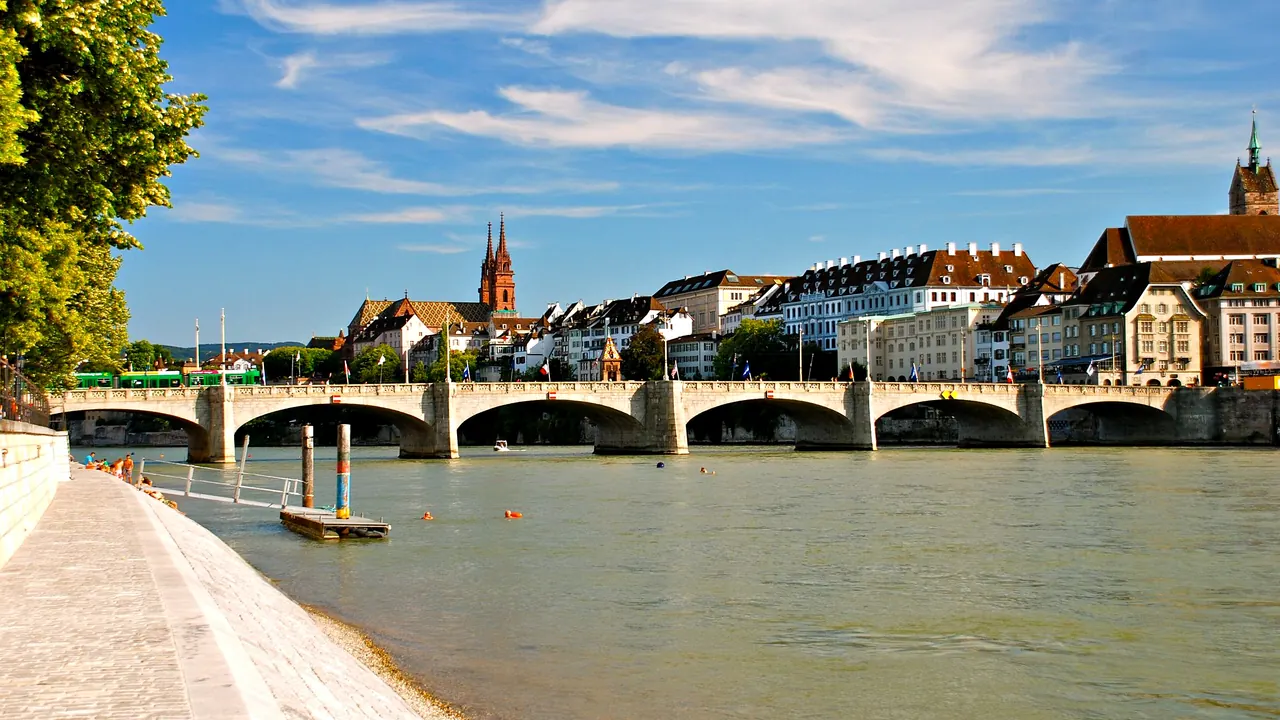
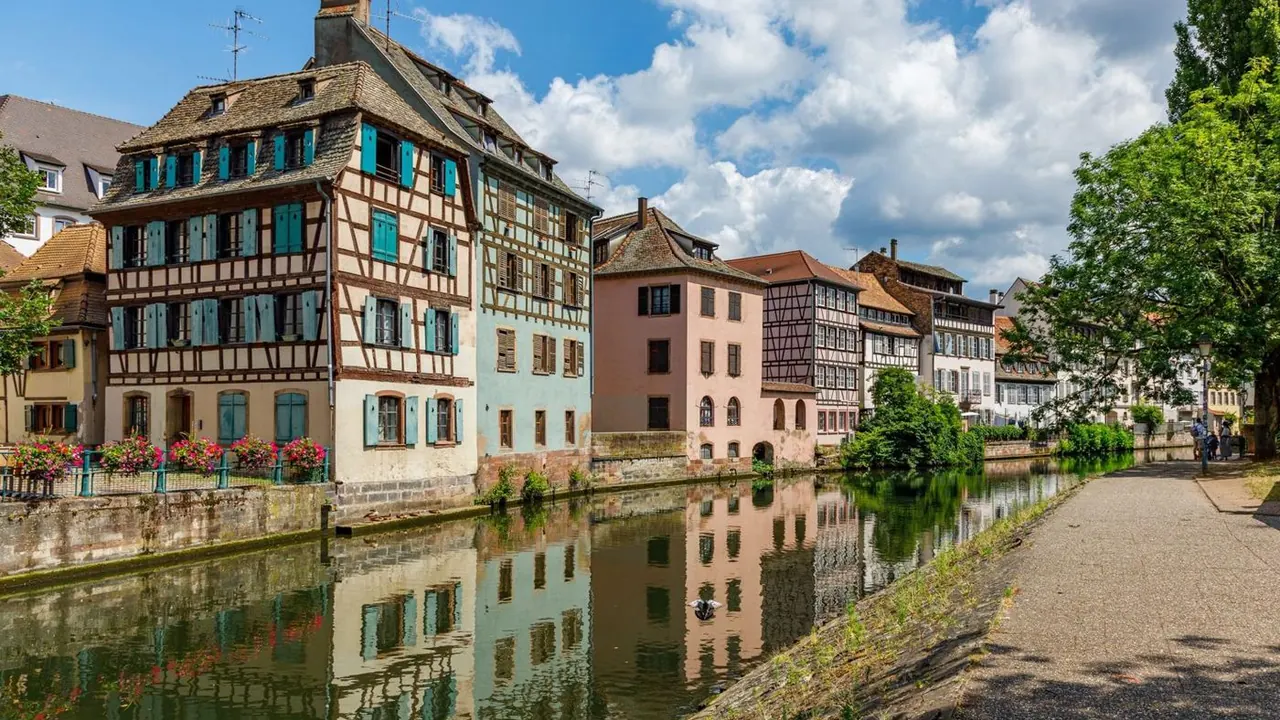
Photos: Basel by Lucazzitto, CC BY-SA 3.0, cropped; Strasbourg by Edoardo Colombo, Pexels License.
Basel or Strasbourg?
Our verdict in twelve categories, each scored against the same fixed benchmark cities, and the climate month by month, so you can choose for your trip.
Choose Basel for
- beaches
- getting around
- day trips
Basel suits travellers who put art and ease first. The Kunstmuseum, the Fondation Beyeler and the Vitra campus are all close by, trams take you everywhere, and fast trains reach three countries for day trips. In summer it offers something Strasbourg cannot, a float down the Rhine past the old town. Swiss prices make it the better fit for someone whose budget is not the main worry.
Choose Strasbourg for
- prices
- food and drink
- shopping
If the table and the bill matter more, pick Strasbourg. Winstub cooking with Alsace wine by the pichet is a real reason to go, and the cathedral and the half-timbered lanes of Petite France make the old town a sight in itself. A stay costs far less than across the border. It suits couples and families who want a slow, well-fed few days with the wine villages close by.
Scoreboard
Twelve categories on one fixed scale from 0 to 100. The shaded stretch is the gap between the two.
Your match
Pick a travel style or drag the sliders, and both match scores follow your weighting.
Too close to call, 2 points apart
Wins on beaches and getting around with your weighting.
Wins on prices and food and drink with your weighting.
What matters to you?
Category by category
What the scores mean for a trip.
Beaches & swimming
Neither city is anywhere near the sea, but the Rhine gives Basel a real summer swimming culture. People walk upstream along the Kleinbasel bank, get in with a waterproof bag and drift back past the Münster, then lie out on the gravel. The current is strong, so this is for confident swimmers only.
In Strasbourg the Rhine is not safe for swimming, so people swim in lifeguarded gravel-pit lakes such as the Baggersee, which the tram reaches. The water is calmer and easier for children, but these lakes are a way to cool off for an afternoon, not a reason to visit.
Food & drink
Strasbourg is the city to travel to for food. Its winstubs serve choucroute garnie, baeckeoffe and tarte flambée with Riesling or Sylvaner from the vineyards just south of the city, and above them sit foie gras and a strong fine-dining tier. Just avoid the tourist menus around the cathedral.
Basel eats well, but much of its cooking is borrowed from Alsace and Baden. Läckerli and the Fasnacht flour soup are among its few local specialities. The Markthalle is the best place for a casual meal, and everyday restaurant food can feel expensive for what you get.
Culture & sights
Both reward a few days of sightseeing, but in different ways. Basel is above all a museum city: Holbein in the Kunstmuseum, modern art at the Fondation Beyeler in Riehen, Tinguely's machines by the river and the Vitra architecture just over the border. Modern buildings by Herzog & de Meuron stand among its old guild houses.
In Strasbourg the main attraction is the city itself. The pink sandstone cathedral with its astronomical clock, the timber-framed lanes of Petite France and the German-built Neustadt together form a UNESCO-listed ensemble. The Palais Rohan museums and the European institutions add to it.
Nightlife
Evenings are low-key in both, and the difference is in the setting. Basel's best nights are outdoors in summer, with drinks on the steps by the Kleinbasel riverside kiosks and a few clubs in old harbour buildings. For three days each late winter, Fasnacht hands the city over to drums and lanterns from four in the morning.
In Strasbourg, students set the tone, in the bars and beer cellars of Krutenau and around Place Saint-Étienne, with terraces on the quays in summer. Drinks cost less than in Basel, but few nights go on late.
Nature & outdoors
The two share much of the same countryside, with the Vosges on one side and the Black Forest on the other, so the difference is what lies closest. Basel has the wooded Jura ridges starting at its southern edge, Black Forest summits such as the Feldberg within an hour and the Lange Erlen park for running. The real Alps are a couple of hours away.
Strasbourg is flat but green inside the city, with storks, herons and beavers in the Rhine forests, and it is one of France's best cities for cycling. For walking you go to the Vosges, around Mont Sainte-Odile and the sandstone castle ruins, which are easier to reach with a car.
Day trips
Each city makes a good day trip from the other, but Basel has the edge because Switzerland is added to Alsace and Baden. Lucerne, Bern and Zurich are each about an hour by train, Roman Augusta Raurica is a quarter of an hour away, and Colmar and Freiburg take about an hour or less, all without a car.
Strasbourg is closer to Colmar, half an hour away, and to the Alsace wine route, and it has Baden-Baden, Heidelberg and Nancy within reach. The wine villages themselves are much easier by car or bike than by train.
Good for families
Both are compact, safe and easy with a pushchair, and Europa-Park is about an hour from each. Basel's big draw is the Zolli, one of Europe's best zoos, a short walk from the station, along with the Rhine ferries pulled across by the current and the free animal park in the Lange Erlen. The river itself is too strong for small children.
Strasbourg's appeal is spread across more places: boat trips around the Grande Ile, the storks, playgrounds and rowing boats of the Orangerie, the hands-on Le Vaisseau science centre and the moving figures of the astronomical clock. The Vosges add stork and monkey parks.
Getting around
Basel is the easier of the two. Both banks of the Rhine are walkable, green trams reach the whole city and cross into Germany and France, and hotel guests travel free. Direct trains from the main station handle every day trip without a car.
Strasbourg's island centre can be crossed on foot in twenty minutes, its trams are good and one line runs to Kehl, and with separated cycle lanes a bike is often the quickest way about. It falls behind outside the city, where the wine villages and hills are much easier with a car.
Shopping & style
Neither is a shopping destination, but Strasbourg has more worth taking home. Its lanes near the cathedral have delicatessens and bookshops, and Alsace wine, Soufflenheim pottery, printed linens and kougelhopf moulds make proper regional souvenirs, with chain stores and a department store around Place Kléber.
Basel's Freie Strasse is stronger on Swiss watches, jewellery and chocolate, and the Spalenberg lanes have small design shops. Both hold well-known Christmas markets, and Strasbourg's is one of the oldest in Europe.
Affordability
This is where the two differ most. Basel is very expensive, with Swiss prices for rooms, meals, drinks and museums, and rooms get scarce and dear during fairs such as Art Basel. Free transport for hotel guests and cheaper meals over the border help a little.
Strasbourg costs what a large French regional city does. Winstub meals and wine by the pichet are reasonably priced, trams are cheap and the cathedral is free. Hotels are the main expense, and prices climb in December and in the weeks when the European Parliament sits.
Live music & performing arts
Both have more on stage than their size suggests, and Basel is a step ahead. Theater Basel stages opera, ballet and drama under one roof and is known for bold productions. The Stadtcasino's fine acoustics serve its orchestras, and early-music concerts are a local speciality. The city's stages go quiet in July and August.
Strasbourg has the Opéra national du Rhin, a full Philharmonic season and the Théâtre National de Strasbourg. Its autumn Musica festival makes it the better choice for contemporary music.
Wellness & relaxation
Neither city is a spa destination in itself, and both send you a short way out for warm water. Basel has the saline baths at Rheinfelden about twenty minutes away and German spa towns such as Badenweiler just over the border, and its quiet Sundays set a calm pace.
Strasbourg has its own Bains municipaux, an early twentieth-century bathhouse with tiled pools, a hammam and saunas, and the Friedrichsbad and Caracalla baths in Baden-Baden are under an hour away. Long winstub lunches suit an unhurried stay, except in December, when crowds fill the centre.
When should you go?
Pick your month. The climate figures are measured averages, not a forecast.
Basel in July
Strasbourg in July
Daytime high, °C
Rainfall in the month, mm
Temperature and rainfall are climate normals, averaged over the years shown. Basel: 1991-2020 (sunshine 1961-1990) normals, Basel / Binningen (1.9 km from centre). Strasbourg: 1991-2020 normals, Strasbourg (9.1 km from centre).
The two cities have almost the same climate, so the time of year matters more than which one you choose. Both warm from about 20°C in May to 26°C in July and August. Those are the months for floating down the Rhine in Basel and for the lifeguarded lakes around Strasbourg, which are open only in July and August. Spring and September are the most pleasant for walking the old towns, mild and fairly sunny.
The differences are in the rain and the winter light. Basel is the wetter of the two, with summer showers peaking at 96mm in May, while Strasbourg stays drier all year. Winters are cold and grey in both, with highs of 5°C in January. Strasbourg is the gloomier in December, the month when both cities hold their Christmas markets, so pack for the cold rather than expect sun.
Which traveller are you?
On a trip with a tight budget, Basel works only if you sleep across the border in Germany or France and come in for the museums. Strasbourg is the better base, provided you avoid December and the weeks when the European Parliament sits, when hotel rooms get scarce and dear.
For a beach and sun trip, Basel comes closer, though neither city has sand. From June to early September, strong swimmers can join the locals in the Rhine, where the water is often above 20°C in August. Strasbourg only has calm gravel-pit lakes, fine for an afternoon.
On a food and nightlife trip, Basel's summer evenings by the river and the all-night drums of Fasnacht give it the more memorable nights in season. Strasbourg wins at the table, though, with baeckeoffe, foie gras and Munster cheese, and Krutenau's student bars keep it level after dark.
Before you go
| Measure | Basel | Strasbourg |
|---|---|---|
| Official language | French, German, Italian, Romansh | French |
| Currency | Swiss Franc (CHF) | Euro (EUR) |
| Sockets | CJ230 V, 50 Hz | CE230 V, 50 Hz |
| Driving side | Right | Right |
| Time zone | UTC+1, UTC+2 in summer | UTC+1, UTC+2 in summer |
| Emergency number | 112 | 112 |
| Elevation | 247 m | 132 m |
| Main airport | EuroAirport Basel–Mulhouse–Freiburg (BSL)7 km from centre112 non-stop destinations | Strasbourg Airport (SXB)10 km from centre43 non-stop destinations |
| Public holidays this year | 10 days | 11 days |
By the numbers
| Measure | Basel | Strasbourg |
|---|---|---|
| City population | 176,329 | 293,771 |
| People per km² | 7,378 | 3,752 |
| Museums within 10 km | 61 | 21 |
| UNESCO World Heritage sites within 50 km | 2 | 3 |
Where else could you go?
Every comparison below shares a destination with this one, so you can follow Basel or Strasbourg somewhere new.