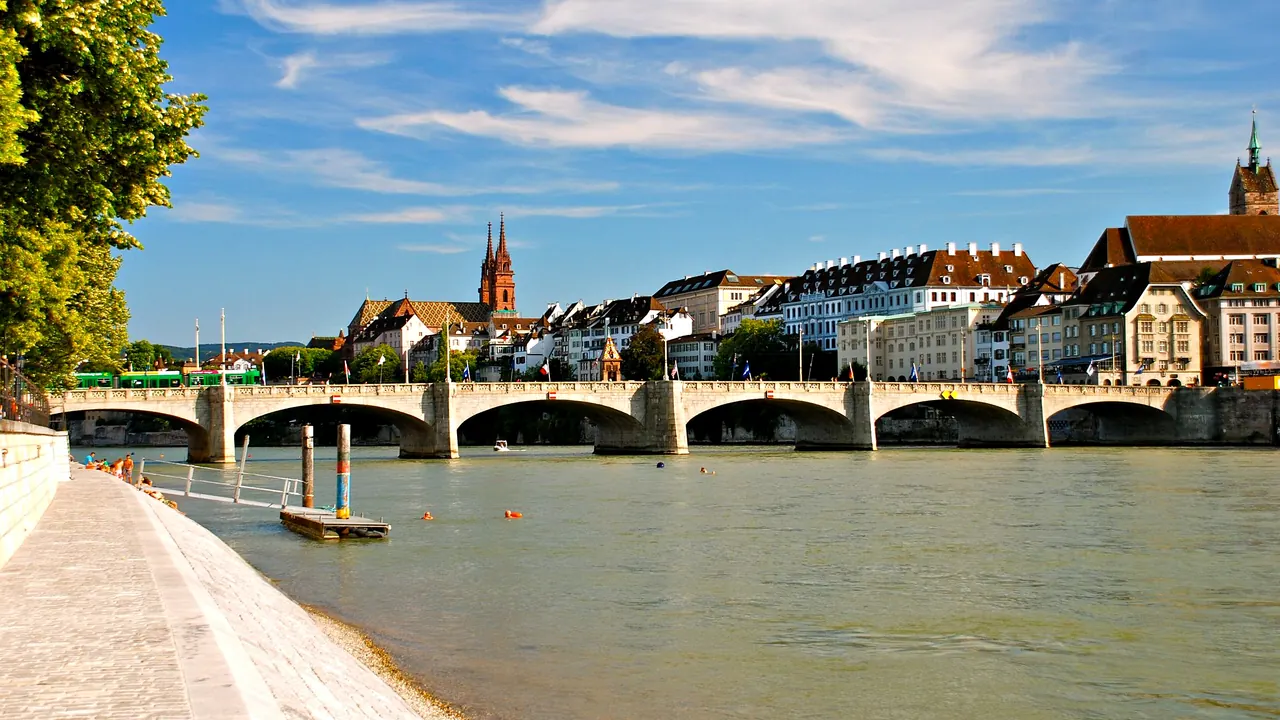
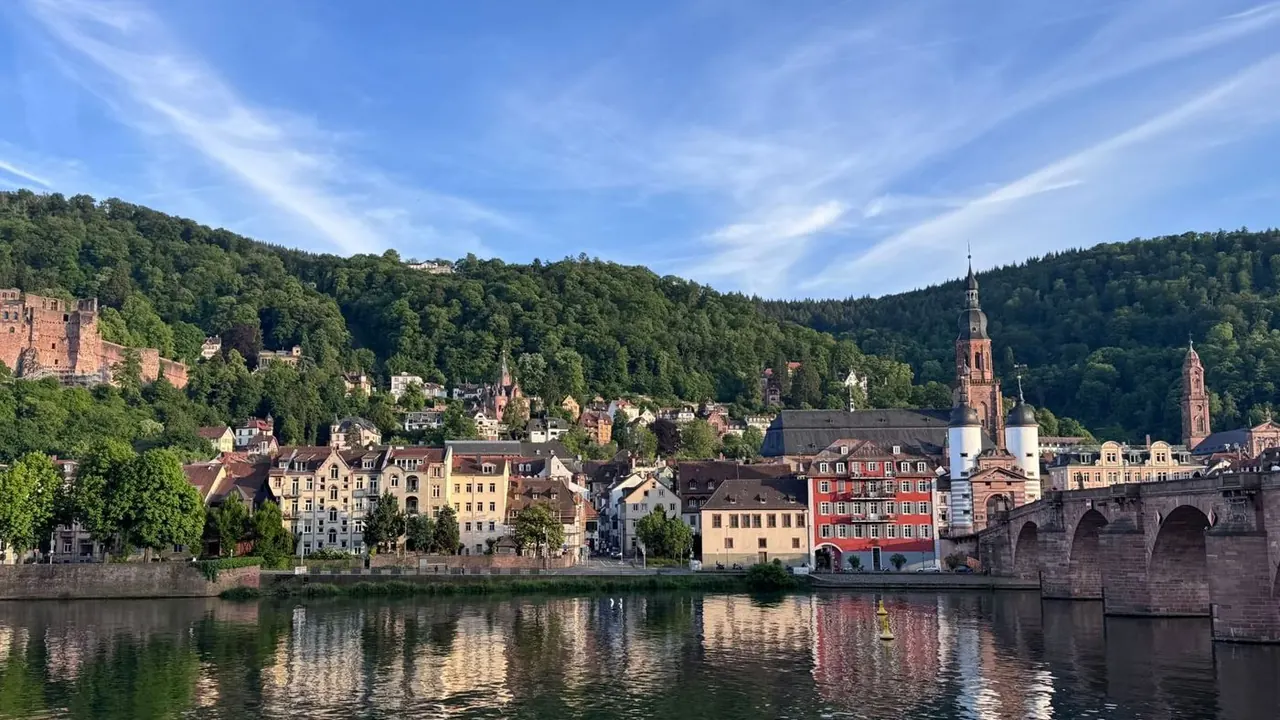
Photos: Basel by Lucazzitto, CC BY-SA 3.0, cropped; Heidelberg by Kuanling Chen, Pexels License.
Basel or Heidelberg?
Our verdict in twelve categories, each scored against the same fixed benchmark cities, and the climate month by month, so you can choose for your trip.
Choose Basel for
- beaches
- getting around
- live music and the arts
Basel suits the traveller who wants depth over postcard charm. Its museums, from the Kunstmuseum to the Fondation Beyeler and the Vitra campus, outclass anything in Heidelberg. Theater Basel and the Stadtcasino give it the stronger stage. The trams and fast trains make it the easier base for day trips, with France, Germany and the rest of Switzerland all within an hour. In summer you can float down the Rhine past the old town. The price of all this is a very expensive stay.
Choose Heidelberg for
- prices
Heidelberg is the choice for a Romantic, photogenic German town at a far gentler cost. The castle ruin, the Old Bridge and the student quarter of the Altstadt fill a day or two beautifully. Forest trails start at the edge of town, and the wine taverns of the Bergstrasse are close by. It suits couples, first-time visitors to Germany and anyone touring the Upper Rhine who would rather spend their money on good Riesling than on a Swiss hotel bill.
Scoreboard
Twelve categories on one fixed scale from 0 to 100. The shaded stretch is the gap between the two.
Your match
Pick a travel style or drag the sliders, and both match scores follow your weighting.
Wins on beaches and getting around with your weighting.
Wins on prices with your weighting.
What matters to you?
Category by category
What the scores mean for a trip.
Beaches & swimming
Neither city has a beach, but Basel has a summer swimming culture that Heidelberg lacks. From June to early September people walk upstream along the Kleinbasel bank, drop their clothes into swim bags and drift back on the current. It is best for confident swimmers.
In Heidelberg the Neckar is for boats and lawns. A hot day means the outdoor pools or a half-hour trip to the gravel-pit lakes on the Rhine plain.
Food & drink
Basel eats a little better, mainly thanks to its neighbours. There is Alsatian tarte flambée, Baden wines, a small but very good fine-dining tier, and the Markthalle and Marktplatz market for casual meals. The everyday options can feel expensive for what you get.
Heidelberg cooks heartier Kurpfalz food, such as Schäufele, Maultaschen and spring asparagus. Its real asset is the Bergstrasse and Palatinate wine on the doorstep. The day-tripper restaurants on the Hauptstrasse are uneven, so the better meals are in the side streets and in Neuenheim.
Culture & sights
Basel has the richer sights, and the gap lies in its museums. The Kunstmuseum's Old Masters, the Fondation Beyeler, the Museum Tinguely and the Vitra campus give it a weight of art that Heidelberg cannot match. Add the Münster, the Rathaus and the Spalentor and you have three or four full days.
Heidelberg offers a smaller, more romantic set. There is the castle ruin with its Great Tun, the Old Bridge, and the Student Prison covered in graffiti, all within Germany's oldest university town. It is wonderful to look at, but most people have seen it in a day or two.
Nightlife
Both are quiet places to go out, but in different ways. Basel's nights are at their best outdoors in summer, at the riverside kiosks on the Kleinbasel bank, with a few electronic clubs in old harbour buildings. Fasnacht, the late-winter carnival, turns the city upside down for three days.
Heidelberg's evenings belong to students. The small pubs of the Untere Strasse and the old fraternity taverns are lively in term time, then go quiet out of term and on weeknights.
Nature & outdoors
The two are well matched as gentle walking and cycling bases. Heidelberg has the woods closer to hand: the Philosophers' Walk and the funicular up the Königstuhl put you on forest trails within minutes of the old town.
Basel's hills are a short trip away, but there is more choice. The Jura lies to the south, the Black Forest summits above 1,400m to the north-east and the Vosges to the west, and the Black Forest even has some light skiing.
Day trips
Basel's position on the French and German borders gives it the wider choice of outings. Within about an hour you can be among the half-timbered wine villages around Colmar, in Freiburg's old town, beside the lake at Lucerne or under the arcades of Bern. The Roman ruins of Augusta Raurica are barely a quarter of an hour out, so a week of trips need never repeat itself.
Heidelberg's outings stay mostly within the Upper Rhine and lean towards churches and monasteries: the cathedrals of Speyer and Worms, Schwetzingen's palace gardens, the walled cloister at Maulbronn and the castle villages up the Neckar. The Palatinate wine villages are easier with a car, and Strasbourg, an easy run from Basel, makes a long day from here.
Good for families
Both are small, safe and equally easy with children, with different highlights. Basel has the Zolli, one of Europe's best zoos, plus the current-pulled Rhine ferries and smooth tram rides with a pram.
Heidelberg wins children over with the funicular and the fairy-tale park on the Königstuhl, and with the Technik Museum Speyer, where they can climb into a space shuttle. Its cobbled, sloping lanes are harder going with a pushchair. Basel's catch is the Swiss price of every meal.
Getting around
Basel is the easier city to move around. Its trams cover both banks and cross into France and Germany, hotel guests ride free, and the main station sends direct trains in three directions.
Heidelberg works well too, with a shared tram, bus and S-Bahn fare across the Rhine-Neckar. However, the station lies well west of the Altstadt, the old town streets are cobbled and the climb to the castle is steep unless you take the funicular.
Shopping & style
Neither is a shopping destination, and what you find is different in kind. Basel sells Swiss watches, jewellery, chocolate and Läckerli along Freie Strasse, and its Christmas market by the Münster is a pretty one.
Heidelberg has the long pedestrian Hauptstrasse, with German chains at one end and steins, cuckoo clocks and Studentenkuss chocolates at the other. A bottle of Bergstrasse wine is its best souvenir.
Affordability
This is where the two differ most. Basel is very expensive in every respect, from rooms to museum tickets, and trade fairs such as Art Basel make beds scarce. Free trams and cheaper meals over the border help only a little.
Heidelberg costs what you would expect in western Germany. Hotels are the main expense, while student cafés, simple taverns and modest castle entry keep the rest of the bill reasonable.
Live music & performing arts
Basel has the stronger stage. Theater Basel is known well beyond Switzerland for bold opera and ballet, the Stadtcasino's fine acoustics serve two orchestras, and early-music concerts add a speciality of their own.
Heidelberg offers a sound municipal programme and two seasonal draws: the Heidelberger Frühling chamber festival in spring and open-air performances in the castle courtyard in summer. Mannheim's bigger house is twenty minutes away.
Wellness & relaxation
Basel has the edge for an easy pace with a spa day added. The saline baths at Rheinfelden are twenty minutes away, and the Baden spa towns of Badenweiler and Bad Krozingen are just over the border. Quiet Sundays by the river do the rest.
Heidelberg relies on the Kraichgau thermal complexes and Baden-Baden, an hour south. Its calm comes from the Neckar meadows and the forest paths, though the midday crowds around the castle break it.
When should you go?
Pick your month. The climate figures are measured averages, not a forecast.
Basel in July
Heidelberg in July
Daytime high, °C
Rainfall in the month, mm
Temperature and rainfall are climate normals, averaged over the years shown. Basel: 1991-2020 (sunshine 1961-1990) normals, Basel / Binningen (1.9 km from centre). Heidelberg: 1991-2020 (sunshine 1971-2000) normals, Heidelberg (4.5 km from centre).
The two cities share almost the same temperatures through the year, so the difference lies in rain and sun. Both are pleasant for walking from May to September and peak at about 26°C in July. Winters are cold and grey in both, with highs around 5°C in January, and that suits Basel's museums better than Heidelberg's outdoor castle and riverside sights.
Basel is the wetter of the two in summer, with May and July each bringing over 90mm, against nearer 70mm in Heidelberg. Heidelberg is a little sunnier in late spring, which makes April and May its sweet spot for the Philosophers' Walk and the almond blossom on the Bergstrasse. Basel's best stretch is July and August, when the Rhine is warm enough to swim in. Early autumn is mild and comfortable in both.
Which traveller are you?
For a culture and arts trip, Basel is the clear pick. Holbein in the Kunstmuseum, the Fondation Beyeler and the Vitra Design Museum make a stronger collection than Heidelberg's castle and university sights, and Theater Basel and the Stadtcasino add evenings of real quality.
On a trip with a tight budget, Heidelberg makes far more sense. Western German prices, student cafés, cheap kebab and pizza and a good-value regional ticket keep the costs down. In Basel, rooms, meals, drinks and museum entry all carry full Swiss prices.
For a beach and sun trip without the coast, Basel at least offers something memorable. On summer afternoons you can float down the Rhine past the old town and sunbathe on its gravel banks. In Heidelberg the Neckar is not for swimming, so you are left with pools and gravel-pit lakes.
Before you go
| Measure | Basel | Heidelberg |
|---|---|---|
| Official language | French, German, Italian, Romansh | German |
| Currency | Swiss Franc (CHF) | Euro (EUR) |
| Sockets | CJ230 V, 50 Hz | CF230 V, 50 Hz |
| Driving side | Right | Right |
| Time zone | UTC+1, UTC+2 in summer | UTC+1, UTC+2 in summer |
| Emergency number | 112 | 112 |
| Elevation | 247 m | 114 m |
| Main airport | EuroAirport Basel–Mulhouse–Freiburg (BSL)7 km from centre112 non-stop destinations | Frankfurt Main Airport (FRA)69 km from centre281 non-stop destinations |
| Public holidays this year | 10 days | 12 days |
By the numbers
| Measure | Basel | Heidelberg |
|---|---|---|
| City population | 176,329 | 156,092 |
| People per km² | 7,378 | 1,433 |
| Museums within 10 km | 61 | 17 |
| UNESCO World Heritage sites within 50 km | 2 | 4 |
Where else could you go?
Every comparison below shares a destination with this one, so you can follow Basel or Heidelberg somewhere new.