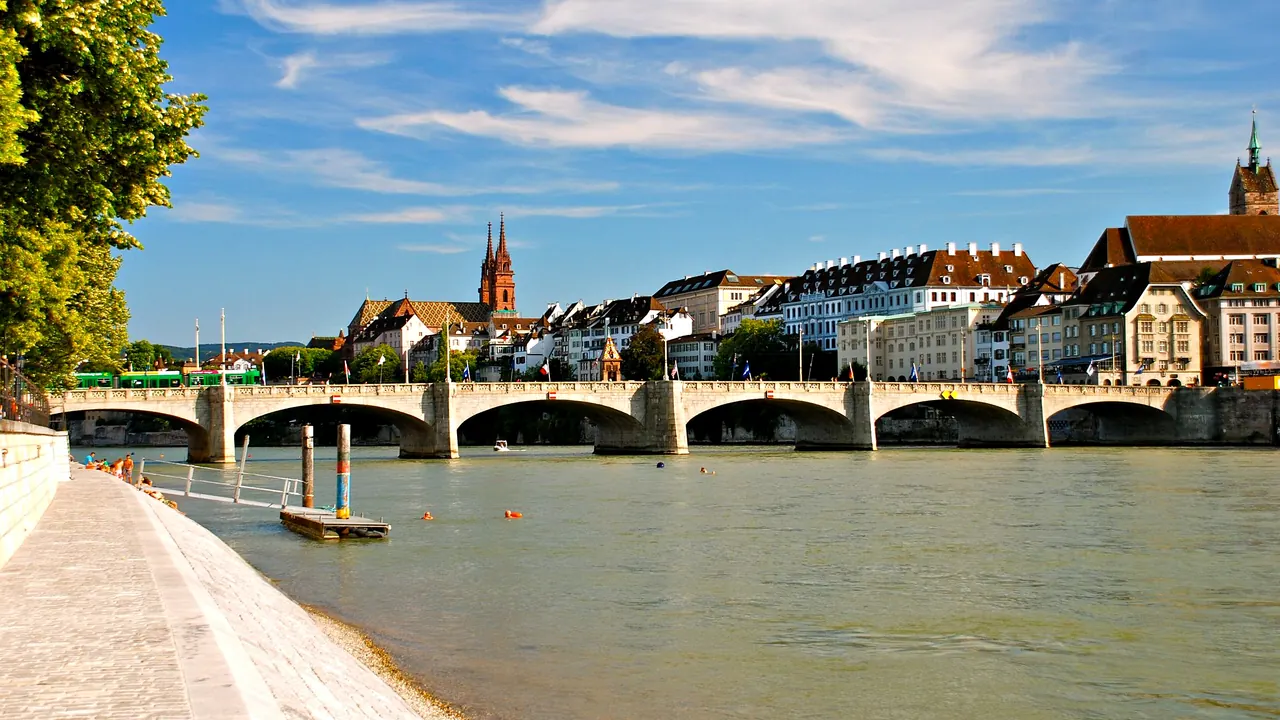
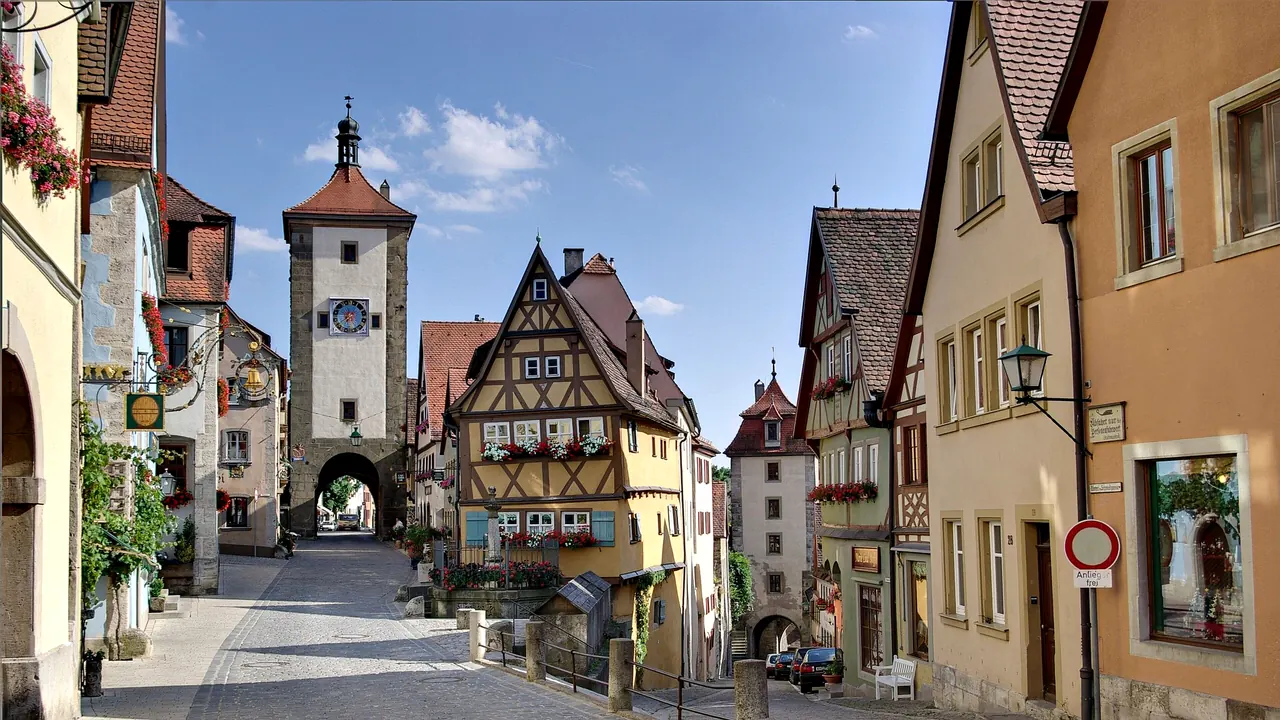
Photos: Basel by Lucazzitto, CC BY-SA 3.0, cropped; Rothenburg ob der Tauber by Berthold Werner, Public domain.
Basel or Rothenburg ob der Tauber?
Our verdict in twelve categories, each scored against the same fixed benchmark cities, and the climate month by month, so you can choose for your trip.
Choose Basel for
- live music and the arts
- nightlife
- getting around
Basel suits travellers who want a base rather than a single sight. It is a museum city with opera and orchestral concerts, it is easy to get around by tram and on foot, and fast trains reach Alsace, the Black Forest and the Swiss lakes. Everything costs Swiss money, but a stay of four or five days is well spent.
Choose Rothenburg ob der Tauber for
- prices
Rothenburg ob der Tauber is for a short, atmospheric stop in one of Europe's most complete medieval walled towns. Come for the ramparts, the cobbled lanes and the quiet evenings once the day visitors have left. It costs much less than Basel and works best as one night or two on a driving tour of the Romantic Road.
Scoreboard
Twelve categories on one fixed scale from 0 to 100. The shaded stretch is the gap between the two.
Your match
Pick a travel style or drag the sliders, and both match scores follow your weighting.
Wins on live music and the arts and nightlife with your weighting.
Wins on prices with your weighting.
What matters to you?
Category by category
What the scores mean for a trip.
Beaches & swimming
Neither city has a beach, but Basel has something Rothenburg cannot match: from June to early September you can float down the Rhine past the old town, then dry off on the gravel banks. The current is strong, so this is for confident swimmers only.
In Rothenburg, swimming means the town's outdoor pool or about an hour's drive to the grassy bathing areas of the Franconian lake district, at lakes such as the Altmühlsee.
Food & drink
Basel has the better table, mostly because it sits where three kitchens meet. In one evening you can choose between Alsatian tarte flambée, Swiss-German comfort food and a glass of Baden wine, and above that sits a small tier of serious cooking that Rothenburg has nothing to match. The Markthalle stalls and the Marktplatz market add an easy lunch, although ordinary restaurants can feel dear for what arrives.
Rothenburg does one thing, and does it plainly: Schäufele, dumplings and bratwurst in timbered inns, with Silvaner in its squat Bocksbeutel or a regional beer. It is worth walking away from the main square, where kitchens serve the day-trippers, to the family guesthouses and the taverns pouring Tauber valley wine. Neither town is a reason to travel for food, but over several nights Basel keeps offering something different, while Rothenburg's menus soon start to repeat."}
Culture & sights
Each offers a different kind of culture. Basel's strength is its collections: Holbein in the Kunstmuseum, modern art at the Fondation Beyeler, the Tinguely by the river and the Vitra campus over the border. A compact old town runs from the red sandstone Münster to the Spalentor, and the whole city fills three or four rich days.
Rothenburg is the sight itself, a nearly complete medieval walled town. It has a covered walkway along the walls, the classic view at the Plönlein and Riemenschneider's carved Holy Blood Altar in St Jakob's. It is memorable but quickly seen, and beyond the Medieval Crime Museum it has nothing like Basel's museums.
Nightlife
Basel's nightlife is modest but real. In summer people drink at the riverside buvettes on the Kleinbasel bank, there are bars around the Kaserne and the Rheingasse, and a few clubs in old harbour and industrial buildings play electronic music at weekends. Fasnacht, the late-winter carnival, takes over the city for three days and nights.
In Rothenburg an evening means dinner, a glass of wine and the night watchman's tour, and the lanes are quiet by eleven. For a real night out you have to go to Würzburg or Nuremberg.
Nature & outdoors
Basel has three upland regions close by: the wooded Jura just to the south, the Black Forest within an hour with summits above 1,400m, and the Vosges to the west. All have marked trails, and flat paths along the Rhine make for easy cycling into Germany and France.
Rothenburg's outdoors is gentler, but it starts right at the walls. Paths drop into the Tauber valley past mills and meadows, the well-known Tauber valley cycle path follows the river through vineyards, and the rolling Frankenhöhe lies to the south and east. It is lovely for an easy walk or ride, but there are no mountains or wild country to aim for.
Day trips
Both are fine bases, but Basel's position on three borders gives it the edge. Colmar and the Alsace wine villages, Freiburg, Lucerne, Bern and Zurich are each about an hour away. Fast, direct trains reach almost all of them, so a week of outings needs no car.
Rothenburg has a smaller but excellent circuit along the Romantic Road. It takes in walled Dinkelsbühl, Nördlingen inside its meteorite crater, Schwäbisch Hall, Würzburg's Residenz and Nuremberg's castle. Most of these really need a car.
Good for families
Basel has more for children. Its Zolli is one of Europe's best zoos, the Natural History and toy museums fill wet mornings, and the little Rhine ferries pulled by the current are a treat. Europa-Park is about an hour away, and the trams take prams without fuss.
Rothenburg delights children for a day or two, with ramparts to walk, the Rathaus tower to climb and the night watchman's lantern tour. After that the list runs out, and the cobbles and steep valley paths are hard on pushchairs and small legs.
Getting around
Basel makes getting around effortless. The centre and both riverbanks are walkable, green trams cover the rest of the city, and hotel guests get a free local transport card. Four small ferries carry you across the Rhine.
Rothenburg is simple only inside its walls. You can cross the old town on foot in fifteen minutes, though the cobbles and the climb back up from the valley take some effort. Beyond the gates the railway means a change at Steinach and the buses are sparse.
Shopping & style
Basel has a proper high street, while Rothenburg has a Christmas trade. Freie Strasse and Gerbergasse have Swiss watchmakers, jewellers and chocolatiers, and the lanes of Spalenberg add small design and craft shops, though few visitors come to Basel just to shop.
On the Herrngasse and Schmiedgasse in Rothenburg, glass baubles, nutcrackers, Erzgebirge carvings and teddy bears are sold all year round, and there is little fashion or everyday shopping. Both towns hold fine Christmas markets. Rothenburg's on the Marktplatz is among the most atmospheric in Germany, and Basel's around the Münster is one of the prettiest in Switzerland.
Affordability
Rothenburg is much the cheaper of the two. Prices are those of small-town Germany with a tourist premium, and they peak in December and on summer weekends. Staying just outside the walls or in a nearby village saves a good deal.
Basel is very expensive for everything from rooms to museum tickets, and rooms get scarce during trade fairs such as Art Basel. The free transport card and cheaper meals over the German and French borders help, but the bill will still be far bigger.
Live music & performing arts
Basel has a serious stage life for a city its size. Theater Basel stages opera, ballet and drama, and the Stadtcasino is home to the Sinfonieorchester Basel. Early-music concerts and a jazz school that supplies small clubs round out the calendar, though it is quieter in July and August.
Rothenburg's performances are mostly historical. The costumed Meistertrunk play re-enacts the wine-drinking feat said to have saved the town in the Thirty Years' War, a small open-air theatre stages summer productions, and St Jakob's holds organ and choral concerts. On most evenings there is no show to go to.
Wellness & relaxation
Basel has proper bathing close by. The saline thermal baths at Rheinfelden are about twenty minutes away, the mineral pools and saunas of Badenweiler and Bad Krozingen are just over the German border, and Baden-Baden makes a longer day out. In the city itself, quiet Sundays and the riverbank suit an unhurried stay.
Rothenburg's calm comes at set times, in the early morning and after the coach groups leave, when the walls and valley paths go quiet. Some larger hotels have small spas, but for thermal bathing you drive up to an hour to Bad Windsheim's salt-water pool or to Bad Mergentheim.
When should you go?
Pick your month. The climate figures are measured averages, not a forecast.
Basel in July
Rothenburg ob der Tauber in July
Daytime high, °C
Rainfall in the month, mm
Where the figures come from
Rothenburg ob der Tauber's sunshine is measured 27 km from the centre, at Feuchtwangen-heilbronn.
Temperature and rainfall are climate normals, averaged over the years shown. Basel: 1991-2020 (sunshine 1961-1990) normals, Basel / Binningen (1.9 km from centre). Rothenburg ob der Tauber: 1991-2020 normals, Rothenburg ob der Tauber (0.9 km from centre).
The two follow the same central European seasons, warm summers and cold, grey winters, but Basel stays a degree or two warmer all year. Its July highs reach about 26°C, and from June to early September the Rhine is warm enough for floating through town. Summer is also Basel's wettest season, with May to August each bringing close to or more than 90mm of rain, often as thunderstorms.
Rothenburg is drier in summer and sunnier from spring through August, so late spring and early autumn are ideal for walking the walls and the Tauber valley. Its winters are colder, with January highs near 3°C, and walking the cobbles from December to February means wrapping up well. Basel's slightly milder winter makes a museum-led trip in the cold months more comfortable.
Which traveller are you?
On a culture and arts trip, Basel is the clear choice. The Kunstmuseum, the Fondation Beyeler and the Tinguely could fill several days. In the evening, Theater Basel and the Stadtcasino offer opera, ballet and orchestral concerts, and Rothenburg has nothing to match them.
For a food and nightlife trip, Basel wins again, though modestly. Its cooking draws on Alsace and Baden and includes a small fine-dining tier, while Rothenburg's menus are narrowly Franconian. Summer drinks on the Kleinbasel riverbank also go on long after Rothenburg's lanes fall silent.
On a trip on a tight budget, Rothenburg is far easier on the wallet. Guesthouses just outside the walls, inn beer and wine and modest entry fees all cost much less than Swiss prices, and the town's main pleasure, walking its walls and lanes, is free.
Before you go
| Measure | Basel | Rothenburg ob der Tauber |
|---|---|---|
| Official language | French, German, Italian, Romansh | German |
| Currency | Swiss Franc (CHF) | Euro (EUR) |
| Sockets | CJ230 V, 50 Hz | CF230 V, 50 Hz |
| Driving side | Right | Right |
| Time zone | UTC+1, UTC+2 in summer | UTC+1, UTC+2 in summer |
| Emergency number | 112 | 112 |
| Elevation | 247 m | 430 m |
| Main airport | EuroAirport Basel–Mulhouse–Freiburg (BSL)7 km from centre112 non-stop destinations | Nuremberg Airport (NUE)66 km from centre56 non-stop destinations |
| Public holidays this year | 10 days | 12 days |
By the numbers
| Measure | Basel | Rothenburg ob der Tauber |
|---|---|---|
| City population | 176,329 | 11,331 |
| People per km² | 7,378 | 272 |
| Museums within 10 km | 61 | 6 |
| UNESCO World Heritage sites within 50 km | 2 | 2 |
Where else could you go?
Every comparison below shares a destination with this one, so you can follow Basel or Rothenburg ob der Tauber somewhere new.
- Freiburgvs Basel
- Colmarvs Basel
- Nurembergvs Rothenburg ob der Tauber
- Bernvs Basel
- Zurichvs Basel
- Bambergvs Rothenburg ob der Tauber