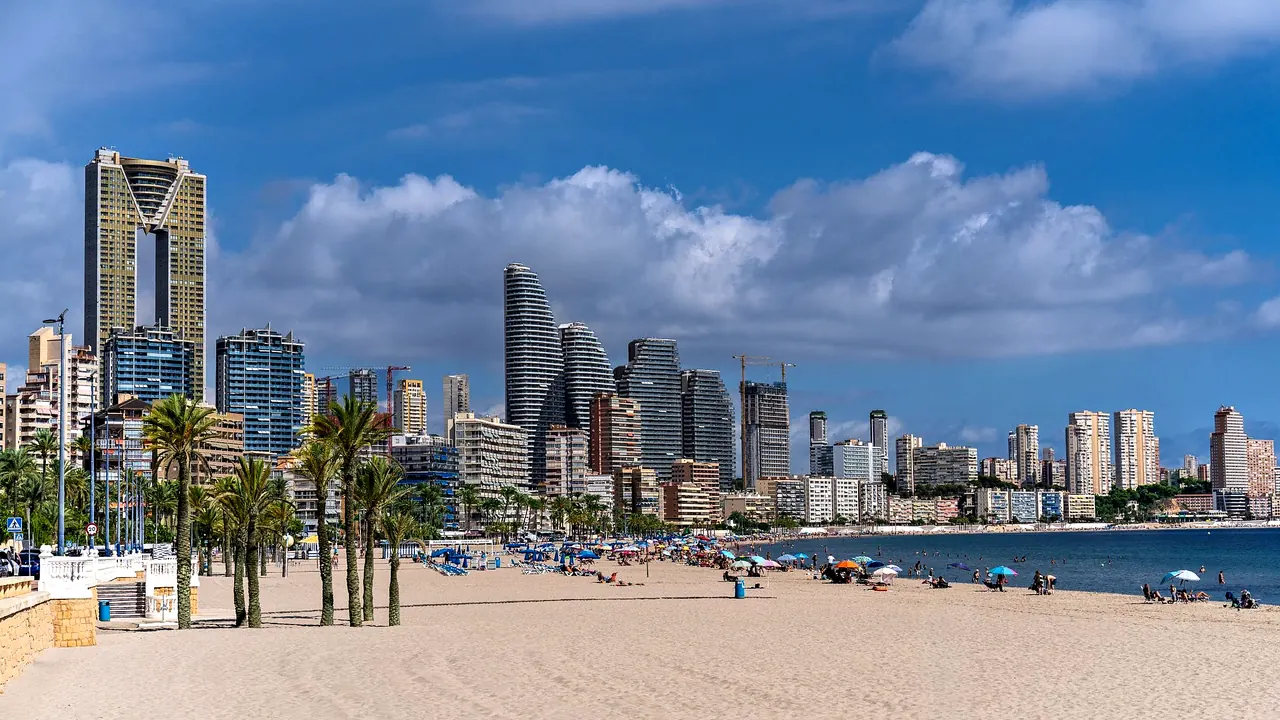

Photos: Benidorm by Emilio Sánchez Hernández, Pexels License; Cadiz by Bronch, CC BY-SA 3.0 ES, cropped.
Benidorm or Cadiz?
Our verdict in twelve categories, each scored against the same fixed benchmark cities, and the climate month by month, so you can choose for your trip.
Choose Benidorm for
- nightlife
- families
- prices
Benidorm is the better pick for an easy beach week where the resort does the work. The Mediterranean is warm and calm, there are theme and water parks for the children, rooms and rounds of drinks are cheap, and a night out can run until dawn. It suits families and groups who want sun and fun laid on, and who are happy to find their history on a day out to Altea or Guadalest rather than in town.
Choose Cadiz for
- culture and sights
- food and drink
- live music and the arts
Choose Cadiz if you would rather stay in a real Spanish city by the sea than in a resort. Its old town of watchtowers, the cathedral and the Roman theatre, its fried fish and sherry, and the flamenco in its peñas give a stay a depth that Benidorm does not try to offer. With Jerez, Seville and the white towns within reach, it is also the better base for exploring. The Atlantic is cooler and the levante wind can blow for days, so Cadiz suits curious travellers more than those who want to lie on a sunbed all week.
Scoreboard
Twelve categories on one fixed scale from 0 to 100. The shaded stretch is the gap between the two.
Your match
Pick a travel style or drag the sliders, and both match scores follow your weighting.
Wins on nightlife and families with your weighting.
Wins on culture and sights and food and drink with your weighting.
What matters to you?
Category by category
What the scores mean for a trip.
Beaches & swimming
These are two strong beach towns, but the beaches feel very different. Benidorm has two long, groomed crescents of sand, Levante and Poniente, in front of a wall of towers. The water is shallow, calm and warm, and the sand is packed from morning to sunset in high summer.
Cadiz has the Atlantic, which is cooler, and the levante wind can sweep sand across the beach. In return you get La Caleta, a small cove between two castles where locals swim, the wide sweep of Playa Victoria, and the long, empty strands of the Costa de la Luz at Bolonia and Zahara, which are nothing like the crowded seafront in Benidorm.
Food & drink
Cadiz is much the better place to eat. Fried fish from the freidurías, almadraba tuna in the tapas bars of La Viña, the counters at the Mercado Central and cold manzanilla from the nearby sherry towns make almost every meal worth having, even if the range is narrow.
In Benidorm you have to look harder. The seafront and the Rincón de Loix serve full breakfasts and generic grills to package visitors. The good food is in the old town's lane of tapas bars and in the rice restaurants that cook arroz negro and arroz a banda in the Alicante way.
Culture & sights
There is little contest here. Cadiz, with its claim to be the oldest city in Western Europe, has a Roman theatre in the Barrio del Pópulo, the gold-domed cathedral, the camera obscura in the Torre Tavira and the oratory where the 1812 constitution was signed, which is enough for two or three rewarding days.
Benidorm's heritage comes down to the whitewashed lanes of the old village, the blue-domed church and the Balcón del Mediterráneo lookout, along with the striking skyline of towers itself. For anything more you have to leave town.
Nightlife
Benidorm is built for going out. Themed pubs, karaoke and drag cabaret bars fill the streets around the Rincón de Loix, stag and hen groups crowd the pavements after midnight, and the big clubs on the edge of town keep going until dawn in summer.
Nights in Cadiz are slower and more Spanish: late tapas in La Viña and around Plaza de San Francisco, and terraces along Playa Victoria in summer. The big exception is February, when Carnival turns the whole city into a street party that lasts through the night.
Nature & outdoors
Both have plenty outdoors, but the landscapes are opposites. Benidorm has mountains close behind the beach: the cliff path through the Serra Gelada, and climbs on Puig Campana and the Bernia ridge within half an hour, plus snorkelling and diving around the island offshore.
Cadiz is flat and watery. The salt pans and marshes of the bay are full of flamingos and spoonbills, Tarifa offers kitesurfing and whale-watching boats in the Strait, and the Sierra de Grazalema and Doñana are further away for real mountain walks or wilderness.
Day trips
Cadiz has more within reach. A half-hour train ride takes you to the bodegas and riding school of Jerez, Seville is under two hours by rail, a ferry crosses the bay to El Puerto de Santa María, and the white towns of Vejer and Arcos and the Roman ruins at Baelo Claudia are an easy drive.
Benidorm still has good outings close by. Altea and Villajoyosa are minutes away, Guadalest's castle sits on its rock inland, and the tram goes to Alicante. Valencia is a longer day, and Elche's palm grove is about an hour away.
Good for families
Benidorm is the easier choice with children. Calm, gently shelving water, flat promenades and a cluster of theme, water and marine parks plus a zoo on the edge of town will fill a week. Staying near Poniente keeps families away from the nightlife streets.
Cadiz works for a simpler beach vacation, with lifeguards on Playa Victoria, the sheltered cove at La Caleta and the Alameda and Genovés parks for running about. There are no big attractions, though. Older children are more likely to remember the castle walls and the camera obscura.
Getting around
Both are easy on foot, in different ways. Benidorm life runs along two flat promenades, with a coastal tram north to Altea and south to Alicante, but the streets behind Levante climb steeply. Cadiz has a compact, largely car-free old town grid and buses out along the isthmus. Its edge is the railway, which runs straight out of the old town to Jerez and Seville, plus the bay catamaran. In both places the countryside beyond really needs a car or a tour.
Shopping & style
Neither is a shopping destination, and both send serious shoppers to a bigger city: Alicante from Benidorm, Seville from Cadiz. What differs is what you find. Benidorm has beachwear, souvenirs and weekly markets full of leather goods and fakes. Cadiz has older family-run shops around Calle Ancha and Plaza de las Flores, and hand-painted fans, flamenco fashion and sherry to take home.
Affordability
Benidorm is the cheaper of the two, mostly because of where you sleep. Its vast stock of hotel rooms and all-inclusive packages keeps rates low, and in winter they fall further.
In Cadiz, eating and getting around cost little: freidurías, market counters, local trains and the bay ferry are all good value. The catch is the old town's small number of hotels, which fill and get pricier in summer and Carnival week. Staying near Playa Victoria helps.
Live music & performing arts
Cadiz has the richer stage. It is one of the cradles of flamenco, and its peñas in Santa María put on singing and guitar for audiences who know the forms well. The Gran Teatro Falla runs plays and concerts all year, a long-running Ibero-American theatre festival in autumn, and the satirical chirigotas at Carnival.
Benidorm's entertainment is lighter and found nightly in the bars: drag cabaret, comedians, tribute acts and a big dinner show. It is cheerful, but there is no theatre or concert hall to speak of.
Wellness & relaxation
Neither town has a bathing tradition, so both rely on hotel spas. Cadiz has the edge for slowing down. Its days fall into a natural rhythm of sea-wall walks, long lunches and sunsets over La Caleta, and resort spas with sea-water treatments at Novo Sancti Petri and Arab-style baths in Jerez are close by.
Benidorm is restful only out of season. From November to March it settles into mild, quiet days, and Poniente is the calmer side of town all year.
When should you go?
Pick your month. The climate figures are measured averages, not a forecast.
Benidorm in July
Cadiz in July
Daytime high, °C
Rainfall in the month, mm
Where the figures come from
Benidorm's temperatures are measured 38 km from the centre, at Alicante.
Benidorm has no rain gauge within 25 km of the centre, so its rainfall comes from a gridded climate dataset read at the city rather than from a gauge further away.
Temperature and rainfall are climate normals, averaged over the years shown. Benidorm: 1991-2020 normals, Alicante (38.1 km from centre). Cadiz: 1991-2020 (sunshine 1961-1990) normals, Cadiz Bay / Puntales (5.2 km from centre).
Benidorm is the warmer of the two in every month. Summer is properly hot, with highs around 31°C in August, too hot for the hills behind town, and the sea warms to about 26°C, so swimming is comfortable from June well into October. Most of its rain falls from September to November. From December to March it stays mild, sunny and mostly dry, which suits promenade walks and hiking in the Serra Gelada and the mountains inland.
Cadiz has a fresher summer, with highs nearer 28°C, and from June to September it is the drier of the two, with July and August almost rainless. The Atlantic peaks around 23°C, so the swimming season is shorter, roughly June to early October. Its wet season runs from October to January, with November the wettest month at about 89mm, and winter stays wetter than in Benidorm. April and May are the best months for walking its streets, warm without the summer heat. For winter sun, choose Benidorm. For a mild city break in spring, Cadiz is the more pleasant of the two.
Which traveller are you?
On a culture and arts trip, Cadiz is the clear choice. Phoenician sarcophagi, a Roman theatre, a cathedral you can climb and flamenco peñas in Santa María give days of real interest, while Benidorm's sights barely fill a morning on the headland.
On a family trip with young children, Benidorm makes things easier. Its gently shelving beaches and flat promenades are backed by a theme park, a water park, a marine park and a zoo. Cadiz has good beaches and shady parks, but almost nothing built for children.
For a trip on a tight budget, Benidorm stretches money further. Its huge supply of hotel rooms and apartments keeps rates low for most of the year, and winter is especially cheap. In Cadiz the tapas are good value, but the few old-town hotels fill up and cost more.
Before you go
| Measure | Benidorm | Cadiz |
|---|---|---|
| Official language | Spanish | Spanish |
| Currency | Euro (EUR) | Euro (EUR) |
| Sockets | CF230 V, 50 Hz | CF230 V, 50 Hz |
| Driving side | Right | Right |
| Time zone | UTC+1, UTC+2 in summer | UTC+1, UTC+2 in summer |
| Emergency number | 112 | 112 |
| Elevation | 15 m | 11 m |
| Main airport | Alicante-Elche Miguel Hernández Airport (ALC)48 km from centre126 non-stop destinations | Jerez Airport (XRY)31 km from centre26 non-stop destinations |
| Public holidays this year | 13 days | 12 days |
By the numbers
| Measure | Benidorm | Cadiz |
|---|---|---|
| City population | 77,327 | 109,950 |
| People per km² | 2,008 | 9,087 |
| Museums within 10 km | 5 | 12 |
| UNESCO World Heritage sites within 50 km | 1 | 0 |
| Swim season, months above 21 °C | 5 months | 3 months |
Where else could you go?
Every comparison below shares a destination with this one, so you can follow Benidorm or Cadiz somewhere new.
- Jerez de la Fronteravs Cadiz
- Alicantevs Benidorm
- Sevillevs Cadiz
- Rondavs Cadiz
- Valenciavs Benidorm
- Marbellavs Cadiz