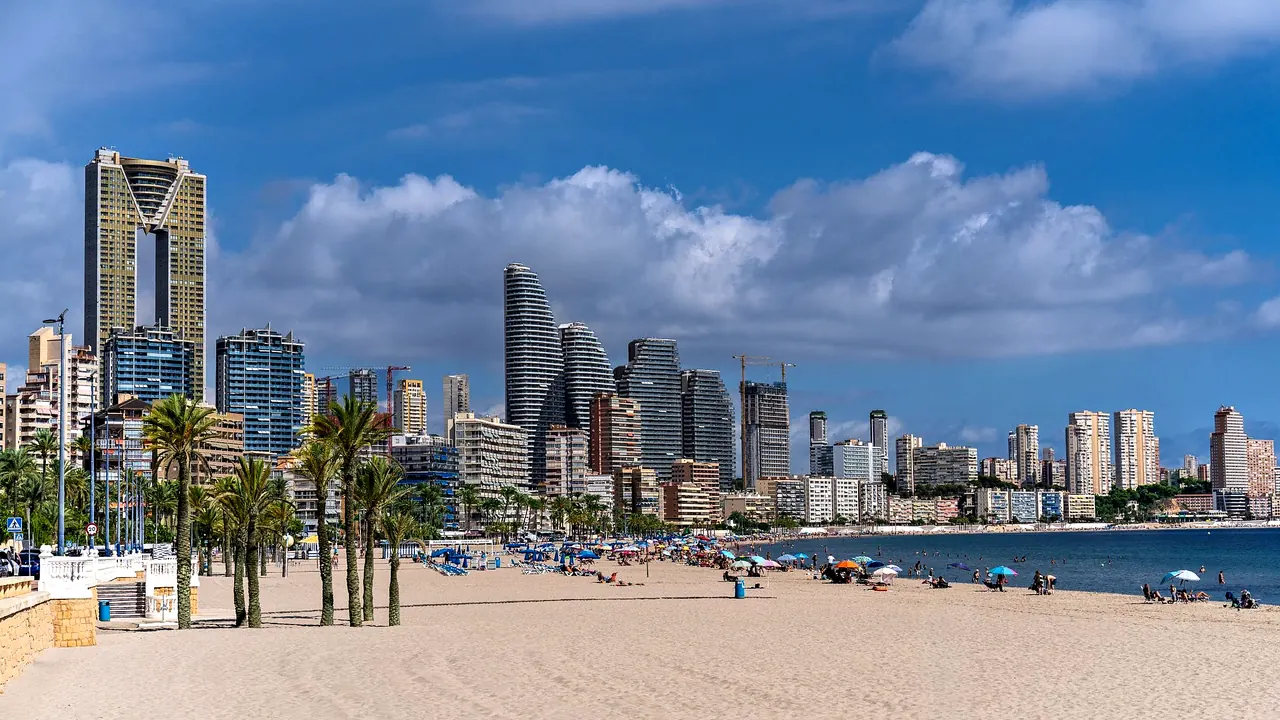

Photos: Benidorm by Emilio Sánchez Hernández, Pexels License; Santiago de Compostela by Luis Miguel Bugallo Sánchez (Lmbuga), CC BY-SA 3.0, cropped.
Benidorm or Santiago de Compostela?
Our verdict in twelve categories, each scored against the same fixed benchmark cities, and the climate month by month, so you can choose for your trip.
Choose Benidorm for
- beaches
- families
- nightlife
Benidorm is the one for a sun and sea vacation. It has two long sandy beaches with warm, shallow water, theme and water parks for the children, and a loud, late night out behind Levante. It suits travellers who want to unpack once and spend their days on the sand, and its mild, bright winters make it a good choice for long, quiet stays out of season.
Choose Santiago de Compostela for
- culture and sights
- food and drink
- wellness
Pick Santiago de Compostela when the trip is about history and eating well. The cathedral and the granite old town around the Obradoiro have far more heritage than Benidorm can offer. The Abastos market and the taverns of Rúa do Franco serve some of Europe's best seafood, and trains make the city an easy base for the rest of Galicia. Bring a waterproof, and look elsewhere for a swim.
Scoreboard
Twelve categories on one fixed scale from 0 to 100. The shaded stretch is the gap between the two.
Your match
Pick a travel style or drag the sliders, and both match scores follow your weighting.
Too close to call, 1 point apart
Wins on beaches and families with your weighting.
Wins on culture and sights and food and drink with your weighting.
What matters to you?
Category by category
What the scores mean for a trip.
Beaches & swimming
Benidorm is built on its beaches. Levante and Poniente run for kilometres of groomed sand right outside the hotels, with shallow, clear water, and the coves at Mal Pas and under the Serra Gelada give a change of scene. In summer the sand is crowded from morning to sunset.
Santiago has no beach of its own. The white-sand inlets of the Ría de Muros e Noia and the Ría de Arousa, about 35km away, are sheltered and beautiful. The Atlantic stays chilly and the summer is short, though, so they make an outing rather than a reason to stay.
Food & drink
Eating in Benidorm is uneven. Menus along the seafront and in the Rincón de Loix are built for package visitors. The better meals are tucked away in the old town's tapas lane and in the rice restaurants that cook arroz a banda and arroz negro the Alicante way.
Santiago is worth the journey for food. Galician seafood is among Europe's best, from pulpo á feira to scallops and percebes, and you can buy it at the granite Mercado de Abastos or eat it with Albariño in the taverns of Rúa do Franco. The range is narrow, but the regional cooking is honest and reliable across the old town.
Culture & sights
Benidorm has little to see beyond its old fishing quarter on the headland. There is the blue-domed church, the view from the Balcón del Mediterráneo and the tower skyline at sunset. For heritage you go to other towns along the coast.
Santiago is one of Spain's great historic cities. The cathedral, with the Pórtico da Gloria and the shrine of Saint James, faces the Praza do Obradoiro. Around it, the granite arcades and monasteries such as San Martiño Pinario, the Museo do Pobo Galego and the Cidade da Cultura fill two or three full days.
Nightlife
Going out is a big part of Benidorm. The pubs, karaoke and drag cabaret bars around the Rincón de Loix stay full of stag and hen groups well past midnight. The old town offers a calmer Spanish evening on tapas terraces, and in summer the clubs on the edge of town go on until dawn.
Santiago's nights are smaller and more local. They start with wine along Rúa do Franco, move to pub-like bars around the Praza de Cervantes, some with folk sessions, and end in a few late clubs. Students drive it during term, and it goes much quieter in summer when pilgrims fill the town.
Nature & outdoors
Both have good countryside close by, but of very different kinds. Benidorm's is dry and steep. There is the cliff path of the Serra Gelada, and the jagged Puig Campana and the Aitana range for hiking and climbing. Diving and kayaking are on offer along the coast, and spring and autumn are the times to walk.
Santiago's is green and wet. Oak woods and stone-walled fields surround the city, and you can walk the Camino paths straight from the centre. The ancient Fragas do Eume and the wild cliffs of the Costa da Morte are within reach. There are no high mountains, and a waterproof is essential.
Day trips
Both make good bases, Benidorm for the Costa Blanca and Santiago for Galicia. From Benidorm, Altea and Villajoyosa are minutes away and Guadalest's castle rock is the classic inland outing. The tram reaches Alicante, and Elche's palm grove and Valencia are further afield.
Santiago's advantage is the train. A Coruña's Tower of Hercules is about half an hour away, and Pontevedra, Vigo, Ourense and the walled city of Lugo are on the same network. With a car or a tour you can add the Albariño country around Cambados and the fishing villages of Fisterra and Muxía at the end of the Camino.
Good for families
Benidorm is far better set up for children. The beaches shelve gently into calm water and the promenades are flat for pushchairs. On the edge of town there is a cluster of parks: a theme park built around ancient civilisations, a long-running water park, a marine park and a zoo. Staying near Poniente keeps the adult nightlife at a distance.
Santiago is safe and welcoming, but its sights are churches and museums. The cobbles and hills are hard work with a pushchair, and rain can wash out whole days. Most families see the city in a day or two, then head for the coast or A Coruña's aquarium.
Getting around
Benidorm is a long, flat strip. Nearly everything lies along the Levante and Poniente promenades, so you walk the seafront, take a local bus out to the theme parks and use the coastal tram for Altea or Alicante. The only climbs come if your hotel sits high on the hills behind Levante, and in town a car is more trouble than it is worth because parking is scarce.
Santiago fits into a compact granite core you can cross on foot in about twenty minutes. There are some short climbs, and the stone gets slippery in the rain. City buses run out to the station, the Cidade da Cultura and the airport, and trains connect the city with the coast and Ourense. As around Benidorm, though, the wine villages and the Costa da Morte are much easier with a car or a tour.
Shopping & style
Neither is a shopping destination, and what they sell is quite different. Benidorm's shops are practical and aimed at the beach: souvenirs, beachwear, sunglasses and big weekly markets full of fakes. Alicante is a tram ride away for anything serious.
Santiago leans towards crafts and food. You will find jet carvings set in silver along the Azabachería, Sargadelos ceramics, and tetilla cheese, tinned seafood and tarta de Santiago from the delicatessens and the Abastos market. Its things are more worth taking home.
Affordability
Benidorm is cheap because it is a package resort on an enormous scale. The huge number of rooms and apartments, all-inclusive deals and low-priced drinks and breakfasts keep everyday costs down, and winter is the cheapest time of all. The money goes in July and August, and on family days at the parks.
In Santiago the savings come from the habits of a pilgrim city. Tapas often arrive free with a drink, set lunches are generous, pensiones and pilgrim hostels keep rooms cheap, and you can enter the cathedral itself without paying. Its expensive time is July, when the feast of Saint James fills the rooms.
Live music & performing arts
Benidorm's stage is pure entertainment: a dinner-show spectacular and nightly drag, tribute and comedy acts in the bars. There is no theatre or orchestra of note.
Santiago has a little more range. The Real Filharmonía de Galicia plays at the Auditorio de Galicia and the Teatro Principal stages drama. Above all there is Galician music: bagpipes and folk sessions in old-town bars, student tunas in black capes singing in the streets, and concerts on the Obradoiro for the feast of Saint James.
Wellness & relaxation
Benidorm offers hotel spas and little else. Real calm only comes in winter, when promenade walks and long lunches suit people staying to rest, and Poniente is always the quieter side of town.
Santiago is quiet all year once the day's pilgrims have arrived, and Galicia's hot springs make a proper bathing outing. The old spa towns of Caldas de Reis and Cuntis are about half an hour away. Ourense's riverside thermal pools, some open to all, are a short train ride away.
When should you go?
Pick your month. The climate figures are measured averages, not a forecast.
Benidorm in July
Santiago de Compostela in July
Daytime high, °C
Rainfall in the month, mm
Where the figures come from
Benidorm's temperatures are measured 38 km from the centre, at Alicante.
Benidorm has no rain gauge within 25 km of the centre, so its rainfall comes from a gridded climate dataset read at the city rather than from a gauge further away.
Temperature and rainfall are climate normals, averaged over the years shown. Benidorm: 1991-2020 normals, Alicante (38.1 km from centre). Santiago de Compostela: 1991-2020 normals, Santiago / Labacolla (8.4 km from centre).
Benidorm has much the kinder climate for a beach trip. The sea is warm enough for swimming from June to October and peaks around 26°C in August. Summer days are dry and very sunny, but July and August reach 31°C, which is too hot for the mountains and hard going in the streets at midday. Spring and autumn are the best weather for walking. Winter stays mild and bright, with daytime highs in the high teens and little rain, so it works well as a winter escape.
Santiago is cooler and much wetter. From October to January rainfall tops 200mm a month and sunshine is short, so you will often see the old town under an umbrella. June to September is its season: drier, around 25°C at the warmest, and comfortable for walking all day. Even then the Atlantic stays near 17°C, so a swim in the rías is brisk rather than long.
Which traveller are you?
On a beach and sun trip, Benidorm wins easily. Levante and Poniente are long stretches of fine sand, with shallow, warm water and a promenade behind them. Santiago is inland, and its lovely rías stay cold and need a bus.
For a culture and arts trip, Santiago is the clear choice. The cathedral with its Pórtico da Gloria, the Obradoiro and the UNESCO old town fill two or three days, and there is an orchestra season too. Benidorm has a headland church and its skyline.
On a family trip with young children, Benidorm is far easier. Gently shelving beaches, flat promenades and a cluster of theme, water and marine parks keep children busy for a week. Santiago's cobbled, rainy streets and churches hold their attention for a day or two.
Before you go
| Measure | Benidorm | Santiago de Compostela |
|---|---|---|
| Official language | Spanish | Spanish |
| Currency | Euro (EUR) | Euro (EUR) |
| Sockets | CF230 V, 50 Hz | CF230 V, 50 Hz |
| Driving side | Right | Right |
| Time zone | UTC+1, UTC+2 in summer | UTC+1, UTC+2 in summer |
| Emergency number | 112 | 112 |
| Elevation | 15 m | 260 m |
| Main airport | Alicante-Elche Miguel Hernández Airport (ALC)48 km from centre126 non-stop destinations | Santiago-Rosalía de Castro Airport (SCQ)10 km from centre29 non-stop destinations |
| Public holidays this year | 13 days | 13 days |
By the numbers
| Measure | Benidorm | Santiago de Compostela |
|---|---|---|
| City population | 77,327 | 100,965 |
| People per km² | 2,008 | 459 |
| Museums within 10 km | 5 | 6 |
| UNESCO World Heritage sites within 50 km | 1 | 2 |
| Swim season, months above 21 °C | 5 months | None |
Where else could you go?
Every comparison below shares a destination with this one, so you can follow Benidorm or Santiago de Compostela somewhere new.
- Alicantevs Benidorm
- Valenciavs Benidorm
- Portovs Santiago de Compostela
- Coimbravs Santiago de Compostela
- Salamancavs Santiago de Compostela
- Granadavs Benidorm