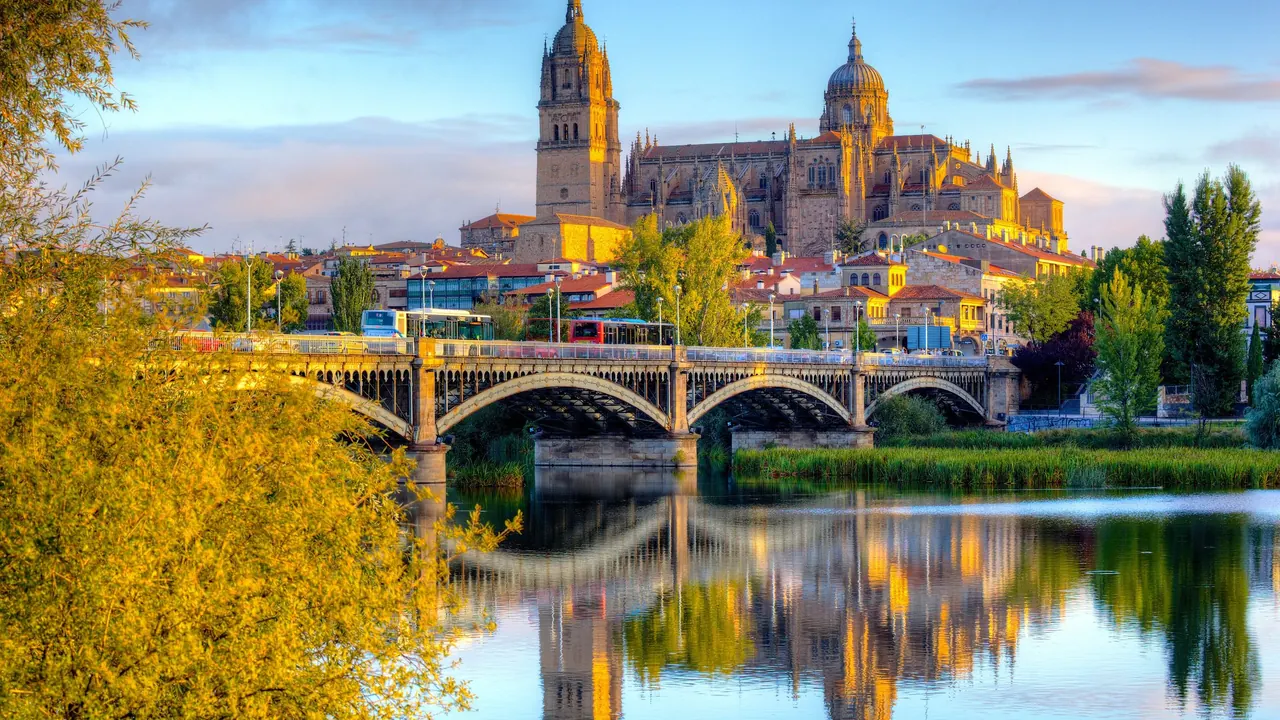
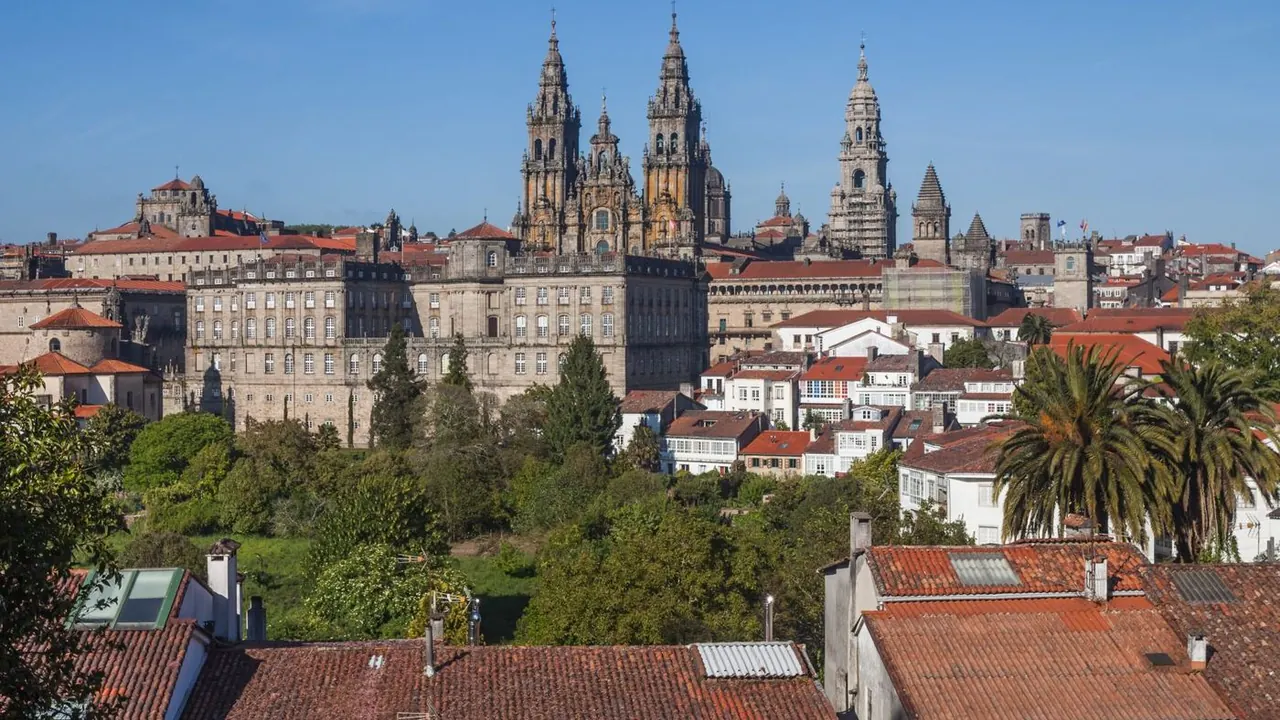
Photos: Salamanca by Jiuguang Wang, CC BY-SA 3.0 ES, cropped; Santiago de Compostela by Luis Miguel Bugallo Sánchez (Lmbuga), CC BY-SA 3.0, cropped.
Salamanca or Santiago de Compostela?
Our verdict in twelve categories, each scored against the same fixed benchmark cities, and the climate month by month, so you can choose for your trip.
Choose Salamanca for
- nightlife
- getting around
- culture and sights
Salamanca suits travellers who want a city of golden stone to walk around in dry, sunny weather. You get a grand baroque square, two cathedrals side by side and a university that fills the streets at night. It is the better choice if late evenings out matter as much as the sights, and it makes a good base for the walled towns and mountain villages of Old Castile.
Choose Santiago de Compostela for
- beaches
- food and drink
- nature and the outdoors
Santiago de Compostela is the pick for travellers who care about the table and the landscape. It has Galician seafood straight from the market hall, green hills you can walk into from the edge of town, and sheltered sandy inlets less than an hour away. The pilgrimage cathedral is one of the great sights of Europe. The price is rain, so come prepared to enjoy wet granite and quieter nights.
Scoreboard
Twelve categories on one fixed scale from 0 to 100. The shaded stretch is the gap between the two.
Your match
Pick a travel style or drag the sliders, and both match scores follow your weighting.
Too close to call, 2 points apart
Wins on nightlife and getting around with your weighting.
Wins on beaches and food and drink with your weighting.
What matters to you?
Category by category
What the scores mean for a trip.
Beaches & swimming
Neither city is on the coast, but only Santiago puts a proper beach within easy reach. The fine white sand of the Ría de Muros e Noia and the Ría de Arousa lies about 35km away, in calm inlets sheltered from the Atlantic. The water stays cold and summers are short, so treat it as a day out rather than a reason to stay.
Salamanca, high on the Castilian plain, has nothing comparable. In summer, swimming there means municipal open-air pools or the river beaches along the Tormes and in the province's reservoirs. That is welcome after a scorching afternoon, but it is not a beach trip.
Food & drink
Santiago eats better, mainly because of the sea. At the granite Mercado de Abastos you can have the morning's scallops, razor clams or octopus cooked at the counter, and the taverns on Rúa do Franco serve pimientos de Padrón and empanada with Albariño. That is Salamanca's weak spot, since it has little seafood worth seeking out.
Salamanca's strength is the pig. Ibérico ham from nearby Guijuelo, farinato sausage, hornazo pastry and roast suckling pig fill the bar counters around the Plaza Mayor and Calle Van Dyck, with Toro and Ribera del Duero reds to drink. Neither city offers much international cooking.
Culture & sights
The two are well matched, and both old towns are on the UNESCO list, but they work in different ways. Salamanca is a whole set of monuments in golden sandstone: the baroque Plaza Mayor, the Plateresque university façade with its hidden frog, the Old and New Cathedrals and the Casa de las Conchas. It is most striking floodlit at night. Its museums are thin, though, apart from the Art Nouveau collection at Casa Lis.
Santiago builds everything around one great church. It has the Pórtico da Gloria, the botafumeiro and the shrine of Saint James, and the Obradoiro square in front. Its museums go further, with the Museo do Pobo Galego, the contemporary art centre at Bonaval and the modern Cidade da Cultura. In either city two or three days is enough.
Nightlife
Salamanca is clearly the bigger night out. Tens of thousands of university and language students fill the old centre from Thursday to Saturday, moving from tapas to packed bars on Calle Bordadores and Gran Vía and then on to dance bars that close long after 3am. It is cheap and international, though aimed squarely at a young crowd.
Santiago's evenings are smaller and more intimate. Pub-like bars around Rúa da Raíña and the Praza de Cervantes sometimes have Galician folk sessions, and only a handful of clubs keep going late. In both cities summer is quieter once the students leave, and in Santiago the pilgrims who replace them go to bed early.
Nature & outdoors
Santiago has the greener and more accessible setting. Oak woods and stone-walled fields start at the edge of town, the Camino paths make ready-made walks, and within a couple of hours you reach the cliffs of the Costa da Morte, the Fragas do Eume forest and kayaking in the rías.
Around Salamanca the flat, open Meseta leaves only the Tormes riverside paths close at hand. It does have something Santiago lacks: real mountains, with the Sierra de Béjar and the edge of Gredos rising above 2,000m. There are also the chestnut forests of Las Batuecas and the granite canyon of the Arribes del Duero, all about an hour away and needing a car.
Day trips
Both are strong bases, and the difference is the kind of place you visit. From Salamanca the trips are to inland history: the medieval walls of Ávila, Zamora's Romanesque churches, fortified Ciudad Rodrigo and the half-timbered villages of La Alberca and Mogarraz, which mostly need a car.
From Santiago, more of it works by train. A Coruña's Roman lighthouse is about half an hour away, Pontevedra and Vigo are a short ride south, and Lugo's Roman walls make a full day. Add a car and you get the coast too, from the Albariño country around Cambados to Fisterra at the end of the Camino.
Good for families
Neither city is built around children. Both are safe and small, and both have Spanish street life that welcomes children late into the evening. Salamanca turns its sights into a game, with the frog on the university façade, the astronaut on the New Cathedral and the climb up the towers, and its weather is drier, if very hot in summer.
In Santiago, rain and hilly cobbles for pushchairs are the problems. Its advantage is A Coruña's aquarium and science museums a short train ride away, plus beaches for the rest of the trip.
Getting around
On foot the two are almost identical, each with an old town you can cross in about twenty minutes. Salamanca's walk runs from the Plaza Mayor down to the Roman bridge over gently sloping cobbles. Santiago's granite streets have short climbs and get slippery in the rain.
Santiago has slightly more useful transport: buses reach the airport and the Cidade da Cultura, and coastal trains connect several Galician cities. Salamanca's rail links lead mainly to Madrid and Valladolid. In both regions the best countryside needs a car.
Shopping & style
In both cities the shopping that matters is local craft and food, not fashion. Salamanca's speciality is charro jewellery, the silver filigree buttons and pendants of the province, along with ibérico ham and cheese. Its high-street chains on the streets of Toro and Zamora are ordinary.
Santiago offers black jet carved in the Azabachería beside the cathedral, often set in silver, as well as blue-and-white Sargadelos ceramics and tinned Galician seafood. Expect plenty of pilgrim souvenirs among them.
Affordability
Both are easy on the wallet, and in both a drink often comes with a free tapa. The extra costs fall in different places. In Salamanca the admission charges for the cathedrals, university and towers add up over a day, and rooms cost more at Easter and on festival weekends.
In Santiago the cathedral itself is free, and pilgrim hostels and generous set lunches keep costs down. July is the dear month, as rooms fill up around the feast of Saint James.
Live music & performing arts
Neither city has an opera season, and both have black-caped student tunas singing in the streets. Santiago has the edge for concertgoers because it has a resident orchestra, the Real Filharmonía de Galicia at the Auditorio de Galicia, and the bagpipes and folk sessions of Galician bars.
Salamanca relies on touring shows at the Teatro Liceo and the municipal arts centre, plus university choral concerts held in historic halls and churches.
Wellness & relaxation
The two are equally restful, and in both the real spas lie outside town. Salamanca's are a drive away, at the old balneario in Ledesma and the Roman-era springs of Baños de Montemayor. In town, the quiet cloisters of San Esteban and Las Dueñas and the long siesta are the best kind of rest.
Santiago's thermal waters are easier to reach without a car. Ourense's riverside pools, some of them free, are a short train ride away, and the spa towns of Caldas de Reis and Cuntis are close by, which suits tired walking legs.
When should you go?
Pick your month. The climate figures are measured averages, not a forecast.
Salamanca in July
Santiago de Compostela in July
Daytime high, °C
Rainfall in the month, mm
Temperature and rainfall are climate normals, averaged over the years shown. Salamanca: 1991-2020 normals, Salamanca / Matacan (13.9 km from centre). Santiago de Compostela: 1991-2020 normals, Santiago / Labacolla (8.4 km from centre).
The two cities have very different climates. Salamanca is a dry, sunny plateau city with sharp seasons. July and August reach about 31°C with almost no rain, which makes afternoon sightseeing hard work, and winter days stay around 9°C under clear, cold skies. The best walking weather is in May and June, then again in September and October, when the stone is warm, the days are mild and there is still plenty of sunshine.
Santiago is milder and far wetter. From October to January it gets about 200mm of rain or more each month, so the drier stretch from June to September is the time to go. Summer highs of about 25°C are pleasant for walking. The sea in the nearby rías stays cool, peaking at around 17°C, so beach days are more for paddling than for long swims. Santiago also gets noticeably less sunshine than Salamanca in every month of the year.
Which traveller are you?
On a beach and sun trip, Santiago is the only one of the two that gets you onto sand. The sheltered white beaches of the Galician rías are a short drive away, while Salamanca offers only pools and river beaches. Expect cool water and changeable summers, though.
For an outdoors trip, Santiago wins because the walking starts at the city edge on the Camino paths. Further out are the Costa da Morte cliffs, the ancient Fragas do Eume woodland and kayaking in the rías. Salamanca's higher sierras are an hour's drive away.
On a food and nightlife trip, Salamanca is the livelier choice, with student crowds filling bars and dance clubs until well past 3am from Thursday to Saturday. Santiago eats better, especially for seafood, but its nights are smaller and quieter.
Before you go
| Measure | Salamanca | Santiago de Compostela |
|---|---|---|
| Official language | Spanish | Spanish |
| Currency | Euro (EUR) | Euro (EUR) |
| Sockets | CF230 V, 50 Hz | CF230 V, 50 Hz |
| Driving side | Right | Right |
| Time zone | UTC+1, UTC+2 in summer | UTC+1, UTC+2 in summer |
| Emergency number | 112 | 112 |
| Elevation | 798 m | 260 m |
| Main airport | Adolfo Suárez Madrid–Barajas Airport (MAD)184 km from centre239 non-stop destinations | Santiago-Rosalía de Castro Airport (SCQ)10 km from centre29 non-stop destinations |
| Public holidays this year | 12 days | 13 days |
By the numbers
| Measure | Salamanca | Santiago de Compostela |
|---|---|---|
| City population | 146,110 | 100,965 |
| People per km² | 3,690 | 459 |
| Museums within 10 km | 13 | 6 |
| UNESCO World Heritage sites within 50 km | 1 | 2 |
| Swim season, months above 21 °C | - | None |
Where else could you go?
Every comparison below shares a destination with this one, so you can follow Salamanca or Santiago de Compostela somewhere new.
- Madridvs Salamanca
- Toledovs Salamanca
- Portovs Santiago de Compostela
- Portovs Salamanca
- Coimbravs Salamanca
- Coimbravs Santiago de Compostela