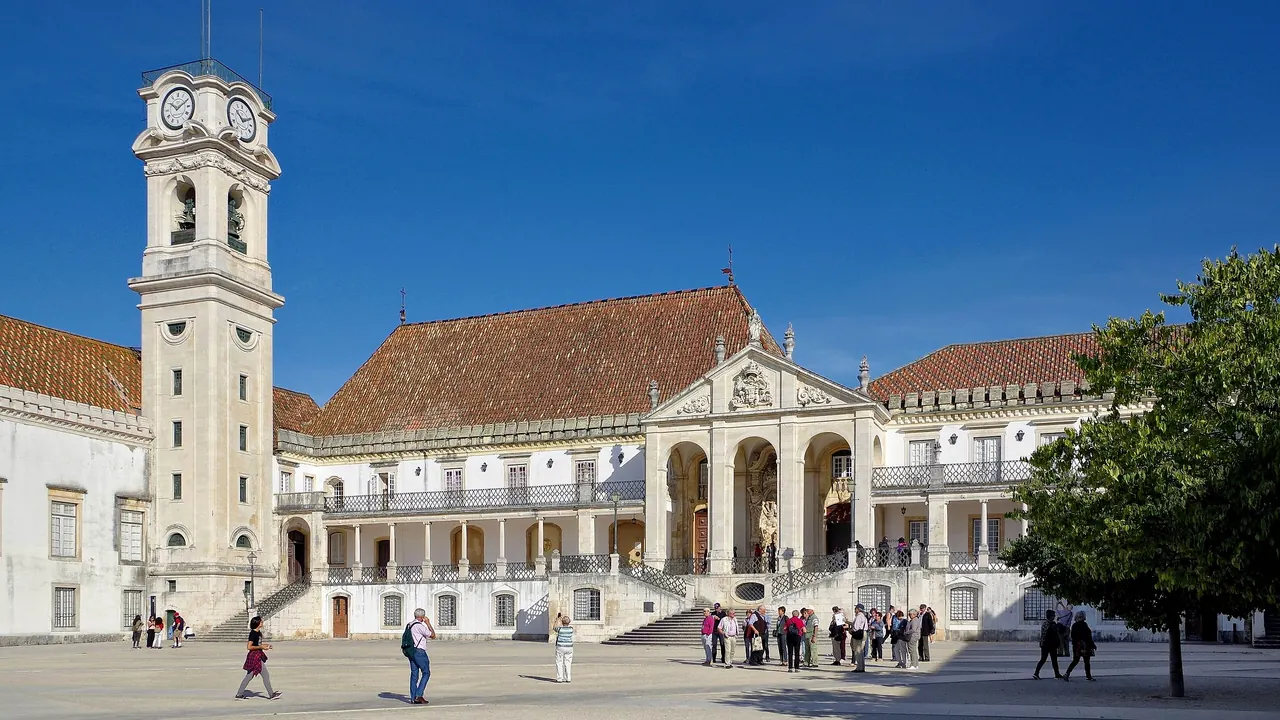

Photos: Coimbra by Berthold Werner, CC BY-SA 3.0, cropped; Santiago de Compostela by Luis Miguel Bugallo Sánchez (Lmbuga), CC BY-SA 3.0, cropped.
Coimbra or Santiago de Compostela?
Our verdict in twelve categories, each scored against the same fixed benchmark cities, and the climate month by month, so you can choose for your trip.
Choose Coimbra for
- day trips
- families
- live music and the arts
Coimbra suits travellers who want a base rather than just a destination. It sits on the main line between Lisbon and Porto, so Porto, Aveiro, the Roman mosaics of Conímbriga and the great monasteries of central Portugal are all within a day out. Families get more here too, the summers are warmer and drier, and the hills to the east have proper mountain walking.
Choose Santiago de Compostela for
- food and drink
- getting around
- culture and sights
Santiago de Compostela is the better pick if you want to eat well and stay put in a beautiful old town. Galician seafood, the cathedral and the granite lanes around it are the heart of the trip, and you can cover it all easily on foot. Pack for rain, though, because it falls in nearly every season.
Scoreboard
Twelve categories on one fixed scale from 0 to 100. The shaded stretch is the gap between the two.
Your match
Pick a travel style or drag the sliders, and both match scores follow your weighting.
Too close to call, 1 point apart
Wins on day trips and families with your weighting.
Wins on food and drink and getting around with your weighting.
What matters to you?
Category by category
What the scores mean for a trip.
Beaches & swimming
Neither city is a beach base, and both coasts take an outing to reach. From Coimbra you head an hour west to Figueira da Foz, with a huge open Atlantic beach and real surf. In summer you can also swim in the calmer, warmer river beaches in the hills inland.
Santiago's beaches are closer and gentler. The fine white sand of the Ría de Muros e Noia and the Ría de Arousa sits in sheltered inlets, out of the swell. In both places the water stays cold even in August.
Food & drink
Santiago is clearly the place to go if you travel to eat. Galician seafood is the draw: octopus, scallops, razor clams and percebes. You can buy at the granite Abastos market and have counters cook it for you, then work along Rúa do Franco with pimientos de Padrón and a glass of Albariño.
Coimbra's cooking is heartier and narrower. Its great dishes are roast suckling pig, best eaten in Mealhada's roadside restaurants, and goat slow-cooked in clay. Inside the city, eating out mostly means simple set lunches in family tascas and convent pastries.
Culture & sights
Santiago has the slightly richer heritage, and the cathedral alone justifies the trip. Add the Pórtico da Gloria, the Praza do Obradoiro and a whole UNESCO-listed old town of arcades and monasteries, which takes two or three days to explore.
Coimbra's sights climb a single hill. The old university and its gilded Biblioteca Joanina sit at the top, with the royal tombs at Santa Cruz below and the half-buried convent of Santa Clara-a-Velha across the river. It is a fine group, but one or two days covers it.
Nightlife
Both are university towns with nights to match: cheap, friendly and mostly in bars rather than clubs. Coimbra's crowd drinks in the streets and squares around Praça da República, and in May the Queima das Fitas takes over the whole city for a week.
In Santiago the evening starts with tapas and wine on Rúa do Franco and moves to pub-like bars, some with Galician folk sessions, and it all runs late in the Spanish way. Both cities go quiet in summer. Coimbra's evenings then end over dinner by the river, while Santiago's pilgrims are in bed early.
Nature & outdoors
There is plenty of green country around both, but of different kinds. From Coimbra you look inland to the hills. There is the old monastic forest of Buçaco, slate villages in the Serra da Lousã and, two hours away, proper mountain hiking in the Serra da Estrela, plus kayaking down the Mondego valley.
Santiago looks to the coast. You have the cliffs and lighthouses of the Costa da Morte, the ancient Fragas do Eume woodland and kayaking in the rías, with Camino paths for easy walks straight out of town. It has no high mountains, though, and the rain never quite goes away.
Day trips
Coimbra is the stronger base, because the main rail line puts it halfway between Lisbon and Porto. Porto and Aveiro are each about an hour or less by train, and Conímbriga's Roman mosaics are just south of town. Batalha, Alcobaça and the Convent of Christ at Tomar are a short drive or coach ride away.
Santiago's day trips stay mostly within Galicia, but they are good ones. Choose from the Tower of Hercules in A Coruña, the Roman walls of Lugo, Ourense's hot springs and the Albariño villages of the Rías Baixas. Porto, by contrast, is a stretch from here.
Good for families
Coimbra gives children more to do. Portugal dos Pequenitos, a park of miniature houses and monuments, and the hands-on Exploratório by the river are both made for them, and the drier weather keeps the parks usable.
Santiago is just as safe and relaxed, but its sights are churches and museums, and rain can cancel outdoor plans. Families usually end up taking the train to the aquarium in A Coruña or heading for the coast. In both old towns, cobbles and slopes are hard going with a pushchair.
Getting around
Santiago is easier on the legs. Its pedestrian granite centre takes about twenty minutes to cross, with only short climbs, though the stone gets slippery when wet.
Coimbra is also walkable, but the route from the Baixa up to the university means steep lanes and long stairways like the Quebra-Costas. A public lift and a funicular help with the climb. Both cities have good rail links, but you will want a car for the countryside around either.
Shopping & style
Neither city is a shopping destination, and in both the best buys are local crafts and food. In Coimbra that means hand-painted faience, convent sweets and Bairrada wine from the shops along the Baixa's pedestrian streets.
In Santiago, look for jet amulets set in silver in the lanes beside the cathedral, blue-and-white Sargadelos ceramics, tetilla cheese and tinned seafood. You will have to look past a great many scallop-shell souvenirs to find them.
Affordability
Both cities are cheap by Western European standards, though the savings come from different places. Coimbra's prices are set for its students, and the university ticket for the Joanina library is the only real expense. Rooms get dearer around the Queima das Fitas in May.
In Santiago, free tapas with drinks, free entry to the cathedral and plenty of pilgrim hostels keep costs down. Its expensive time is July, around the feast of Saint James.
Live music & performing arts
In both cities the music to hear is sung by students in black capes, but it sounds quite different. Coimbra has its own fado, more lyrical than Lisbon's and played on the Coimbra guitar, with short concerts in small fado houses most evenings.
Santiago's equivalent is the student tunas and the bagpipe folk sessions in old-town bars. It also has an orchestra, the Real Filharmonía de Galicia. Neither city has opera.
Wellness & relaxation
Neither city has spas of its own worth the name, and in both the real thermal waters are a short trip out. From Coimbra you go north to Luso, below the Buçaco forest, or to Curia with its thermal park and Belle Époque hotels.
From Santiago you can take the train to Ourense, where some of the riverside hot pools are free, or drive to the old spa towns of Caldas de Reis and Cuntis. After walking the Camino, that soak is very welcome.
When should you go?
Pick your month. The climate figures are measured averages, not a forecast.
Coimbra in July
Santiago de Compostela in July
Daytime high, °C
Rainfall in the month, mm
Temperature and rainfall are climate normals, averaged over the years shown. Coimbra: 1991-2020 normals, Coimbra (1.6 km from centre). Santiago de Compostela: 1991-2020 normals, Santiago / Labacolla (8.4 km from centre).
Coimbra is the warmer and much drier of the two. July and August reach about 29°C with almost no rain, and that makes the climb up to the university hard work at midday. May, June and September are the easiest months for walking the city and the hills around it. The rain comes back in October and stays through the winter, though winters here are milder and sunnier than in Galicia.
Santiago never gets as hot, with highs around 25°C in July and August. That makes summer the comfortable season for walking, and it is also the only stretch that is reasonably dry. From October to January the city often gets more than 200mm of rain a month. If you want a beach day from either city, plan it for July to September. Even then the Atlantic barely reaches 18°C off Figueira da Foz, and the rías are a degree or so colder.
Which traveller are you?
On a food and nightlife trip, choose Santiago. Coimbra has hearty set lunches and cheap student bars, but Santiago has Galician seafood from the Mercado de Abastos, then tapas and Albariño along Rúa do Franco, and Spanish hours keep the evening going late.
On a family trip with children, Coimbra is the better bet. Portugal dos Pequenitos and the hands-on Exploratório are built for young visitors, and the summers are drier. Santiago has little aimed at children, and rain can keep you indoors for days.
For a short city break, Santiago is the easier choice. Coimbra's sights climb one steep hill of lanes and stairways. Santiago's granite centre takes about twenty minutes to cross on foot, and its climbs are shorter and gentler. The cathedral and the Obradoiro alone make a full first day.
Before you go
| Measure | Coimbra | Santiago de Compostela |
|---|---|---|
| Official language | Portuguese | Spanish |
| Currency | Euro (EUR) | Euro (EUR) |
| Sockets | CF230 V, 50 Hz | CF230 V, 50 Hz |
| Driving side | Right | Right |
| Time zone | UTC, UTC+1 in summer | UTC+1, UTC+2 in summer |
| Emergency number | 112 | 112 |
| Elevation | 43 m | 260 m |
| Main airport | Francisco de Sá Carneiro Airport (OPO)117 km from centre133 non-stop destinations | Santiago-Rosalía de Castro Airport (SCQ)10 km from centre29 non-stop destinations |
| Public holidays this year | 14 days | 13 days |
By the numbers
| Measure | Coimbra | Santiago de Compostela |
|---|---|---|
| City population | 140,816 | 100,965 |
| People per km² | 441 | 459 |
| Museums within 10 km | 10 | 6 |
| UNESCO World Heritage sites within 50 km | 1 | 2 |
| Swim season, months above 21 °C | None | None |
Where else could you go?
Every comparison below shares a destination with this one, so you can follow Coimbra or Santiago de Compostela somewhere new.
- Portovs Coimbra
- Lisbonvs Coimbra
- Sintravs Coimbra
- Portovs Santiago de Compostela
- Salamancavs Coimbra
- Salamancavs Santiago de Compostela