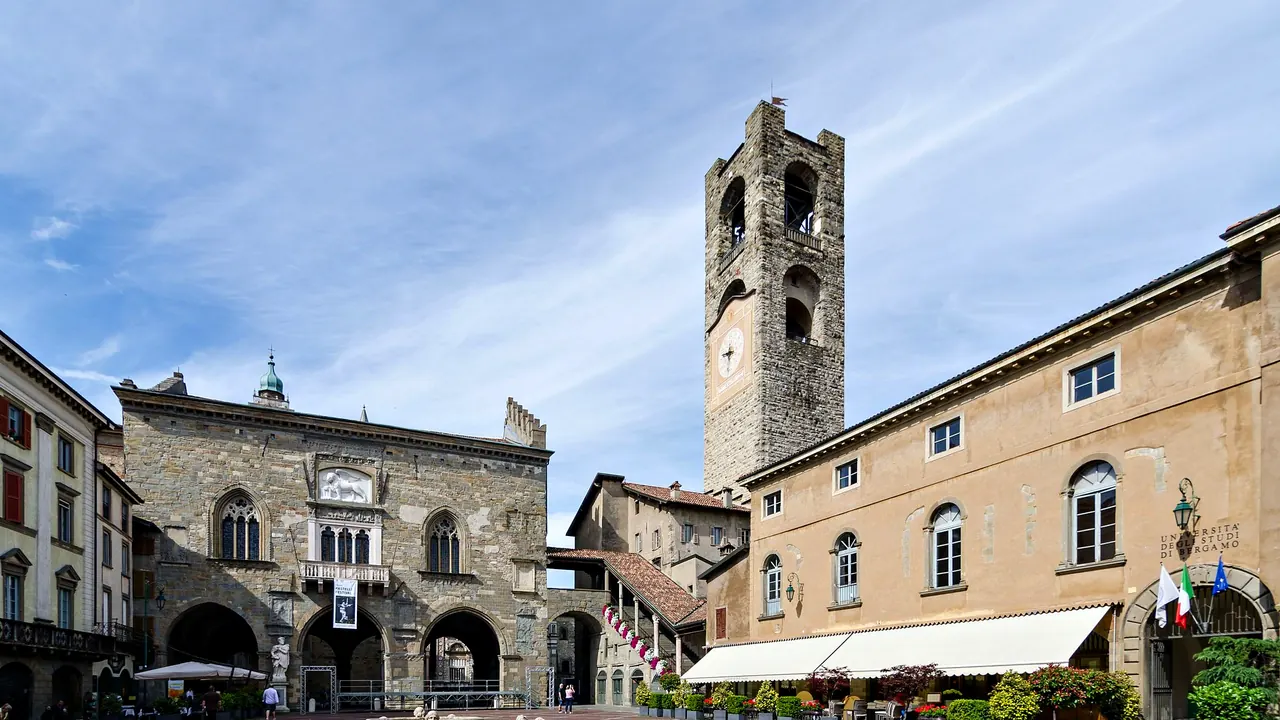
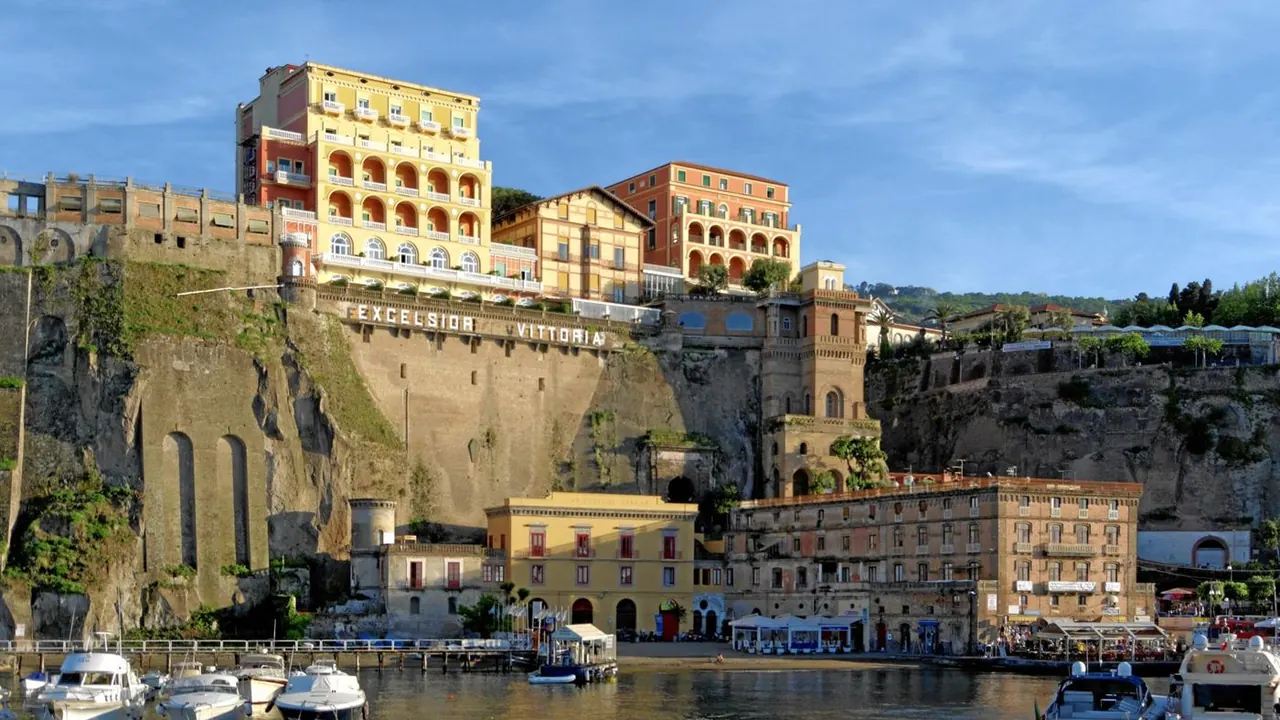
Photos: Bergamo by Steffen Schmitz, CC BY-SA 4.0, cropped; Sorrento by Berthold Werner, CC BY-SA 3.0, cropped.
Bergamo or Sorrento?
Our verdict in twelve categories, each scored against the same fixed benchmark cities, and the climate month by month, so you can choose for your trip.
Choose Bergamo for
- culture and sights
- live music and the arts
- prices
Bergamo suits travellers who want a walled hilltop town with serious art, an opera house and hearty mountain cooking, all at a gentler price. It also makes a calm, well-connected base for Milan and the lakes by train. It is the easier pick with children, on a tighter budget, and for anyone who wants their evenings at the theatre rather than on a terrace.
Choose Sorrento for
- beaches
- day trips
- nature and the outdoors
Choose Sorrento for the sea and everything within reach of it. You can swim off wooden piers, take a boat to Capri, ride the train to Pompeii and walk the cliff paths to Punta Campanella. It works best as a base for days out rather than as a place to explore in itself. Summers here are reliably dry and sunny. Expect to pay resort prices, and to find the town's own sights and evenings modest.
Scoreboard
Twelve categories on one fixed scale from 0 to 100. The shaded stretch is the gap between the two.
Your match
Pick a travel style or drag the sliders, and both match scores follow your weighting.
Wins on culture and sights and live music and the arts with your weighting.
Wins on beaches and day trips with your weighting.
What matters to you?
Category by category
What the scores mean for a trip.
Beaches & swimming
Bergamo has no coast at all. Swimming there means a trip to Lake Iseo or the Lecco arm of Lake Como, where the lidos sit on grass, pebble or concrete and the water reaches about 23°C in midsummer. It makes a pleasant escape from the heat but is not a reason to go.
Sorrento has the sea right below the town. Neither place has a sandy beach, but at Marina Piccola and Marina Grande you step off wooden piers into deep, clear water, and the rocky inlet of the Bagni della Regina Giovanna is a short walk away. The catch is space: in high summer the shore is crowded and mostly taken up by paid lidos.
Food & drink
Both cook Italian food from their own region, but from opposite landscapes. Bergamo eats like the Alps: casoncelli in butter and sage, polenta with braised meat and game, and Taleggio, Branzi and Strachitunt from the valleys, with Valcalepio and Franciacorta to drink.
Sorrento cooks from the sea and the lemon groves: gnocchi alla sorrentina, fish all'acqua pazza, fresh mozzarella and Neapolitan pizza. Its main squares lean towards tour-group menus, so the better meals are on the back lanes, at Marina Grande and in the hill villages. Neither offers much beyond Italian cooking.
Culture & sights
This is where the two differ most. Bergamo's Città Alta is an almost intact walled town inside UNESCO-listed Venetian fortifications. Piazza Vecchia, Santa Maria Maggiore and the marble front of the Cappella Colleoni sit within a few steps of one another, and the Accademia Carrara below holds Raphael, Bellini and Mantegna.
Sorrento's own sights are pleasant rather than major: the Roman street grid, the cloister of San Francesco, the Museo Correale and the ruined mill in the Vallone dei Mulini. A gentle day covers them, and the region's great history lies outside the town.
Nightlife
Both towns are quiet after dark, and neither suits someone looking for clubs. Bergamo's evenings are an aperitivo and wine bars around Via XX Settembre and Borgo Santa Caterina, with students keeping a few places lively, and Milan is close for anything bigger.
Sorrento's evenings follow the passeggiata on Corso Italia, then a drink on a terrace over the bay or a piano bar with Neapolitan songs. Because the trains and ferries stop early, a big night in Naples or on Capri means staying over.
Nature & outdoors
Sorrento has the edge for scenery you can walk straight into. Terraced paths lead out of town to Punta Campanella and the protected bay of Ieranto, the Path of the Gods and Vesuvius are within reach, and kayaks and small boats explore the coves and grottoes.
Bergamo's outdoors is mountain country. The Colli park climbs from the upper town, and Val Brembana and Val Seriana lead into the Orobie Alps, with rifugi, high lakes and small ski areas in winter, plus lake sailing and good cycling. For most of this a car helps, whereas Sorrento's best trails start on foot.
Day trips
Both are excellent bases, but Sorrento has more famous names close by. Pompeii and Herculaneum are a short train ride away, Capri is less than an hour by ferry, and boats run to Positano and Amalfi, with Naples and its archaeological museum also near.
Bergamo's outings are more relaxed and mostly by rail: Milan and the Last Supper, the towns on Lake Como, Monte Isola on Lake Iseo, Crespi d'Adda, Brescia and Verona. Its trains are calmer than the crowded Circumvesuviana and the summer coast road.
Good for families
Bergamo is the easier family choice. Children enjoy the funicular rides up to the Città Alta and San Vigilio, and the walls make a gentle walk. Leolandia and the Le Cornelle wildlife park are short drives away. The steep cobbles of the upper town are the one struggle with a buggy.
Sorrento's flat centre is actually easier with a pushchair, and boat trips and Pompeii go down well. However, little is designed for children, swimming means deep water off piers rather than shallow sand, and many hotels sit on steep lanes with no pavements.
Getting around
Bergamo is simpler to get around. Two funiculars link its levels, buses run to the station and the airport, and direct trains reach Milan, Brescia and Lecco. You only need a car for the upper valleys and the lake shores.
Sorrento's centre is small and flat, with a lift down to the marinas, but leaving it takes more patience. The Circumvesuviana is old and crowded, coastal buses get stuck on the hairpins in summer, and ferries are often the most comfortable option. A car there is more burden than help.
Shopping & style
Neither town is a shopping destination. Each sends serious shoppers elsewhere, Bergamo to Milan and Sorrento to Naples or Capri. The difference is in what you bring home.
Bergamo's lower-town arcades hold Italian chains and mid-range fashion, and the lane through the Città Alta is lined with cheese shops, salumi and wine. Sorrento sells lemon-themed goods by the shelf, but also real local crafts: intarsia boxes, sandals made to measure and cameo jewellery.
Affordability
Bergamo is noticeably easier on the budget. Lower-town hotels and trattorias are fairly priced, and buses and the funicular cost little. Only rooms inside the Città Alta and summer weekends push the cost up.
Sorrento charges resort rates in summer for sea views, lido sunbeds, terrace dinners and private boats. Cheap trains and back-lane pizzerias help, and hotel rates fall considerably in spring and late autumn.
Live music & performing arts
Bergamo has a real stage life for its size. Donizetti was born here, and the Teatro Donizetti runs an opera and concert season and an autumn festival of his works. The Teatro Sociale and the long-running Bergamo Jazz festival add more, and La Scala is an easy evening away.
Sorrento offers mainly tarantella and Neapolitan song shows staged for visitors, plus summer chamber music in the San Francesco cloister. For proper opera you travel to the San Carlo in Naples.
Wellness & relaxation
The two are about level, but the rest they offer is quite different. From Bergamo you can take the waters properly: the Belle Époque spa at San Pellegrino Terme is forty minutes away, and the sulphur springs at Trescore Balneario go back to Roman times.
Sorrento's calm comes from clifftop hotel spas, pools over the bay and the slow pace of the lemon gardens, with Ischia's thermal gardens a ferry ride away. Its centre gets noisy in July and August, while Bergamo's upper town stays quiet in the early mornings and evenings.
When should you go?
Pick your month. The climate figures are measured averages, not a forecast.
Bergamo in July
Sorrento in July
Daytime high, °C
Rainfall in the month, mm
Where the figures come from
Bergamo has no rain gauge within 25 km of the centre, so its rainfall comes from a gridded climate dataset read at the city rather than from a gauge further away.
Bergamo's sunshine is measured 64 km from the centre, at Lugano.
Sorrento has no rain gauge within 25 km of the centre, so its rainfall comes from a gridded climate dataset read at the city rather than from a gauge further away.
Sorrento's sunshine is measured 54 km from the centre, at Grazzanise.
Temperature and rainfall are climate normals, averaged over the years shown. Bergamo: 1991-2020 normals, Bergamo / Orio Al Serio (3.9 km from centre). Sorrento: 2005-2025 (sunshine 1991-2020, rainfall 1991-2020) normals, Capri (17 km from centre).
Bergamo has a proper winter, with daytime highs around 7°C in January. By July and August it reaches 29°C, which is warm enough for a lake swim but hot for climbing the lanes of the upper town. Winter and early spring are its driest months. The rain builds from May, and autumn is the wettest season, peaking at 129mm in October. April is the best balance for walking the Città Alta, mild and fairly dry. May and September are just as comfortable for hiking in the valleys, but you trade that for a good chance of showers.
Sorrento's year runs the other way. From June to August it is almost dry, with under 25mm a month and far more sunshine than Bergamo gets. The sea warms to 26°C in August and stays pleasant for swimming into October. Its winter is milder than Bergamo's but much wetter, and November is the rainiest month. For the coastal paths, spring is the time to go: April and May are mild and drying out, before the exposed trails turn hot in summer and the autumn rain comes back.
Which traveller are you?
For a beach and sun trip, Sorrento is the clear choice. You swim in the sea itself, off piers and rocks into deep, clear water, under dry summer skies. Bergamo can only offer lake lidos on pebble and grass, a day's outing away.
On a culture and arts trip, Bergamo wins easily. The walled Città Alta, the Cappella Colleoni and the paintings in the Accademia Carrara outclass Sorrento's cloister and villa museum, and the Teatro Donizetti gives you opera and concerts, which Sorrento cannot match.
On a tight budget, Bergamo goes further. Lower-town hotels and trattorias are fairly priced, and cheap trains reach Milan and Brescia. Sorrento charges resort rates in summer for sea-view rooms, sunbeds and boats, and is only kind to the wallet in spring and late autumn.
Before you go
| Measure | Bergamo | Sorrento |
|---|---|---|
| Official language | Italian | Italian |
| Currency | Euro (EUR) | Euro (EUR) |
| Sockets | CFL230 V, 50 Hz | CFL230 V, 50 Hz |
| Driving side | Right | Right |
| Time zone | UTC+1, UTC+2 in summer | UTC+1, UTC+2 in summer |
| Emergency number | 112 | 112 |
| Elevation | 249 m | 50 m |
| Main airport | Il Caravaggio International Airport (BGY)4 km from centre146 non-stop destinations | Naples International Airport (NAP)30 km from centre131 non-stop destinations |
| Public holidays this year | 13 days | 13 days |
By the numbers
| Measure | Bergamo | Sorrento |
|---|---|---|
| City population | 119,534 | 15,407 |
| People per km² | 2,973 | 1,541 |
| Museums within 10 km | 21 | 6 |
| UNESCO World Heritage sites within 50 km | 6 | 5 |
| Swim season, months above 21 °C | - | 5 months |
Where else could you go?
Every comparison below shares a destination with this one, so you can follow Bergamo or Sorrento somewhere new.
- Positanovs Sorrento
- Amalfivs Sorrento
- Naplesvs Sorrento
- Salernovs Sorrento
- Milanvs Bergamo
- Comovs Bergamo