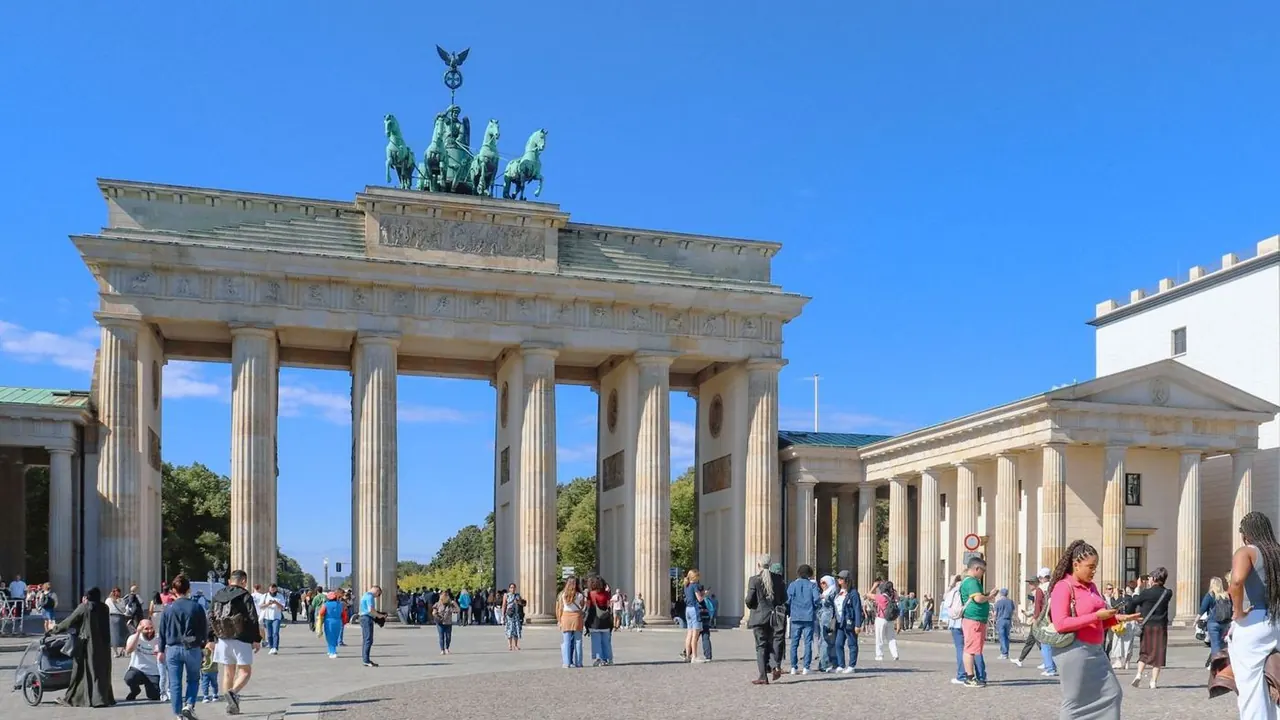
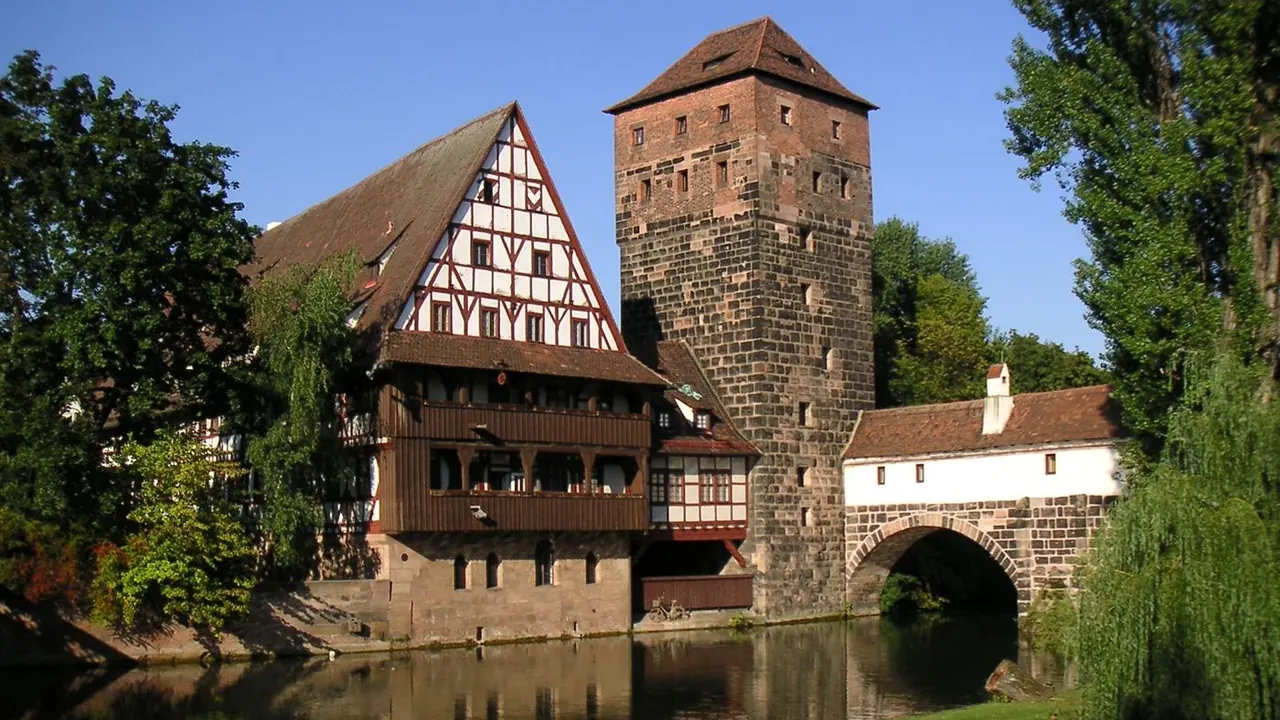
Photos: Berlin by Claudia Solano, Pexels License; Nuremberg by Horst Gutmann, CC BY 2.0, cropped.
Berlin or Nuremberg?
Our verdict in twelve categories, each scored against the same fixed benchmark cities, and the climate month by month, so you can choose for your trip.
Choose Berlin for
- nightlife
- live music and the arts
- beaches
Berlin suits travellers who want a big capital with full evenings and long nights. It has techno clubs that run through the weekend, three opera houses and the Berlin Philharmonic, and twentieth-century history told where it happened, at the Wall, the Reichstag and the Holocaust memorial. It also works well for families and for anyone after flea markets and food from many countries, as long as they accept that the city is spread across several separate centres.
Choose Nuremberg for
- day trips
- nature and the outdoors
- prices
Nuremberg is the better pick for a slower, more compact trip. It is built around a walled medieval old town, Franconian taverns and beer from small local breweries. Bamberg, Regensburg, Würzburg and Rothenburg are all within easy train reach, which makes it an excellent base for a week of day trips. The limestone valleys of Franconian Switzerland add walking and climbing that Berlin's flat surroundings cannot offer.
Scoreboard
Twelve categories on one fixed scale from 0 to 100. The shaded stretch is the gap between the two.
Your match
Pick a travel style or drag the sliders, and both match scores follow your weighting.
Wins on nightlife and live music and the arts with your weighting.
Wins on day trips and nature and the outdoors with your weighting.
What matters to you?
Category by category
What the scores mean for a trip.
Beaches & swimming
Neither city has a coast, but Berlin makes far more of its water. Strandbad Wannsee, the Müggelsee and forest lakes such as Schlachtensee and Plötzensee are a train or bus ride from the centre, so a summer swim can fit in between museums.
In Nuremberg, the nearest proper lake bathing is in the Franconian Lake District around the Brombachsee, about an hour south, which turns a swim into a half-day outing. In town you are limited to outdoor pools and leisure baths.
Food & drink
Berlin wins on range. You could eat something different every night between the Turkish grill houses and bakeries of Kreuzberg and Neukölln, the Vietnamese and Korean kitchens, the market-hall street-food evenings and a serious fine-dining tier.
Nuremberg's food is narrower but has a stronger identity: finger-sized bratwurst on pewter plates, Schäufele on Sundays, Lebkuchen, and local lagers and unfiltered Kellerbier from Franconia's many small breweries. Come for that and you eat well. Look beyond it and the choice thins out quickly.
Culture & sights
Berlin has more to see and deeper collections. Museum Island holds Nefertiti and the Pergamon collections, the Gemäldegalerie has its old masters, and the Cold War is told on site at Bernauer Strasse and the East Side Gallery. What Berlin lacks is a coherent old town.
That is exactly what Nuremberg offers. The walls, the Kaiserburg, St Sebaldus, St Lorenz and Dürer's house make up a medieval townscape that Berlin cannot match, even though much of it was rebuilt. Both cities share a dark twentieth-century history, and Nuremberg's Rally Grounds and Courtroom 600 make a natural companion to Berlin's Topography of Terror.
Nightlife
This is where the two cities differ most. Berlin's techno clubs in old power stations and warehouses run from Saturday night into Monday, and Friedrichshain, Kreuzberg and Neukölln have bars for every hour in between.
Nuremberg's evenings are pleasant but modest. There are taverns and wine bars in the old town, students on the riverbanks in summer, and small alternative bars in Gostenhof. It is a good night out after a day of sightseeing, but not a reason to plan a weekend.
Nature & outdoors
Nuremberg has a modest edge for outdoor trips. The Reichswald forest starts at the edge of the city, and about an hour away Franconian Switzerland has limestone towers, caves, trails between villages and some of Germany's best-known rock climbing.
Berlin's green space is flatter and more urban: cycling on the Tempelhof runways, walks in the Grunewald, sailing on the Havel and the Wall Trail by bike. It is all easy to reach without a day trip, but there is nothing to climb.
Day trips
Nuremberg is the better base for excursions. Bamberg is under an hour away by train, Regensburg and Würzburg about an hour each, and Rothenburg ob der Tauber, Bayreuth and even Munich all make practical days out. Even on a week-long stay you will not run out of options.
Berlin has one outstanding trip, to Potsdam's palaces, plus Wittenberg, Leipzig and the Spreewald. Dresden is possible but makes for a long day, and after those few the choice runs out.
Good for families
Berlin gives children more to do. It has two big zoos, the Zoologischer Garten with its aquarium and the vast Tierpark, plus the dinosaur skeleton at the Natural History Museum and the hands-on Museum of Technology. The flat streets and parks make prams easy.
Nuremberg's long history of toy-making runs through its offer for children: the Toy Museum, full-size locomotives at the railway museum, a zoo set in old quarries and a play park in Zirndorf. It is smaller and easier to manage, but the climb to the castle is steep and cobbled.
Getting around
Both cities are easy without a car, but they work differently. In Berlin you will ride the U-Bahn, S-Bahn or trams between Mitte, Kreuzberg, Prenzlauer Berg and Charlottenburg, or cycle on flat bike lanes, and the trains run all night at weekends.
Nuremberg's old town is about 1.5km across, so most sightseeing is on foot from the station by the southern gate. The U-Bahn and trams cover the Rally Grounds, the zoo and Fürth.
Shopping & style
Berlin is the better shopping trip, mainly for independent shops. There are concept stores around Hackescher Markt, vinyl and vintage clothing in Kreuzberg and Prenzlauer Berg, the big brands on the Kurfürstendamm and the KaDeWe food hall. The Sunday flea markets at Mauerpark and Boxhagener Platz are the highlight.
Nuremberg's main streets are mostly chains and department stores. What it does have is souvenirs with a story, such as Lebkuchen in tins, wooden toys and crafts from the Handwerkerhof, and in Advent the stalls of the Christkindlesmarkt.
Affordability
Overall costs are much the same. Both cities have cheap, filling food, with döner and Vietnamese canteens in Berlin and bratwurst, tavern meals and inexpensive local beer in Nuremberg. In both, hotel rates jump during trade fairs.
What differs is what pushes the bill up. In Berlin it is a trip heavy on museum tickets and fine dining. In Nuremberg the main risk is booking during the toy fair or the Advent market season.
Live music & performing arts
Berlin is in another league here. It has three opera houses, the Berlin Philharmonic in the Philharmonie, the Konzerthaus, and theatre from the Berliner Ensemble to the Schaubühne, plus jazz cellars and experimental venues. You could see something different every night of the week.
Nuremberg's Staatstheater, in its Art Nouveau opera house, covers opera, ballet and drama well. Summer brings the free Bardentreffen in the old town squares and an open-air orchestra concert in the Luitpoldhain. That makes for a good evening out, but not a reason to travel.
Wellness & relaxation
Neither city has thermal springs of its own, and both follow the German custom of mixed, clothes-free saunas. Berlin has more choice within the city, with large sauna complexes and the columned halls of the Stadtbad Neukölln.
Nuremberg relies more on its neighbours: the thermal spa in Fürth, a short U-Bahn ride away, and the saline pools of Bad Windsheim about an hour west. Even so, its unhurried old town makes it an easy place to slow down.
When should you go?
Pick your month. The climate figures are measured averages, not a forecast.
Berlin in July
Nuremberg in July
Daytime high, °C
Rainfall in the month, mm
Temperature and rainfall are climate normals, averaged over the years shown. Berlin: 1991-2020 normals, Berlin / Alexanderplatz (0.9 km from centre). Nuremberg: 1991-2020 normals, Nuernberg (5.5 km from centre).
The two cities have almost the same calendar. Both reach about 25°C in July and August, the only months warm enough for a lake swim, and both drop to around 4°C in December and January, when short grey days make long walks hard going. May, June and September are the most comfortable months for sightseeing on foot, with mild days and long light.
The differences are small. Nuremberg is a little wetter in early summer, and both cities get their heaviest rain in July, around 76mm. Berlin's winters are slightly gloomier, with about 41 hours of sunshine in December, a touch less than Nuremberg gets.
Which traveller are you?
For a food and nightlife trip, Berlin is the clear choice. Its clubs run from Saturday into Monday, the bars of Kreuzberg and Friedrichshain fill the hours in between, and Turkish, Vietnamese and Korean cooking keep dinners varied. Nuremberg's beer taverns are lovely but quieter.
On a culture and arts trip, Berlin offers far more: Museum Island, the Gemäldegalerie, three opera houses and the Berlin Philharmonic, with Cold War sites on top. Nuremberg's walled old town and the Germanisches Nationalmuseum fill two good days, but its stage programme is regional.
For a short city break, Nuremberg is the easier fit. The station is right by the old town gate and everything inside the walls is walkable, so the castle, churches, bratwurst and brewery taverns fit into two days without crossing between districts.
Before you go
| Measure | Berlin | Nuremberg |
|---|---|---|
| Official language | German | German |
| Currency | Euro (EUR) | Euro (EUR) |
| Sockets | CF230 V, 50 Hz | CF230 V, 50 Hz |
| Driving side | Right | Right |
| Time zone | UTC+1, UTC+2 in summer | UTC+1, UTC+2 in summer |
| Emergency number | 112 | 112 |
| Elevation | 34 m | 209 m |
| Main airport | Berlin Brandenburg Airport (BER)19 km from centre161 non-stop destinations | Nuremberg Airport (NUE)5 km from centre56 non-stop destinations |
| Public holidays this year | 10 days | 12 days |
By the numbers
| Measure | Berlin | Nuremberg |
|---|---|---|
| City population | 3,700,577 | 531,159 |
| People per km² | 4,153 | 2,848 |
| Museums within 10 km | 157 | 50 |
| UNESCO World Heritage sites within 50 km | 4 | 1 |
Where else could you go?
Every comparison below shares a destination with this one, so you can follow Berlin or Nuremberg somewhere new.