Photos: Nuremberg by Horst Gutmann, CC BY 2.0, cropped; Stuttgart by Baden de, CC BY 3.0, cropped.
Nuremberg or Stuttgart?
Our verdict in twelve categories, each scored against the same fixed benchmark cities, and the climate month by month, so you can choose for your trip.
Choose Nuremberg for
- prices
- culture and sights
- beaches
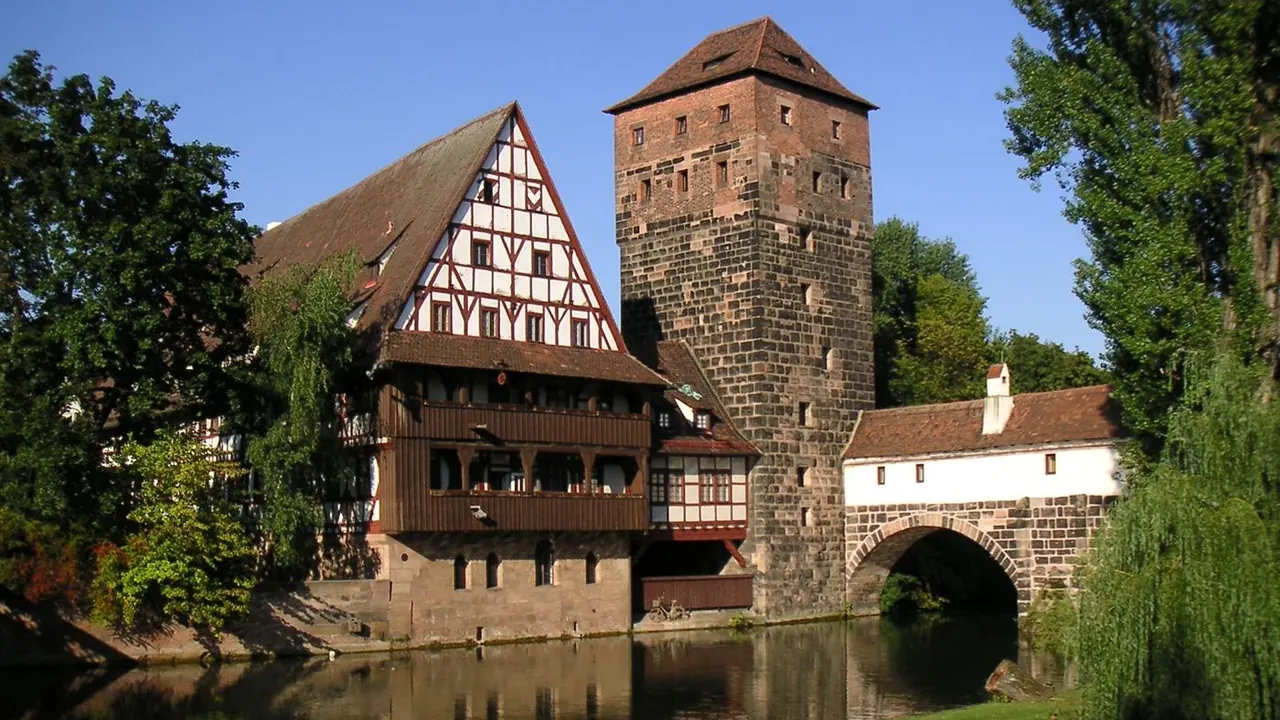
Nuremberg suits travellers who want a walled medieval city to explore on foot, with an imperial castle, Gothic churches and one of Germany's great museums inside a centre you can cross in twenty minutes. Its twentieth-century sites add a sobering layer that Stuttgart has no equivalent for, and food, beer and rooms cost less, as long as you avoid the trade fairs and the Advent rush.
Choose Stuttgart for
- live music and the arts
- wellness
- shopping
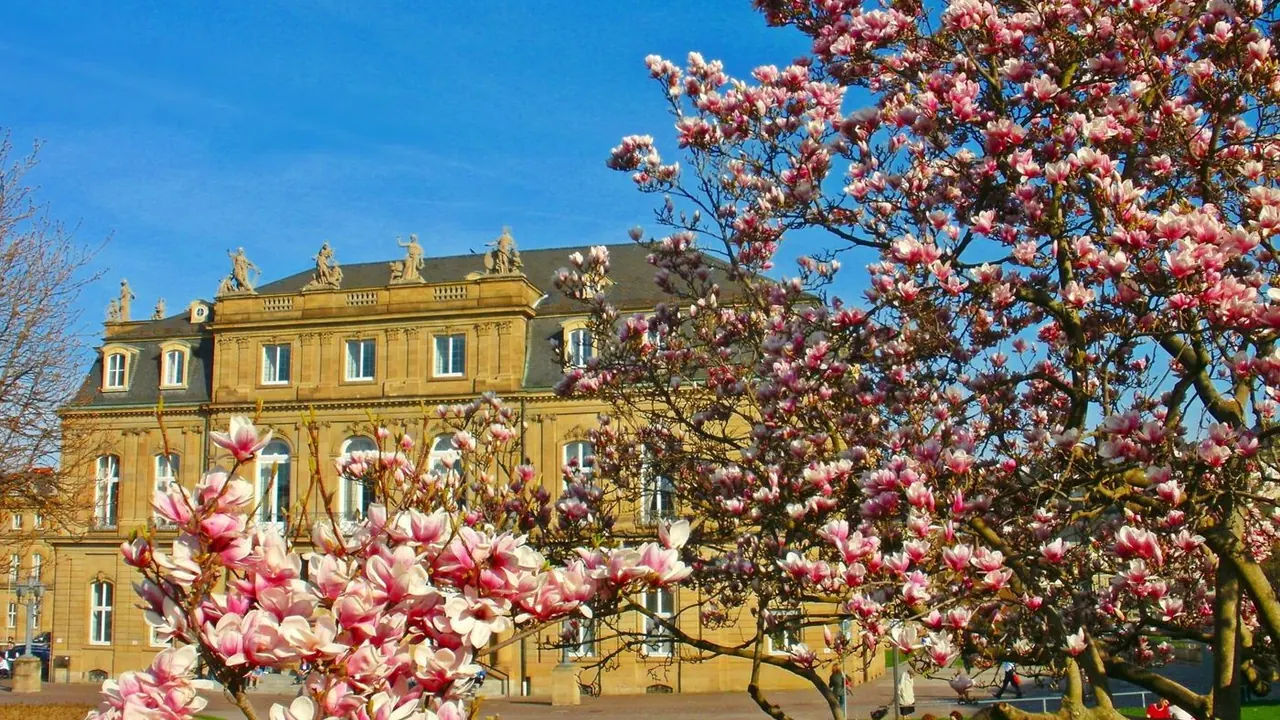
Stuttgart is the better pick if your evenings matter as much as your days. It has a ballet company with a European reputation, an opera house known for bold staging, mineral baths fed by its own springs and brand shopping that stretches to the Metzingen outlets. Expect a modern, prosperous city of car museums and vineyard slopes rather than old stones, and expect to pay more for it.
Scoreboard
Twelve categories on one fixed scale from 0 to 100. The shaded stretch is the gap between the two.
Your match
Pick a travel style or drag the sliders, and both match scores follow your weighting.
Wins on prices and culture and sights with your weighting.
Wins on live music and the arts and wellness with your weighting.
What matters to you?
Category by category
What the scores mean for a trip.
Beaches & swimming
Neither city is for a swimming trip, but Nuremberg has the better summer escape. The Franconian Lake District is about an hour south, where the reservoirs around the Brombachsee have grassy shores, small sandy strips and water that warms to about 23°C in a hot spell.
Stuttgart has nothing comparable nearby. The Neckar is a working river and the Max-Eyth-See is not for bathing, so locals use the outdoor pools, some fed by mineral springs, and Lake Constance is more than two hours away.
Food & drink
Both cities eat heartily, and the real difference is beer against wine. In Nuremberg you are in Franconian brewery country, with small beechwood-grilled bratwurst, Sunday Schäufele with crackling, and smoky Kellerbier in old-town taverns and beer gardens along the Pegnitz. Lebkuchen is the edible souvenir.
Stuttgart is Swabian and wine-led. Maultaschen, Käsespätzle and Zwiebelrostbraten come with Trollinger or Riesling from vineyards inside the city limits, and in season growers serve wine and onion tart in Besen taverns in their homes. The Markthalle and a deeper fine-dining tier give Stuttgart more choice for a special dinner.
Culture & sights
Nuremberg comes out ahead for sightseeing because its history is all in one place. The near-complete medieval walls enclose the Kaiserburg, St Sebaldus and St Lorenz, Dürer's house and the Hauptmarkt. The Germanisches Nationalmuseum can fill a whole day, and the Rally Grounds and Courtroom 600 tell the twentieth-century story with real weight.
Stuttgart's culture is industrial and modern instead. The Mercedes-Benz and Porsche museums, the Staatsgalerie and the Le Corbusier houses of the Weissenhof Estate are first rate. Its bombed old core survives only around Schlossplatz and the two palaces, though, so two or three days covers it.
Nightlife
Nights out are low-key in both, so pick by style. Nuremberg's better evenings are in Gostenhof, west of the walls, with small bars and alternative venues in old working-class streets, and in summer students drink on the squares and riverbanks.
Stuttgart is a little more polished and club-minded, with bars and lounges along Theodor-Heuss-Strasse and electronic music in basements and former industrial spaces. Its peaks are the autumn beer tents of the Cannstatter Volksfest and the late-summer wine village.
Nature & outdoors
Both cities have gentle country for walkers and cyclists rather than mountains, and Stuttgart's sits slightly closer to hand. From its basin you can climb on foot into vineyards and the deer forests of the Rotwildpark and Schönbuch, and the Swabian Jura and the northern Black Forest are each about an hour away.
Nuremberg's landscape is pine forest, with the Reichswald at the edge of town. Its best country is Franconian Switzerland an hour north-east, with limestone towers, caves and well-known climbing, and the lakes to the south add sailing and paddling.
Day trips
This is a strength of both, and the difference is in flavour. From Nuremberg the trips are mostly into the medieval and baroque: Bamberg's UNESCO old town, Regensburg on the Danube, Würzburg's Residence and the walled Romantic Road towns of Rothenburg and Dinkelsbühl, with Munich an hour away by fast train.
Stuttgart mixes palaces and university towns with a border crossing. You can visit Ludwigsburg's palace, Tübingen's punts, Heidelberg in about forty minutes, Hohenzollern Castle, Maulbronn monastery, Ulm's spire and Baden-Baden, and Strasbourg is within reach for a long day.
Good for families
Both are safe, easy cities for children, each with its own theme. Nuremberg plays on centuries of toy-making, with the Toy Museum, a railway museum with full-size locomotives, a zoo in wooded former quarries and a separate children's Christmas market in Advent.
Stuttgart's highlight is Wilhelma, a zoo and botanical garden among Moorish-style pavilions. The Killesberg park has a little railway, and the car museums suit older children. Both cities mean some hill climbing with a pushchair: in Nuremberg up the cobbles to the castle, in Stuttgart up the sides of the basin.
Getting around
Nuremberg is the simpler city to get around. Almost everything sits inside walls about 1.5km across, the station is at the southern gate, and the U-Bahn, trams and S-Bahn on one ticket take you to the zoo, the Rally Grounds and Fürth.
Stuttgart's centre is flat and compact too, but beyond it the city climbs steeply, so you rely more on the Stadtbahn and S-Bahn, or the Stäffele stairways. The rack railway and funicular make the hills part of the fun.
Shopping & style
Stuttgart is the stronger shopping city. Königstrasse is one of Germany's longest pedestrian streets, Breuninger anchors luxury and designer fashion, and the Bohnenviertel adds independent shops, while the Metzingen outlet town is half an hour away.
Nuremberg's high streets between the station and the Hauptmarkt are ordinary, so the buys are local: Lebkuchen in decorated tins, wooden toys and Handwerkerhof crafts. In Advent, the Christkindlesmarkt makes it a much better browsing city for a few weeks.
Affordability
Nuremberg goes further on the same budget. Tavern food and local beer are cheap, sights are modestly priced and ordinary hotel stays are fair, though rooms get scarce during the big toy fair and the Christmas market.
Stuttgart is a prosperous business city and prices show it, especially in smart restaurants and central hotels. Weekends and quieter months bring rooms down, and the wine taverns still give good portions for what you pay.
Live music & performing arts
Stuttgart is in a different league for an evening at the theatre. The Stuttgart Ballet, renowned since the Cranko era, shares the state theatre by the palace gardens with an opera company known for daring productions. The Liederhalle adds orchestras and a strong Bach tradition, and big musicals and a jazz scene fill the rest of the week.
Nuremberg's Staatstheater in its Art Nouveau opera house is respectable and regional. Its best moments come in summer, with the free folk music of the Bardentreffen, the open-air concert in the Luitpoldhain and the rock festival at the Zeppelinfeld.
Wellness & relaxation
Nuremberg has no historic or thermal baths of its own, only leisure pools with saunas on the edges of the city. For a proper soak, you take the U-Bahn to the thermal spa in Fürth or go an hour west to the saline pools at Bad Windsheim. The unhurried old town and the beer gardens along the Pegnitz make up for some of that.
Stuttgart is the better place for bathing. Its springs at Bad Cannstatt and Berg are among the most productive in Europe, and baths such as the Mineralbad Cannstatt and the Mineralbad Leuze let you soak in naturally fizzy warm water indoors and out. The vineyard walks and parks are good for a quiet stroll, though the city's everyday pace is businesslike.
When should you go?
Pick your month. The climate figures are measured averages, not a forecast.
Nuremberg in July
Stuttgart in July
Daytime high, °C
Rainfall in the month, mm
Temperature and rainfall are climate normals, averaged over the years shown. Nuremberg: 1991-2020 normals, Nuernberg (5.5 km from centre). Stuttgart: 1991-2020 normals, Stuttgart / Neckartal (2.8 km from centre).
Both cities have the same central European rhythm, and late May to September is the best time for either. Nuremberg peaks at about 25°C in July and August, and Stuttgart runs a degree or two warmer through the year, reaching 26°C. Summer is the wettest season in both. Stuttgart's showers are a little heavier from May onwards and peak at 79mm in July, so pack for rain whichever city you choose. From spring to autumn the two get almost the same amount of sunshine.
Winter is where they differ a little. Nuremberg drops to about 4°C in December and January and has the darker days, while Stuttgart stays a couple of degrees milder and gets a little more sun. You will still need warm clothes for walking the streets in either city. Swimming only works in high summer, and in Nuremberg that means a trip out to the Franconian lakes in July or August.
Which traveller are you?
For a short city break, Nuremberg fits more into two or three days. You walk from the train straight into the old town and stay on foot from then on, with the castle, the churches and a great museum all close together. Stuttgart's sights are spread across its hills.
On a trip on a tight budget, Nuremberg makes the money last longer. Walking takes the place of most fares, filling meals and local beer keep the evenings cheap, and the old town's summer folk music is free. The same days in Stuttgart cost more.
For a relaxing and wellness trip, Stuttgart gives slow days an easy shape: a morning soak in warm spring water, an afternoon on the vineyard slopes and an evening at the ballet, all without leaving town. Nuremberg's proper spas are outside the city.
Before you go
| Measure | Nuremberg | Stuttgart |
|---|---|---|
| Official language | German | German |
| Currency | Euro (EUR) | Euro (EUR) |
| Sockets | CF230 V, 50 Hz | CF230 V, 50 Hz |
| Driving side | Right | Right |
| Time zone | UTC+1, UTC+2 in summer | UTC+1, UTC+2 in summer |
| Emergency number | 112 | 112 |
| Elevation | 209 m | 245 m |
| Main airport | Nuremberg Airport (NUE)5 km from centre56 non-stop destinations | Stuttgart Airport (STR)10 km from centre124 non-stop destinations |
| Public holidays this year | 12 days | 12 days |
By the numbers
| Measure | Nuremberg | Stuttgart |
|---|---|---|
| City population | 531,159 | 609,365 |
| People per km² | 2,848 | 2,938 |
| Museums within 10 km | 50 | 42 |
| UNESCO World Heritage sites within 50 km | 1 | 3 |
Where else could you go?
Every comparison below shares a destination with this one, so you can follow Nuremberg or Stuttgart somewhere new.