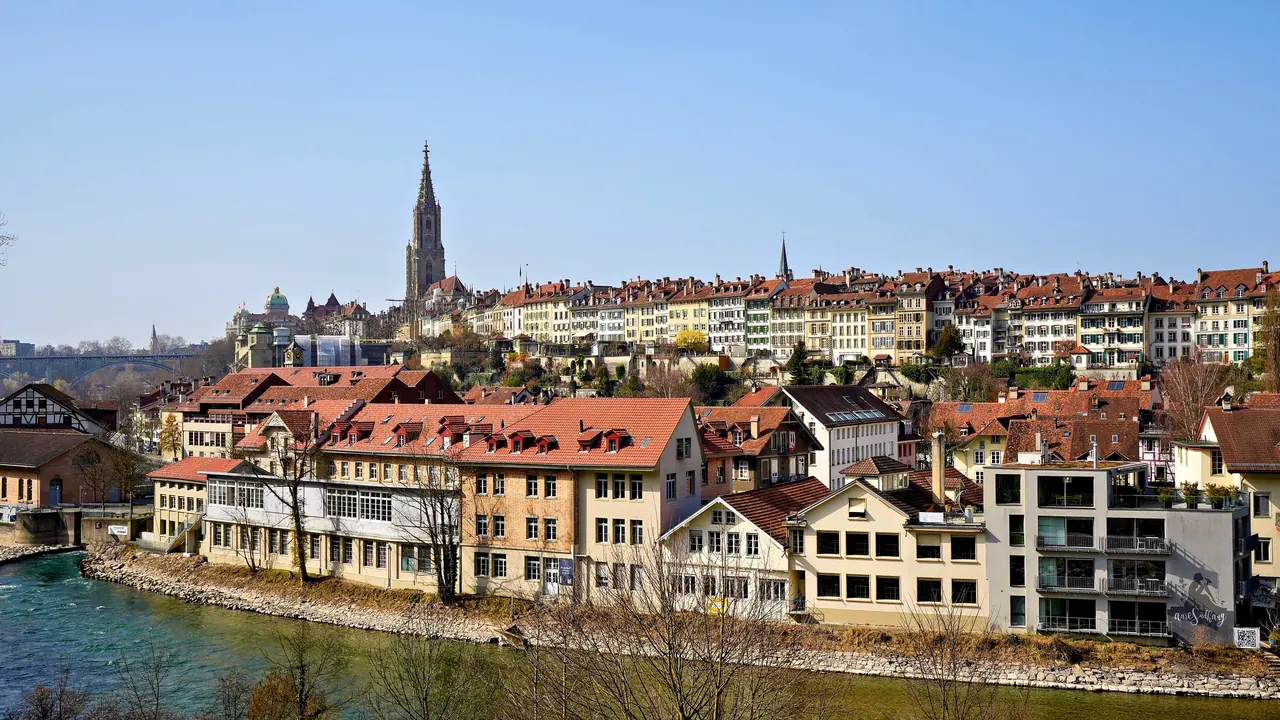
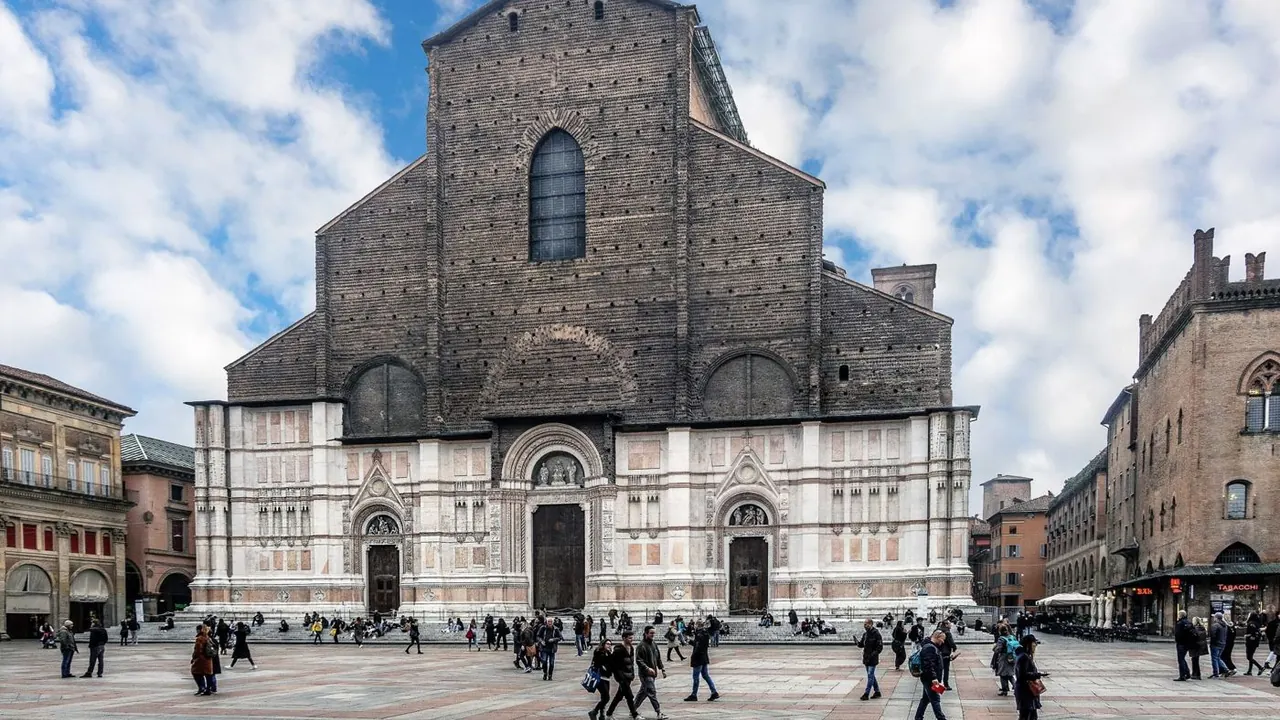
Photos: Bern by Beat Bieri, Pexels License; Bologna by Vanni Lazzari, CC BY-SA 4.0, cropped.
Bern or Bologna?
Our verdict in twelve categories, each scored against the same fixed benchmark cities, and the climate month by month, so you can choose for your trip.
Choose Bern for
- nature and the outdoors
- families
- getting around
Bern suits a calm, scenic trip where the setting matters as much as the sights. The Alps are on the horizon and within an hour by train, the river is there to swim in on summer afternoons, and the small centre, bear park and zoo make it easy with children. Choose it for walking, lakes and mountain days, and plan for a large bill.
Choose Bologna for
- food and drink
- prices
- nightlife
Bologna is the trip for people who travel to eat. Its trattorias, market lanes and evening aperitivo lead the city's appeal, backed by a larger medieval centre, a student nightlife and trains that put Florence, Ravenna and Venice within easy reach. It also costs much less, at least once you have paid for the room.
Scoreboard
Twelve categories on one fixed scale from 0 to 100. The shaded stretch is the gap between the two.
Your match
Pick a travel style or drag the sliders, and both match scores follow your weighting.
Wins on nature and the outdoors and families with your weighting.
Wins on food and drink and prices with your weighting.
What matters to you?
Category by category
What the scores mean for a trip.
Beaches & swimming
Neither city has a coast, but Bern makes swimming part of an ordinary summer day. You walk upstream from the Marzili, drop into the cold green Aare and let the current carry you back past the Federal Palace, with riverside lidos for lawns and pools. Lake Thun offers calmer water twenty minutes away.
Bologna has nothing similar in town. The nearest swimming is the Adriatic at Rimini, an hour by train, and the water there is warmer and much gentler than the Aare, which makes it the safer choice for small children. The shore, though, is a strip of rented sunbeds and green-tinged water, good for a day out of the heat but no real attraction.
Food & drink
Food is the biggest gap between these two cities. In Bologna, eating is a reason to come: tagliatelle al ragù, tortellini in brodo and lasagne verdi in family osterie, pasta rolled by hand in shop windows, and the Quadrilatero's delicatessens and the Mercato delle Erbe a few steps from Piazza Maggiore. Parmigiano, Parma ham and balsamic vinegar come from towns nearby.
Bern eats well in a hearty Alpine way, with the Berner Platte, rösti and fondue in guildhall dining rooms and arcade cellars, plus very good chocolate. The range is small and the bills are high. Bologna's weak point is variety beyond Emilian cooking, which matters less when the local food is this good.
Culture & sights
Bern's UNESCO listing covers the whole old town: sandstone houses on a tight loop of the Aare, about 6km of arcades, painted fountains, the Zytglogge and the Minster tower looking out to the Alps. It is compact and all of a piece. Its museums are better than its size suggests, with the Zentrum Paul Klee and the Einstein Museum both worth planning around, and two days covers it.
Bologna is the stronger city for sightseeing. Here UNESCO lists the porticoes rather than the centre, nearly 40km of them, running through a much larger medieval core in red brick. Piazza Maggiore and San Petronio, the Two Towers, the seven churches of Santo Stefano and the Archiginnasio's wooden anatomical theatre are joined by the Pinacoteca's Bolognese painting and the arcaded climb to San Luca. It fills two or three days and repays them.
Nightlife
Bologna goes out far more, thanks to its students. Crowds fill Piazza Verdi and the cheap bars around the university, Via del Pratello's taverns stay busy until late, and the evening starts with aperitivo around the Quadrilatero. The main exception is August, when the students leave and the city goes quiet.
Bern's evenings are smaller and quieter: cellar bars under the arcades, the streets near the station at weekends, summer terraces along the Aare and the Reitschule for rough late parties. On a weekday the city goes to bed early.
Nature & outdoors
Bern has the great landscape. The Eiger, Mönch and Jungfrau are visible from the old town and about an hour away by train, with high trails, cable cars and skiing. Lake Thun, the Emmental and the Jura are closer, and the Gurten funicular and the Aare's wooded paths begin inside the city.
Bologna's outdoors is gentler. San Luca and the Colli Bolognesi are good for easy hill walks, the Parco dei Gessi has gypsum caves, and the Via degli Dei sets off for Florence from Piazza Maggiore. The higher Apennines are an hour and a half away, and the hot, humid summers keep most walking to spring and autumn.
Day trips
Bern makes day trips effortless. Lucerne, Basel and Zurich are about an hour away, Fribourg and Gruyères lie across the language border, and lake towns such as Murten, Thun and Neuchâtel are closer still. The outings tend to be smaller and more scenic, and you could see a different town every day for a week.
Bologna goes further, mainly because of where its trains lead. Florence is barely half an hour away, Ferrara's walls and castle are under an hour and Ravenna's mosaics about an hour. Modena and Parma lie along the Via Emilia, and Venice, Verona and Padua each make a full day out.
Good for families
Bern is the easier choice with children. The bear park, the wooded Dählhölzli zoo along the river, the dioramas at the Natural History Museum and the playground at the top of the Gurten funicular give younger children plenty to do, and the mountains are close. The one real caution is the fast river.
Bologna is friendly and flat, with traffic-free streets, shade under the porticoes and gelato everywhere. Little of it is aimed at children beyond climbing the Asinelli tower, though, and families usually head out to Mirabilandia or the beach at Rimini. The summer heat is hard on small children.
Getting around
Both centres are best seen on foot, and Bern's is the easier to manage. You can walk from the station to the bear park in about twenty minutes, staying dry under the arcades. Trams and buses run punctually on one fare system, and funiculars and a public lift save you the steep climb up from the river.
Bologna's medieval centre is flat and largely closed to cars, so walking there is simple too. Beyond it, buses cover the wider city and the hills, and there is no metro. Watch out for bikes, which are everywhere under the arches. In both cities the main station sits at the edge of the old town.
Shopping & style
Neither is a shopping destination, and what you bring home differs. In Bologna it is food: mortadella, aged Parmigiano and fresh tortellini from the Quadrilatero, plus a small cluster of luxury fashion around Via Farini and the Galleria Cavour and vintage shops in the university quarter.
Bern's arcaded main streets offer Swiss chains, watches and chocolate. The steep cellar shops on Gerechtigkeitsgasse are the more interesting browse, with antiques and crafts, but there is almost no luxury fashion.
Affordability
This is a large difference. Bern is very expensive across the board: rooms, dinners and even a terrace beer cost far more than visitors expect. The help comes from free pleasures such as the river paths, the bear park and Federal Palace tours, plus the transport pass most hotels include.
In Bologna, eating and drinking are the good news, with trattorias, aperitivo that includes food, and local wine all cheaper than in Italy's tourist hubs. Rooms are the cost to watch, especially during the big trade fairs. Even so, a stay works out far cheaper than in Bern.
Live music & performing arts
Bologna has the deeper musical life. The Teatro Comunale is one of Italy's historic opera houses, UNESCO names the city a City of Music, small jazz clubs play most nights and student venues keep indie gigs going. In summer, Piazza Maggiore hosts outdoor concerts and films.
Bern offers opera and drama in German at the Stadttheater, the symphony orchestra in the Casino, new dance at the Dampfzentrale, a spring jazz festival and the Gurtenfestival in July. In both cities spoken theatre is in the local language, so music is the better bet.
Wellness & relaxation
Bern is the slightly better place to unwind. Its quiet Sundays and unhurried arcades help, and the city has its own thermal bath complex with saunas and steam rooms, plus a hammam-style spa in the old town. Mountain spa hotels in the Bernese Oberland are close for more serious time.
Bologna relaxes you through long lunches under the porticoes, but the university quarter is noisy and summer is heavy. For spa water you leave the city for Castel San Pietro Terme or the old valley spa town of Porretta Terme.
When should you go?
Pick your month. The climate figures are measured averages, not a forecast.
Bern in July
Bologna in July
Daytime high, °C
Rainfall in the month, mm
Where the figures come from
Bern has no rain gauge within 25 km of the centre, so its rainfall comes from a gridded climate dataset read at the city rather than from a gauge further away.
Bern's sunshine is measured 71 km from the centre, at Herten.
Bologna has no rain gauge within 25 km of the centre, so its rainfall comes from a gridded climate dataset read at the city rather than from a gauge further away.
Bologna's sunshine is measured 82 km from the centre, at Cervia.
Temperature and rainfall are climate normals, averaged over the years shown. Bern: 2010-2020 (sunshine 1991-2020, rainfall 1991-2020) normals, Bern / Bern - Belp Airport (5.5 km from centre). Bologna: 1991-2020 normals, Bologna / Borgo Panigale (5.5 km from centre).
Bern is at its best from June to September, when days reach about 26°C, the Aare is warm enough to swim and the mountains are open for hiking. Those are also its wettest months, with rain peaking around 118mm in May, so expect showers. From November to February the city is cold and grey, though the arcades keep the old town walkable.
Bologna warms earlier and gets much hotter. July and August reach about 32°C under strong sun, which makes sightseeing on foot hard work, so May, June and September are the comfortable months. Autumn is its wet season, with October and November close to 95mm, while summer stays fairly dry. For spring or early autumn Bologna is the warmer choice. In high summer Bern is the more comfortable one.
Which traveller are you?
For a food and nightlife trip, Bologna wins easily. Hand-made tortellini, ragù and mortadella in old osterie lead into aperitivo and late nights among the students on Via del Pratello, while Bern's heavy traditional cooking and quiet weekday evenings cannot compete.
On an outdoors trip, Bern is the better base. The Jungfrau region's high trails and cable cars are about an hour away, Lake Thun is nearer still, and the Gurten sits on the edge of the city. Bologna's Apennine hills are gentler and suffer from the summer heat.
On a trip with a tight budget, Bologna makes far more sense. Trattoria meals, aperitivo with food and local wine all cost much less there, and most sights are free churches. In Bern even simple rooms and a terrace beer are expensive.
Before you go
| Measure | Bern | Bologna |
|---|---|---|
| Official language | French, German, Italian, Romansh | Italian |
| Currency | Swiss Franc (CHF) | Euro (EUR) |
| Sockets | CJ230 V, 50 Hz | CFL230 V, 50 Hz |
| Driving side | Right | Right |
| Time zone | UTC+1, UTC+2 in summer | UTC+1, UTC+2 in summer |
| Emergency number | 112 | 112 |
| Elevation | 542 m | 54 m |
| Main airport | Zürich Airport (ZRH)101 km from centre226 non-stop destinations | Bologna Guglielmo Marconi Airport (BLQ)6 km from centre98 non-stop destinations |
| Public holidays this year | 10 days | 13 days |
By the numbers
| Measure | Bern | Bologna |
|---|---|---|
| City population | 136,988 | 387,971 |
| People per km² | 2,655 | 2,754 |
| Museums within 10 km | 30 | 68 |
| UNESCO World Heritage sites within 50 km | 2 | 3 |
Where else could you go?
Every comparison below shares a destination with this one, so you can follow Bern or Bologna somewhere new.