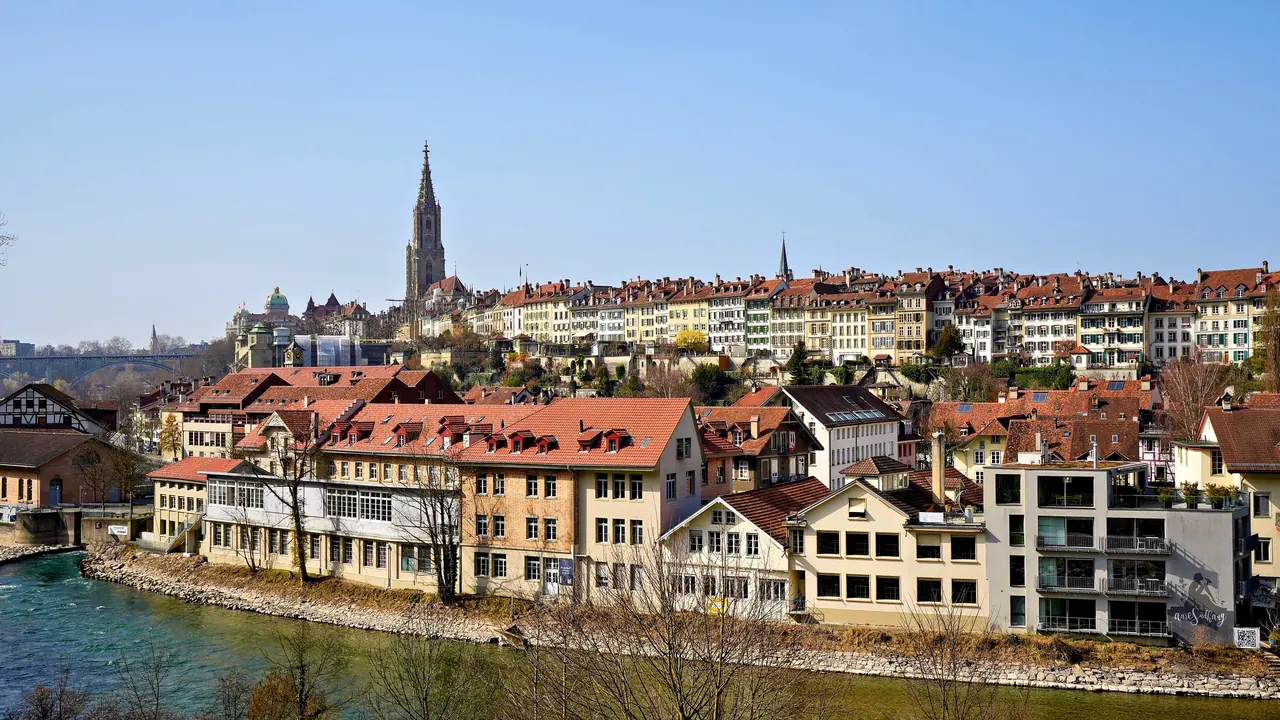
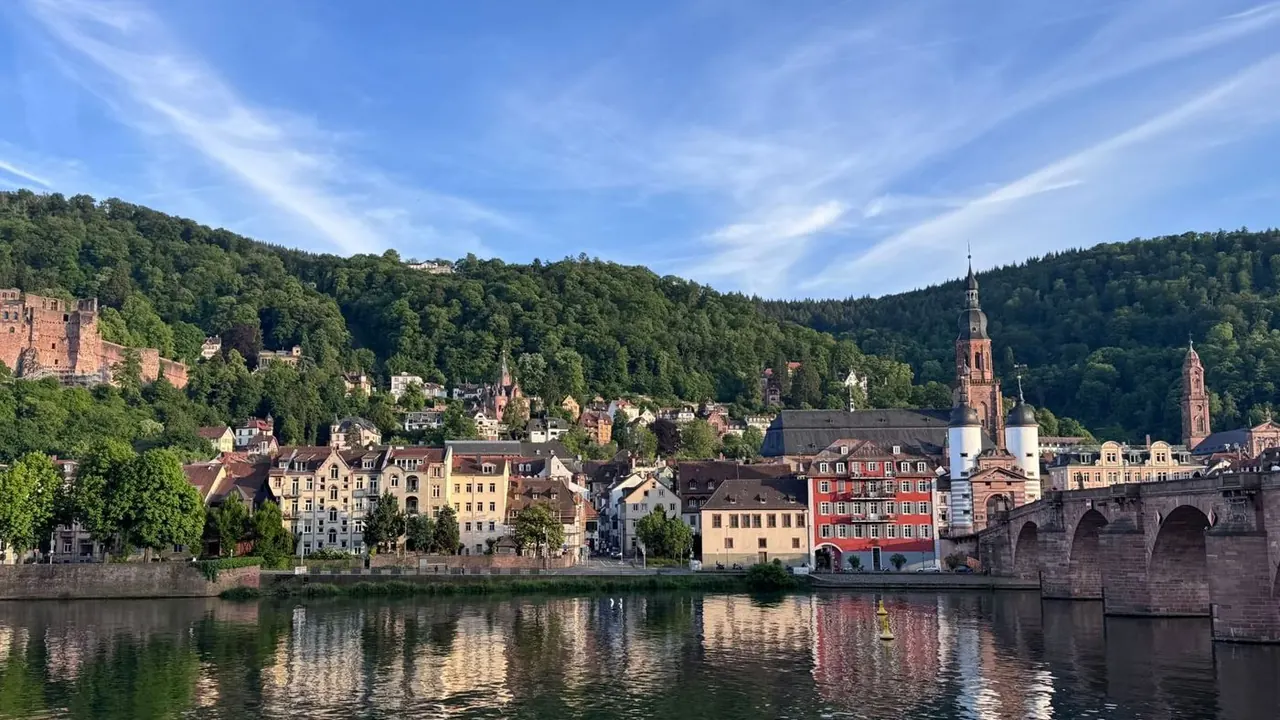
Photos: Bern by Beat Bieri, Pexels License; Heidelberg by Kuanling Chen, Pexels License.
Bern or Heidelberg?
Our verdict in twelve categories, each scored against the same fixed benchmark cities, and the climate month by month, so you can choose for your trip.
Choose Bern for
- beaches
- nature and the outdoors
- getting around
Bern suits travellers who want the Alps on the horizon and a base from which much of Switzerland is easy by train. The UNESCO old town takes minutes to cross on foot, the Aare offers a summer swim that Heidelberg has nothing to match, and the Jungfrau region makes a straightforward day out. The catch is the cost, which is steep for every part of a stay.
Choose Heidelberg for
- prices
- nightlife
Choose Heidelberg for a gentler and much cheaper few days built around a castle ruin, Germany's oldest university and the wine country around them. Forested hills start at the edge of town, the student quarter keeps meals affordable, and Speyer, Schwetzingen and the Palatinate wine villages are easy outings. There is no swimming to speak of and no mountains, but it asks far less of the wallet.
Scoreboard
Twelve categories on one fixed scale from 0 to 100. The shaded stretch is the gap between the two.
Your match
Pick a travel style or drag the sliders, and both match scores follow your weighting.
Wins on beaches and nature and the outdoors with your weighting.
Wins on prices and nightlife with your weighting.
What matters to you?
Category by category
What the scores mean for a trip.
Beaches & swimming
Neither city has a coast, but Bern has a real swimming culture. On summer afternoons people walk upstream from the Marzili baths, jump into the Aare and drift back on its fast, cold current. The Marzili, Lorraine and Eichholz lidos add lawns and pools, and Lake Thun, twenty minutes away by train, has calmer water below the Alps.
Heidelberg offers far less. The Neckar is for boats, not swimmers, so on a hot day the choice is an outdoor pool or a gravel-pit lake on the Rhine plain, about half an hour out of town.
Food & drink
Neither city is a food destination, and both serve the hearty, traditional cooking of a small city. The emphasis differs. Bern leans on cheese and chocolate, with fondue, rösti and the meat-heavy Berner Platte served in vaulted cellars under the arcades. Heidelberg's strength is wine: Riesling and Pinot from the Bergstrasse and the Palatinate appear on every list, and white asparagus fills menus in spring.
Heidelberg is also the easier place to eat cheaply, thanks to its students. Its Hauptstrasse restaurants are uneven, though, and the better meals are found in Neuenheim and in the wine taverns of nearby villages.
Culture & sights
Both are compact, handsome old towns that take a day or two to see, but Bern has the edge. Its UNESCO-listed centre on a loop of the Aare has arcades, painted fountains, the Zytglogge and the Minster. Behind that are museums stronger than the city's size suggests: the Zentrum Paul Klee, the Kunstmuseum and the Einstein Museum.
Heidelberg's appeal is more Romantic and more concentrated. The red sandstone castle ruin stands above the Neckar, the Old Bridge crosses the river, and the university has its ceremonial hall and the graffiti-covered Student Prison. Its museums cover less ground, so the sights themselves carry most of the visit.
Nightlife
Both cities go quiet early on weeknights, and neither suits anyone looking for big clubs. The character differs. In Bern, evenings happen in vaulted cellar bars, along Aarbergergasse and on summer terraces by the Aare, with the Reitschule for rough-edged late parties.
Heidelberg's nights are driven by students. They centre on the crowded little pubs of the Untere Strasse and the old student taverns, are livelier in term time, and have Mannheim and Frankfurt close by for a bigger night.
Nature & outdoors
Here Bern pulls well ahead. The Eiger, Mönch and Jungfrau are visible from the old town and reachable for a day of high trails, cable cars or winter skiing. Closer in, the Gurten, Lake Thun, the Emmental and the Jura offer gentler options.
Heidelberg's outdoors is lovely but on a smaller scale: forest trails from the Königstuhl, the Philosophers' Walk, the Neckar cycle path and the sandstone crags of the Palatinate Forest. This is green walking country, not mountains.
Day trips
Both make good bases, but Bern is the easier one. It sits at the hub of the Swiss rail network, so Lucerne, Basel and Zurich are about an hour away, and Fribourg, Murten, Thun, Solothurn and Neuchâtel are closer still. Trains run often enough that no planning is needed.
Heidelberg's day trips are about history more than scenery: the cathedrals of Speyer and Worms, the palace at Schwetzingen, Lorsch and Maulbronn, and the castle towns up the Neckar. The Palatinate wine villages are easier by car, and Strasbourg makes a long day.
Good for families
Bern's best family outings are in the city itself, and many cost nothing. There is the bear park on the riverbank below the old town, the Dählhölzli zoo with free paths along the Aare, and the playground and meadows at the top of the Gurten funicular. The Marzili has shallow pools for small children, but the river itself is for strong swimmers only, and there is no theme park.
Heidelberg's bigger attractions are a short trip out of town. The Technik Museum Speyer, with a space shuttle and a submarine to climb into, and a large theme park in the Palatinate are good for older children. In town there is a compact zoo, and a funicular ride leads to a small fairy-tale park on the Königstuhl. The cobbled lanes are harder going with a pushchair.
Getting around
Bern is easier to get around. The station sits at the top of the old town, the centre is a twenty-minute walk from end to end under arcades that keep off the rain, and punctual trams, buses and funiculars cover the rest.
Heidelberg's Altstadt is also walkable along the Hauptstrasse, but the station is well to the west, so most arrivals begin with a tram ride. Cobbles and the steep walk up to the castle add effort, though the shared Rhine-Neckar fare system makes regional journeys simple.
Shopping & style
Bern is the more rewarding place to browse. The arcaded line of Spitalgasse, Marktgasse and Kramgasse mixes watch and chocolate shops with Swiss chains. The cellar shops along Gerechtigkeitsgasse add antiques, design and books.
Heidelberg's Hauptstrasse is long, but it runs from high-street chains to souvenirs and beer steins, with a few boutiques in the side lanes. Local Bergstrasse wine is the best thing to buy. Neither city has much luxury shopping, and Heidelberg visitors who want fashion take the train to Mannheim or Frankfurt.
Affordability
This is Heidelberg's clearest advantage. It costs about what western Germany usually does. Hotels are the main expense, while student cafés, bakeries and simple taverns keep meals reasonable, and many visitors save by staying in Mannheim and coming in by train.
Bern is very expensive in every respect, from guesthouses to a beer on a terrace. Some things soften it: hotels usually give guests a transport pass, and the bear park, river paths and Federal Palace tours are free. Supermarket lunches help too, but a stay still costs far more.
Live music & performing arts
Bern's stages lean towards the contemporary and the festival. The Dampfzentrale, a former power station, puts on new dance and new music, the spring jazz festival brings well-known players, and in July the Gurtenfestival brings rock and pop to the hill. The Bern Symphony Orchestra in the Casino covers the classical side.
Heidelberg is more classical, and more about the setting. Chamber music and leading soloists come for the Heidelberger Frühling, the castle courtyard becomes an open-air stage in summer and church concerts are frequent. Mannheim's larger opera house is twenty minutes away. In either city a good evening is easy to find, but neither is a reason to book the trip.
Wellness & relaxation
Bern has its spa time inside the city. There is a large thermal complex with saunas and steam rooms on the western edge, a hammam-style spa in the old town and several hotel spas. Quiet Sundays and long riverside lunches set the pace, and for serious pampering visitors head to the mountain spa hotels of the Bernese Oberland.
Heidelberg has no thermal baths of its own, so it relies on its neighbours: the Kraichgau spa towns are about half an hour away and Baden-Baden about an hour south. In town, calm comes from the Neckar meadows in Neuenheim and the forest paths above the Philosophers' Walk. The midday crowds on the Hauptstrasse are easy to leave behind.
When should you go?
Pick your month. The climate figures are measured averages, not a forecast.
Bern in July
Heidelberg in July
Daytime high, °C
Rainfall in the month, mm
Where the figures come from
Bern has no rain gauge within 25 km of the centre, so its rainfall comes from a gridded climate dataset read at the city rather than from a gauge further away.
Bern's sunshine is measured 71 km from the centre, at Herten.
Temperature and rainfall are climate normals, averaged over the years shown. Bern: 2010-2020 (sunshine 1991-2020, rainfall 1991-2020) normals, Bern / Bern - Belp Airport (5.5 km from centre). Heidelberg: 1991-2020 normals, Heidelberg (4.5 km from centre).
The two cities follow almost the same temperatures through the year. Both reach about 26°C in July and August and drop to around 5°C in midwinter, and spring and autumn bring 16-21°C, which is comfortable for walking. The real difference is rain. Bern's wettest stretch runs from May to August, with about 118mm in May, while Heidelberg stays much drier through summer, with about 69mm that month. Bern gets a little more sunshine at the height of summer, and its river swimming season runs from June to early September.
Both cities are grey and cold in winter, and Heidelberg's December is the darker of the two. May, June and September suit sightseeing in either. Bern is at its best in July and August, for the river and the mountains. Heidelberg's dry spring is a safer bet for walking the Philosophers' Walk and the Bergstrasse.
Which traveller are you?
For an outdoors trip, Bern wins comfortably. Alpine hiking, lakes and cable cars are within easy train reach. Heidelberg's wooded Odenwald hills are good for gentle walks and riverside cycling, but they offer nothing on a mountain scale.
On a trip on a tight budget, Heidelberg is the clear choice. In Bern, hotels, meals and drinks are all expensive. Heidelberg's student cafés, bakeries and good-value regional transport ticket keep the days affordable, even when rooms in town fill up.
For a beach and sun trip, neither city has a coast, but Bern comes much closer. In summer, locals float down the Aare past the Federal Palace, and Lake Thun has places to bathe. Heidelberg's Neckar is not a river for swimming.
Before you go
| Measure | Bern | Heidelberg |
|---|---|---|
| Official language | French, German, Italian, Romansh | German |
| Currency | Swiss Franc (CHF) | Euro (EUR) |
| Sockets | CJ230 V, 50 Hz | CF230 V, 50 Hz |
| Driving side | Right | Right |
| Time zone | UTC+1, UTC+2 in summer | UTC+1, UTC+2 in summer |
| Emergency number | 112 | 112 |
| Elevation | 542 m | 114 m |
| Main airport | Zürich Airport (ZRH)101 km from centre226 non-stop destinations | Frankfurt Main Airport (FRA)69 km from centre281 non-stop destinations |
| Public holidays this year | 10 days | 12 days |
By the numbers
| Measure | Bern | Heidelberg |
|---|---|---|
| City population | 136,988 | 156,092 |
| People per km² | 2,655 | 1,433 |
| Museums within 10 km | 30 | 17 |
| UNESCO World Heritage sites within 50 km | 2 | 4 |
Where else could you go?
Every comparison below shares a destination with this one, so you can follow Bern or Heidelberg somewhere new.