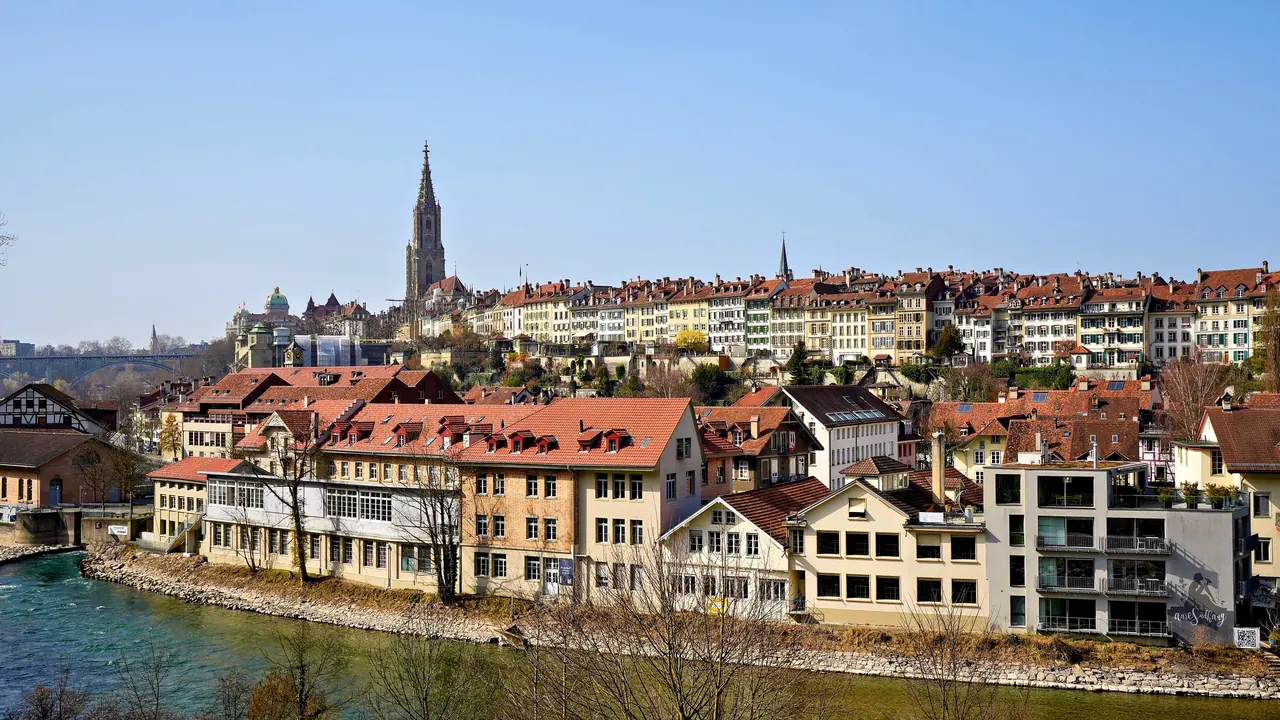
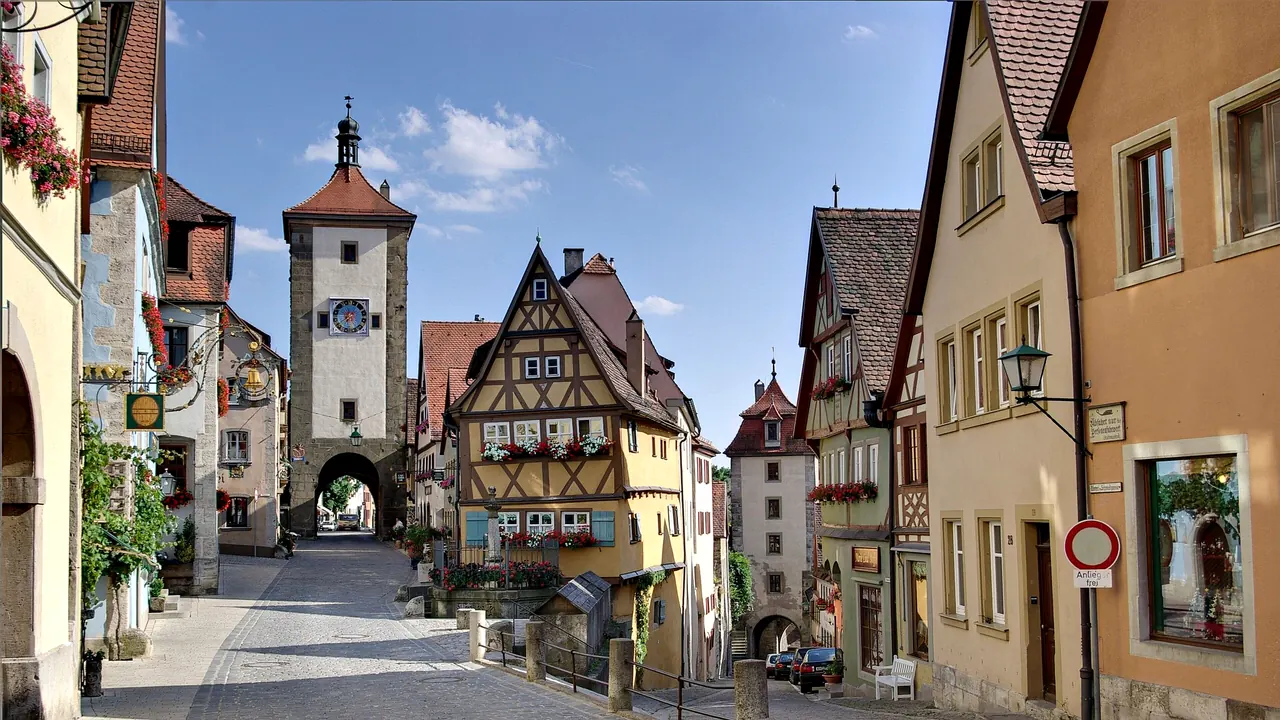
Photos: Bern by Beat Bieri, Pexels License; Rothenburg ob der Tauber by Berthold Werner, Public domain.
Bern or Rothenburg ob der Tauber?
Our verdict in twelve categories, each scored against the same fixed benchmark cities, and the climate month by month, so you can choose for your trip.
Choose Bern for
- nature and the outdoors
- beaches
- getting around
Bern suits a traveller who wants a base rather than a single sight. Its arcaded old town and strong art museums fill a couple of days. After that the rail network takes over, and the Jungfrau peaks, Lake Thun, Lucerne and Gruyères are all easy to reach without a car. Summer adds swimming in the Aare. It costs a great deal, but it gives far more to do for children, for outdoor people and for anyone who wants an evening out.
Choose Rothenburg ob der Tauber for
- prices
Choose Rothenburg ob der Tauber for a short, atmospheric stop on a road trip through Franconia. The walled town is a remarkably complete piece of the Middle Ages, and it is at its best early in the morning and late in the evening, after the day visitors have gone. Prices are noticeably gentler, the Christmas market and the year-round Christmas shops are a draw of their own, and a hire car opens up Dinkelsbühl, Würzburg and the rest of the Romantic Road.
Scoreboard
Twelve categories on one fixed scale from 0 to 100. The shaded stretch is the gap between the two.
Your match
Pick a travel style or drag the sliders, and both match scores follow your weighting.
Wins on nature and the outdoors and beaches with your weighting.
Wins on prices with your weighting.
What matters to you?
Category by category
What the scores mean for a trip.
Beaches & swimming
Neither town has a coast, but Bern has real summer swimming. Locals walk upstream from the Marzili and let the fast, cold Aare carry them back through town. There are also riverside lidos with lawns, and Lake Thun is twenty minutes away by train. This suits confident swimmers, and only from June to early September.
Rothenburg has its outdoor pool, and the Franconian lakes are about an hour's drive away. Water plays no real part in a visit there.
Food & drink
Both kitchens are heavy and regional. In Bern that means Berner Platte, rösti and fondue, and in Rothenburg Schäufele, dumplings and bratwurst. Bern has a wider choice, with some Italian, Asian and modern Swiss cooking, excellent chocolate and markets stocked with Emmental cheese, although every meal costs a lot.
Rothenburg's range is narrower, and many kitchens around the Marktplatz cook for the coach parties. Its strength is what you drink: dry Silvaner in the squat Bocksbeutel bottle and the Tauber valley's own wines, served in family-run taverns away from the main square.
Culture & sights
Both are among the best-preserved old towns in German-speaking Europe, and either one rewards you for its streets alone. Bern adds the institutions of a capital: the Zentrum Paul Klee, the Kunstmuseum and the Einstein Museum, along with the Federal Palace and the Minster tower, which looks out to the Alps.
Rothenburg is more about the whole townscape. It is walled and almost untouched inside, and the best views are from the covered walkway on the wall and at the Plönlein. Its highlights are Riemenschneider's Holy Blood Altar in St Jakob's and the Medieval Crime Museum, and you will see it all in less time than Bern's two days.
Nightlife
Neither is a party town, but in Bern you can have an actual night out. There are vaulted cellar bars under the arcades, busy weekend streets around Aarbergergasse, summer terraces by the Aare and late, rough-edged nights at the Reitschule.
Rothenburg goes quiet once the day visitors leave. An evening there means a wine tavern and the night watchman's tour, and anyone who wants more has to go to Würzburg or Nuremberg.
Nature & outdoors
This is where the two are furthest apart. From Bern the Jungfrau region is about an hour away by train, with cable cars, high-mountain hiking and skiing. Closer to town there are the Gurten, Lake Thun and the wooded paths along the Aare.
Rothenburg's countryside is gentle and pretty. The Tauber valley lies right below the walls, a family cycle path runs through vineyards, and the orchards are at their best in spring blossom and autumn colour. There are no mountains or big lakes to head for.
Day trips
Bern sits at the centre of the Swiss rail network, so Lucerne, Basel, Zurich, Fribourg, Murten and Thun are all simple train rides away. You can see a different town every day without a car or any planning.
Rothenburg's surroundings are rich too, with walled Dinkelsbühl, Nördlingen inside its crater, Würzburg's Residenz and Nuremberg's castle. The branch line makes the train slow, though, so in practice you need a car to see them.
Good for families
Bern is easier with children and gives you more to do. It has the bear park, the Dählhölzli zoo, the dioramas at the Natural History Museum, the funicular up to the Gurten playground, and pushchair-friendly trams.
Rothenburg works like a storybook for a day or two. Children can walk the ramparts, climb the Rathaus tower and follow the night watchman. Beyond that little is made for them, and the cobbles and steep valley paths are hard on pushchairs and small legs.
Getting around
Both old towns are easy to cross on foot in about a quarter of an hour, and both have a steep climb up from the river. In Bern the arcades keep you dry, funiculars and a lift link the riverside quarter, and punctual trams and buses cover the rest of the city.
Rothenburg's car-free lanes are a pleasure to walk, but once you leave the walls things get harder. Most rail journeys mean changing trains at Steinach, and buses to the villages are sparse, especially at weekends.
Shopping & style
Bern has the more useful shopping. A long line of arcaded streets runs from Spitalgasse to Kramgasse with watch and chocolate shops and a department store, and further down there are cellar shops selling antiques, design and books. Neither town is the place for luxury or fashion.
Rothenburg's shops sell almost only souvenirs, with Christmas at the centre. Glass baubles, nutcrackers and Erzgebirge carvings are on sale all year, and the Christmas market on the Marktplatz is one of Germany's most atmospheric.
Affordability
Bern is a costly stay at every level, and eating out is where the costs mount fastest. Many visitors keep the bill down by buying lunch at supermarket takeaway counters or from the stalls at the Bundesplatz market, and save restaurants for the evening. The tram and bus pass that most hotels give their guests helps. So do the free guided tours of the Federal Palace and the old town, which costs nothing to wander.
Rothenburg is clearly the cheaper of the two, though you pay more inside the walls than you would in an ordinary Franconian town. Timing matters more than it does in Bern. Rooms and meals are dearest in December, when the Christmas market is on, and on summer weekends, so a midweek visit in spring or autumn is easier on the budget. The sights charge only small entry fees.
Live music & performing arts
Bern has the regular cultural calendar of a small capital. There is opera, ballet and drama at the Stadttheater, the symphony orchestra at the Casino, new dance at the Dampfzentrale, a jazz festival in spring and the Gurtenfestival in July.
Rothenburg's stage is mostly its own history. The costumed Meistertrunk play is the big event, along with summer open-air theatre and organ concerts in St Jakob's, and on most evenings there is no performance to go to at all.
Wellness & relaxation
For warm pools, saunas and steam rooms, Bern has a large thermal bath complex on the city's edge and a hammam-style spa in the old town. Its everyday pace is unhurried too, with quiet Sundays and long lunches by the river.
In Rothenburg the calm comes at dawn and dusk, when the lanes empty and a walk on the walls is deeply quiet. For a proper thermal soak you have to drive to the floating salt-water pool at Bad Windsheim or to Bad Mergentheim.
When should you go?
Pick your month. The climate figures are measured averages, not a forecast.
Bern in July
Rothenburg ob der Tauber in July
Daytime high, °C
Rainfall in the month, mm
Where the figures come from
Bern has no rain gauge within 25 km of the centre, so its rainfall comes from a gridded climate dataset read at the city rather than from a gauge further away.
Bern's sunshine is measured 41 km from the centre, at Payerne.
Rothenburg ob der Tauber's sunshine is measured 27 km from the centre, at Feuchtwangen-heilbronn.
Temperature and rainfall are climate normals, averaged over the years shown. Bern: 2010-2020 (sunshine 1961-1990, rainfall 1991-2020) normals, Bern / Bern - Belp Airport (5.5 km from centre). Rothenburg ob der Tauber: 1991-2020 normals, Rothenburg ob der Tauber (0.9 km from centre).
The two towns follow the same central European pattern: cold, grey winters and warm summers that peak in July and August, when Bern reaches about 26°C. Neither gets too hot for walking the streets. Bern is the wetter of the two, and most of its rain falls in the warm months. May is its wettest month at 118mm, and showers are likely on any visit from May to August. Summer is also the only time for swimming in the Aare, roughly June to early September. September is often Bern's most comfortable month for sightseeing. It is still warm at around 21°C and noticeably less wet than early summer.
Rothenburg is drier in every month and sunnier through spring, so April and May are good walking months there while Bern is still unsettled. Its summers run a degree or so cooler. June and September suit both towns for exploring on foot, with more umbrella weather in Bern. Winter is short and dim in both, and Rothenburg is the colder, with January highs of about 3°C. In Bern the arcades keep you dry, and the Alps above the city are often sunny when the city itself is grey.
Which traveller are you?
On an outdoors trip, Bern is the obvious pick. The Eiger, Mönch and Jungfrau are about an hour away by train, with high-mountain hiking and winter skiing. Rothenburg has gentle Tauber valley walks and a cycle path, but no mountains.
On a family trip with children, Bern has more to fill the days: the bear park, the Dählhölzli zoo, the playground on the Gurten and the shallow pools at the Marzili. Rothenburg's ramparts and its night watchman delight children, but a day or two covers them.
For a trip on a tight budget, Rothenburg is much kinder. Rooms, meals and drinks in Bern cost far more than in most of Europe. In Rothenburg the inns pour reasonably priced beer and wine, and staying just outside the walls saves a good deal.
Before you go
| Measure | Bern | Rothenburg ob der Tauber |
|---|---|---|
| Official language | French, German, Italian, Romansh | German |
| Currency | Swiss Franc (CHF) | Euro (EUR) |
| Sockets | CJ230 V, 50 Hz | CF230 V, 50 Hz |
| Driving side | Right | Right |
| Time zone | UTC+1, UTC+2 in summer | UTC+1, UTC+2 in summer |
| Emergency number | 112 | 112 |
| Elevation | 542 m | 430 m |
| Main airport | Zürich Airport (ZRH)101 km from centre226 non-stop destinations | Nuremberg Airport (NUE)66 km from centre56 non-stop destinations |
| Public holidays this year | 10 days | 12 days |
By the numbers
| Measure | Bern | Rothenburg ob der Tauber |
|---|---|---|
| City population | 136,988 | 11,331 |
| People per km² | 2,655 | 272 |
| Museums within 10 km | 30 | 6 |
| UNESCO World Heritage sites within 50 km | 2 | 2 |
Where else could you go?
Every comparison below shares a destination with this one, so you can follow Bern or Rothenburg ob der Tauber somewhere new.
- Interlakenvs Bern
- Nurembergvs Rothenburg ob der Tauber
- Lucernevs Bern
- Baselvs Bern
- Bambergvs Rothenburg ob der Tauber
- Lausannevs Bern