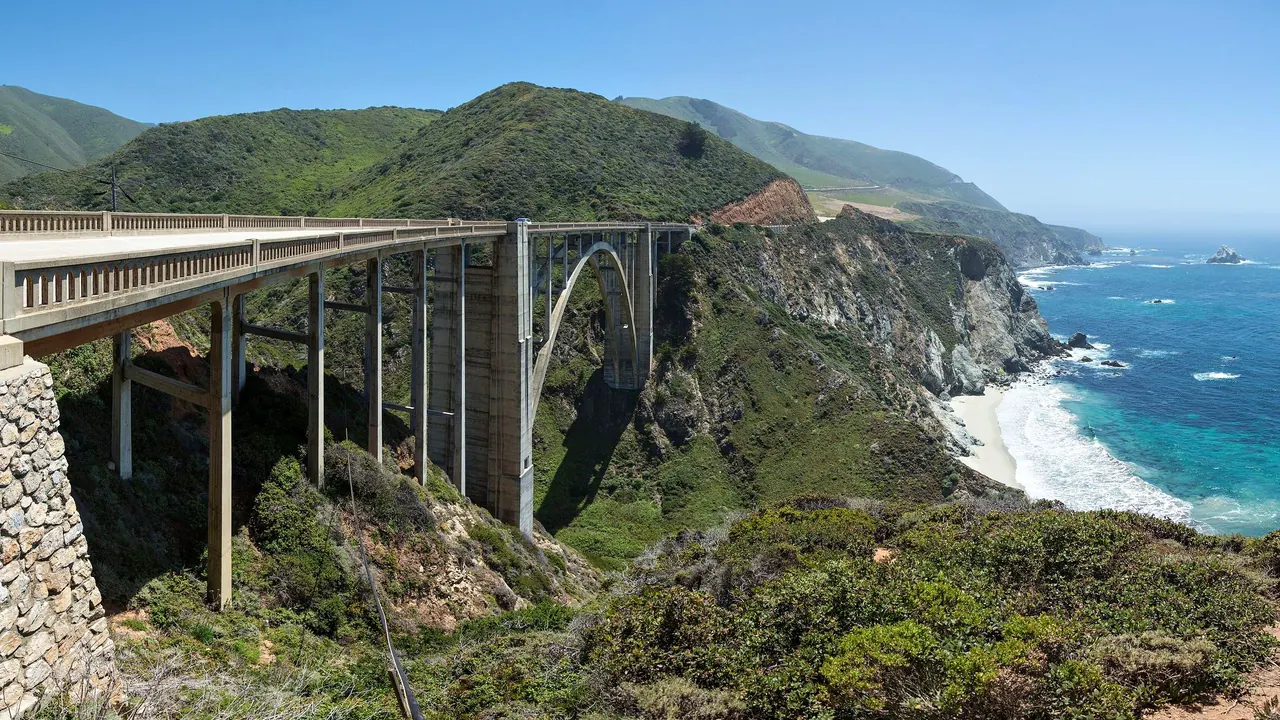
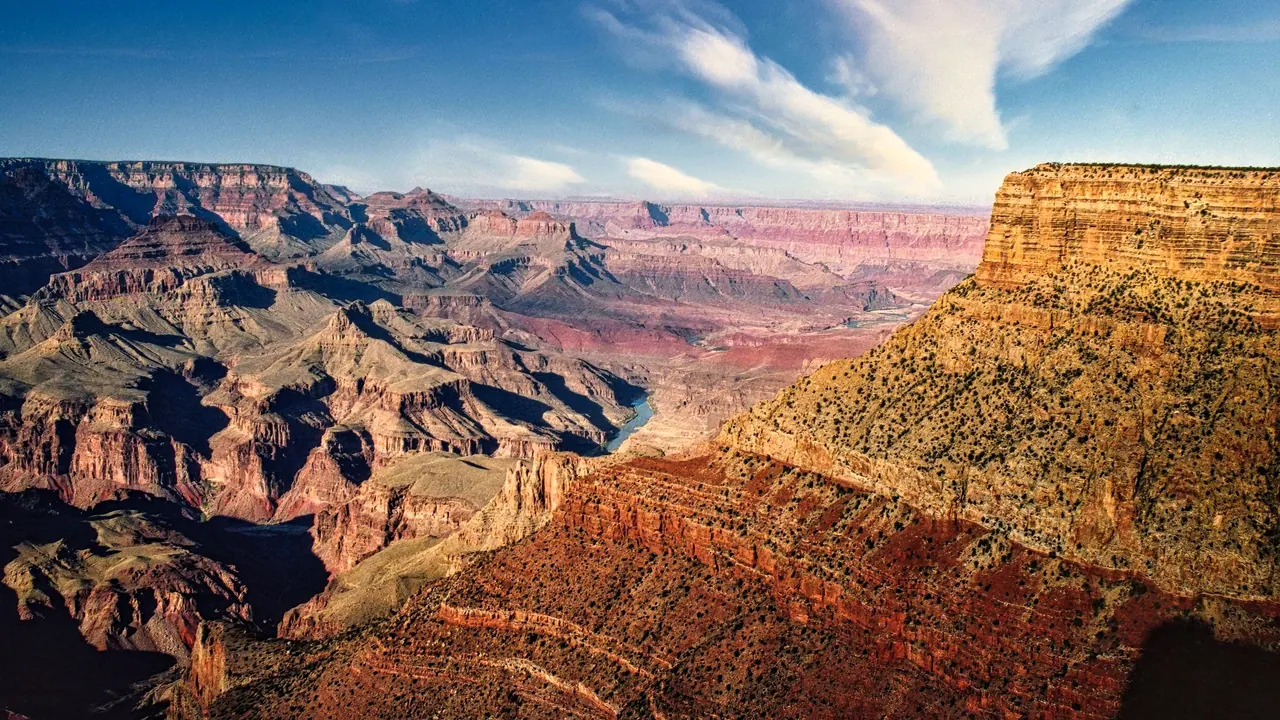
Photos: Big Sur by Diliff, CC BY-SA 3.0, cropped; Grand Canyon by Tom Fisk, Pexels License.
Big Sur or Grand Canyon?
Our verdict in twelve categories, each scored against the same fixed benchmark cities, and the climate month by month, so you can choose for your trip.
Choose Big Sur for
- wellness
- day trips
- beaches
Big Sur suits travellers who want to slow right down: a couple on a cliff-top retreat, a long drive with the Pacific below, a few days of soaking tubs, forest walks and nights with no lights. It gives you mountains, redwoods and sea in one view, and a wellness tradition the canyon cannot match. In return you accept the costliest rooms in the region, one winding road and very little to do once the sun goes down.
Choose Grand Canyon for
- getting around
- prices
- shopping
The Grand Canyon is the better pick for anyone who wants the bigger spectacle and an easier visit. Shuttle buses, the Rim Trail and ranger programmes make it simple to see, school-age children are well looked after, and motels in Williams and Flagstaff keep the bill down. It also has more to it beyond the scenery, from Mary Colter's buildings to Native American craft. What it lacks is the pampering and the sea air, and its summers below the rim are fierce.
Scoreboard
Twelve categories on one fixed scale from 0 to 100. The shaded stretch is the gap between the two.
Your match
Pick a travel style or drag the sliders, and both match scores follow your weighting.
Wins on wellness and day trips with your weighting.
Wins on getting around and prices with your weighting.
What matters to you?
Category by category
What the scores mean for a trip.
Beaches & swimming
Neither place is for swimming, but each disappoints in its own way. Big Sur at least has real shoreline: Pfeiffer Beach, with its rock arch and purple-streaked sand, and the coves at Garrapata are lovely for a walk in a jacket beside a cold Pacific with heavy surf.
The Grand Canyon has no shore at the rim at all. The Colorado at the bottom allows only a bracing dip on a rafting trip, and the Havasu pools need a permit hike. For actual swimming you have to drive to Lake Powell's sandy coves near Page.
Food & drink
Food is no reason to choose either, and the gap between them is small. Big Sur's few kitchens rely on the cliff view, with a respected bakery and a couple of dinner rooms using Central Coast produce and wine, and it works best as one long lunch, with serious dinners in Carmel or Monterey.
At the canyon, meals are fuel: lodge dining rooms, with El Tovar the most atmospheric, cafeterias and Tusayan's chain restaurants. The difference is Flagstaff. Its breweries, diners and Southwestern dishes such as green chile and Navajo frybread give you a proper food town within reach.
Culture & sights
The Grand Canyon has more to see beyond the landscape. Grand Canyon Village keeps its railway-era lodges and the pueblo-style Hopi House, Mary Colter's Desert View Watchtower has Hopi murals inside, and Flagstaff adds the Museum of Northern Arizona and Lowell Observatory, where Pluto was discovered.
Big Sur's heritage fits into an afternoon. You stop at Bixby Bridge, take a guided walk at the Point Sur Lightstation and visit the Henry Miller Memorial Library, which is more about the coast's literary and Beat-era mood than about buildings.
Nightlife
Both are places for early nights, but the canyon has an escape route. Flagstaff's historic downtown has brewpubs, dive bars and student venues, though it is too far from the rim if you plan a sunrise start. Along Big Sur, a lodge bar or the roadside tavern is all there is, and nobody wants to drive the dark, winding highway afterwards. In both places the best night-time activity is the sky.
Nature & outdoors
Both are among the great landscapes of the American West, and the canyon has the edge for sheer scale. Its mile-deep gorge of layered rock can be walked along the Rim Trail, descended on the Bright Angel or South Kaibab trails, rafted, ridden by mule or crossed rim to rim, and the North Rim adds aspen and spruce forest.
Big Sur offers variety instead. The Santa Lucia Mountains drop straight into the Pacific, with redwood canyons, waterfalls and short walks at Point Lobos and Julia Pfeiffer Burns. It also has marine wildlife the desert cannot offer: sea otters in the kelp, grey whales offshore and elephant seals at Piedras Blancas. California condors fly over both.
Day trips
The two are about equal for outings, but they lead to different things. From Big Sur you reach towns and set pieces: Carmel's cottages and mission, Monterey's Cannery Row and aquarium, the Carmel Valley wineries and, at the southern end, Hearst Castle and Cambria. Most visitors stick to whichever end they are staying at.
From the canyon, the trips are longer and deeper into the past. Sedona's red rock and hillside Jerome lie to the south, Wupatki, Walnut Canyon and Montezuma Castle preserve Ancestral Puebloan dwellings, and the Navajo lands lead towards Antelope Canyon.
Good for families
The Grand Canyon does far more for children. Junior Ranger badges, ranger talks, paved sections of the Rim Trail, the vintage train from Williams and a drive-through wildlife park with bears and bison all fill a family trip, though it suits children who walk well more than toddlers.
Big Sur works mainly for families who camp. They get a creek to paddle in at the Big Sur River campgrounds and otters and elephant seals to spot. There are no attractions made for children, the sea is unsafe and the twisting road brings on car sickness. Both places have long stretches of unfenced cliff edge.
Getting around
The canyon is much easier to get around. Good, quiet highways run from Flagstaff and Williams, and inside the park free shuttle buses loop the village and run along Hermit Road, while the Rim Trail links viewpoints on foot. Beyond the village you need a car, and the North Rim is a long drive round.
Big Sur has only Highway 1, a narrow road of hairpins that is slow with summer traffic, short of petrol stations and often without phone signal. Landslides can close sections for long periods and force detours of several hours inland.
Shopping & style
The canyon has one kind of shopping worth seeking out, Native American craft. Navajo rugs and silver, Hopi kachina carvings and pottery are sold at Hopi House and at the old trading posts around Cameron, by staff who can explain who made them. Big Sur has nothing of that weight, only roadside gift shops, a couple of galleries and general stores, and visitors who want to browse drive up to Carmel.
Affordability
Both cost a lot, but Big Sur costs far more. Its few rooms are priced as luxury stays, even simple cabins cost what a good city hotel does elsewhere, and food and petrol carry the premium of a coast supplied by a single road. Camping is the only real saving, and summer pitches go months ahead.
At the canyon, the rim lodges are expensive, but once you have paid the entrance fee the walks, shuttles and ranger programmes cost nothing more. Motels in Williams and Flagstaff are noticeably cheaper. The big costs are optional extras such as rafting, mule rides and helicopter flights.
Live music & performing arts
Neither is a place to go for live performance, and the outdoor events both offer mostly happen in the warm months. On the Big Sur coast that means concerts, readings and film screenings at the Henry Miller Memorial Library under the redwoods. For a proper programme you drive an hour or more north to Monterey's jazz festival or Carmel's Bach festival.
At the canyon itself, music comes from a late-summer chamber festival on the South Rim and Native American dancers at Desert View and the village. Flagstaff is what sets it apart. Its small symphony orchestra, university arts programme and historic downtown theatre perform indoors and are not tied to summer, though the town is about an hour and a half from the rim.
Wellness & relaxation
Big Sur is one of America's classic retreat coasts. The Esalen Institute's stone baths, fed by hot springs above the surf, the cliff-top spas with ocean-facing tubs and the coast's lack of signal and street light all invite long, slow stays, though these have to be booked well ahead and are expensive.
The Grand Canyon offers only stillness: a quiet viewpoint at dawn, the slower forest of the North Rim and dark skies at night. There are no springs and few spa services, so travellers who want yoga or treatments go to Sedona.
When should you go?
Pick your month. The climate figures are measured averages, not a forecast.
Big Sur in July
Grand Canyon in July
Daytime high, °C
Rainfall in the month, mm
Where the figures come from
Big Sur's temperatures are measured 42 km from the centre, at Monterey / Pacific Grove Acres.
Big Sur has no rain gauge within 25 km of the centre, so its rainfall comes from a gridded climate dataset read at the destination rather than from a gauge further away.
Temperature and rainfall are climate normals, averaged over the years shown. Big Sur: 1991-2020 normals, Monterey / Pacific Grove Acres (41.9 km from centre). Grand Canyon: 1991-2020 normals, Grand Canyon Park (1 km from centre).
Big Sur is mild all year. Daytime highs stay between the high teens and low twenties, so when you go depends on rain rather than heat. Winter is wet, with December bringing about 205mm, and storms in that season are what close the coast road. From May to September it is almost dry. The Pacific never gets warmer than about 15°C, so no month is a beach month. Summer often brings fog on the shore, and the dry, warm weeks of September and October are the most reliable.
The Grand Canyon swings much further. Where its figures are measured, July reaches about 36°C, which is too hot for hiking below the rim, and December highs of 6°C mean cold and sometimes icy walking. It is dry for most of the year, with a little more rain from August to October. April and October, both around 21°C, are the comfortable months for long walks. Autumn is therefore the one season when both destinations are at their best.
Which traveller are you?
On a relaxing and wellness trip, Big Sur is the clear choice. Esalen's hot-spring baths above the surf, the cliff-top spas and a coast with poor signal and dark nights make slowing down easy. The canyon offers stillness, but anyone who wants treatments has to go to Sedona.
On a family trip with children, the Grand Canyon works better. Junior Ranger badges, ranger talks, the vintage train from Williams and shuttles between viewpoints keep school-age children busy. Big Sur offers camping and seal-spotting but no attractions made for children, and its road brings on car sickness.
For a trip on a tight budget, the Grand Canyon is far easier. The walks, viewpoints, shuttles and ranger programmes are all covered by the entrance fee, and motels in Flagstaff and Williams cost much less. Big Sur's rooms are among the most expensive in the country.
Before you go
| Measure | Big Sur | Grand Canyon |
|---|---|---|
| Currency | US Dollar (USD) | US Dollar (USD) |
| Sockets | AB120 V, 60 Hz | AB120 V, 60 Hz |
| Driving side | Right | Right |
| Time zone | UTC-8, UTC-7 in summer | UTC-7 |
| Emergency number | 911 | 911 |
| Main airport | Monterey Regional Airport (MRY)11 non-stop destinations | Phoenix Sky Harbor International Airport (PHX)149 non-stop destinations |
| Public holidays this year | 13 days | 12 days |
By the numbers
| Measure | Big Sur | Grand Canyon |
|---|---|---|
| Swim season, months above 21 °C | None | - |
Where else could you go?
Every comparison below shares a destination with this one, so you can follow Big Sur or Grand Canyon somewhere new.
- Carmel-by-the-Seavs Big Sur
- Montereyvs Big Sur
- Sedonavs Grand Canyon
- Zionvs Grand Canyon
- Bryce Canyonvs Grand Canyon
- Napa Valleyvs Big Sur