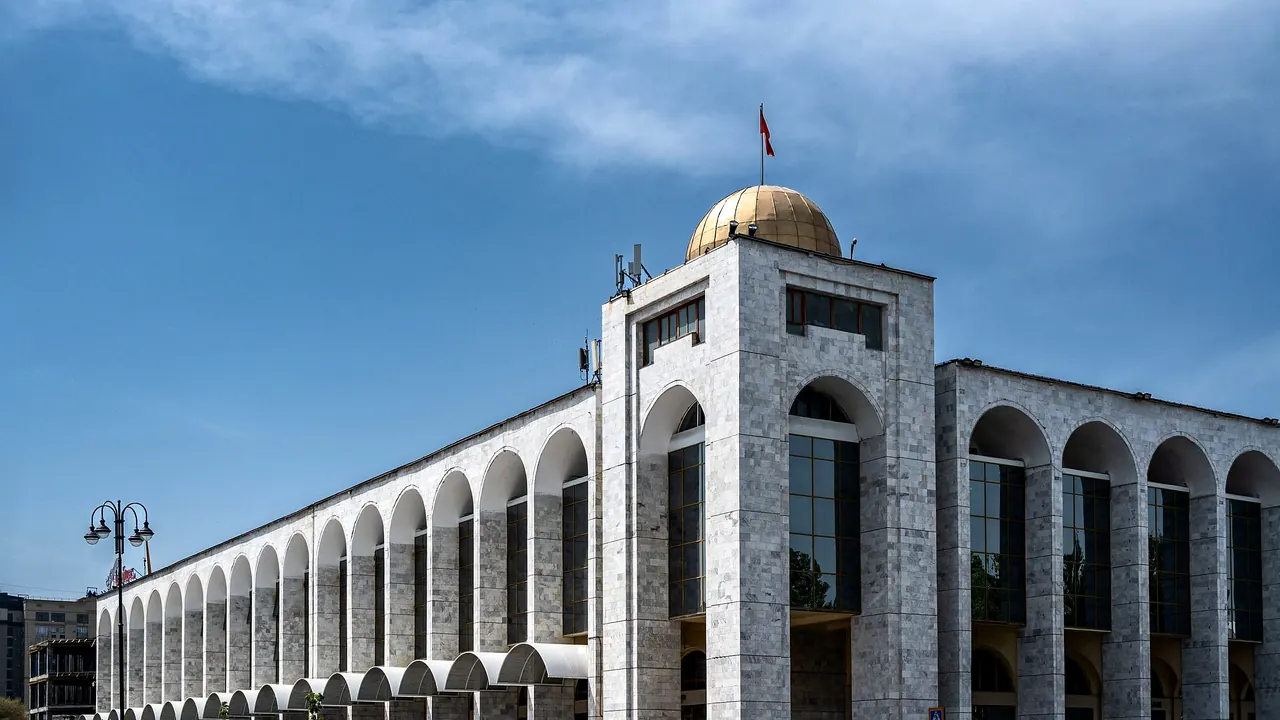
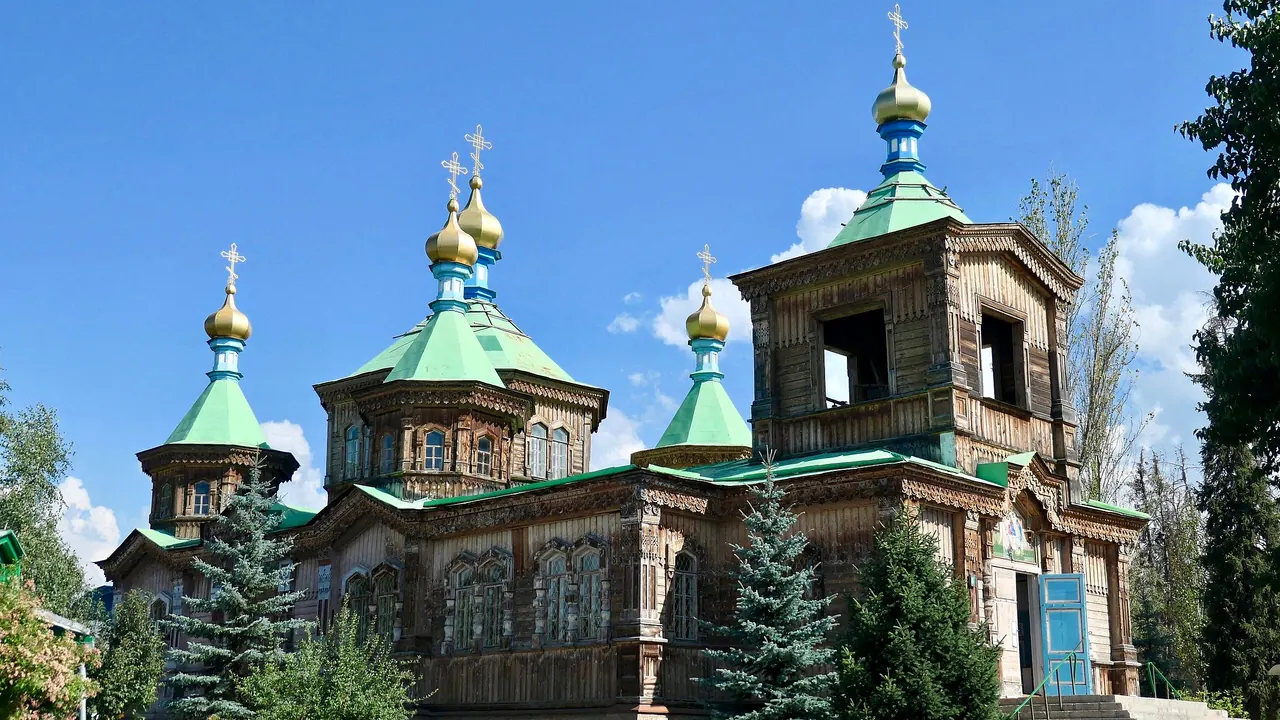
Photos: Bishkek by xiquinhosilva, CC BY 4.0, cropped; Karakol by Bruno Rijsman, CC BY 2.0, cropped.
Bishkek or Karakol?
Our verdict in twelve categories, each scored against the same fixed benchmark cities, and the climate month by month, so you can choose for your trip.
Choose Bishkek for
- live music and the arts
- nightlife
- shopping
Bishkek suits travellers who want a working capital around their mountain time. It has an opera and ballet season, a real if modest choice of bars and restaurants, bazaars and felt shops, and Ala-Archa close enough for a day hike. It is the better base if you want evenings out and a couple of days of Soviet avenues and museums between outings, and its long, dry, sunny summer is reliable, if hot.
Choose Karakol for
- beaches
- wellness
- prices
Karakol is for people who came to Kyrgyzstan for the Tian Shan itself. The Altyn-Arashan and Ala-Kul loop, horse treks to herders' yurts, hot springs after a long walk and empty ski runs in winter all start a short drive from town. It is quieter and slightly cheaper, with almost nothing going on after dark, and its summers are cooler, which makes it the place to spend most of a trekking trip rather than a stop on the way.
Scoreboard
Twelve categories on one fixed scale from 0 to 100. The shaded stretch is the gap between the two.
Your match
Pick a travel style or drag the sliders, and both match scores follow your weighting.
Wins on live music and the arts and nightlife with your weighting.
Wins on beaches and wellness with your weighting.
What matters to you?
Category by category
What the scores mean for a trip.
Beaches & swimming
Neither town is a swimming destination, but Karakol is closer to the water. Issyk-Kul lies just beyond the edge of town, though the reedy shore at Pristan is for walking. The sandy beaches at Tamga, Barskoon or the north shore are one and a half to three hours away, so a swim can fit around a trek in late summer.
From Bishkek the same lake is about four hours' drive, so in practice summer swimming there means a hotel pool or paddling in cold mountain rivers.
Food & drink
Bishkek has the broader table. Lagman, plov, manty and beshbarmak are served everywhere from teahouses to large family restaurants with private rooms, and Osh Bazaar is a feast to walk through. There are also some decent cafés and international kitchens for a change from mutton.
Karakol has a narrower menu, but it has one dish of its own: the cold, sour Dungan ashlan-fu, eaten in canteens by the bazaar. A home-cooked Dungan dinner is the best meal in town. Beyond that it is trekkers' cafés and guesthouse kitchens, with no coffee or wine to speak of.
Culture & sights
These two are about level, but they show different eras. Bishkek is all monumental Soviet space: Ala-Too Square with the Manas statue and the State Historical Museum, mosaic apartment blocks, the Victory Monument and Oak Park's sculptures. That is a day or two of walking.
Karakol is older and smaller, a nineteenth-century Russian garrison town of carved wooden houses. Its two set pieces are the green-domed Holy Trinity Cathedral and the pagoda-style Dungan Mosque, built without nails. Add the Przhevalsky memorial and the Sunday animal market, and that is a relaxed half-day.
Nightlife
Bishkek is the only one of the two where going out is a real option. Craft beer pubs, cocktail and hookah bars cluster around the central avenues and the university, and a few clubs stay open late at weekends.
In Karakol an evening means a beer at the guesthouse, perhaps karaoke or a winter drink at the ski area, and bed by mid-evening.
Nature & outdoors
Both are superb mountain bases, so the difference is in how you meet the peaks. From Bishkek, the Kyrgyz Ala-Too rises straight above the city, and Ala-Archa's juniper valleys and the Ak-Sai glacier trail are under an hour away. That makes serious day hikes possible while you sleep in a capital.
Karakol puts you deeper in the Tian Shan, at the mouths of several valleys at once. Multi-day routes such as the Altyn-Arashan to Ala-Kul loop, nights with herders, and longer ski runs through the spruce forest in winter are the reason to stay there.
Day trips
Bishkek has the edge on outings that are not simply another mountain valley. The Burana Tower, with its balbal stones on the site of Silk Road Balasagun, is a manageable trip east, and the gorges add easy half-days.
From Karakol almost everything leads into the hills or along the lake. The south shore villages and the eagle-hunting displays near Bokonbaevo make a long day, and Cholpon-Ata's petroglyphs are better done with an overnight stop.
Good for families
Neither is easy with small children, and both suit families with an outdoor plan more than a city plan. Bishkek has shady parks, the old rides in Panfilov Park and riverside picnics in Ala-Archa, which help on summer evenings.
Karakol has no attractions made for children and only basic medical care. With older, adventurous children, though, a horse ride to a yurt camp or a quiet day on the ski slopes can be the highlight of the trip.
Getting around
Both centres are flat grids that are easy to walk, so the difference is what happens beyond them. Bishkek has cheap, quick ride-hailing that solves most journeys, plus trolleybuses and marshrutkas, though rush-hour traffic is heavy.
In Karakol, leaving town means shared minibuses that go when full from the bazaar, signed in Cyrillic, or a taxi hired for the day after some haggling. The higher valleys need a four-wheel drive or your own legs.
Shopping & style
Bishkek offers more to browse. The vast Osh Bazaar, the container city at Dordoi, craft cooperatives selling shyrdak rugs and ak-kalpak hats, and malls for anything you forgot to pack are all within reach.
Karakol narrows this down to felt, bought from cooperatives and village workshops, often close to where it is made, with a bazaar that is better for wandering than buying.
Affordability
Both are very cheap, so money barely separates them. In Bishkek the savings are urban ones: ride-hailing, bazaar meals and inexpensive theatre seats, with international hotels as the main cost.
In Karakol, guesthouses and canteens cost very little, and the spending goes on guides, horses and four-wheel-drive transfers into the valleys.
Live music & performing arts
Bishkek is far ahead here. Its Soviet-built Opera and Ballet Theatre and Philharmonic hall stage ballet, opera, orchestral concerts and Kyrgyz folk programmes from autumn to spring, and tickets are easy to get. With some luck you can also hear a komuz performance or a Manas recital in a concert setting.
In Karakol the same traditions turn up informally, at a yurt camp or a guesthouse evening, and the small drama theatre offers little a visitor can plan around.
Wellness & relaxation
Karakol is slightly better for unwinding, because the hot springs are part of the outing. You can soak in the outdoor pools at Ak-Suu after skiing, or in the bathhouses of Altyn-Arashan at the end of a trek. The facilities are plain, but the settings are hard to beat.
Bishkek's version is the banya, with steam, birch whisks and a cold plunge, easily booked by the hour. The Issyk-Ata sanatorium is a couple of hours out if you want a longer soak.
When should you go?
Pick your month. The climate figures are measured averages, not a forecast.
Bishkek in July
Karakol in July
Daytime high, °C
Rainfall in the month, mm
Temperature and rainfall are climate normals, averaged over the years shown. Bishkek: 1991-2020 normals, Bishkek (3.3 km from centre). Karakol: 1991-2020 normals, Kyzyl-Suu / Chelpek (16 km from centre).
The two towns have quite different summers. Bishkek gets very hot, with July highs around 33°C, and from June to September it is dry and sunny almost every day. That is good weather for the mountains above town, but walking the city at midday is tiring, so May and September are the most comfortable months for the streets. Spring brings the most rain, peaking in April, and winters are cold, with highs near freezing from December to February.
Karakol sits higher and stays milder, peaking around 25°C in August, so June to September is pleasant for walking and is also the hiking season. Its rain comes in summer instead, steady at about 48mm a month in July and August, usually as showers in the mountains. Winters are colder than in Bishkek, which is what keeps the ski slopes above town in use.
Which traveller are you?
On an outdoors trip, Karakol is the stronger choice. It puts the Altyn-Arashan valley, the Ala-Kul lake loop, Jeti-Oguz and horse trekking a short drive away, while Bishkek mostly offers Ala-Archa and its gorges as day hikes from a city.
For a food and nightlife trip, Bishkek clearly wins. It has a much wider range of teahouses, family restaurants and international kitchens, along with craft beer pubs, cocktail bars and weekend clubs. Karakol's evenings end early, after a bowl of ashlan-fu.
On a culture and arts trip, Bishkek gives you more to do. You can see ballet and opera at the colonnaded theatre, folk concerts at the Philharmonic and felt collections at the Fine Arts Museum. Karakol's wooden cathedral and Dungan Mosque fill a pleasant half-day, but it has no stage worth planning around.
Before you go
| Measure | Bishkek | Karakol |
|---|---|---|
| Official language | Kyrgyz | Kyrgyz |
| Currency | Som (KGS) | Som (KGS) |
| Sockets | CF220 V, 50 Hz | CF220 V, 50 Hz |
| Driving side | Right | Right |
| Time zone | UTC+6 | UTC+6 |
| Emergency number | 161 | 161 |
| Elevation | 750 m | 1,690 m |
| Main airport | Manas International Airport (BSZ)23 km from centre42 non-stop destinations | Manas International Airport (BSZ)326 km from centre42 non-stop destinations |
By the numbers
| Measure | Bishkek | Karakol |
|---|---|---|
| Population | 1,191,000 | 85,588 |
| People per km² | 9,378 | 1,779 |
| Museums within 10 km | 6 | 1 |
| UNESCO World Heritage sites within 50 km | 2 | 0 |
Where else could you go?
Every comparison below shares a destination with this one, so you can follow Bishkek or Karakol somewhere new.
- Almatyvs Karakol
- Almatyvs Bishkek
- Tashkentvs Bishkek
- Dushanbevs Bishkek
- Samarkandvs Bishkek
- Lehvs Karakol