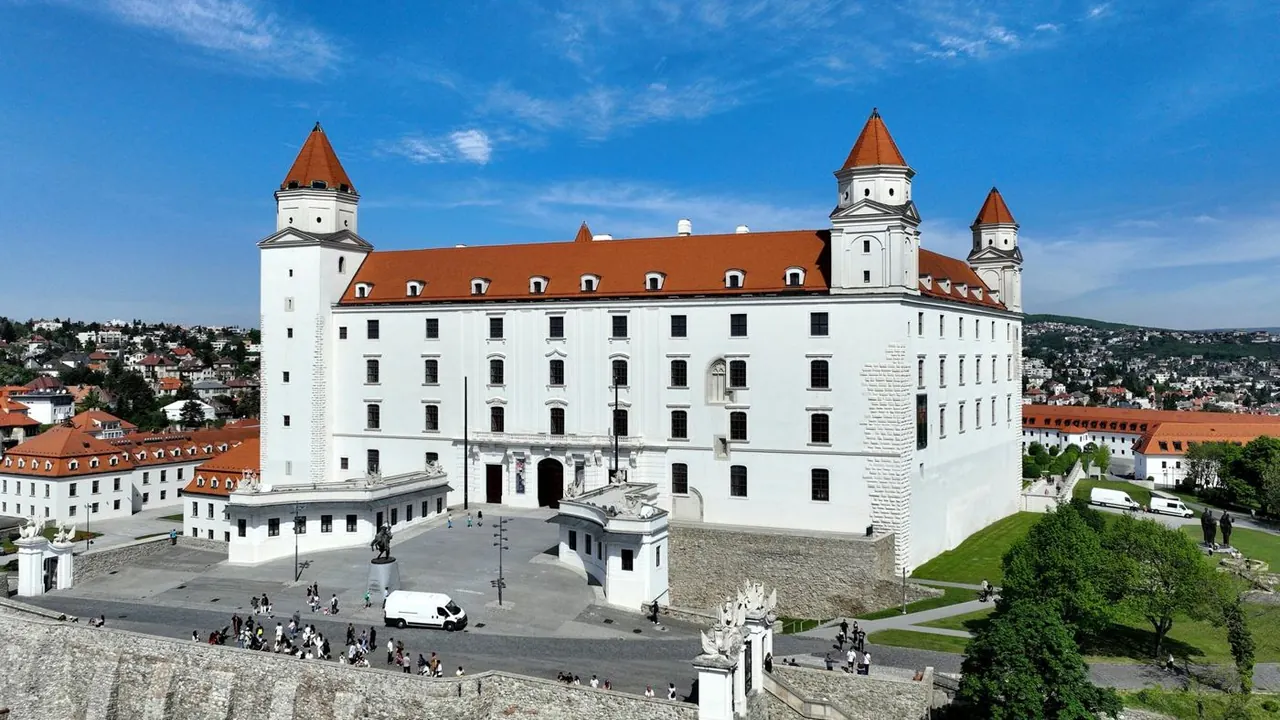
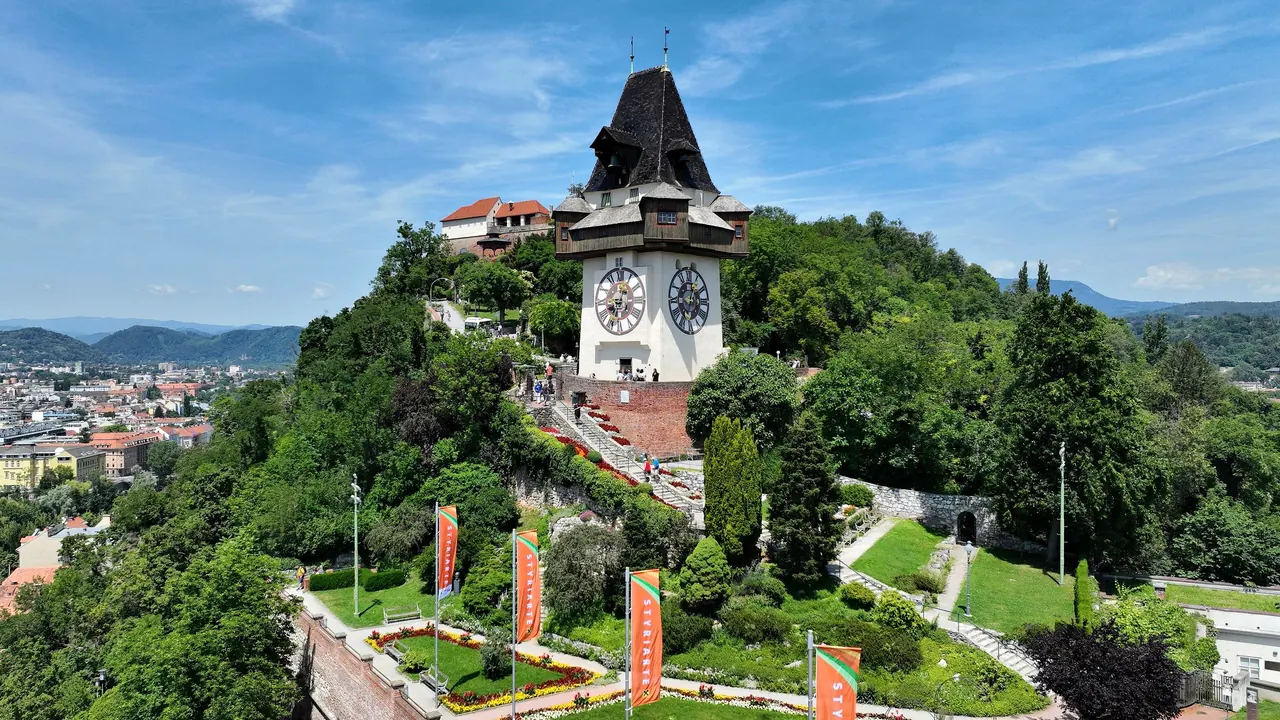
Photos: Bratislava by C.Stadler/Bwag, CC BY-SA 4.0, cropped; Graz by C.Stadler/Bwag, CC BY-SA 4.0, cropped.
Bratislava or Graz?
Our verdict in twelve categories, each scored against the same fixed benchmark cities, and the climate month by month, so you can choose for your trip.
Choose Bratislava for
- prices
- day trips
- beaches
Bratislava suits travellers who want a cheap, easy base with a lot within reach. Its small Old Town, coronation cathedral and castle take a day or two. After that the real draw is what lies around it: Vienna by train or boat, the Small Carpathian wine villages, and castles and chateaux across three borders. For a budget-minded trip that mixes one city with several day trips, it gives more for the money.
Choose Graz for
- families
- culture and sights
- food and drink
Graz is the better choice if you want the city itself to fill the stay. The old town is finer and has more in it, from the armoury to Schloss Eggenberg. Styrian food and wine are a real reason to come, the opera house runs a full season, and children have the Schlossberg to explore. The Alps and the spa villages are close for outdoor days and rest days, so families, culture lovers and anyone after a slower, fuller few days will get more from it.
Scoreboard
Twelve categories on one fixed scale from 0 to 100. The shaded stretch is the gap between the two.
Your match
Pick a travel style or drag the sliders, and both match scores follow your weighting.
Wins on prices and day trips with your weighting.
Wins on families and culture and sights with your weighting.
What matters to you?
Category by category
What the scores mean for a trip.
Beaches & swimming
Neither city is a place for a swim, and both send you to lakes on hot July and August afternoons. The difference is the kind of lake and how you get there. In Bratislava, Zlate piesky is a sandy shore inside the city that you can reach by tram, and the Senec lakes are half an hour out.
Graz swims in old gravel pits on the plain to the south, led by the Schwarzlsee, with grassy banks and jetties rather than sand. Stubenbergsee in the eastern hills makes a half-day out.
Food & drink
Graz eats better. Styrian cooking has a clear identity: pumpkin seed oil on almost everything, cold fried chicken salad and boiled pork with horseradish. Farmers' markets at Kaiser-Josef-Platz and Lendplatz run every morning except Sunday, and the Buschenschank taverns in the southern vineyards are under an hour away.
Bratislava offers hearty dumplings with sheep's cheese, roast duck with lokse and poppy-seed rolls, with brewpubs pouring lager alongside. Its strength is the Small Carpathian wine served in city wine bars. The most central streets lean towards tourist menus, though, so good meals take more looking for than in Graz.
Culture & sights
Graz has the richer sightseeing. Its red-roofed old town of arcaded courtyards climbs to the Schlossberg and the Uhrturm. The Landeszeughaus armoury, still packed with its seventeenth-century weapons, has no match in Bratislava. Schloss Eggenberg and the bulbous Kunsthaus add a palace and a modern landmark, and together they easily fill two or three days.
Bratislava's appeal is more about history than collections. St Martin's Cathedral crowned Hungarian kings and queens for nearly three centuries, and brass crowns mark the route through the lanes. The castle, the Blue Church, the saucer tower on Most SNP and the ruins of Devin round it out in a day or two.
Nightlife
Both are student cities that go out on a small scale, so neither is a clubbing destination. The difference is the crowd. Bratislava's Old Town gets loud on Friday and Saturday nights, with cheap drinks drawing weekend groups and stag parties from abroad, and it goes quiet in the week.
Graz is more local and more varied. There are bars in the lanes of the Bermuda Triangle, artier places across the river in Lend and a university quarter that fills during term. The whole city goes noticeably quieter in the long summer break.
Nature & outdoors
Graz has the bigger outdoors. The Schöckl rises to 1,445m on the city's edge, with a cable car, trails and paragliders launching from the top. The gorge ladders of the Bärenschützklamm are close by, and the alpine walls of the Gesäuse and Hochschwab are about two hours away.
Bratislava's countryside is gentler and flatter. Beech-wood trails climb from Koliba to Kamzik, and the steppe meadows of Devinska Kobyla look over two rivers. The Danube adds floodplain forests, a flat cycle route into Austria and rafting at Cunovo, but real mountains are a full day away.
Day trips
Bratislava wins clearly, because Vienna is about an hour away by train, or a little longer by boat up the Danube. Add the wine towns of Svaty Jur, Pezinok and Modra, Roman Carnuntum, the chateaux of Lednice-Valtice and Pannonhalma Abbey, and three countries are within easy reach, many of them by rail.
From Graz the outings are rural Styria: the South Styrian Wine Road, Riegersburg on its volcanic crag, the Lipizzaners at Piber and Admont's great monastic library. Maribor across the Slovenian border is an hour by train, but most of the rest is much easier by car.
Good for families
Graz is better set up for children. The Schlossberg alone makes a day out: a glass lift or funicular up, a long underground slide down and a little train through fairytale scenes in the rock. Add a children's museum in the Augarten, toboggan runs on the Schöckl and the Herberstein wildlife park.
Bratislava is just as safe and calm, but less is built for children. Spotting its bronze statues, the chairlift at Kamzik, the hillside zoo and the water park at Senec make a pleasant short stay. Beyond two or three days, you will run out of ideas sooner than in Graz.
Getting around
The real difference is the ground underfoot. Bratislava's main sights are within a twenty-minute walk, but the castle climb is steep and the main station sits on a rise above the Old Town. Trams, trolleybuses and buses reach Kamzik, the zoo and Devin. There is no metro, though, so trips across the river or out to the suburbs take longer than the map suggests.
In Graz the centre is flat and mostly pedestrianised, so the sights are only a few minutes apart. Trams run along the Herrengasse to the station and Eggenberg, and a lift and a funicular do the climbing up the Schlossberg. Cycling along the Mur is easy, too. In both cities a car only matters once you head for the countryside.
Shopping & style
Bratislava offers folk craft and malls, while Graz has historic shopping streets and good things to eat and drink. Bratislava's Old Town has souvenir shops and a few small design stores. The state folk-craft centre sells genuine Modra majolica, lace and blue-print cloth, and Small Carpathian wine makes the best gift. Otherwise locals shop in riverside malls full of chains, and they take the train to Vienna for serious boutiques.
Graz is more pleasant to browse. The Herrengasse and the sloping Sporgasse have shops in old buildings, and the grand nineteenth-century department store has a rooftop terrace over the red roofs. Across the river, Lend adds design and vintage shops. The best things to take home are pumpkin seed oil, Schilcher rosé and regional chocolate from the markets and delicatessens.
Affordability
Bratislava is the cheaper stay. Local beer and wine, trams and museum tickets cost little, and ordinary pubs serve filling lunch menus. Prices only reach Western levels on the main squares and in the glassy riverside complexes.
Graz has Austrian prices. Student bakeries and lunch spots keep daytime eating reasonable, and combined tickets help with the Joanneum museums. A sit-down dinner with wine will cost noticeably more than the same evening in Bratislava.
Live music & performing arts
Graz gives a fuller evening programme. Its opera house, the second largest in Austria, runs opera, operetta, ballet and musicals. Styriarte brings early music in early summer and steirischer herbst brings avant-garde work in autumn, and the music university feeds a strong jazz scene.
Bratislava's Slovak National Theatre and the Philharmonic in the Reduta offer solid opera and concerts, and tickets are easy to get. For bigger international names, though, people take the train to Vienna.
Wellness & relaxation
Neither city has baths of its own, but Graz is closer to a proper spa culture. A string of thermal villages lies about an hour east, from Hundertwasser's grass-roofed resort at Bad Blumau to the large warm pools of Loipersdorf and Bad Radkersburg.
From Bratislava, the options are the water park at Senec or a train of about an hour to the historic mud and sulphur cures of Piestany. In town, both offer the same calm cafés and quiet forest or castle-hill paths.
When should you go?
Pick your month. The climate figures are measured averages, not a forecast.
Bratislava in July
Graz in July
Daytime high, °C
Rainfall in the month, mm
Where the figures come from
Bratislava has no rain gauge within 25 km of the centre, so its rainfall comes from a gridded climate dataset read at the city rather than from a gauge further away.
Bratislava's sunshine is measured 56 km from the centre, at Wien / Hohe Warte.
Temperature and rainfall are climate normals, averaged over the years shown. Bratislava: 1991-2020 normals, Bratislava Ivanka (8.6 km from centre). Graz: 1991-2020 normals, Graz Airport (7.9 km from centre).
Both cities follow the same pattern of temperature: cold winters with highs around 3°C in January, mild springs, and summers that peak at about 27°C in July and August. Late spring and early autumn are the most comfortable months for walking either city. July and August are the only months warm enough for the lakes. Rain is where they differ. Bratislava stays fairly dry all year and peaks at about 82mm in July. Graz takes far more rain in summer, up to about 127mm a month from June to August, often as heavy showers, so a summer trip there needs a flexible plan.
Bratislava gets slightly more sunshine from spring to late summer. Graz is clearly brighter from November to February, so a winter city break there feels less grey. September suits both: it is still warm, and the summer storms in Graz begin to ease.
Which traveller are you?
On a trip on a tight budget, Bratislava goes further. Beer, wine, transport and museum entry are cheap, and pub lunch menus are hearty. Graz charges ordinary Austrian prices for dinners and wine, though student lunch spots help.
For a culture and arts trip, Graz has more to offer. Its old town is finer and fuller, with the Landeszeughaus armoury, Schloss Eggenberg and the Kunsthaus. It also has the second-largest opera house in Austria and two festivals that bring serious music and avant-garde theatre.
On a family trip with children, Graz keeps young ones busy for longer. They can slide down through the inside of the Schlossberg, ride a fairytale train in the rock and visit a hands-on children's museum. In Bratislava the options thin out after two or three days.
Before you go
| Measure | Bratislava | Graz |
|---|---|---|
| Official language | Slovak | German, Austrian Sign Language |
| Currency | Euro (EUR) | Euro (EUR) |
| Sockets | CE230 V, 50 Hz | CF230 V, 50 Hz |
| Driving side | Right | Right |
| Time zone | UTC+1, UTC+2 in summer | UTC+1, UTC+2 in summer |
| Emergency number | 112 | 112 |
| Elevation | 152 m | 353 m |
| Main airport | M. R. Štefánik Airport (BTS)8 km from centre68 non-stop destinations | Graz Airport (GRZ)9 km from centre26 non-stop destinations |
| Public holidays this year | 15 days | 16 days |
By the numbers
| Measure | Bratislava | Graz |
|---|---|---|
| City population | 480,902 | 306,971 |
| People per km² | 1,308 | 2,406 |
| Museums within 10 km | 22 | 29 |
| UNESCO World Heritage sites within 50 km | 2 | 1 |
Where else could you go?
Every comparison below shares a destination with this one, so you can follow Bratislava or Graz somewhere new.