Brazil
Recife
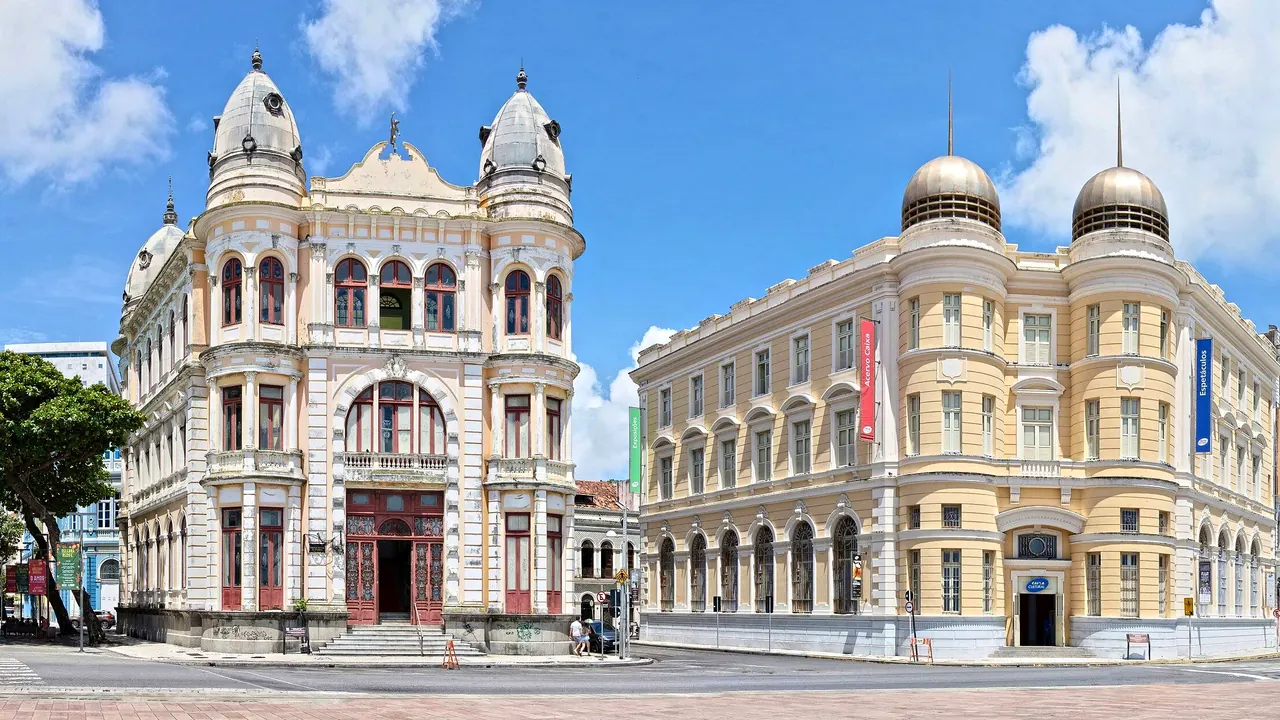
Historic buildings on the Praça do Marco Zero
- Affordable cities74
- Beaches64
- Food & drink64
Match
54
Every category weighted equally
- Beach & sun54
- Culture & arts55
- Food & nightlife57
- Family trip53
- Outdoors53
- Relax & unwind51
- Shopping & style53
- On a budget56
Recife in twelve categories
Our verdict on each, scored 0 to 100 against the same fixed benchmark cities, so a score means the same thing on every page.
Beaches & swimming. Scores 64 out of 100.
Food & drink. Scores 64 out of 100.
Culture & sights. Scores 63 out of 100.
Nightlife. Scores 64 out of 100.
Nature & outdoors. Scores 42 out of 100.
Day trips. Scores 57 out of 100.
Good for families. Scores 43 out of 100.
Getting around. Scores 36 out of 100.
Shopping & style. Scores 46 out of 100.
Affordability. Scores 74 out of 100.
Live music & performing arts. Scores 62 out of 100.
Wellness & relaxation. Scores 27 out of 100.
Recife category by category
Beaches & swimming
64Beach life is central to Recife, and Boa Viagem is where it happens: a long urban strand backed by apartment towers, with coconut sellers, beach kiosks and football on the sand from early morning. The sea is warm all year, around 27°C, and at low tide the offshore reef leaves calm, shallow pools that are pleasant for wading. The catch is that sharks are a lasting hazard off the city shore, and warning signs ask bathers to stay inside the reef and out of deeper water. In practice the city beach is for sun, sea air and a dip, not for real swimming.
For proper swimming, visitors head south, about an hour or more by road. Porto de Galinhas has clear natural pools reached by raft and full of small fish, Muro Alto has a sheltered lagoon behind its reef, and further down Carneiros has a small chapel on the sand and calm water where a river meets the sea. North of the city, Itamaracá has quieter beaches with a local feel. Many beach-focused visitors stay down the coast rather than in the city.
Food & drink
64Pernambuco has a cooking of its own, and Recife is where to eat it. Carne de sol with macaxeira and melted cheese, sururu shellfish broths, caldinhos sipped at the bar, crab cracked with a wooden mallet at beach kiosks and moquecas of local fish carry the meal. Sweets matter too: bolo de rolo, a cake rolled thin around guava paste, and cartola, banana with cheese and cinnamon sugar, are both regional emblems. Tapioca pancakes are made to order on street corners, especially in Olinda next door.
The best eating is casual: beachfront barracas in Boa Viagem, bars in the old centre serving petiscos with very cold beer, and the Mercado da Boa Vista and São José markets for a more local scene. There is a respectable tier of regional fine dining, but international range is limited and the city is not a coffee or wine destination.
Culture & sights
63Recife's history runs deep: a sugar port fought over by the Portuguese and the Dutch, and the site of the first synagogue in the Americas, whose rebuilt Kahal Zur Israel stands on Rua do Bom Jesus in Recife Antigo. That island quarter, with the Marco Zero square and pastel facades, is the obvious starting point. Across the bridges, Santo Antônio and São José hold baroque churches, above all the gilded Capela Dourada, and the Casa da Cultura, a former prison turned into a crafts centre.
The two Brennand institutions are the standouts: the Instituto Ricardo Brennand, a mock castle with a large collection of arms, Dutch-period paintings and tapestries, and the Oficina Brennand, a ceramic workshop with a strange, monumental sculpture garden. The Paço do Frevo explains the city's music. Much of the historic centre is faded and patchy between the highlights, and the colonial hill town of Olinda lies just beyond the city line.
Nightlife
64Going out in Recife is informal and outdoorsy: plastic tables on the pavement, cold beer, live forró or brega from a neighbouring bar and conversations that run until late. The main clusters are Recife Antigo, around Rua da Moeda, which fills on weekend nights, the bars of Boa Viagem and the more polished bar strips of Casa Forte and Graças. Clubs play brega funk, axé and electronic music, and the crowd is local rather than international.
Carnival transforms everything. The Galo da Madrugada parade on Carnival Saturday draws an enormous crowd, and for days the streets of Recife and Olinda are one continuous party. Outside that season the scene is lively but not famous, and the distances between districts mean taxis at night.
Nature & outdoors
42Recife is a flat delta city of rivers, bridges and mangroves, and its natural side is mostly water. Boat trips along the Capibaribe show the city from its rivers, and the Dois Irmãos park keeps a patch of Atlantic forest within the urban edge. The coast south of the city is the main outdoor draw: reefs for snorkelling at Porto de Galinhas, rafting out to natural pools, kitesurfing and stand-up paddle, and mangrove kayaking near Carneiros.
There are no mountains or long hiking trails within easy reach, and the heat and humidity make midday activity heavy going. The archipelago of Fernando de Noronha, one of Brazil's great natural sites, is a flight away rather than an outing from the city.
Day trips
57Olinda is the outing that matters: a colonial hill town of whitewashed churches, convents and painted houses looking down on the sea, a short taxi ride north and easily combined with an evening there. Beyond it the list gets shorter and quieter. Igarassu, further north, has one of the oldest churches in Brazil and a small colonial centre, and the island of Itamaracá pairs a Dutch-built fort with an unhurried local feel.
South, Porto de Galinhas is a resort village of craft shops and restaurants about an hour away, pleasant but more a beach stop than a place to explore. Inland, Caruaru is about two hours by road for its huge open-air market and the Alto do Moura potters' district, and João Pessoa, the Paraíba capital with a fine baroque convent, is a similar distance up the coast. Both are long days for what they offer.
Good for families
43Brazilian culture is warm towards children, and families are welcome in restaurants late into the evening. The most rewarding thing for children is the calm, warm water inside the reefs, at low tide in Boa Viagem or more reliably in the natural pools of Porto de Galinhas, where they can see fish while standing up. The Dois Irmãos park has a zoo in the forest, and the Brennand sculpture garden and castle appeal to older children.
Beyond that there is little built for children, and the city itself is hard work: heat, heavy traffic, broken pavements and the need to keep watch on bags. Many families base themselves in a resort hotel down the coast and visit the city on day outings.
Getting around
36Most visitors stay in Boa Viagem, a long seafront strip that is easy to walk along the beach promenade, and travel to the old centre and Olinda by taxi or ride-hailing app, which is cheap and the usual choice. The metro exists but runs mainly to residential suburbs and the airport and is of limited use for sightseeing, and the bus network is large but hard for a newcomer to read.
Recife Antigo and Santo Antônio are walkable once you are there, though pavements are uneven and some streets empty out after dark, when a car is the sensible option. Traffic is heavy at rush hour, and trips down the coast are by tour, transfer or hire car.
Shopping & style
46Shopping in Recife splits between big air-conditioned malls, where locals shop for Brazilian fashion and beachwear, and the regional crafts that are worth carrying home. The Casa da Cultura, with former prison cells turned into small stalls, sells clay figurines, lace, leatherwork, hammocks and woodcut prints of cordel folk literature. The markets of São José and Boa Vista are more for atmosphere and food than buying.
Olinda has artists' studios and Carnival puppet makers, and the potters of Alto do Moura in Caruaru are the source of the best ceramics. There is no luxury street or design district of note.
Affordability
74Recife is an inexpensive city for most visitors. Everyday eating at beach kiosks, per-kilo lunch restaurants and neighbourhood bars costs little, beer and coconuts are cheap, and ride-hailing trips across the city are modest. Seafront hotels in Boa Viagem are reasonably priced for what they offer, and most museums charge little or nothing.
The exceptions are predictable: rooms during Carnival are steeply priced and sell out early, the resort hotels at Porto de Galinhas are pitched at well-off Brazilian families on vacation from the big southern cities, and imported wine and international dining cost more.
Live music & performing arts
62Recife has one of Brazil's richest musical traditions, and visitors can hear it rather than just read about it. Frevo, the fast brass music of Carnival with its acrobatic umbrella dance, and maracatu, with its heavy drums and processions of kings and queens, are rehearsed and performed through the year and explode in the weeks before Carnival. The city also gave rise to manguebeat, which fused these rhythms with rock and hip hop, and live bands play coco, forró and ciranda in bars and on the streets of Recife Antigo and Olinda.
The June festivals bring forró to the whole region. The neoclassical Teatro Santa Isabel hosts concerts and plays, but formal classical music, opera and theatre are limited.
Wellness & relaxation
27Recife has no bathing or spa tradition of its own, and the city itself is hot, loud and traffic-heavy rather than restful. Relaxation here means hotel spas and massages, a long afternoon at a beach kiosk or, more convincingly, a few days at one of the resort hotels around Porto de Galinhas and Muro Alto, which offer spa treatments and a slow pace beside calm water.
When should you go?
Pick a month to see what it is like. The climate figures are measured averages, not a forecast.
Recife in July
Daytime high, °C
Rainfall in the month, mm
The whole year
Shaded against this city’s own year: the deepest cell is its best month for that figure and the palest its weakest.
Temperature and rainfall are climate normals, averaged over the years shown. Recife: 1991-2020 normals, Recife (4 km from centre).
Before you go
| Measure | Recife |
|---|---|
| Official language | Portuguese |
| Currency | Brazilian Real (BRL) |
| Sockets | CN60 Hz |
| Driving side | Right |
| Time zone | UTC-3 |
| Emergency number | Police 190, ambulance 192, fire 193 |
| Elevation | 6 m |
| Main airport | Recife/Guararapes - Gilberto Freyre International Airport (REC)9 km from centre39 non-stop destinations |
| Public holidays this year | 14 days |
By the numbers
| Measure | Recife |
|---|---|
| City population | 1,488,920 |
| People per km² | 6,805 |
| Museums within 10 km | 21 |
| UNESCO World Heritage sites within 50 km | 1 |
| Swim season, months above 21 °C | 12 months |
Compare Recife with
Every comparison with a written verdict behind it.