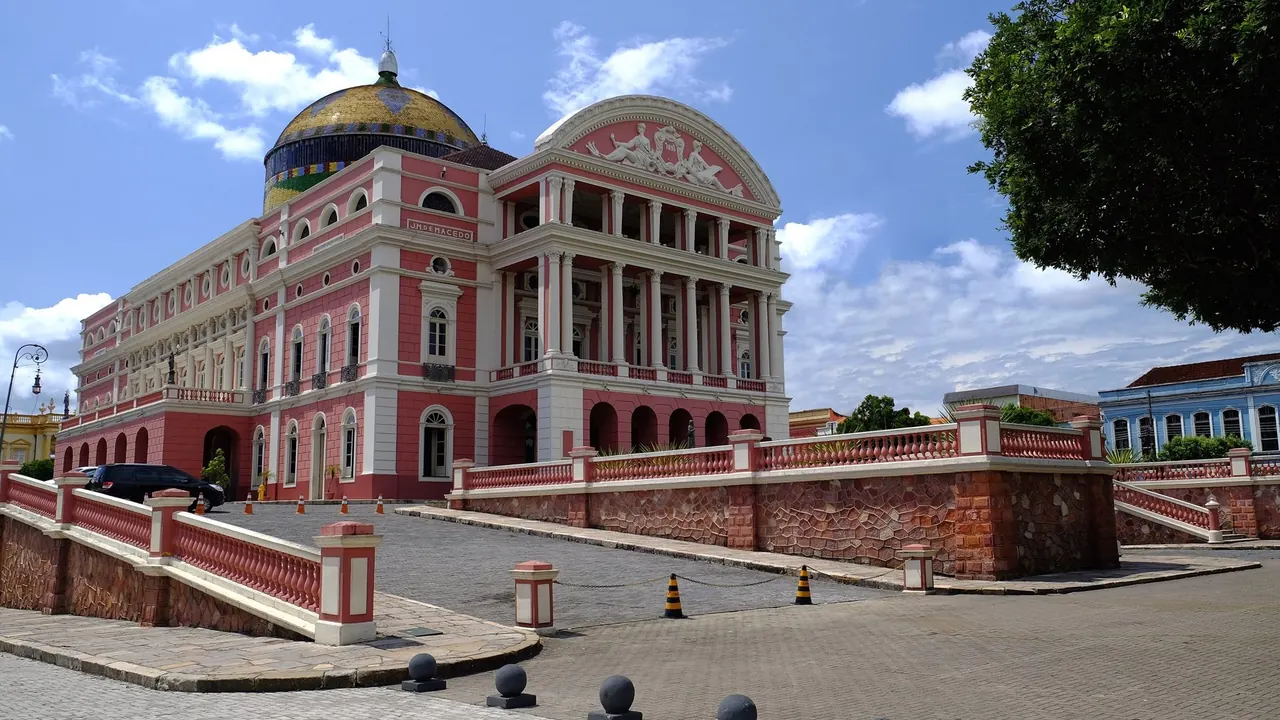
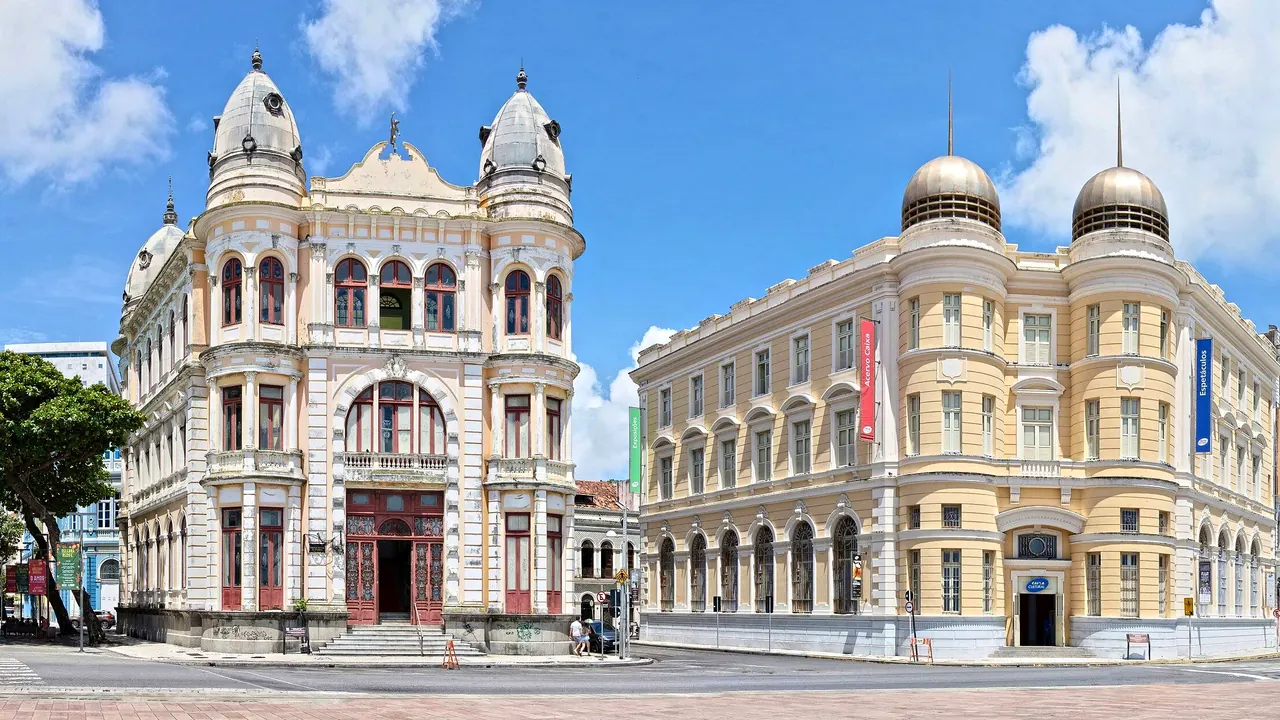
Photos: Manaus by Jardelsliumba, CC BY-SA 4.0, cropped; Recife by Wilfredor, CC0.
Manaus or Recife?
Our verdict in twelve categories, each scored against the same fixed benchmark cities, and the climate month by month, so you can choose for your trip.
Choose Manaus for
- nature and the outdoors
Manaus is for travellers whose real destination is the rainforest. The city itself is a hot, sprawling base with one great opera house and a rubber-boom centre you can see in two days. From its port, though, boats reach the Meeting of the Waters, flooded forest and pink river dolphins, and a few nights at a river lodge become the heart of the trip.
Choose Recife for
- day trips
- beaches
- nightlife
Recife suits a coastal Brazilian trip with more to do in town: a warm sea with reef pools, Pernambuco cooking, frevo and maracatu, the Brennand collections and an evening in colonial Olinda. It is cheaper from day to day, and the resort beaches down the coast give it a slower side that Manaus cannot offer.
Scoreboard
Twelve categories on one fixed scale from 0 to 100. The shaded stretch is the gap between the two.
Your match
Pick a travel style or drag the sliders, and both match scores follow your weighting.
Wins on nature and the outdoors with your weighting.
Wins on day trips and beaches with your weighting.
What matters to you?
Category by category
What the scores mean for a trip.
Beaches & swimming
Neither city is a simple swimming destination. Manaus has river beaches on the Rio Negro: Ponta Negra is the main one, and the white sandbanks around Tupé appear only in the low-water months. The water there is warm and dark, and its quality varies.
Recife has the sea, and that puts it ahead. Boa Viagem is a real city beach with kiosks and shallow reef pools at low tide, although sharks keep bathers inside the reef. For proper swimming, Porto de Galinhas, Muro Alto and Carneiros, an hour or more south, have clear, calm water.
Food & drink
Manaus eats from the river and the forest, and almost nothing on its menus turns up on the coast. You get grilled tambaqui ribs, pirarucu cooked like salt cod, tacacá with lip-tingling jambu leaves from late-afternoon stalls, and fruits such as cupuaçu, buriti and camu-camu. Once you have tried those, the choice thins out quickly.
Recife gives a food trip more depth. Pernambuco cooking runs from carne de sol with macaxeira and sururu broth to crab cracked with a mallet at Boa Viagem kiosks, with bolo de rolo afterwards and tapioca made to order in Olinda. It also has a respectable tier of regional fine dining, which Manaus largely lacks, though neither city is the place for international cooking.
Culture & sights
Manaus shows one period, the rubber boom. The Teatro Amazonas is the highlight, with the palaces and the iron market hall close by, and its museums are small.
Recife's history goes back much further. It covers the struggle between the Portuguese and the Dutch, the Kahal Zur Israel synagogue in Recife Antigo, the gilded Capela Dourada and the two Brennand institutions, which have more to see than any museum in Manaus. With Olinda next door, Recife can fill a longer stay.
Nightlife
Manaus has no club culture to speak of, and that is the clearest difference. Nights there mean the Ponta Negra waterfront, the bars of Adrianópolis and Vieiralves, and dance halls playing forró, sertanejo and boi-bumbá. Most visitors are resting before or after the jungle, so evenings tend to end early.
Recife goes further. Rua da Moeda in Recife Antigo fills on weekend nights, Casa Forte and Graças have more polished bar strips, and clubs play brega funk, axé and electronic music. At Carnival the Galo da Madrugada parade turns Recife and Olinda into one continuous street party. The pavement tables, cold beer and taxis between districts are much the same in both.
Nature & outdoors
This is why most people go to Manaus. Boats from the port reach the Meeting of the Waters, side channels with giant water lilies, the pink river dolphins and the island maze of the Anavilhanas. A few nights at a lodge take you properly into the forest.
Recife's outdoors is coastal and smaller in scale. There are boat trips on the Capibaribe, the forest at Dois Irmãos, and snorkelling, kitesurfing and mangrove kayaking down the coast. Fernando de Noronha is a flight away rather than an outing.
Day trips
From Manaus there is very little to reach on a day out. Presidente Figueiredo, up the road north, has waterfalls and caves, everything else is forest and river, and Parintins is many hours away by boat.
Recife has Olinda a short taxi ride away, good for an afternoon and an evening. Beyond it are Igarassu, the Dutch-built fort on Itamaracá and the beach at Porto de Galinhas, plus longer days out to the market and potters at Caruaru or to João Pessoa.
Good for families
Children who love animals get the most out of Manaus. There are boat trips to see river dolphins, and manatees, otters and squirrel monkeys at the Bosque da Ciência. Constant heat, mosquitoes and long jungle excursions make it a better fit for older children than for toddlers.
Recife is a little easier, mainly because of the sea. In the natural pools at Porto de Galinhas, or at low tide in Boa Viagem, children can stand in calm, warm water and watch fish, and the forest zoo at Dois Irmãos makes another outing. Many families stay at a resort down the coast and visit the city on day trips. Expect heat, traffic and broken pavements in either city, though children are warmly welcomed everywhere.
Getting around
In Manaus you can walk only the few blocks around the Teatro Amazonas and the market, and even there the heat and traffic wear you down. Everything else, including Ponta Negra and the restaurant districts, means a taxi or ride-hailing car, and anything on the river means an organised boat or a ferry from the port.
Recife is somewhat easier. Most visitors stay in Boa Viagem, where the beach promenade makes a pleasant walk, and once a taxi has dropped you in Recife Antigo or Santo Antônio you can explore both on foot. The metro is of little use except for the airport, and trips down the coast need a tour, a transfer or a hire car.
Shopping & style
Manaus is a free-trade zone, so the streets of its old centre are lined with electronics and imported goods, which are rarely what visitors are after. The better buys are Indigenous basketry, seed jewellery, feather work and guaraná powder from around the Adolpho Lisboa market.
Recife has more crafts and more places to find them. At the Casa da Cultura, the former prison cells are now stalls selling clay figurines, lace and cordel woodcuts. Olinda has artists' studios and Carnival puppet makers, and the best ceramics come from the potters of Alto do Moura in Caruaru. Its malls are also good for Brazilian beachwear, though neither city has a fashion or design street.
Affordability
Recife works out cheaper over a whole trip, and the reason is what people go to Manaus for. From day to day Manaus is inexpensive too, with street tacacá, market meals, cheap taxis and fairly priced business hotels. River excursions and jungle lodges soon outweigh all of that, though, especially private boats and the more remote lodges.
In Recife most spending stays small: kiosk meals, neighbourhood bars, ride-hailing across town, seafront hotels in Boa Viagem and museums that charge little or nothing. The costly exceptions are rooms at Carnival and the resort hotels at Porto de Galinhas.
Live music & performing arts
Manaus is the place for a formal evening. Opera, ballet and the Amazonas Philharmonic play inside the Teatro Amazonas, and the Amazonas Opera Festival is the high point of the year. Boi-bumbá drumming fills the dance halls.
Recife has the richer musical life overall, and most of it happens in the street. Frevo and maracatu rehearse all year, coco and ciranda bands play in Recife Antigo and Olinda, and forró takes over in June, though formal opera and theatre are limited.
Wellness & relaxation
Neither city is restful in itself, and neither has a spa tradition. In Manaus, calm means leaving town for a river lodge with hammocks and forest sounds. Recife has resort spas around Porto de Galinhas and Muro Alto beside calm water, which is the easier choice for a few slow days.
When should you go?
Pick your month. The climate figures are measured averages, not a forecast.
Manaus in July
Recife in July
Daytime high, °C
Rainfall in the month, mm
Temperature and rainfall are climate normals, averaged over the years shown. Manaus: 1991-2020 normals, Manaus (1.7 km from centre). Recife: 1991-2020 normals, Recife (4 km from centre).
Manaus is hot all year, and the rain is what changes. January to May is the wet season, with heavy rain most days. June to October is drier and much sunnier, and August is the driest month at 58mm. September is the hottest at 35°C, which makes walking the centre hard going. The river follows the rain a little later. High water comes around May to July, when boats glide through flooded forest, and low water arrives from about September, when sandbanks and forest trails appear.
Recife has its rainy season at a different time. The rain peaks from April to July, with 388mm in June. September to January is dry and sunny, with only 43mm in November. The sea never drops below 26°C, so the beach works all year, but it is best in the dry months. If you want to visit both cities, September and October suit both, because each is in its drier spell then.
Which traveller are you?
On an outdoors trip, Manaus is the clear choice. It is the gateway to the Amazon, with boat trips into flooded forest, river dolphins, caimans and the Anavilhanas islands, and lodge stays for serious wildlife watching. Recife's nature is mostly reefs and mangroves along the coast.
For a beach and sun trip, choose Recife. Boa Viagem has a warm sea and reef pools at low tide, and the clear natural pools at Porto de Galinhas are an hour or so south. Manaus only has river beaches, and many of them disappear when the water is high.
On a food and nightlife trip, Recife gives you more. You get Pernambuco cooking at beach kiosks and old-centre bars, weekend crowds on Rua da Moeda, and clubs playing brega funk. Nights in Manaus are short and spread out, and there are no real clubs.
Before you go
| Measure | Manaus | Recife |
|---|---|---|
| Official language | Portuguese | Portuguese |
| Currency | Brazilian Real (BRL) | Brazilian Real (BRL) |
| Sockets | CN60 Hz | CN60 Hz |
| Driving side | Right | Right |
| Time zone | UTC-4 | UTC-3 |
| Emergency number | Police 190, ambulance 192, fire 193 | Police 190, ambulance 192, fire 193 |
| Elevation | 92 m | 6 m |
| Main airport | Eduardo Gomes International Airport (MAO)9 km from centre21 non-stop destinations | Recife/Guararapes - Gilberto Freyre International Airport (REC)9 km from centre39 non-stop destinations |
| Public holidays this year | 14 days | 14 days |
By the numbers
| Measure | Manaus | Recife |
|---|---|---|
| City population | 2,303,732 | 1,488,920 |
| People per km² | 202 | 6,805 |
| Museums within 10 km | 13 | 21 |
| UNESCO World Heritage sites within 50 km | 1 | 1 |
| Swim season, months above 21 °C | - | 12 months |
Where else could you go?
Every comparison below shares a destination with this one, so you can follow Manaus or Recife somewhere new.
- Salvadorvs Recife
- Cuscovs Manaus
- Rio de Janeirovs Recife
- Quitovs Manaus
- Sao Paulovs Recife
- Florianopolisvs Recife