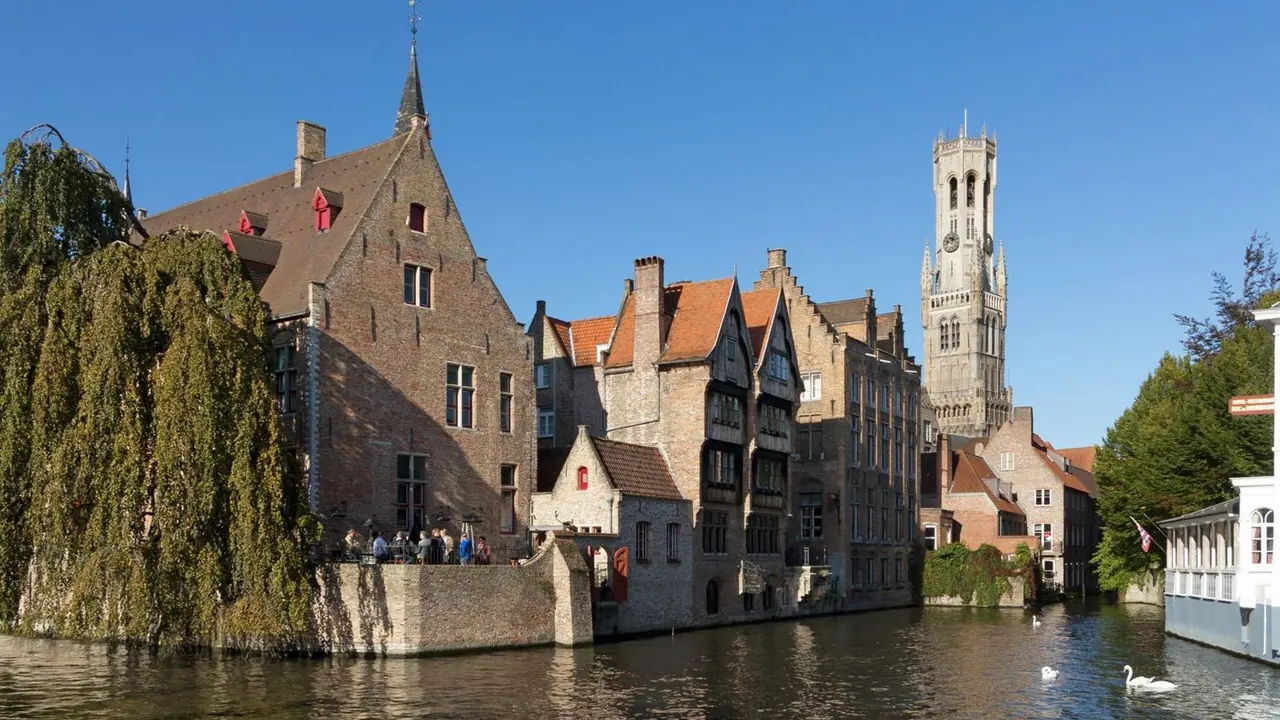
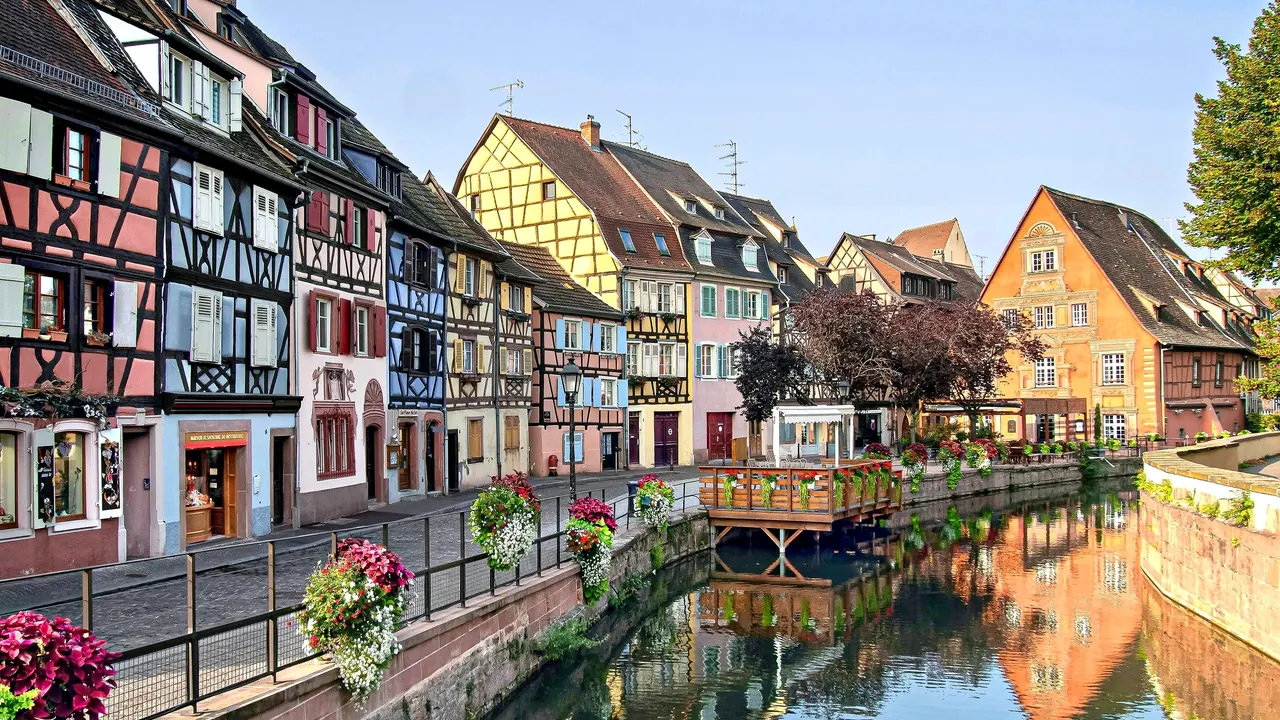
Photos: Bruges by Michielverbeek, CC BY-SA 4.0, cropped; Colmar by Rolf Kranz, CC BY-SA 4.0, cropped.
Bruges or Colmar?
Our verdict in twelve categories, each scored against the same fixed benchmark cities, and the climate month by month, so you can choose for your trip.
Choose Bruges for
- beaches
- getting around
- live music and the arts
Bruges is the better pick for a city break built around art and atmosphere. Its canal-ringed medieval centre and the Flemish Primitives in the Groeninge Museum and St John's Hospital make a richer set of sights. The flat, car-free core is easy to cover on foot, and an evening of Trappist ale in a brown café has more life than anything Colmar offers after dinner. The coast is also close enough for a sunny afternoon.
Choose Colmar for
- nature and the outdoors
- prices
- families
If you want the countryside as much as the town, Colmar will suit you better. The vineyards and the forested Vosges start almost at the edge of town, and Alsace cooking and its wines offer more range than Bruges's beer and mussels. Children get storks, monkey parks and Europa-Park within reach, and the trip costs a little less overall. The catch is that much of the region works best with a car.
Scoreboard
Twelve categories on one fixed scale from 0 to 100. The shaded stretch is the gap between the two.
Your match
Pick a travel style or drag the sliders, and both match scores follow your weighting.
Too close to call, 2 points apart
Wins on beaches and getting around with your weighting.
Wins on nature and the outdoors and prices with your weighting.
What matters to you?
Category by category
What the scores mean for a trip.
Beaches & swimming
Neither is a beach destination, but only Bruges has a sea within reach. Blankenberge is a short train ride away, and from there the coast tram runs along wide sandy beaches between De Panne and Knokke. That makes for a breezy afternoon and a brisk dip in the cool North Sea.
Colmar is landlocked in the Rhine plain, so summer swimming means a municipal pool or a small lake up in the Vosges valleys.
Food & drink
Both cities have a strong regional table, but Colmar's is broader. Alsace cooking runs from choucroute and baeckeoffe to tarte flambée and munster cheese, and you can taste Riesling and Gewurztraminer at the cellar door a short drive away.
Bruges is at its best in a glass, with Trappist and abbey beers in wood-panelled cafés and mussels, beer-braised beef and chocolate alongside. Both share the same trap of tired menus on the most photographed squares, so in either town it pays to walk a few streets away to eat.
Culture & sights
Both are remarkably intact old towns that take about two days to see, but Bruges holds more. Its whole canal-ringed centre is a World Heritage site, with the Belfry, the Gothic City Hall on the Burg and the Begijnhof. Its art is deeper too: van Eyck in the Groeninge, Memling in St John's Hospital and Michelangelo in the Church of Our Lady.
Colmar answers with painted half-timbering, the Maison Pfister and the canals of Petite Venise, plus one overwhelming work, Grünewald's Isenheim Altarpiece at the Unterlinden. It makes a superb single visit rather than a circuit of galleries.
Nightlife
Neither is a place for clubbing, but Bruges keeps going a little longer. Students keep a few cellar bars and brown cafés busy late around the Eiermarkt and 't Zand, and a session over strong ales can run well into the night.
Colmar's evenings centre on dinner and a glass of wine on a terrace in Petite Venise, and the town goes quiet early. For a proper night out, people take the train to Strasbourg.
Nature & outdoors
This is where Colmar pulls well ahead. Vineyard paths between wine villages begin within half an hour, and the valleys of Munster and Kaysersberg climb to the Route des Crêtes. Up there you find glacial lakes, summer pastures, dense trail networks and modest winter skiing in the forested Vosges.
Bruges has flat polder land instead: the towpath ride to Damme, quiet lanes towards the Dutch border and birdwatching in the Zwin salt marsh. It is lovely for an afternoon on a bike, but there are no hills at all.
Day trips
Both make first-rate bases, but in different ways. From Bruges the trips are mostly cities by train: Ghent in under half an hour, then Brussels and Antwerp, plus the Ypres battlefields and the coast, all without a car.
Colmar's best outings are the wine villages of Eguisheim, Riquewihr and Kaysersberg and the castle of Haut-Koenigsbourg, which are easiest by car or bike. Strasbourg is half an hour away by train, and Basel and Freiburg take you into Switzerland and Germany in about an hour.
Good for families
Both towns are small, flat and safe with children, and each has gentle canal boat rides. Colmar has the longer list of outings: storks nesting on the rooftops, an eagle show at Kintzheim, the zoo in Mulhouse and the castle above the plain, though most of them need a car.
Bruges offers the Belfry climb, swans at the Minnewater, Boudewijn Seapark and sandcastles at Blankenberge. Beyond those, its main sights are paintings and churches, and the cobbles make pushchairs hard work.
Getting around
Both are easy on foot inside town, so the difference lies beyond it. Frequent trains from Bruges reach Ghent, Brussels, Antwerp and the coast, so a car is never needed. Inside the canal ring, bikes are the local way to get about, and the only nuisance is the cobbles.
Colmar's station is a short walk from the centre, and trains run quickly to Strasbourg and Mulhouse. The wine villages and the Vosges, though, have only thin bus services, so many visitors hire a car or a bike.
Shopping & style
Neither is a shopping destination, and both lean on things to eat and drink. Bruges has a little more to browse: chocolate makers on almost every street, specialist beer shops, the Steenstraat high street and the markets on 't Zand and along the Dijver.
Colmar's best buys are wine straight from the producers, Soufflenheim pottery and printed Alsatian linen, with independent boutiques around Rue des Marchands. Big-name retail is thin.
Affordability
Neither is cheap, but Colmar is easier on the budget. Set lunches and regional wine are moderately priced, village tastings are often free, and rooms are the main cost when summer demand peaks.
Bruges costs more across the board, especially for hotels inside the canal ring at weekends and for food on the main squares. In both towns, staying outside the old centre is the simplest way to save.
Live music & performing arts
Bruges has the steadier programme. The Concertgebouw puts on early music, chamber music and contemporary dance, the summer early-music festival draws performers and listeners from across Europe, and the Belfry carillon plays over the rooftops.
Colmar's small Italian-style theatre hosts touring productions from the Opéra national du Rhin, and its July classical festival and autumn jazz are the highlights. Outside those weeks the calendar is thin, so serious audiences head to Strasbourg or Basel, much as Bruges sends them to Ghent.
Wellness & relaxation
Neither has a spa tradition, so relaxation in both comes from the pace rather than from treatments. Bruges has a few more hotel and day spas, plus corners such as the Begijnhof, Minnewater park and the Sint-Anna area that stay calm even when the main streets fill.
Colmar's restfulness is more rural: long lunches, quiet evenings by the canals and slow walks through the vines, with hotel spas scattered among the wine villages.
When should you go?
Pick your month. The climate figures are measured averages, not a forecast.
Bruges in July
Colmar in July
Daytime high, °C
Rainfall in the month, mm
Where the figures come from
Bruges has no rain gauge within 25 km of the centre, so its rainfall comes from a gridded climate dataset read at the city rather than from a gauge further away.
Bruges's sunshine is measured 37 km from the centre, at Vlissingen.
Temperature and rainfall are climate normals, averaged over the years shown. Bruges: 2009-2025 (sunshine 1991-2020, rainfall 1991-2020) normals, Zeebrugge / Zeemanshaard (15.8 km from centre). Colmar: 1991-2020 normals, Ihringen (21.1 km from centre).
Bruges has a mild, damp, maritime climate. Summer highs only reach about 21°C in July and August, so the streets are pleasant for walking all summer and it never gets truly hot. The North Sea warms to about 19°C in August, which is enough for a quick dip rather than a long swim. April to June are the driest and sunniest stretch. Rain builds from late summer, and autumn and winter are wet and grey, with up to 89mm a month and short, dull days.
Colmar is more continental. Summers are noticeably warmer, around 27°C in August, which is good weather for vineyard walks and terraces, though it can feel warm in the old town at midday. Winters are a touch colder but much drier than in Bruges, with little sunshine. May is the wettest month at 87mm, and September and October bring mild days for the harvest season in the vines.
Which traveller are you?
For a culture and arts trip, Bruges gives you more without extra effort. Several first-rate collections and churches sit inside one walkable ring, and a serious concert hall fills the evenings. In Colmar you see one extraordinary painting and a lovely townscape, then the town is done.
On an outdoors trip, Colmar is the clear choice, provided you hire a car. You can spend a morning walking high in the mountains and be back in town for dinner. Bruges keeps the outdoors to flat, gentle bike rides, pleasant but quickly done.
On a family trip with children, Colmar keeps them busier for longer, with animal parks, castles and a major theme park in the region, though you will be driving most days. Bruges is simpler without a car and has the beach close, but its sights mostly suit adults.
Before you go
| Measure | Bruges | Colmar |
|---|---|---|
| Official language | French, German, Dutch | French |
| Currency | Euro (EUR) | Euro (EUR) |
| Sockets | CE230 V, 50 Hz | CE230 V, 50 Hz |
| Driving side | Right | Right |
| Time zone | UTC+1, UTC+2 in summer | UTC+1, UTC+2 in summer |
| Emergency number | 112 | 112 |
| Elevation | 2 m | 185 m |
| Main airport | Brussels Airport (BRU)94 km from centre191 non-stop destinations | EuroAirport Basel–Mulhouse–Freiburg (BSL)55 km from centre112 non-stop destinations |
| Public holidays this year | 14 days | 11 days |
By the numbers
| Measure | Bruges | Colmar |
|---|---|---|
| City population | 118,509 | 66,970 |
| People per km² | 840 | 1,006 |
| Museums within 10 km | 38 | 9 |
| UNESCO World Heritage sites within 50 km | 4 | 3 |
| Swim season, months above 21 °C | None | - |
Where else could you go?
Every comparison below shares a destination with this one, so you can follow Bruges or Colmar somewhere new.