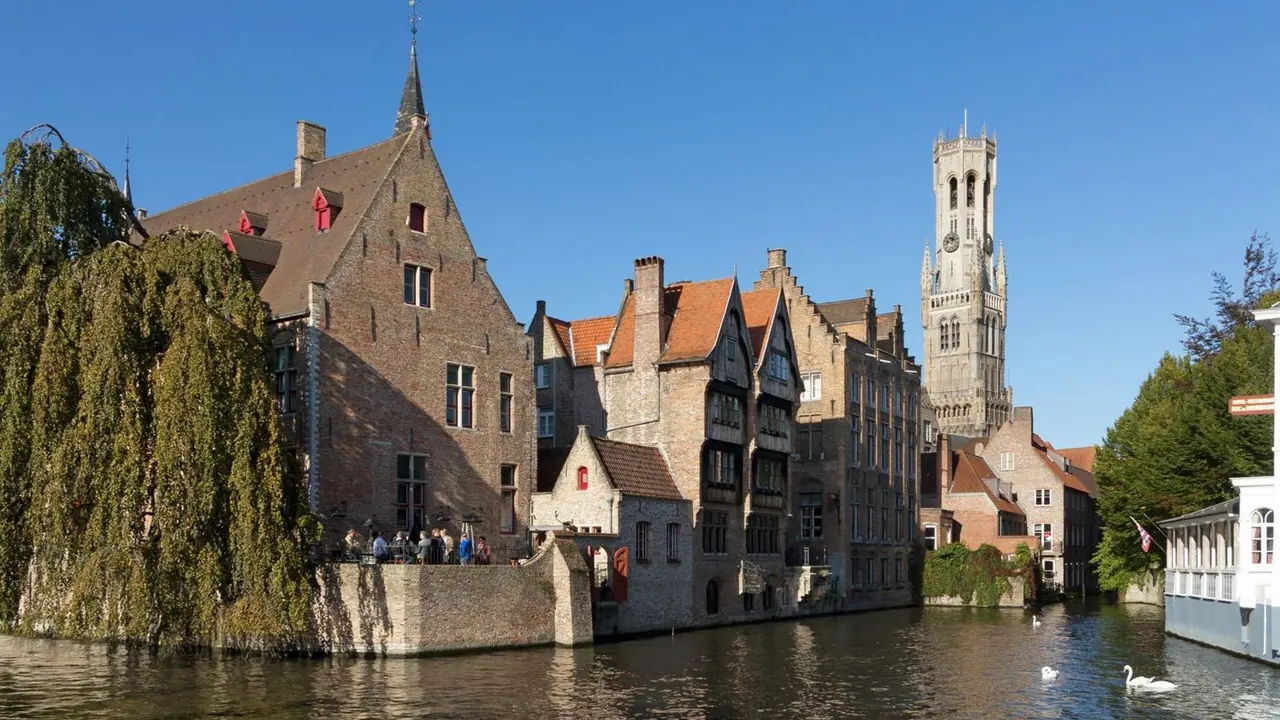
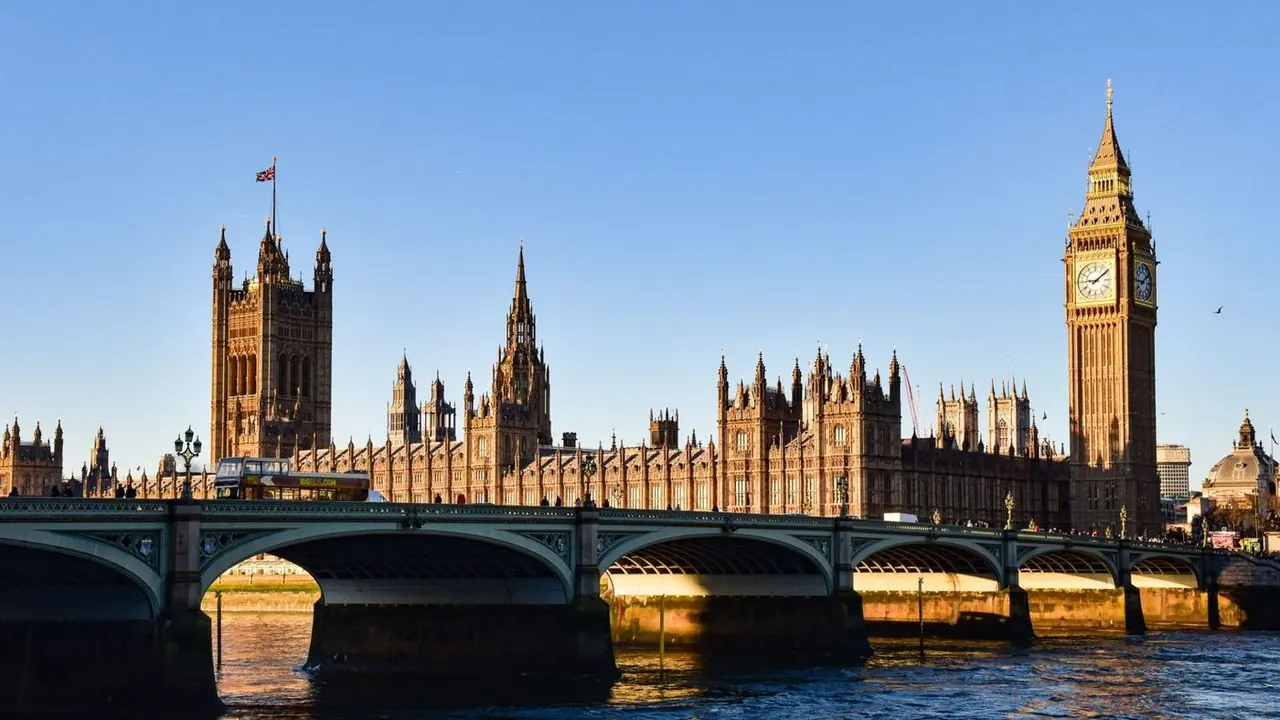
Photos: Bruges by Michielverbeek, CC BY-SA 4.0, cropped; London by AXP Photography, Pexels License.
Bruges or London?
Our verdict in twelve categories, each scored against the same fixed benchmark cities, and the climate month by month, so you can choose for your trip.
Choose Bruges for
- prices
- beaches
Bruges suits a slow, compact trip built around one remarkably intact medieval town: canals, brick guildhalls, Flemish Primitives in the Groeninge Museum and long evenings over Trappist ale in a brown café. It costs less than London, needs nothing more than your feet and a hired bike, and makes an easy base for Ghent, Brussels and the coast. Couples and anyone who likes quiet evenings will be happiest here.
Choose London for
- nightlife
- live music and the arts
- shopping
Choose London when you want range more than atmosphere. Its museums, theatres, concert halls, restaurants and shops go so deep that a week barely covers them, and its nights out reach well past last orders at the pub. Families get free museums and huge parks. The price is a spread-out, fast-moving city that is much dearer.
Scoreboard
Twelve categories on one fixed scale from 0 to 100. The shaded stretch is the gap between the two.
Your match
Pick a travel style or drag the sliders, and both match scores follow your weighting.
Wins on prices and beaches with your weighting.
Wins on nightlife and live music and the arts with your weighting.
What matters to you?
Category by category
What the scores mean for a trip.
Beaches & swimming
Neither city is a beach destination, but the seaside works differently. From Bruges, a short train to Blankenberge puts you on the coast tram along wide, flat sandy beaches, from the dunes near France up to Knokke.
London's nearest seaside is Brighton's pebble beach, an hour away, with sandier shores further off at Margate and Whitstable. Swimming in the city itself means the lidos at Brockwell Park and Parliament Hill and the Hampstead Heath ponds, which Bruges has nothing to match.
Food & drink
London eats far more widely. Bangladeshi cooking on Brick Lane, Punjabi food in Southall, Caribbean and West African kitchens south of the river, a serious fine-dining layer and markets such as Borough give it a range Bruges cannot approach.
Bruges is narrower but has a clear identity: Trappist and abbey beers poured in their own glasses, mussels with frites, beer-braised beef, waterzooi and chocolate. Its weakness is the set-menu restaurants on the main squares, so it pays to eat on the side streets.
Culture & sights
Bruges gives you one complete medieval picture: the Belfry over the Markt, the Burg with the Basilica of the Holy Blood, the Begijnhof, and Van Eyck and Memling within a few minutes' walk. Two days take in the core, and the setting is the main attraction.
London works on another scale. The British Museum, the National Gallery, the V&A and both Tates are each a day's visit, and most are free. They sit alongside the Tower, Westminster Abbey, St Paul's and Greenwich. A culture-led trip to London can fill a week without repeating itself.
Nightlife
The gap here is wide. A night in Bruges is a long, unhurried session over strong ale in a vaulted cellar or brown café around the Eiermarkt, then a walk by the canals. Most of the centre is asleep by midnight on weeknights.
London lets you pick a district to suit the mood: Soho for late cocktail bars and its long-established gay scene, Shoreditch, Hackney and Dalston for clubs and warehouse parties, Brixton and Peckham for big venues and rooftops. Weekends especially run long and loud.
Nature & outdoors
London has more green space to enjoy. Richmond Park's deer and ancient oaks, the views from Hampstead Heath, Kew and the Thames Path are all within the city, and the Chilterns and the Downs offer marked walks an hour away.
The flat polder around Bruges is gentler and better on two wheels than on foot. The towpath ride to Damme, quiet lanes towards the Dutch border and the birdlife of the Zwin salt marsh make a pleasant afternoon, but nothing more demanding than that.
Day trips
Both are excellent bases, and what differs is the kind of outing. From Bruges the trips are short and Flemish: Ghent and its Van Eyck altarpiece in under half an hour, Brussels and Antwerp a little further, the First World War memorials around Ypres, and Lille across the border.
London's outings cover a whole region of England: the colleges of Oxford and Cambridge, Windsor Castle, Roman and Georgian Bath, Stonehenge with Salisbury, and Canterbury. The journeys are longer, but the variety is wider.
Good for families
London is much easier to fill with children's days. The Natural History Museum's dinosaurs, the Science Museum and the Young V&A cost nothing, the Diana Memorial Playground and London Zoo are in central parks, and Legoland and the Harry Potter studio tour are within reach. The drawbacks are long distances and Tube stairs with a buggy.
Bruges is safer-feeling and small enough that short legs cope. Canal boats, swans at the Minnewater, the Belfry climb and Boudewijn Seapark are good for a few days, and the beaches are close. After that, its paintings and churches will mostly appeal to the adults.
Getting around
Bruges is a walking town. The egg-shaped canal ring can be crossed in about half an hour on flat, mostly car-free streets, bikes are easy to hire, and the station sends frequent trains across Flanders. The cobbles are the only real nuisance.
London is the more capable system for a much bigger area. The Underground, the Elizabeth line, buses, riverboats and cycle hire all run on one contactless payment, and you never need a car. The trade-off is time: crossing the city takes far longer, and rush-hour Tubes are packed.
Shopping & style
Here London has a huge lead. It has the luxury houses of Bond Street, bespoke tailoring on Savile Row, Harrods, Liberty and Fortnum & Mason, plus Portobello Road, Columbia Road and the vintage shops of Spitalfields and Shoreditch. You can plan a whole trip around it.
Shopping in Bruges mostly means things to eat and drink: pralines from its many chocolate makers, bottles and branded glasses from beer shops, and bobbin lace if you find the genuine local work. The Dijver flea market is pleasant for a browse.
Affordability
Both are expensive, but Bruges is noticeably easier on the wallet. Staying midweek or near the station and eating away from the Markt keeps costs down, and train fares to Ghent or the coast are modest.
London's central hotel rooms are among Europe's costliest and smallest, and theatre seats and pub rounds add up fast. Its big saving is free entry to the national museums, which in Bruges cost money.
Live music & performing arts
Bruges takes music seriously for a small city, but its range is narrow. The modern Concertgebouw and the long-running summer festival focus on early music, chamber music and contemporary dance, the Stadsschouwburg hosts touring theatre, and the Belfry carillon plays over the rooftops. There is no opera company, so for a wider choice you take the train to Ghent or Brussels.
London is on another scale entirely. On any evening of a stay you could pick between a West End musical, drama at the National Theatre, the Globe or a fringe stage above a pub, opera and ballet at Covent Garden, one of five orchestras, the Proms in summer or a Soho jazz cellar. Bruges gives you a few fine concerts in a week, while London offers far more than one trip could ever take in.
Wellness & relaxation
Neither city has much of a spa culture, so the difference is in how you unwind. In Bruges, calm comes from the hour of day: the Begijnhof, the Minnewater and the Sint-Anna streets are deeply peaceful early and late.
London has real bathing history in its surviving Victorian and Edwardian Turkish baths in Bayswater and at Ironmonger Row, plus grand hotel spas and cold dips in the Hampstead ponds. Bath's thermal waters are a day trip away.
When should you go?
Pick your month. The climate figures are measured averages, not a forecast.
Bruges in July
London in July
Daytime high, °C
Rainfall in the month, mm
Where the figures come from
Bruges has no rain gauge within 25 km of the centre, so its rainfall comes from a gridded climate dataset read at the city rather than from a gauge further away.
Bruges's sunshine is measured 37 km from the centre, at Vlissingen.
Temperature and rainfall are climate normals, averaged over the years shown. Bruges: 2009-2025 (sunshine 1991-2020, rainfall 1991-2020) normals, Zeebrugge / Zeemanshaard (15.8 km from centre). London: 1992-2020 (sunshine 1991-2020, rainfall 1991-2020) normals, London Weather Centre (1.3 km from centre).
The two climates are close, and neither city gets too hot for walking. Summer highs reach about 22°C in Bruges and 24°C in London in July and August, which is the only time a trip to the beach makes sense. Even then the North Sea off the Flemish coast peaks at about 19°C, so expect a paddle rather than a swim. In the measured data Bruges gets noticeably more sunshine than London from spring to late summer, but it is also wetter from July onwards, with up to 79mm a month into early winter.
For walking the streets, late spring is the best season in both cities. Bruges is at its driest in April, with about 43mm, and London stays fairly dry right through summer before the rain picks up in October and November. Winters are short-daylight, grey and cold in both, a little colder in Bruges. That suits museums and beer cafés more than long days outdoors.
Which traveller are you?
On a food and nightlife trip, London is the clear choice. It has Brick Lane curries, Borough Market, Cantonese Chinatown and Turkish grills in Dalston, then Soho bars and east London clubs that run until morning. Bruges offers superb beer but quiet nights.
For a short city break, Bruges fits the time well. Its whole UNESCO-listed centre can be crossed on foot in half an hour, two full days cover the main sights, and evenings by the lit canals round it off without any travel planning.
On a tight budget, Bruges is the easier of the two, though neither is cheap. Rooms near the station and meals away from the Markt keep costs reasonable. In London the free museums help, but hotels and per-journey fares weigh heavily.
Before you go
| Measure | Bruges | London |
|---|---|---|
| Official language | French, German, Dutch | English |
| Currency | Euro (EUR) | Pound Sterling (GBP) |
| Sockets | CE230 V, 50 Hz | G230 V, 50 Hz |
| Driving side | Right | Left |
| Time zone | UTC+1, UTC+2 in summer | UTC, UTC+1 in summer |
| Emergency number | 112 | 112 or 999 |
| Elevation | 2 m | 4 m |
| Main airport | Brussels Airport (BRU)94 km from centre191 non-stop destinations | London Heathrow Airport (LHR)23 km from centre224 non-stop destinations |
| Public holidays this year | 14 days | 8 days |
By the numbers
| Measure | Bruges | London |
|---|---|---|
| City population | 118,509 | 8,799,728 |
| People per km² | 840 | 5,598 |
| Museums within 10 km | 38 | 216 |
| UNESCO World Heritage sites within 50 km | 3 | 4 |
| Swim season, months above 21 °C | None | - |
Where else could you go?
Every comparison below shares a destination with this one, so you can follow Bruges or London somewhere new.