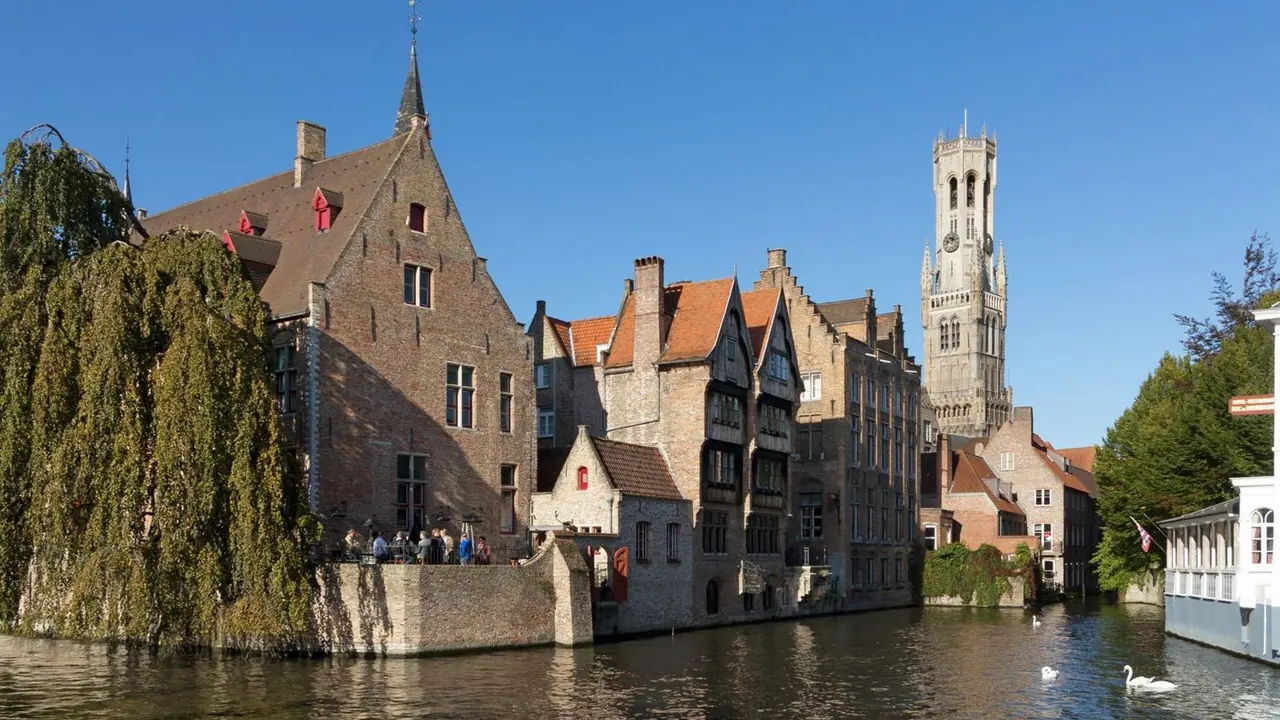
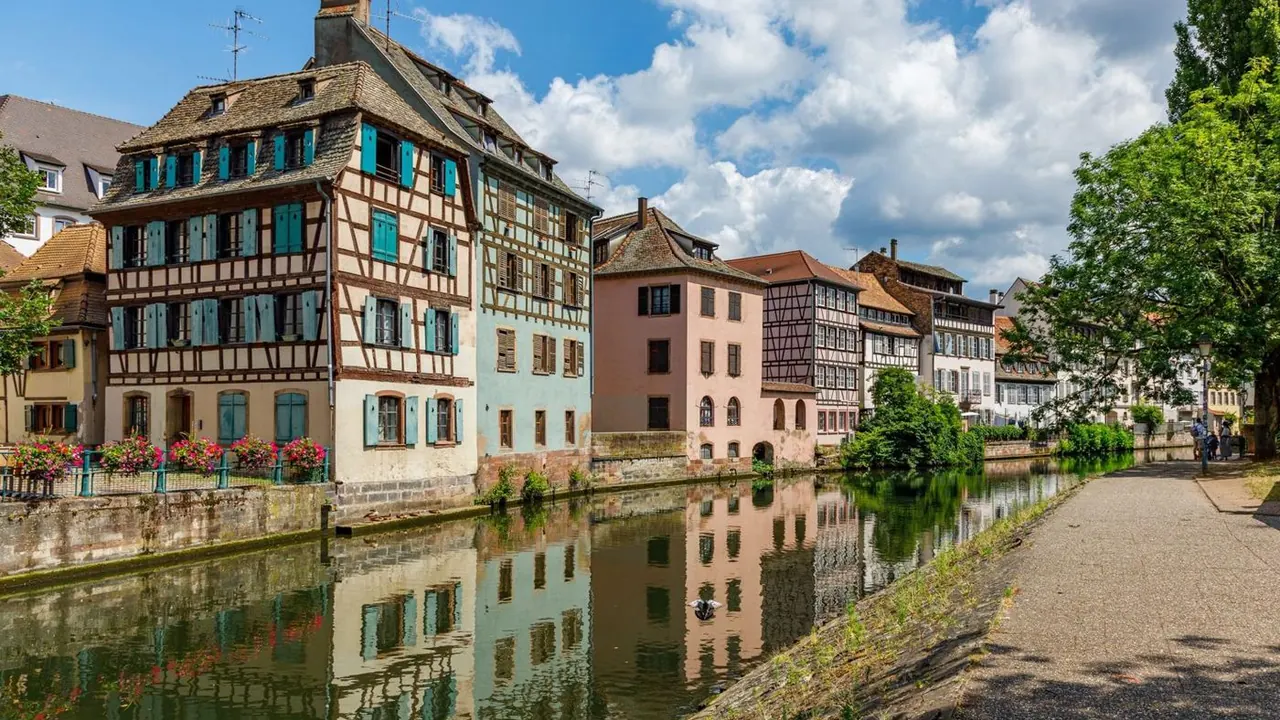
Photos: Bruges by Michielverbeek, CC BY-SA 4.0, cropped; Strasbourg by Edoardo Colombo, Pexels License.
Bruges or Strasbourg?
Our verdict in twelve categories, each scored against the same fixed benchmark cities, and the climate month by month, so you can choose for your trip.
Choose Bruges for
- beaches
- culture and sights
- day trips
Bruges suits a short, slow trip built around one beautifully intact medieval town. Choose it for the Flemish Primitives in their original setting, long evenings over Trappist ales in brown cafés, and the ease of hopping on a train to Ghent, Brussels or Antwerp. The coast is close enough for a sandy afternoon by the North Sea, too. It works best for couples and art lovers who are happy to walk, look and drink well, and who don't need much going on after dark.
Choose Strasbourg for
- nature and the outdoors
- live music and the arts
- wellness
Strasbourg is the better pick for a longer, more varied stay. Alsatian cooking and wine are richer than anything on the Bruges menu, the opera house and national theatre fill the evenings, and the Vosges and the Black Forest put real hills within an hour. Families have more to do, the Baden-Baden baths are close, and a stay costs a little less.
Scoreboard
Twelve categories on one fixed scale from 0 to 100. The shaded stretch is the gap between the two.
Your match
Pick a travel style or drag the sliders, and both match scores follow your weighting.
Wins on beaches and culture and sights with your weighting.
Wins on nature and the outdoors and live music and the arts with your weighting.
What matters to you?
Category by category
What the scores mean for a trip.
Beaches & swimming
Bruges is the one with a real coast nearby. Trains reach Blankenberge in about fifteen minutes, and from there the coast tram runs past continuous wide sandy beaches backed by promenades. The North Sea is cold and often windy, though, so this is a half-day outing rather than a beach trip.
Strasbourg has no sea at all. Its summer swimming happens in old gravel-pit lakes such as the Baggersee, which you can reach by tram, with grassy banks and lifeguards in high summer. It is fine for cooling off, but there is no sand and no surf.
Food & drink
Strasbourg eats better and more broadly. A winstub meal of choucroute, baeckeoffe or tarte flambée, with a pichet of Riesling from the vineyards to the south, makes a meal in itself. The covered market adds Munster, charcuterie and foie gras.
Bruges is really about what is in the glass: Trappist and abbey beers, each poured into its own glass, alongside mussels, beef stewed in beer and plenty of chocolate. Beyond that the everyday range is narrow. Both cities share the same trap of set menus on the main squares, and in both you eat better a few streets away.
Culture & sights
The two are broadly level, but the experience differs. Bruges is one complete medieval picture of canals, guildhalls, the Belfry and the Begijnhof. Its art is concentrated and superb: Van Eyck in the Groeninge, Memling in St John's Hospital and Michelangelo's Madonna. It is small, though, and two days cover it.
Strasbourg is layered rather than uniform. There is the pink cathedral with its astronomical clock, Petite France by the locks and the German-built Neustadt with its imperial avenues. The Palais Rohan, an eighteenth-century palace, holds the fine arts, decorative arts and archaeology collections under one roof. The modern side comes from the large museum of modern and contemporary art by the river and the European institutions. All of that fills two or three unhurried days.
Nightlife
Neither city is for late clubbing, but Strasbourg has more going on after dark. Its large university keeps the Krutenau and the streets around Place Saint-Étienne busy with student bars and beer cellars, and the riverside terraces stay full on summer evenings.
Bruges is quieter and more about atmosphere. Expect a long session over strong ales in a brown café or a vaulted cellar near the Eiermarkt, followed by a walk along the lit canals, with most of the town asleep by midnight.
Nature & outdoors
Strasbourg wins clearly, because real hills lie within an hour. To the west the Vosges rise above the vineyards, with forest trails and sandstone castle ruins. To the east, the Black Forest offers higher ridges and longer hikes. Closer in, the Rhine forests shelter storks, herons and beavers.
Bruges sits in flat polder country. It is lovely for an easy bike ride along the poplar-lined canal to Damme or for birdwatching at the Zwin salt marsh, but there are no hills, no real forests and no proper hiking.
Day trips
Both are excellent bases, but for different kinds of excursion. From Bruges, the trips are to Flemish cities, all easy by train: Ghent in under half an hour, then Brussels and Antwerp. Add the canal village of Damme by bike and the First World War memorials around Ypres.
From Strasbourg, the trips cross a border and a wine region. Choose Colmar and the Isenheim Altarpiece, the wine villages of Riquewihr and Eguisheim, or Baden-Baden, Freiburg and Basel. The cities are easy by train, but the wine route is much easier with a car or a bike.
Good for families
Strasbourg is the easier and fuller choice with children. Trams replace long walks, and the Orangerie has nesting storks, playgrounds and rowing boats. Le Vaisseau is built for hands-on young visitors, and Europa-Park makes a big day out about an hour away.
Bruges charms younger children with canal boats, horse-drawn carriages and the swans on the Minnewater. Boudewijn Seapark and the beaches are close, but beyond those the sights are mostly paintings and churches, and pushchairs fare badly on the cobbles.
Getting around
Both centres are compact, flat and largely car-free, so you can get almost everywhere on foot or by bike. The difference is in the tools. Bruges has no tram, so it is walking and cycling inside the canal ring, with the station a fair walk out and cobbles that punish suitcases. Strasbourg adds a tram network that reaches the station, the European quarter and even Kehl across the Rhine, and its separated cycle lanes run all over the city.
Shopping & style
Strasbourg offers a little more to browse. It has chain stores and a department store around Place Kléber, independent bookshops and delicatessens near the cathedral, and regional things to take home, such as Soufflenheim pottery, Alsace wine and kougelhopf moulds. December's Christmas market is the high point for crafts.
In Bruges, shopping is mostly edible: chocolate makers and specialist beer shops. There are pleasant browses at the Saturday market on 't Zand and the flea market along the Dijver, but much of the lace is imported.
Affordability
Neither is cheap, but Strasbourg stretches a budget a little further. Winstub meals, wine by the pichet and the trams are fair value, and its hotels are only really expensive during the Christmas market and the weeks the European Parliament sits.
Bruges hotels inside the canal ring charge a lot all year, especially at weekends and in summer, and so do the restaurants on the main squares. Staying midweek or near the station, and drinking its very good beer, softens the bill.
Live music & performing arts
Strasbourg has the fuller stage. The Opéra national du Rhin, a philharmonic orchestra with a full season and the Théâtre National de Strasbourg give it real depth. The Musica festival makes autumn a draw for contemporary music.
Bruges is more specialised. Its Concertgebouw and summer festival are known for early and chamber music, and the Belfry carillon plays over the rooftops. There is no opera, though, and for a wider choice of evenings people take the train to Ghent or Brussels.
Wellness & relaxation
Strasbourg has a genuine bathing culture to offer. Locals use the tiled pools, hammam and saunas of the Bains municipaux, and the Friedrichsbad and Caracalla thermal baths at Baden-Baden are under an hour away.
Bruges has only hotel and day spas. Its calm comes from timing instead: the Begijnhof and the Minnewater at dawn, or the quiet Sint-Anna streets at midday, away from the summer crowds.
When should you go?
Pick your month. The climate figures are measured averages, not a forecast.
Bruges in July
Strasbourg in July
Daytime high, °C
Rainfall in the month, mm
Where the figures come from
Bruges has no rain gauge within 25 km of the centre, so its rainfall comes from a gridded climate dataset read at the city rather than from a gauge further away.
Bruges's sunshine is measured 37 km from the centre, at Vlissingen.
Temperature and rainfall are climate normals, averaged over the years shown. Bruges: 2009-2025 (sunshine 1991-2020, rainfall 1991-2020) normals, Zeebrugge / Zeemanshaard (15.8 km from centre). Strasbourg: 1991-2020 normals, Strasbourg (9.1 km from centre).
Bruges stays mild all year. July and August top out around 22°C, which is comfortable for walking all day but only just warm enough for the beach, and the North Sea peaks near 19°C, so a swim is brisk. April is the driest month at about 43mm, though it is still cool. May and June bring the most sunshine, and showers pick up as summer goes on. From July to December rain comes steadily every month, and the winters are grey, dim and chilly rather than freezing.
Strasbourg has a more continental year. Its summers are clearly warmer, at around 26°C, which is good for an afternoon at the lakes, and its winters are slightly colder and darker. Its rain runs the other way round. Late winter and early spring are fairly dry, May is the wettest month at about 77mm, and early summer stays showery. September is the best balance there: warm, sunny and calmer on rain. Bruges is also pleasant in September but noticeably wetter. In July and August Strasbourg feels properly summery, while Bruges stays fresh.
Which traveller are you?
For a beach and sun trip, Bruges is the only real option of the two, but only for a relaxed half day. Come for the old town and add an afternoon by the sea, knowing the water stays cold.
On an outdoors trip, choose Strasbourg without hesitation. Proper hill walking and forest hiking begin within an hour, in two different ranges. Around Bruges the countryside is good for an easy afternoon on a bike, but not for a week.
For a short city break, Bruges is hard to beat. Its medieval centre and finest paintings fit into two days on foot with no transport to plan, and the evenings slip easily into beer and canal walks. Strasbourg rewards a longer stay.
Before you go
| Measure | Bruges | Strasbourg |
|---|---|---|
| Official language | French, German, Dutch | French |
| Currency | Euro (EUR) | Euro (EUR) |
| Sockets | CE230 V, 50 Hz | CE230 V, 50 Hz |
| Driving side | Right | Right |
| Time zone | UTC+1, UTC+2 in summer | UTC+1, UTC+2 in summer |
| Emergency number | 112 | 112 |
| Elevation | 2 m | 132 m |
| Main airport | Brussels Airport (BRU)94 km from centre191 non-stop destinations | Strasbourg Airport (SXB)10 km from centre43 non-stop destinations |
| Public holidays this year | 14 days | 11 days |
By the numbers
| Measure | Bruges | Strasbourg |
|---|---|---|
| City population | 118,509 | 293,771 |
| People per km² | 840 | 3,752 |
| Museums within 10 km | 38 | 21 |
| UNESCO World Heritage sites within 50 km | 3 | 1 |
| Swim season, months above 21 °C | None | - |
Where else could you go?
Every comparison below shares a destination with this one, so you can follow Bruges or Strasbourg somewhere new.