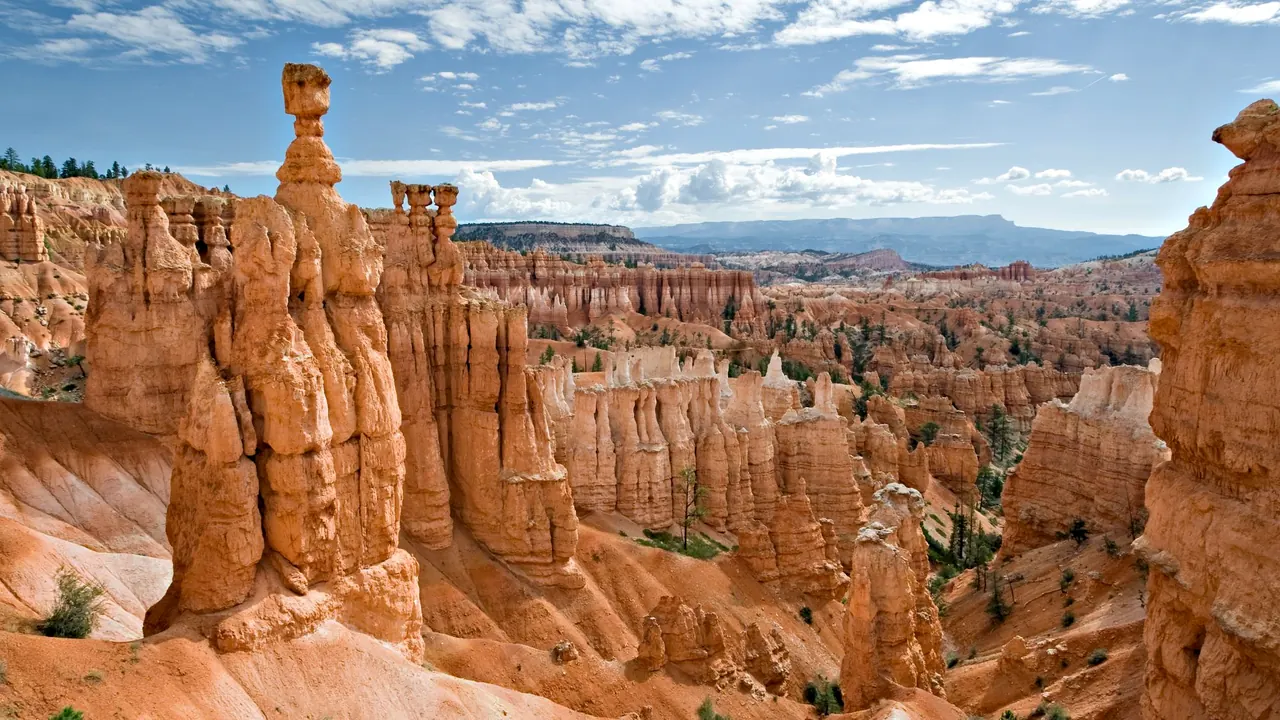
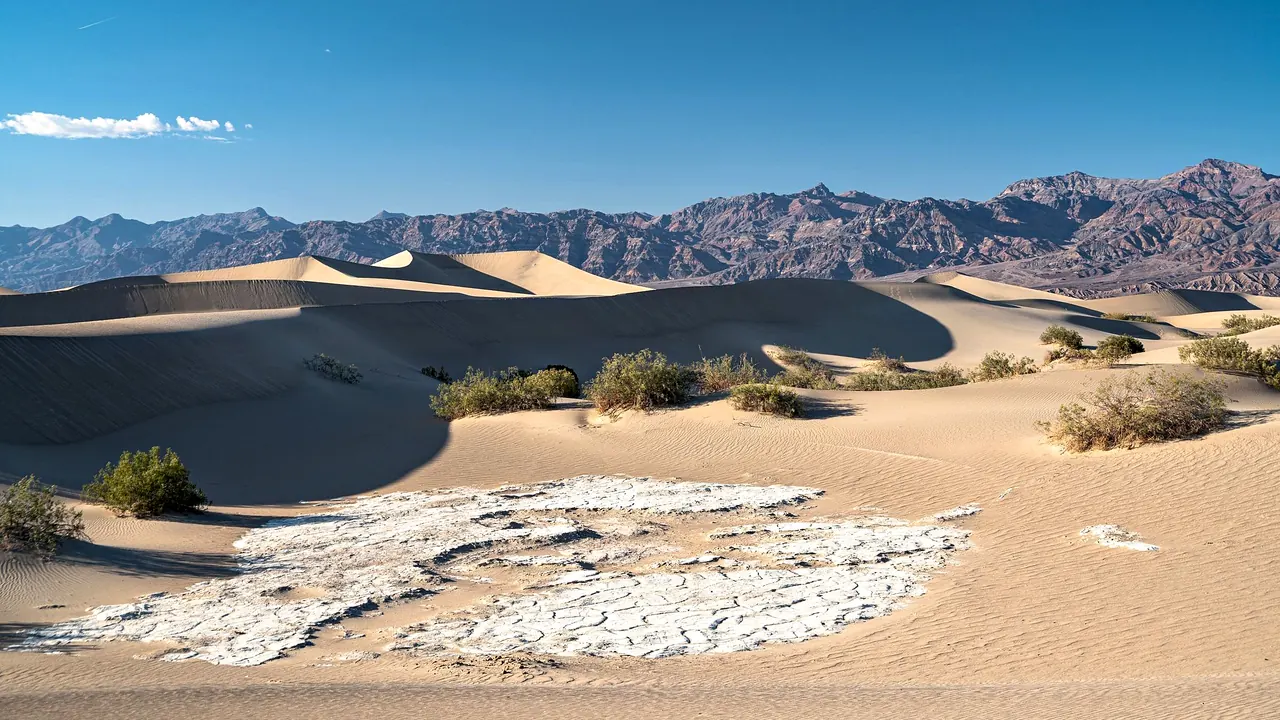
Photos: Bryce Canyon by Luca Galuzzi (Lucag), CC BY-SA 2.5, cropped; Death Valley by Anthony Brown, Pexels License.
Bryce Canyon or Death Valley?
Our verdict in twelve categories, each scored against the same fixed benchmark cities, and the climate month by month, so you can choose for your trip.
Choose Bryce Canyon for
- families
- getting around
- live music and the arts
Bryce Canyon is the pick for a summer trip on foot, and for families with school-age children. The hoodoos stand high on a plateau, so the warm months stay pleasant for walking, and the park is compact. The Rim Trail, the seasonal shuttle and short descents such as Queen's Garden put you among the spires without long drives between sights. Theatre lovers can add an evening at the Utah Shakespeare Festival in Cedar City.
Choose Death Valley for
- wellness
- day trips
- culture and sights
For a winter escape into open desert, Death Valley makes the stronger case. Its draw is the land itself: the salt crust of Badwater below sea level, the Mesquite Flat dunes, the badlands at Zabriskie Point and narrows like Mosaic Canyon, all a pleasure to walk between November and March. The warm spring-fed pools at Furnace Creek and the hot springs at Tecopa give it a restful side that Bryce lacks. Expect long drives, some dirt roads that need a high-clearance vehicle, and dangerous heat if you come in summer.
Scoreboard
Twelve categories on one fixed scale from 0 to 100. The shaded stretch is the gap between the two.
Your match
Pick a travel style or drag the sliders, and both match scores follow your weighting.
Too close to call, 2 points apart
Wins on families and getting around with your weighting.
Wins on wellness and day trips with your weighting.
What matters to you?
Category by category
What the scores mean for a trip.
Beaches & swimming
Neither has any swimming worth travelling for. Bryce Canyon at least has water in view, in cold mountain reservoirs such as Panguitch Lake used for fishing and paddling, while Death Valley's lakebeds are dry salt, and its only swims are the spring-fed resort pools at Furnace Creek.
Food & drink
Meals are functional in both, but Bryce Canyon has a slight edge. Ranch breakfasts, steaks and Navajo tacos in Tropic and Panguitch are basic, but a dinner drive along Scenic Byway 12 to Escalante or Boulder finds a few kitchens cooking seriously with local produce.
Death Valley means lodge dining rooms and saloons at Furnace Creek, Stovepipe Wells and Panamint Springs, with a cool box doing much of the work. Its one local flavour is dates from the farm near Tecopa, in shakes and bread.
Culture & sights
Both have thin cultural offers that fill an afternoon at most, and the difference is in the story. Bryce Canyon's is settlement and early park architecture: the 1920s timber-and-stone lodge, the red-brick pioneer houses of Panguitch, Mormon farming towns and the ancestral Puebloan village at Boulder.
Death Valley's history is a little richer on the ground, and it is industrial. The Harmony Borax Works ruins, the beehive charcoal kilns at Wildrose and abandoned mine camps along the back roads tell a story of mining and survival, with the Timbisha Shoshone still in the valley.
Nightlife
There is nothing to go out for in either. Bryce Canyon's small Mormon gateway towns have hardly any bars and go to bed early for sunrise on the rim, and in Death Valley the saloons at Stovepipe Wells and Furnace Creek pour a beer and fall quiet by mid-evening. In both, the dark sky is the entertainment.
Nature & outdoors
Both are world-class landscapes of very different kinds. Bryce Canyon is high plateau, packed with orange and pink hoodoos in natural amphitheatres, where the Navajo Loop and Fairyland trails drop you in among the spires, and Red Canyon, Kodachrome Basin and the slot canyons of Grand Staircase-Escalante lie close by.
Death Valley is about scale and extremes, from the salt polygons of Badwater below sea level to snow on Telescope Peak, with the Mesquite Flat dunes, Zabriskie Point's badlands and the Ubehebe crater between them. Bryce has trails and viewpoints close together, while much of Death Valley's best country is on rough dirt roads.
Day trips
Death Valley gives a better reason to leave the park for a day. Rhyolite's ghost town near Beatty, the old film town of Lone Pine and the preserved Manzanar incarceration camp have real character, and Las Vegas is within reach.
From Bryce Canyon most outings lead to more scenery. The towns of Panguitch, Kanab and Cedar City are pleasant enough, but none fills a day.
Good for families
Bryce Canyon is clearly kinder to families. The main viewpoints are close together, the flat rim path and Queen's Garden trail suit school-age walkers, and horse rides, stargazing and motel pools fill the gaps, though thin air and unfenced edges call for care.
Death Valley works only for adventurous older children in winter, sliding down the Stovepipe Wells dunes and crossing the Badwater salt from a Furnace Creek base. Long distances, few shops and dangerous heat outside the cool months make it a harder place to bring young children.
Getting around
Both need a car, but Bryce Canyon is the more manageable one. A single scenic drive runs along the plateau, a summer shuttle links the gateway town to the busiest overlooks, and the Rim Trail lets you walk between viewpoints. The long hours on the road come in getting there and going beyond.
Death Valley is spread across a huge area, with an hour or more between sights, fuel far apart and the Racetrack and Titus Canyon reachable only with a high-clearance vehicle. Las Vegas is the nearest big airport, at least a straightforward drive away.
Shopping & style
Neither is a place to shop. Bryce Canyon has a little more to browse, with Western wear at the big general store and fossils and geodes in roadside rock shops, while Death Valley stops at supplies, borax souvenirs and Tecopa dates, so stock up in Las Vegas or Pahrump.
Affordability
Where you can save is what separates these two, more than the overall bill. In Bryce Canyon, rooms in Bryce Canyon City and Tropic charge high-season rates from late spring to early autumn. The older motels of Panguitch, the campgrounds in the park and national forest, and the free summer shuttle and ranger programmes keep costs in check, and winter is far cheaper if you accept that much of the area closes.
Death Valley's few lodgings at Furnace Creek and Stovepipe Wells charge remote-resort rates for rooms and meals, and fuel inside the valley costs far more than in the towns around it. Camping and a cool box filled before you drive in make the real saving, while motels in Beatty or Pahrump swap a smaller room bill for long hours at the wheel each day.
Live music & performing arts
Bryce Canyon has the one serious evening out of the two: the long-established Utah Shakespeare Festival in Cedar City, worth the drive for a theatre lover in summer or autumn, plus a cowboy dinner show nearer the park.
Death Valley's stage is the Amargosa Opera House at Death Valley Junction, an adobe theatre with a painted audience on its walls. It is more a curiosity to visit than a programme to plan around.
Wellness & relaxation
Death Valley is the better place to unwind. Furnace Creek's spring-fed pools stay warm through winter beside a resort spa, and Tecopa's rustic mineral soaks are at their best at night under the stars.
Bryce Canyon offers quiet and cool air, best enjoyed on a lodge porch in the evening, but little more than the odd hot tub. Its days are spent hiking in and out of the canyon at altitude.
When should you go?
Pick your month. The climate figures are measured averages, not a forecast.
Bryce Canyon in July
Death Valley in July
Daytime high, °C
Rainfall in the month, mm
Where the figures come from
Bryce Canyon has no rain gauge within 25 km of the centre, so its rainfall comes from a gridded climate dataset read at the destination rather than from a gauge further away.
Death Valley has no weather station within reach, so its figures come from a gridded climate model rather than a measured record, and read a broad area rather than one spot.
Temperature and rainfall are climate normals, averaged over the years shown. Bryce Canyon: 2004-2020 (rainfall 1991-2020) normals, Bryce Canyon / Bryce Canyon City (3.9 km from centre). Death Valley: 1991-2020 normals, TerraClimate 4 km grid at the town, no weather station within 90 km.
The two run on opposite calendars. Bryce Canyon is at its best from June to September, when the high air keeps July days on the rim around 27°C and walking stays comfortable. May and early October are cooler but still good for hiking. Late summer is the wettest spell, with around 42mm in August, mostly as afternoon storms. November and March are chilly, and from December to February highs hover just above freezing, snow lies on the hoodoos and the trip turns to snowshoeing and cross-country skiing.
Death Valley is the reverse. From November to March the days are mild to warm, ideal for the canyons and dunes. By May it is already hot, and from June to August the valley floor sits well above 40°C, peaking around 46°C in July, too hot for anything beyond short stops at viewpoints. It is dry almost all year, so rain rarely shapes a plan.
Which traveller are you?
On a family trip with children, Bryce Canyon is the easier choice. The flat paved rim between Sunrise and Sunset Points, the manageable Queen's Garden descent and motel pools close to the park keep days short, while Death Valley's distances and heat are hard on small children.
For a relaxing and wellness trip, Death Valley wins clearly. Warm spring-fed pools and a spa at Furnace Creek, plus simple mineral soaks at Tecopa under the stars, offer real rest, whereas Bryce gives you quiet but days spent climbing at altitude.
On an outdoors trip, both are superb, so let the season choose. Bryce's hoodoo trails, horse rides and snowshoeing suit summer and winter snow, while Death Valley's dunes, salt flats and narrow canyons belong to the mild months from November to March.
Before you go
| Measure | Bryce Canyon | Death Valley |
|---|---|---|
| Currency | US Dollar (USD) | US Dollar (USD) |
| Sockets | AB120 V, 60 Hz | AB120 V, 60 Hz |
| Driving side | Right | Right |
| Time zone | UTC-7, UTC-6 in summer | UTC-8, UTC-7 in summer |
| Emergency number | 911 | 911 |
| Main airport | Harry Reid International Airport (LAS)160 non-stop destinations | Harry Reid International Airport (LAS)160 non-stop destinations |
| Public holidays this year | 12 days | 13 days |
Where else could you go?
Every comparison below shares a destination with this one, so you can follow Bryce Canyon or Death Valley somewhere new.
- Zionvs Bryce Canyon
- Sequoiavs Death Valley
- Grand Canyonvs Bryce Canyon
- Kings Canyonvs Death Valley
- Canyonlandsvs Bryce Canyon
- Archesvs Bryce Canyon