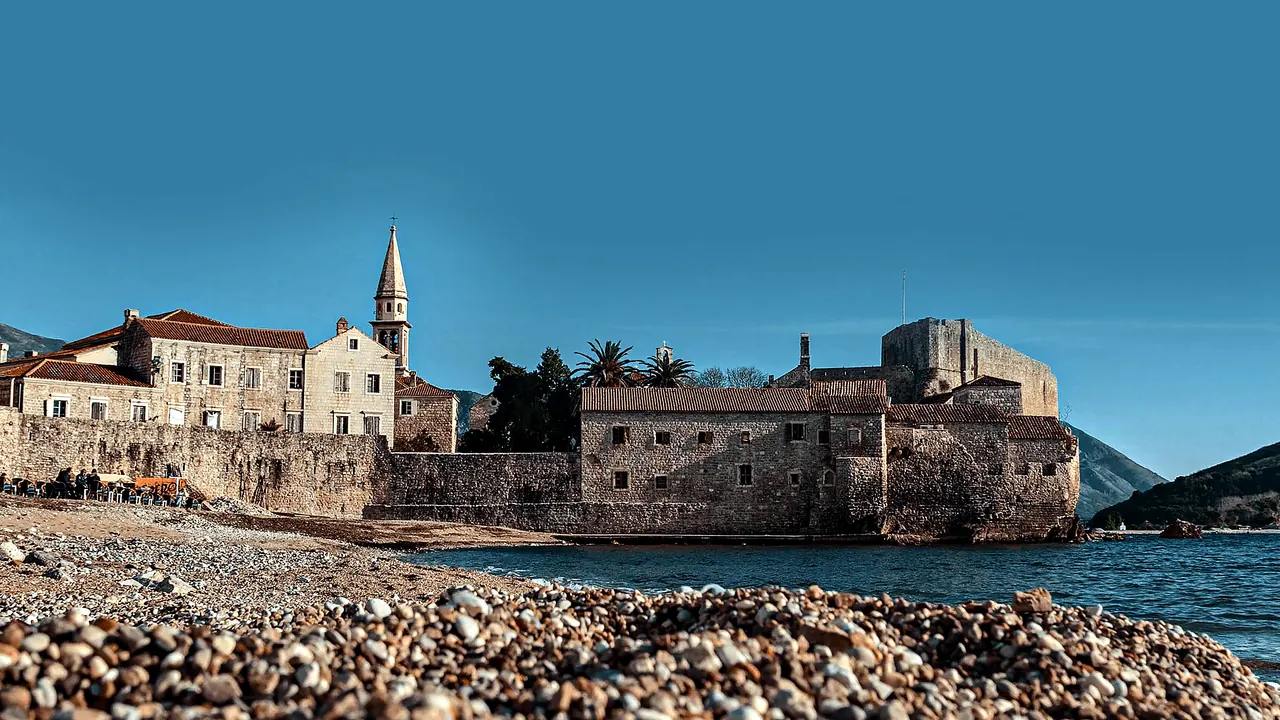
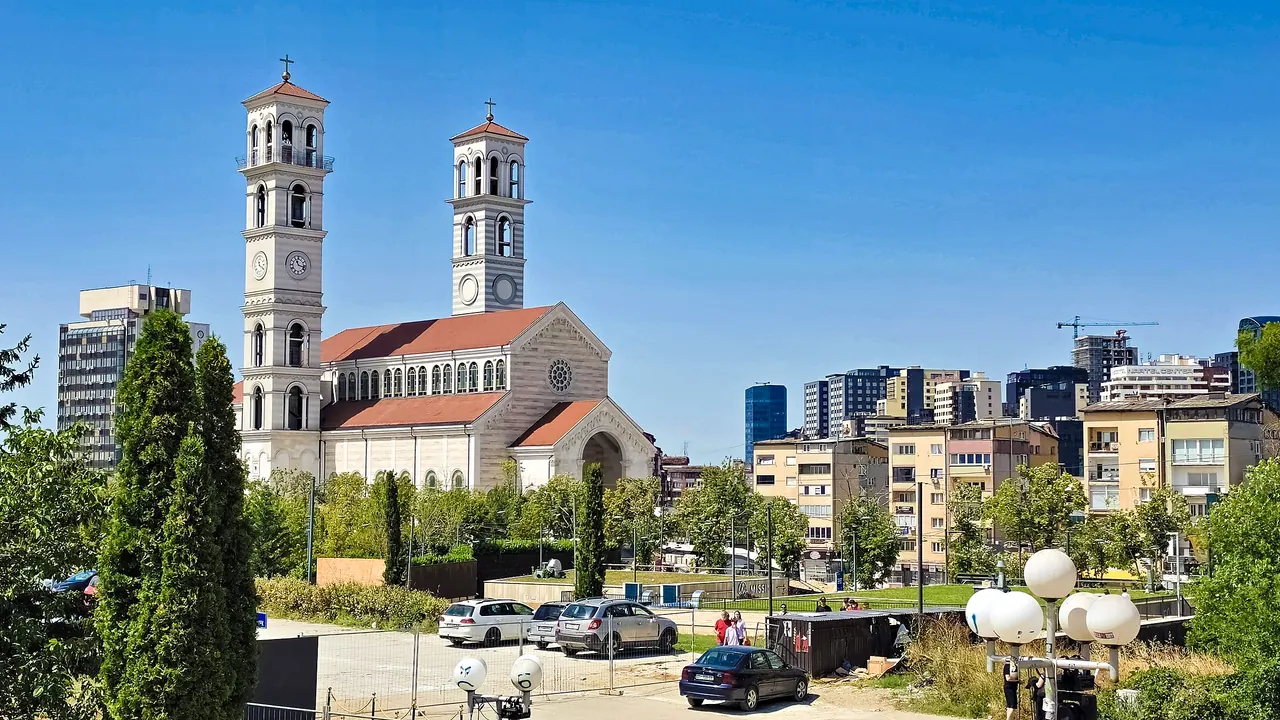
Photos: Budva by Ender Vatan, Pexels License; Pristina by Daciana Cristina Visan, Pexels License.
Budva or Pristina?
Our verdict in twelve categories, each scored against the same fixed benchmark cities, and the climate month by month, so you can choose for your trip.
Choose Budva for
- beaches
- families
- nature and the outdoors
Budva is the choice for a summer vacation built around the sea. It has a long town beach, coves under the old walls and a string of bays down the coast, with long, loud nights on the seafront. It also makes a good base for Kotor, Lovcen and Lake Skadar. Groups of friends and families who want sun and water will get far more out of it, as long as they accept pebbles, crowds in high summer and a centre that sells little beyond the beach.
Choose Pristina for
- prices
- food and drink
- live music and the arts
Pristina makes sense for a traveller who is curious about a young capital and its recent history and would rather spend on experiences than on rooms. Everything costs much less, the café culture is friendly and unhurried, and the food is filling and cheap. It is also the starting point for Prizren and Kosovo's UNESCO-listed monasteries. There is no beach and little laid on for children, so it suits a short, inexpensive city stop or part of a Balkan overland route better than a long stay.
Scoreboard
Twelve categories on one fixed scale from 0 to 100. The shaded stretch is the gap between the two.
Your match
Pick a travel style or drag the sliders, and both match scores follow your weighting.
Wins on beaches and families with your weighting.
Wins on prices and food and drink with your weighting.
What matters to you?
Category by category
What the scores mean for a trip.
Beaches & swimming
In Budva the sea is part of the day rather than an excursion. You can swim off the promenade before breakfast, spend the afternoon in a cove you reach by boat, and try a different bay along the coast on each day of a week. What you give up is softness and calm: the shore is stony enough that water shoes help, and in July and August the town stretch fills with sunbeds and music. A swimmer who comes in June or late September gets more room, clearer water and a sea that is still warm.
From Pristina a swim takes planning and is never routine. Locals escape the summer heat at a reservoir lake in the hills to the north-east, and otherwise there are hotel pools. Salt water means a long journey to the Adriatic, which is really a separate trip.
Food & drink
Pristina eats better, though neither city is a destination for food alone. Its strength is everyday Albanian cooking: flija baked slowly under a lid, tavë in clay pots, qebapa and morning burek. All of it comes with the macchiato ritual that structures the day, and good meals are easy to find at low cost.
Budva's promenade restaurants cater to the summer crowds, and quality varies. The rewards are regional: Njegusi ham and cheese, grilled squid at family konobas and Vranac red from around Lake Skadar. Both cities offer a narrow range and very little fine dining.
Culture & sights
Neither city is rich in sights, and each can be seen properly in a day or less. Budva's is a single compact package: the marble lanes of Stari Grad, its small churches, the Citadel and a small museum of Greek and Roman finds, much of it rebuilt after the 1979 earthquake.
Pristina is more scattered and draws more on its modern story. Ottoman remains cluster around the Imperial Mosque and the bazaar, the Emin Gjiku ethnographic houses are the most atmospheric stop, and the latticed National Library is the most striking building. It also has the frescoed Gracanica Monastery on its doorstep.
Nightlife
For a big night out in summer, Budva is clearly ahead. Its seafront turns into a strip of beach bars and terrace clubs, a hilltop open-air club runs until dawn, and the old town bars stay busy late. The catch is that it is seasonal and closes down from October.
Pristina's evenings centre on café-bars around the pedestrian boulevard and the student area, which are young and sociable but smaller and calmer. Its advantage is that the city keeps going out all year.
Nature & outdoors
Budva has the better outdoors on its doorstep. Limestone mountains rise straight behind the town, and there are coastal paths between the bays, sea kayaking, boat trips under the cliffs and paragliding above Becici. Lovcen's beech forest and Lake Skadar's reed beds are each about an hour away.
Pristina has Germia Park's woods at the city edge and the Mirusha waterfalls within an hour. Its big mountains, the Sharr range and the Rugova Gorge, need a full day by car, and the trails are less developed.
Day trips
Budva has the stronger list of trips. Kotor's walled town and bay are about half an hour away, with baroque Perast beyond. Cetinje, Lake Skadar's wine villages, Stari Bar and Ulcinj are all within reach, and Dubrovnik can be done as a long day.
Pristina's trips have real weight but are fewer. Ottoman Prizren is the highlight, Peja and Visoki Decani hold superb medieval frescoes, and Skopje is close across the border. After those, most outings head to the mountains rather than to towns.
Good for families
Budva works far better with children, simply because the beach keeps them busy. The water is gentle at the town beaches and calmer at Becici, and there is a water park on the hill. Staying outside the centre or coming in June or September avoids the loud summer nights.
Pristina is affectionate towards children, and the pedestrian boulevard and Germia Park's playgrounds and pool help. Busy traffic and broken pavements outside the centre make it hard work with a pushchair, though.
Getting around
Both have compact centres that are easy on foot, and both get harder once you leave them. Budva's problem is its single coast road, which jams in summer. Buses run along the shore to Kotor, and boat taxis are the easy way to reach the coves.
Pristina's difficulty is the street itself, with cars on pavements and uneven surfaces, and most visitors use cheap taxis. Its intercity buses to Prizren, Peja and Skopje are frequent and simple to use.
Shopping & style
Neither city is worth visiting for shopping. Budva sells mostly beachwear, souvenirs, olive oil, honey and rakija in its old town lanes and promenade stalls. Pristina has fashion chains on its boulevard, malls out on the highway, and more distinctive crafts such as plis felt caps, embroidery and Prizren-style silver filigree, which Budva's stalls also carry.
Affordability
Pristina is much easier on the wallet. Meals with wine, taxis and entry to sights cost very little, and a comfortable stay is possible on a modest budget.
Budva is Montenegro's most expensive town, especially for seafront rooms and sunbeds in July and August. It is still cheaper than Western European coasts once you eat at bakeries and stay a few streets back, and June or September brings prices down.
Live music & performing arts
Pristina has more going on, though it is aimed mainly at local audiences. The National Theatre, the Kosovo Philharmonic and a small opera and ballet company perform through the year, alongside a few jazz, classical and film festivals. At the theatre, the language is a barrier.
Budva's one fixture is the Grad Teatar summer festival on open-air stages in the old town squares. Otherwise it offers cover bands in seafront bars.
Wellness & relaxation
Neither city has a bathing tradition, and in both a spa means the wellness area of a large hotel. Budva's are in the resorts at Becici and Sveti Stefan, and the town is restful only in late spring and late September, when it is calm and the sea is still warm. Pristina offers long hours in cafés instead, and its thermal springs at Banja e Pejes and Kllokot are old-fashioned health resorts more than an hour away.
When should you go?
Pick your month. The climate figures are measured averages, not a forecast.
Budva in July
Pristina in July
Daytime high, °C
Rainfall in the month, mm
Where the figures come from
Budva has no rain gauge within 25 km of the centre, so its rainfall comes from a gridded climate dataset read at the destination rather than from a gauge further away.
Budva's sunshine is measured 40 km from the centre, at Podgorica-Grad.
Pristina has no weather station within reach, so its figures come from a gridded climate model rather than a measured record, and read a broad area rather than one spot.
Temperature and rainfall are climate normals, averaged over the years shown. Budva: 1991-2020 normals, Tivat (15.8 km from centre). Pristina: 2001-2020 normals, NASA POWER reanalysis grid, no weather station within 90 km.
Budva's beach season runs from June to September. The sea is warm enough to swim from June, peaks around 26°C in August and is still pleasant in early October. July and August are hot, with highs above 30°C and almost no rain, so walking the old town is best in the morning or evening. Late spring and September are the most comfortable months for doing everything. From October the rain arrives in earnest, and November is the wettest month at over 200mm. Winters are mild but grey and wet.
Pristina is inland and much colder in winter. January highs barely rise above freezing, so the streets are raw from December to February. Rain is spread fairly evenly across the year, without Budva's very wet autumn. May, June and September are the best months for walking the city and getting out to the hills. High summer is warm but rarely as fierce as on the coast.
Which traveller are you?
On a beach and sun trip, Budva wins easily. It has the long Slovenska Plaza, the Mogren coves and the bays at Becici, Jaz and Sveti Stefan, all with warm water through summer. Pristina is landlocked, and a reservoir and hotel pools are all it can offer.
For a trip on a tight budget, Pristina goes much further. Meals, macchiatos and taxis cost very little, most sights are free or nearly so, and hotels are good value. Budva is Montenegro's dearest resort, and its summer seafront prices add up quickly.
On a family trip with children, Budva is the easier choice. Its town beaches shelve gently, Becici has calmer water and there is a water park above the town. Pristina welcomes children warmly, but beyond Germia Park and its pool it has little made for them.
Before you go
| Measure | Budva | Pristina |
|---|---|---|
| Official language | Montenegrin | Albanian, Serbian |
| Currency | Euro (EUR) | Euro (EUR) |
| Sockets | CF230 V, 50 Hz | F230 V, 50 Hz |
| Driving side | Right | Right |
| Time zone | UTC+1, UTC+2 in summer | UTC+1, UTC+2 in summer |
| Emergency number | 112 | 112 |
| Elevation | 3 m | 652 m |
| Main airport | Tivat Airport (TIV)17 km from centre41 non-stop destinations | Priština Adem Jashari International Airport (PRN)15 km from centre42 non-stop destinations |
By the numbers
| Measure | Budva | Pristina |
|---|---|---|
| Population | 13,338 | 227,466 |
| People per km² | 109 | 435 |
| Museums within 10 km | 0 | 4 |
| UNESCO World Heritage sites within 50 km | 3 | 1 |
| Swim season, months above 21 °C | 5 months | - |
Where else could you go?
Every comparison below shares a destination with this one, so you can follow Budva or Pristina somewhere new.