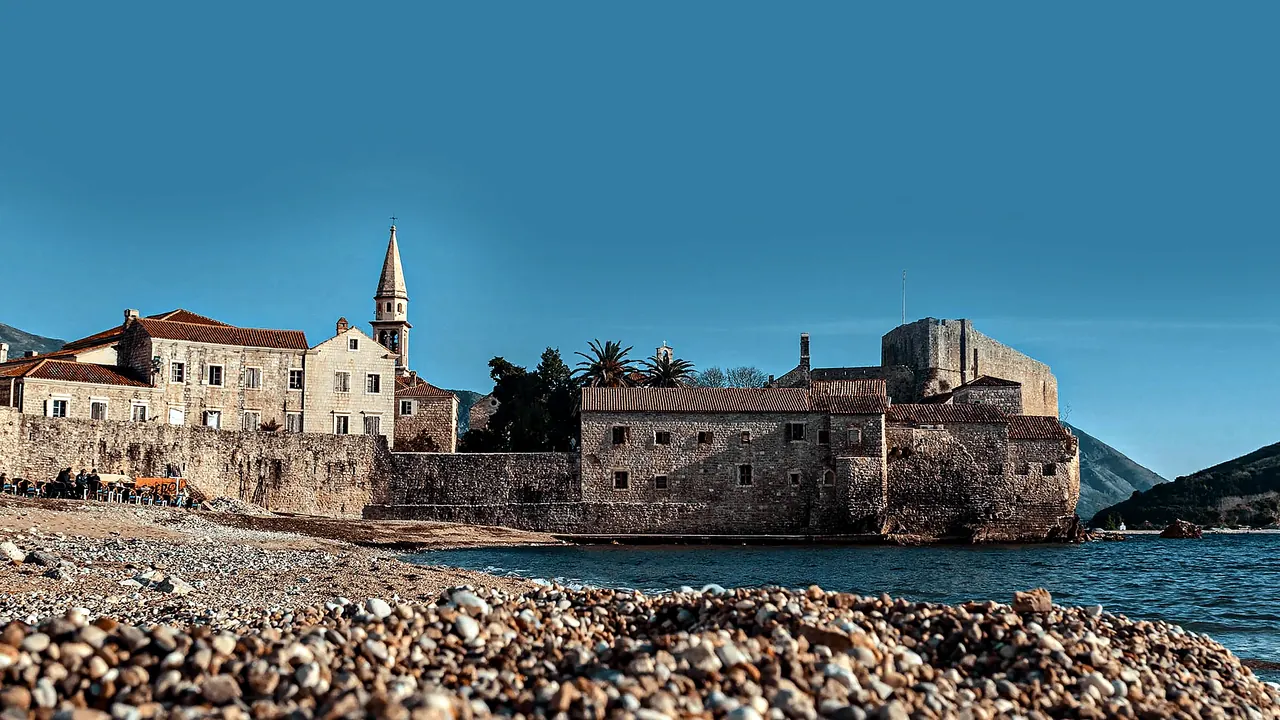
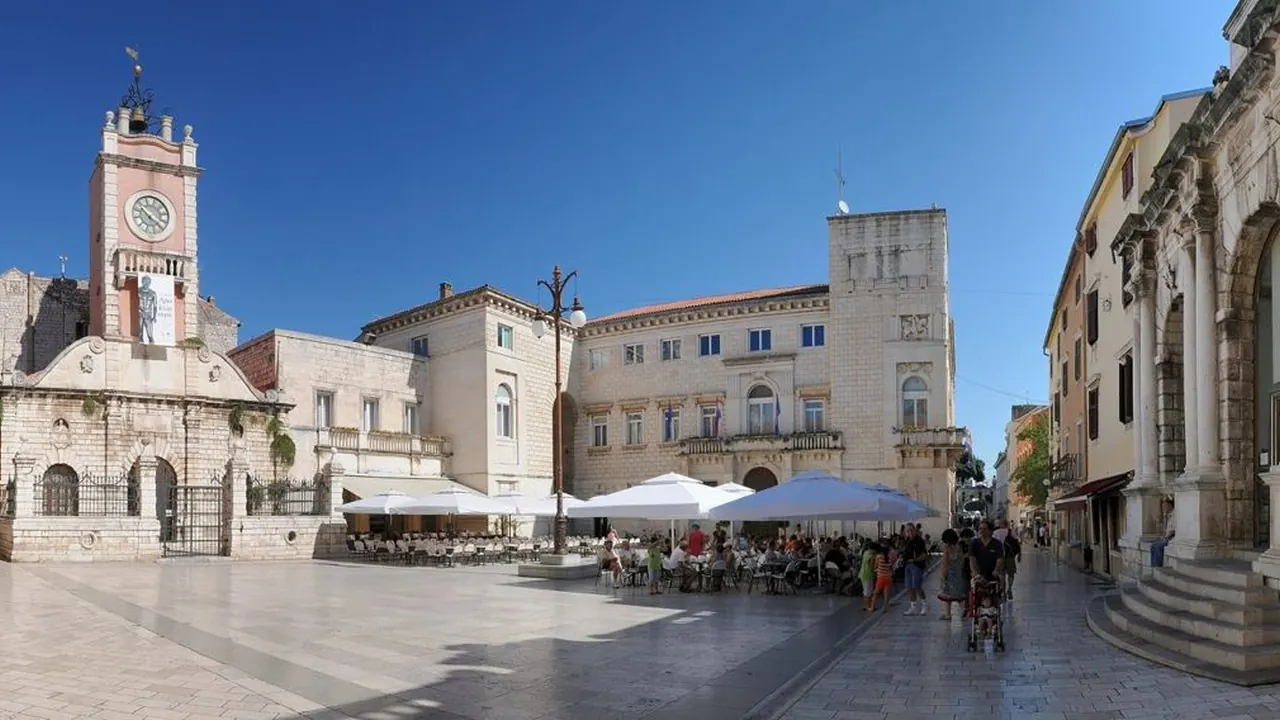
Photos: Budva by Ender Vatan, Pexels License; Zadar by Böhringer Friedrich, CC BY-SA 2.5, cropped.
Budva or Zadar?
Our verdict in twelve categories, each scored against the same fixed benchmark cities, and the climate month by month, so you can choose for your trip.
Choose Budva for
- nightlife
- beaches
- prices
Budva suits a sun-and-sea trip with long nights out. Beaches run right along the town and on down a coast of coves and sandy bays, the summer party scene is the loudest on this stretch of the Adriatic, and Kotor and Lovcen are close enough for days off the sunbed. Away from the seafront it is also a little easier on the budget.
Choose Zadar for
- culture and sights
- getting around
- nature and the outdoors
Choose Zadar if you want more to do between swims. Its walled peninsula holds a Roman forum, the round Church of St Donatus and good small museums, all on a flat, car-free walk. The cooking is a step better, and Paklenica, the Kornati islands and Krka put serious hiking and sailing within reach. Evenings are calmer, which suits couples and families better than party groups.
Scoreboard
Twelve categories on one fixed scale from 0 to 100. The shaded stretch is the gap between the two.
Your match
Pick a travel style or drag the sliders, and both match scores follow your weighting.
Wins on nightlife and beaches with your weighting.
Wins on culture and sights and getting around with your weighting.
What matters to you?
Category by category
What the scores mean for a trip.
Beaches & swimming
Budva has the edge. Swimming is right in town: Slovenska Plaza lines the whole seafront and Mogren's coves sit just past the walls. A short ride brings the long curve of Becici, the open bay at Jaz and the pinkish sand facing Sveti Stefan. The sea is a touch warmer and often stays swimmable into October.
In Zadar you swim off the stone promenade or from the concrete platforms at Kolovare and Borik. The sandy beaches need a trip: Nin's shallows to the north, or a ferry to Sakarun on Dugi Otok. Both places get crowded in high summer.
Food & drink
Zadar eats better, though neither is a food destination. Dalmatian cooking here means lamb or octopus slow-cooked under the peka bell, Pag cheese and pršut, and Maraschino, the cherry liqueur that was first made in the city. The market by the walls makes a good morning out.
In Budva the promenade restaurants are uneven and aimed at summer crowds. The rewarding food is regional: smoked Njegusi ham, grilled squid at family konobas and a glass of Vranac red. You will have to look harder for it.
Culture & sights
There is far more to see in Zadar. Within its small walled peninsula are the open Roman forum, St Donatus, the Cathedral of St Anastasia with a bell tower you can climb, and the UNESCO-listed Venetian fortifications. The glass and archaeology museums are good, and the Sea Organ adds a modern touch on the waterfront.
Budva's Stari Grad is attractive but small. Much of it was rebuilt after the 1979 earthquake, and you can see it in a morning, with the Citadel and a small archaeological museum. The major heritage on this coast lies in Kotor and Cetinje, not in Budva itself.
Nightlife
Budva is the party town. In summer the beach bars and terrace clubs along Slovenska Plaza play loud pop and house, and a large open-air club on the hill keeps going until dawn. It is ideal for groups of friends.
Zadar's evenings start at sunset by the Sea Organ and move on to café-bars on Kalelarga and terraces on the walls. It is relaxed rather than wild. Anyone after real clubbing goes to Zrće on Pag, about an hour away. Both towns go quiet from October.
Nature & outdoors
Zadar is the stronger outdoor base. Paklenica's limestone gorges, about 45 minutes away, offer some of Croatia's best climbing and hiking. Boats and sailing charters head out to the bare Kornati islands and the cliffs of Telašćica, and Krka and Plitvice are within a day's reach.
Budva's setting is dramatic, with bare mountains rising straight behind the beach. Lovcen's beech forest and Lake Skadar's reed beds are each about an hour away. Nearer town, the outdoor options are coastal paths, sea kayaking and paragliding above Becici.
Day trips
Both make good bases, but in different ways. From Budva the best trips are short. Kotor's walls and its fjord-like bay are half an hour away, with Perast beyond, and Cetinje, the old royal capital, is under an hour. Dubrovnik means a long day and a border crossing.
Zadar's highlights are further off, with Šibenik's cathedral an hour south and Split and Trogir making long days. In return it has ferries from the old town to Ugljan, Pašman and car-free Silba, and the island trips give it a different, more nautical feel.
Good for families
Both are easy with children and neither has a zoo or aquarium, so family time is mostly spent by the sea. Budva has gently shelving town beaches and a water park, but its summer nights are loud. Families usually do better staying in Becici.
Zadar is calmer and easier on foot. Its flat, car-free old town works well with pushchairs. Children love the Sea Organ and the glowing Greeting to the Sun, Nin's sandy shallows are ideal for toddlers, and short ferry rides feel like an adventure.
Getting around
Zadar is easier to get around. The old town is a flat pedestrian peninsula you can cross in a quarter of an hour. A footbridge links it to the mainland side, and island ferries leave from its edge.
Budva's centre is compact and walkable too, and boat taxis serve the nearby coves. But there is no railway, and the single coast road jams badly in summer. In both places a car or an organised trip makes the national parks far simpler.
Shopping & style
Neither is a shopping trip. Budva's old town lanes and promenade stalls mostly sell beachwear, sunglasses, silver filigree and rakija. Zadar has a little more: jewellers and a few galleries on the marble Kalelarga, plus Pag lace, Maraschino and cheese to take home.
Affordability
Budva works out slightly cheaper overall, even though it is Montenegro's priciest town. Away from the seafront, bakeries, grill houses, buses and apartments a few streets back cost less than on most Western European coasts.
Zadar costs about what a mid-range Western European city does. Ferries and local buses are inexpensive, but national park tickets and boat excursions add up quickly. In both, June and September are noticeably cheaper than July and August.
Live music & performing arts
Zadar offers a little more. Its Musical Evenings in St Donatus bring early and chamber music into the ninth-century church, klapa singing turns up in summer squares, and a small national theatre stages drama during the season.
Budva has only Grad Teatar, its long-running summer festival of theatre and concerts in the old town squares. The rest of the year, live music means cover bands in seafront bars.
Wellness & relaxation
Zadar is the more restful of the two. Neither has a spa tradition, but Zadar adds a slow daily rhythm, from long café mornings to sunset on the Sea Organ steps, and the mineral mud of the lagoon at Nin.
In Budva, relaxing means the resort spas at Becici and Sveti Stefan. In high summer, music from the seafront carries late into the night, so the town is calmest in May, June or late September.
When should you go?
Pick your month. The climate figures are measured averages, not a forecast.
Budva in July
Zadar in July
Daytime high, °C
Rainfall in the month, mm
Where the figures come from
Budva has no rain gauge within 25 km of the centre, so its rainfall comes from a gridded climate dataset read at the city rather than from a gauge further away.
Budva's sunshine is measured 40 km from the centre, at Podgorica-Grad.
Zadar has no rain gauge within 25 km of the centre, so its rainfall comes from a gridded climate dataset read at the city rather than from a gauge further away.
Temperature and rainfall are climate normals, averaged over the years shown. Budva: 1991-2020 normals, Tivat (15.8 km from centre). Zadar: 1999-2020 (rainfall 1991-2020) normals, Zadar / Zemunik (9.9 km from centre).
Both are summer destinations with almost the same rhythm. From June to September the sea is warm enough for easy swimming. It peaks around 26°C at Budva in August and runs a degree cooler at Zadar. July and August afternoons pass 30°C in both, which is hot for sightseeing on stone streets. May and late September are better for walking, and the sea is still pleasant in September.
The real difference is the rain. Both turn wet from September, but Budva, with mountains rising straight behind it, gets far more: about 212mm in November, nearly twice Zadar's total. In return Budva's high summer is very bright, with over 300 hours of sunshine in July and in August. Zadar's winter is a little cooler, with January highs near 10°C, but drier, so an off-season city stay works better there.
Which traveller are you?
On a beach and sun trip, Budva is the better pick. Its sand and pebble beaches start right at the old town walls and continue to Becici and Sveti Stefan, and the sea stays swimmable a little later into autumn.
For a culture and arts trip, Zadar wins clearly. A Roman forum, a ninth-century church, UNESCO-listed Venetian walls, the Museum of Ancient Glass and summer chamber concerts fill two full days. Budva's old town takes a couple of hours.
On an outdoors trip, Zadar gives you more. Paklenica's gorges offer hiking and climbing, the Kornati and Telašćica are reached by boat, and Krka's waterfalls are an hour away. Budva has Lovcen and Lake Skadar, but less variety.
Before you go
| Measure | Budva | Zadar |
|---|---|---|
| Official language | Montenegrin | Croatian |
| Currency | Euro (EUR) | Euro (EUR) |
| Sockets | CF230 V, 50 Hz | CF230 V, 50 Hz |
| Driving side | Right | Right |
| Time zone | UTC+1, UTC+2 in summer | UTC+1, UTC+2 in summer |
| Emergency number | 112 | 112 |
| Elevation | 3 m | 5 m |
| Main airport | Tivat Airport (TIV)17 km from centre42 non-stop destinations | Zadar Airport (ZAD)10 km from centre66 non-stop destinations |
| Public holidays this year | - | 14 days |
By the numbers
| Measure | Budva | Zadar |
|---|---|---|
| City population | 13,338 | 70,779 |
| People per km² | 109 | - |
| Museums within 10 km | 0 | 1 |
| UNESCO World Heritage sites within 50 km | 3 | 2 |
| Swim season, months above 21 °C | 5 months | 4 months |
Where else could you go?
Every comparison below shares a destination with this one, so you can follow Budva or Zadar somewhere new.