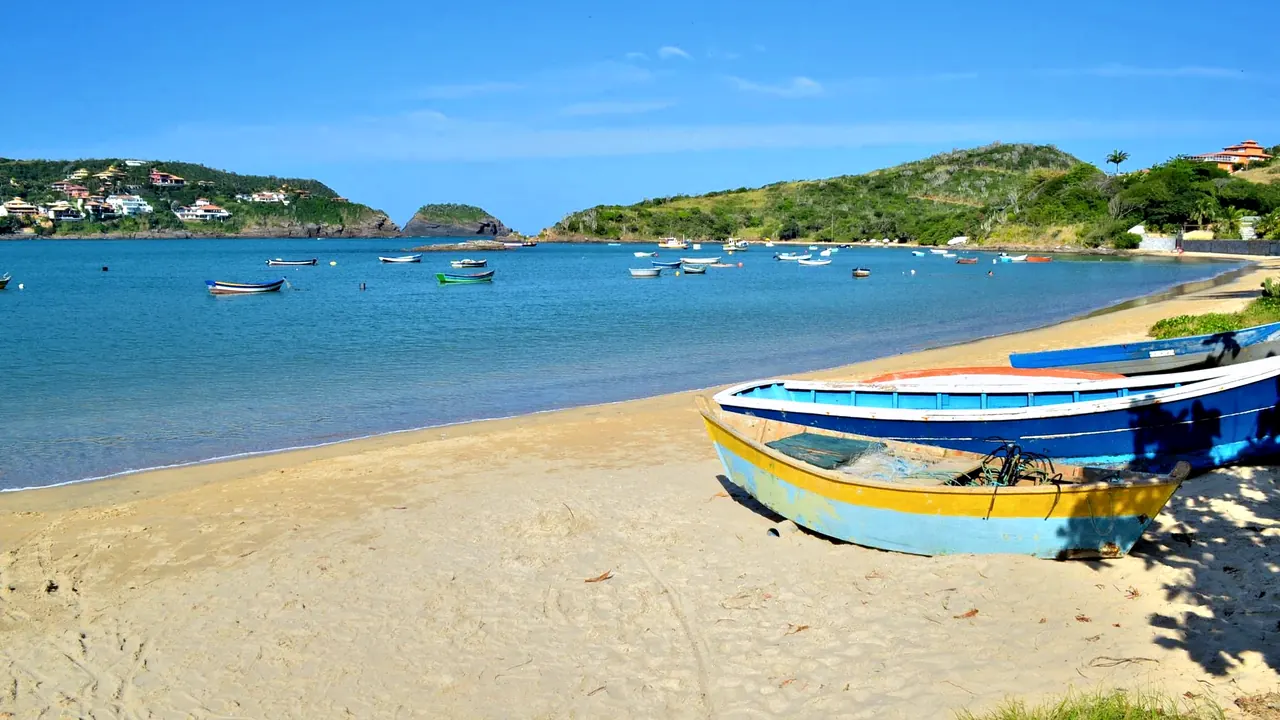
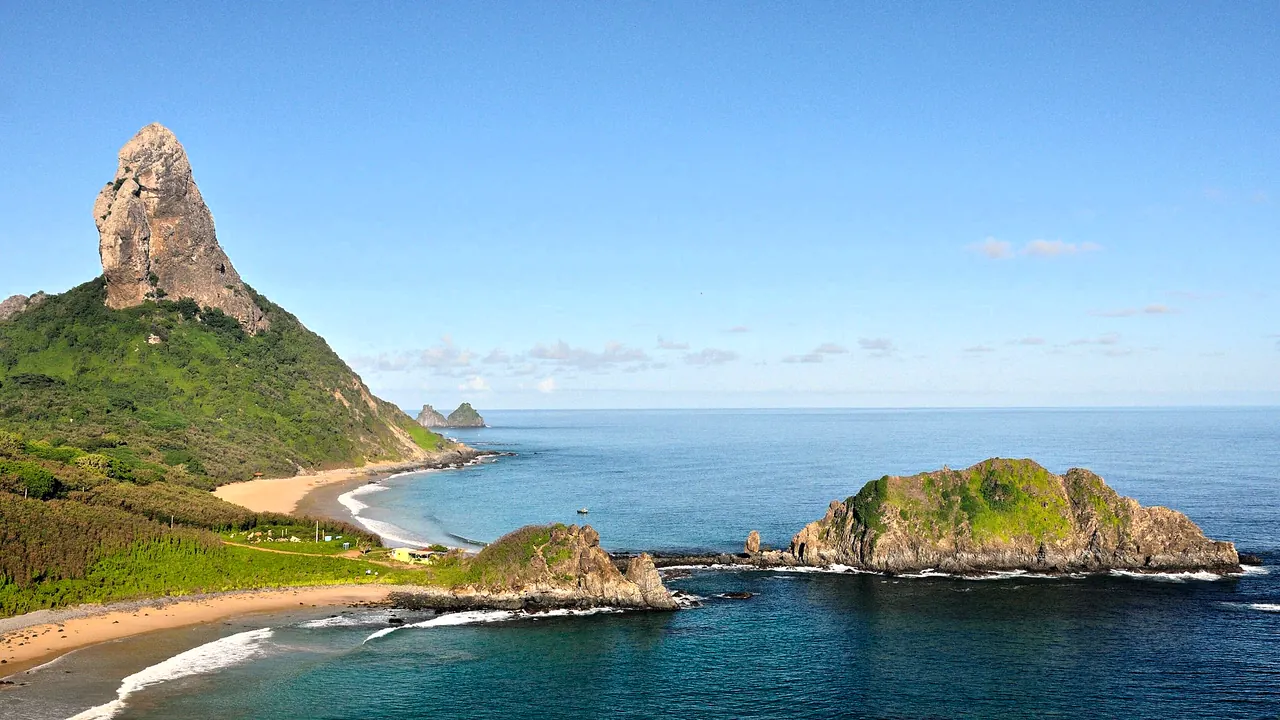
Photos: Buzios by Alberto1939, CC BY-SA 4.0, cropped; Fernando de Noronha by Brunno Monteiro Lira, CC BY-SA 3.0, cropped.
Buzios or Fernando de Noronha?
Our verdict in twelve categories, each scored against the same fixed benchmark cities, and the climate month by month, so you can choose for your trip.
Choose Buzios for
- prices
- nightlife
- shopping
Buzios suits travellers who want the beach by day and a proper evening afterwards. The peninsula offers a different cove every morning, the restaurants and bars of Rua das Pedras keep going late in summer, the boutiques stay open for a stroll after dinner, and getting there is a road transfer from Rio rather than a flight. It is also the easier of the two on the wallet, and families with small children do well in its calm bay coves.
Choose Fernando de Noronha for
- nature and the outdoors
- getting around
- beaches
Choose Fernando de Noronha when the sea itself is the trip. The water is warmer and clearer, the beaches never feel crowded because visitor numbers are capped, and dolphins, turtles and reef sharks are part of an ordinary day. In return you accept quiet nights, almost nothing to buy and one of the costliest stays in Brazil. That makes it a special trip for divers, snorkellers and couples rather than a casual week away.
Scoreboard
Twelve categories on one fixed scale from 0 to 100. The shaded stretch is the gap between the two.
Your match
Pick a travel style or drag the sliders, and both match scores follow your weighting.
Wins on prices and nightlife with your weighting.
Wins on nature and the outdoors and getting around with your weighting.
What matters to you?
Category by category
What the scores mean for a trip.
Beaches & swimming
Both are beach destinations first, but Noronha has the better water. Its sea stays warm all year and is often clear to the bottom at depth, and the sheltered inner coast has Baía do Sancho, reached down ladders through the cliff, and Baía dos Porcos under the twin peaks of Dois Irmãos. Because visitor numbers are capped, even these famous bays never fill up.
Buzios makes up in choice what it lacks in warmth. More than twenty beaches ring the peninsula, with calm bay coves such as Ferradura and Azeda on one side and long, surfable, sociable Geriba on the other. Upwelling can leave the water surprisingly cool, though, and the coves get crowded at summer weekends.
Food & drink
Buzios eats better and more widely. Its years as a resort for visitors from Rio and Argentina left a long run of restaurants along Rua das Pedras and the Orla Bardot, with grilled fish, moqueca and Mediterranean-leaning menus served at tables facing the sunset.
Noronha leans more on the cooking of Brazil's Northeast, with cashew, coconut and tapioca alongside the catch of the day, and a chef-led dinner at a pousada can be a highlight. Because nearly everything is shipped in, though, the menus start to repeat within a week. Neither place is worth planning a trip around for food.
Culture & sights
Neither is a place for sightseeing, and an hour covers what each has. What differs is the story behind it. Buzios is a fishing village turned resort: a few low whitewashed lanes, the chapel of Sant'Ana on its hill above the bay, painted boats drawn up on Ossos beach and the bronze Bardot on the waterfront, a reminder of the 1960s stay that made the town famous.
Noronha's past is military and penal. In Vila dos Remédios the whitewashed church of Nossa Senhora dos Remédios still stands by a small square, while the fort above the bay survives only as ruins. Both date from when the Portuguese fortified the island in the eighteenth century, before it became a prison and later a wartime base.
Nightlife
Buzios is the only one of the two with a night out worth the name. In summer a well-dressed crowd fills Rua das Pedras after a late dinner and moves on to lounge bars and small clubs, and New Year and Carnival bring beach parties. Out of season it shrinks to a drink by the water.
Noronha's evening peaks at sunset, with a drink at the old fort at Boldró, followed by a few bars in the village and forró on some nights. Most people are asleep early, ready for morning dives.
Nature & outdoors
Noronha is the stronger place for nature, and almost all of it is underwater. Most of the archipelago is a marine national park. Spinner dolphins gather at dawn in Baía dos Golfinhos, reef sharks and turtles feed close to shore, and the diving among reefs, walls and a shipwreck is among Brazil's best. On land, guided trails to cliffs and seabird colonies fill a few days.
Buzios offers a gentler version from schooners and snorkelling stops in the bay, and it has something Noronha does not: steady wind at Rasa and Manguinhos for kitesurfing and windsurfing. For serious diving, its divers head to Arraial do Cabo, under an hour away.
Day trips
Buzios at least has a few places within reach. Cabo Frio, half an hour away, has a seventeenth-century fort at the mouth of its canal, and Arraial do Cabo is good for boat trips. Rio is too far for a day out. Noronha has no day trips at all. It is a lone inhabited island far out in the Atlantic, so every outing is a boat tour, a dive or a trail on the island itself.
Good for families
Buzios is easier with young children. The bay coves at Ferradura, Joao Fernandes and Tartaruga are shallow and calm, pousadas with pools are common, and restaurants welcome children late into the evening. Getting between beaches does mean hills and taxis.
Noronha rewards school-age children and teenagers who love the water more than toddlers. Turtles at Sueste, low-tide pools at Atalaia and evening talks at the turtle conservation centre leave a lasting impression, but steep ladders, hot trail walks and summer swells take more care. Neither has attractions built for children.
Getting around
Noronha is the simpler place to get around once you have arrived. The island is about 10km long, with one paved road, a local bus and plenty of taxis, and a rented buggy puts every bay within minutes. The effort comes at the end, on dirt tracks and cliff steps down to the sand.
Buzios spreads across a hilly peninsula with sparse buses and some roads without pavements, so beyond its walkable centre you rely on taxis, buggies or the water taxis between bay beaches. Getting there is a three-hour road transfer from Rio, against a flight from Recife or Natal for Noronha.
Shopping & style
Buzios is a pleasant place to browse. The lanes around Rua das Pedras have Brazilian swimwear labels, linen, jewellery and a few galleries, open late after dinner, plus an evening craft fair. Noronha has only a handful of boutiques selling beachwear, surf clothing and crafts at shipped-in prices, so it pays to arrive with sun cream and snorkel gear already packed.
Affordability
Neither is cheap, but Buzios is far easier to afford. It costs about as much as a mid-range trip in Southern Europe, and beach kiosks, per-kilo lunches and the quieter months from April to November bring it down further.
Noronha is one of the most expensive trips in Brazil. Every visitor pays a daily environmental charge and a marine park fee, and even simple pousadas, food, boat trips and dives carry island prices. Family-run guesthouses help a little, but there is no budget way to do it.
Live music & performing arts
Neither has a theatre or concert programme, and Buzios offers slightly more. On summer evenings musicians play bossa nova and samba in its waterfront restaurants as a backdrop to dinner. On Noronha, live music is mostly a forró band or an acoustic set at a village bar some nights, which at least gets visitors and islanders dancing together.
Wellness & relaxation
Both offer rest through their pace rather than through treatments, with small spas and massage rooms in the better pousadas. What sets them apart is how reliable the quiet is. On Noronha it comes built in: capped visitor numbers, a tiny village, yoga decks over the sea and days that end early.
In Buzios the calm depends on when you go and where you stay. Between April and November it is very restful, but in high season the centre and the popular beaches get loud, so a quiet stay means a hillside pousada away from Rua das Pedras.
When should you go?
Pick your month. The climate figures are measured averages, not a forecast.
Buzios in July
Fernando de Noronha in July
Daytime high, °C
Rainfall in the month, mm
Where the figures come from
Buzios's temperatures are measured 46 km from the centre, at Macae / Barra.
Buzios has no rain gauge within 25 km of the centre, so its rainfall comes from a gridded climate dataset read at the destination rather than from a gauge further away.
Fernando de Noronha has no rain gauge within 25 km of the centre, so its rainfall comes from a gridded climate dataset read at the destination rather than from a gauge further away.
Temperature and rainfall are climate normals, averaged over the years shown. Buzios: 2007-2020 (rainfall 1991-2020) normals, Macae / Barra (45.7 km from centre). Fernando de Noronha: 1943-2025, 29 years observed (rainfall 1991-2020) normals, Fernando De Noronha (0.4 km from centre).
Buzios is warm all year, but December to March is both its hottest and its wettest stretch, with highs near 33°C in February and around 191mm of rain in March. From June to September the rain mostly stops and the days are comfortable for walking, but the sea, never truly tropical here, drops to about 21°C. April and May are a good balance: the sea is still at its warmest and the rain is easing.
On Noronha the temperature barely moves through the year, and the sea stays warm enough to swim in every month. What matters is the rain. It falls heavily from March to July, peaking near 299mm in April, while August to January is dry. The two rainy seasons fall almost opposite each other. Noronha's driest months, October to December, are when Buzios is getting wetter, and Buzios's dry winter coincides with the tail of Noronha's rains.
Which traveller are you?
For a food and nightlife trip, Buzios is the clear choice. Rua das Pedras gives you seafood dinners over the bay followed by lounge bars and small clubs into the early hours in summer, while Noronha's evenings end with forró and an early night.
On a tight budget, Buzios is the only realistic option of the two. Beach kiosks, per-kilo lunches and the quieter months from April to November keep it manageable, whereas Noronha adds daily visitor charges to costs that are high across the board.
For an outdoors trip built around the sea, choose Fernando de Noronha. A protected marine park, dolphins at dawn, turtles and sharks in the shallows and some of Brazil's finest diving outclass anything around Buzios, though kitesurfers will find the wind at Rasa and Manguinhos.
Before you go
| Measure | Buzios | Fernando de Noronha |
|---|---|---|
| Official language | Portuguese | Portuguese |
| Currency | Brazilian Real (BRL) | Brazilian Real (BRL) |
| Sockets | CN60 Hz | CN60 Hz |
| Driving side | Right | Right |
| Time zone | UTC-3 | UTC-2 |
| Emergency number | Police 190, ambulance 192, fire 193 | Police 190, ambulance 192, fire 193 |
| Elevation | 5 m | - |
| Main airport | Rio de Janeiro Galeão – Tom Jobim International Airport (GIG)140 km from centre54 non-stop destinations | Fernando de Noronha Airport (FEN)2 non-stop destinations |
| Public holidays this year | 14 days | 14 days |
By the numbers
| Measure | Buzios | Fernando de Noronha |
|---|---|---|
| Population | 40,006 | 3,167 |
| People per km² | 577 | 122 |
| Museums within 10 km | 0 | - |
| UNESCO World Heritage sites within 50 km | 0 | - |
| Swim season, months above 21 °C | 12 months | 12 months |
Where else could you go?
Every comparison below shares a destination with this one, so you can follow Buzios or Fernando de Noronha somewhere new.
- Rio de Janeirovs Buzios
- Paratyvs Buzios
- Sao Paulovs Buzios
- Florianopolisvs Buzios
- Salvadorvs Buzios
- Punta del Estevs Buzios