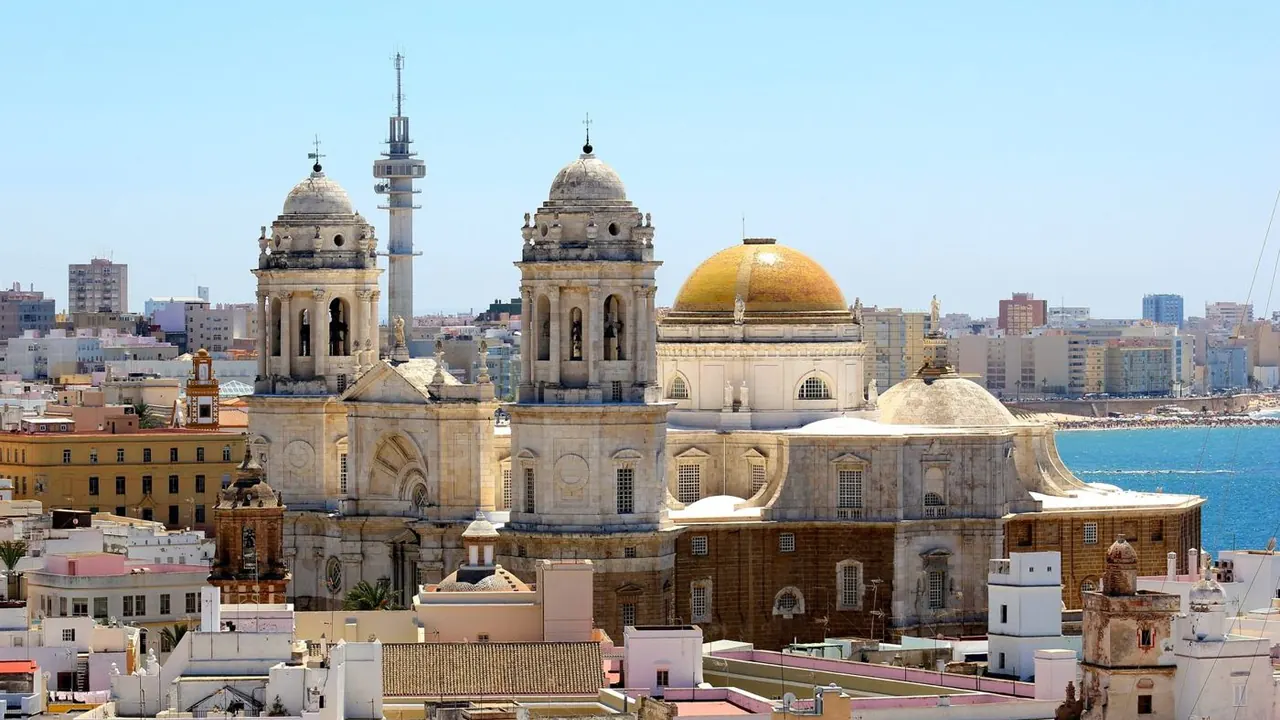
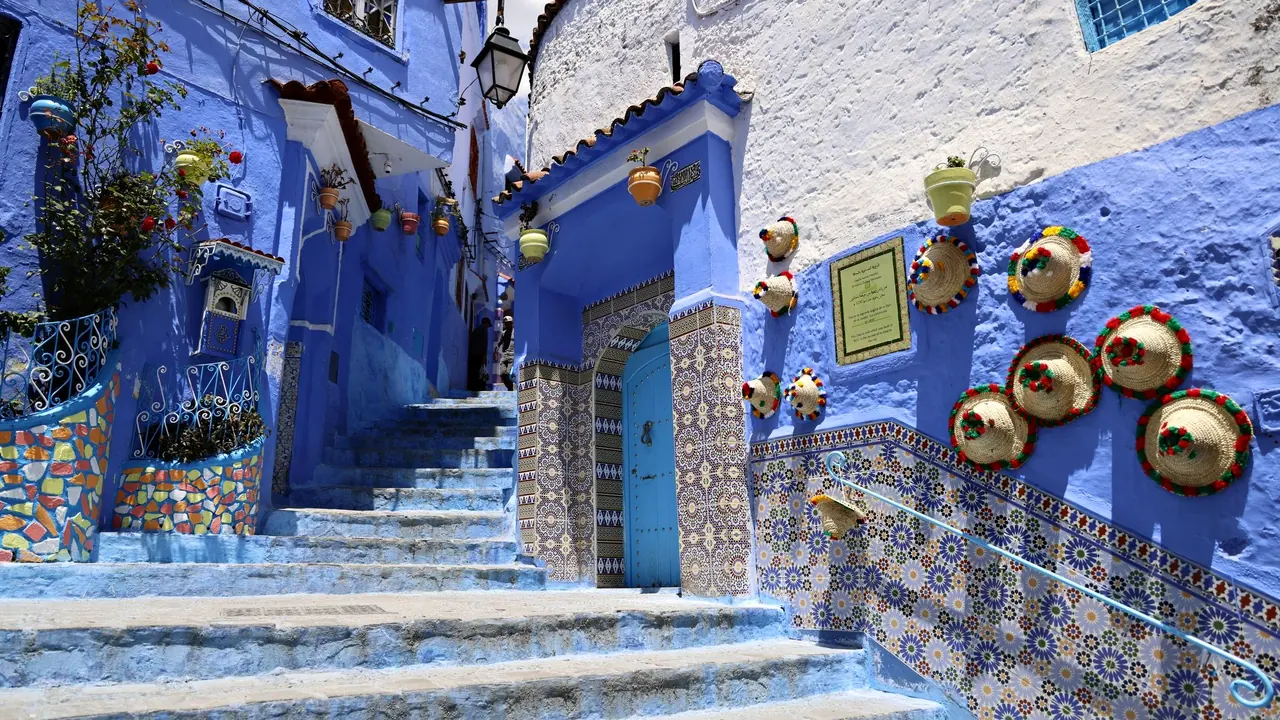
Photos: Cadiz by Bronch, CC BY-SA 3.0 ES, cropped; Chefchaouen by Christophe RASCLE, Pexels License.
Cadiz or Chefchaouen?
Our verdict in twelve categories, each scored against the same fixed benchmark cities, and the climate month by month, so you can choose for your trip.
Choose Cadiz for
- beaches
- day trips
- live music and the arts
Cadiz is the choice when the sea is at the heart of the trip. It has a swimming cove inside the old town, long Atlantic sand a short bus ride away, fried fish and sherry in the evening, and trains to Jerez and Seville for days out. It also suits families, travellers who want several days of sightseeing rather than one, and anyone who likes to stay out on warm summer nights.
Choose Chefchaouen for
- prices
- wellness
- nature and the outdoors
Pick Chefchaouen for a slow, inexpensive stop in the Rif mountains. The blue medina is the sight, and the hill paths start at the edge of town. It rewards photographers, walkers heading for Talassemtane and travellers on a route through northern Morocco. Expect quiet, alcohol-free evenings, plain food and not much left to see after two or three days.
Scoreboard
Twelve categories on one fixed scale from 0 to 100. The shaded stretch is the gap between the two.
Your match
Pick a travel style or drag the sliders, and both match scores follow your weighting.
Wins on beaches and day trips with your weighting.
Wins on prices and wellness with your weighting.
What matters to you?
Category by category
What the scores mean for a trip.
Beaches & swimming
These two are hardly comparable for swimming. Cadiz is surrounded by water. You can swim at La Caleta, the sheltered cove between two castles in the old town, or at Playa Victoria, kilometres of fine sand along the newer city. Beyond that, the Costa de la Luz stretches south to El Palmar, Zahara and Bolonia. The levante wind is the only real drawback.
Chefchaouen is a mountain town with no beach of its own. The grey sand at Oued Laou, down a gorge road, is a day out by grand taxi. The river pools at Akchour are cold and shallow, more a dip than a swim.
Food & drink
Cadiz eats far better. Its strength is seafood: paper cones of fried fish, shrimp fritters, marinated dogfish and bluefin tuna from the trap fisheries. All of it comes with fino or manzanilla from the sherry towns nearby, and the Mercado Central adds food counters later in the day.
Chefchaouen's restaurants repeat the same tagines, couscous and kefta from one lane to the next. The best eating is simple and local: Rif goat cheese in palm leaf, bissara for breakfast and bread from the communal ovens. Wine with dinner is mostly out of reach.
Culture & sights
Cadiz has more history to explore. Phoenician sarcophagi fill the Museo de Cádiz, a Roman theatre lies in the Barrio del Pópulo, and the gold-domed cathedral faces the sea. The Oratorio where the 1812 constitution was signed and the camera obscura in the Torre Tavira are both worth a visit. Together they fill two or three days.
In Chefchaouen the blue lanes are the main attraction, and they reward slow wandering with a camera. The kasbah and its small museum are the only formal sight. After that come the Ras el-Maa spring and the sunset view from the Spanish Mosque, and most people have seen it all within a day or two.
Nightlife
Neither is a party town, but Cadiz at least has evenings out. Tapas bars in La Viña and around Plaza de San Francisco stay busy late, the Playa Victoria promenade keeps going into the early hours in summer, and Carnival in February turns the whole city into a street party.
In Chefchaouen, an evening means dinner, mint tea in Outa el-Hammam square and a walk through the lit lanes. Apart from a couple of hotel bars there is nowhere to drink.
Nature & outdoors
Both are strong for the outdoors, but the landscapes are very different. In Cadiz, nature means flat water and coast: flamingos and spoonbills in the salt pans of the bay, the cliff-top pines of La Breña, kitesurfing and whale-watching from Tarifa. Real mountains are two hours away in Grazalema.
Chefchaouen is mountain country from the doorstep, with paths climbing from Ras el-Maa into the Rif. Talassemtane National Park, near Akchour, has its gorge, waterfalls, God's Bridge and Barbary macaques. Trails are poorly marked, so a local guide helps.
Day trips
Cadiz is the far better base. There are sherry bodegas in Jerez, El Puerto and Sanlúcar, Seville is under two hours by train, and by car you reach white hilltop towns such as Vejer and Arcos and the Roman ruins of Baelo Claudia.
From Chefchaouen there is really one good outing: Tetouan's large, little-visited medina. Tangier and Fes are each about three hours away, too far to go and come back in a day, so they work better as the next stop on a route.
Good for families
Cadiz is much easier with children. Playa Victoria has lifeguards and room to spread out, La Caleta is calm for little ones, and the flat old town and shady parks like the Genovés make pushchairs simple.
Chefchaouen is friendly towards children but tiring for them. The lanes are steep and stepped, there is little to keep young children busy, and adults get persistent offers of hashish. It suits older children who can walk, ideally on a short stop.
Getting around
Cadiz is the easier place to get around, and the easier place to leave. Trains run straight out of the old town to Jerez and Seville, a catamaran crosses the bay to El Puerto and Rota, and city buses run the length of the isthmus to Playa Victoria. The old town itself is flat and mostly closed to cars. Only the Costa de la Luz beaches, the white towns and Tarifa really need a hire car.
Chefchaouen's medina takes about fifteen minutes to cross on foot, but nearly every route climbs stairs and polished steps, which is hard going with luggage or for anyone unsteady on their feet. Within town there is no public transport to speak of, and there is no railway. Petit taxis run to the medina gates, and Tetouan is an easy bus ride away, but Akchour means a shared grand taxi or a hired driver.
Shopping & style
Neither is a place to shop seriously, but what each offers is different. Cadiz has Spanish chains and family shops on Calle Ancha, and the best things to take home are fans, ceramics, flamenco dresses and sherry. Anything grander means a trip to Seville.
Chefchaouen's lanes sell crafts made in the region: Rif blankets and weavings from looms in the shopfronts, djellabas, leather slippers and the blue pigment itself. Bargaining here is gentler than in the big souks.
Affordability
Chefchaouen is clearly the cheaper stay, mainly because rooms in its guesthouses and riads cost so little. Meals and shared taxis are cheap too, and walking the town costs nothing.
Cadiz is good value at the table, with tapas, freidurías and sherry costing less than in most of Western Europe. Old-town hotels are scarce, though, and fill up in July, August and Carnival week. Staying near Playa Victoria or coming outside summer keeps costs down.
Live music & performing arts
Cadiz has a real stage life, and Chefchaouen has almost none. Cadiz is one of the homes of flamenco: the peñas of the Santa María quarter put on alegrías for audiences who know the forms. The Gran Teatro Falla hosts the Carnival chirigota contest, an autumn festival of Ibero-American theatre and plays all year.
Chefchaouen has no theatre or concert hall. Andalusian music turns up at the odd festival, and on most evenings the call to prayer is all you hear.
Wellness & relaxation
The two are broadly level, and both offer an unhurried pace more than treatments. In Cadiz, relaxing means sea walls, long lunches and the siesta. For a spa you drive to Novo Sancti Petri or go to the Arab baths in Jerez.
Chefchaouen has a slight edge. Its neighbourhood hammams give a real scrub for very little, and roof terraces with cool mountain air make it easy to stay longer than planned. Polished spa treatments are rare.
When should you go?
Pick your month. The climate figures are measured averages, not a forecast.
Cadiz in July
Chefchaouen in July
Daytime high, °C
Rainfall in the month, mm
Where the figures come from
Chefchaouen has no weather station within reach, so its figures come from a gridded climate model rather than a measured record, and read a broad area rather than the city itself.
Temperature and rainfall are climate normals, averaged over the years shown. Cadiz: 1991-2020 (sunshine 1961-1990) normals, Cadiz Bay / Puntales (5.2 km from centre). Chefchaouen: 2001-2020 normals, NASA POWER reanalysis grid, no weather station within 90 km.
Cadiz is a summer beach town. From June to early October the Atlantic is warm enough to swim, peaking at 23°C in July and August, when daytime highs sit around 28°C and almost no rain falls. These are also the sunniest months. Rain arrives in October and peaks in November. Winters stay mild at about 16°C, which is cool for the beach but fine for walking the old town.
Chefchaouen runs to wider extremes. July and August reach 35°C, which is too hot for climbing the medina stairs or walking the valleys at midday, although the coast at Oued Laou warms up for a swim. Winter is cold and wet, with 141mm of rain in November. The best months are May and September, which are warm and fairly dry, and suit both the lanes and the trails.
Which traveller are you?
For a beach and sun trip, Cadiz wins easily. La Caleta and Playa Victoria are both in the city, the Costa de la Luz strands are an hour away, and summer is dry and sunny. Chefchaouen's nearest beach is a winding taxi ride down to the coast.
For a food and nightlife trip, Cadiz again. You get almadraba tuna, freidurías, cold manzanilla and late evenings in La Viña or on the Playa Victoria promenade. In Chefchaouen, dinner means the same tagine menus, alcohol is scarce and the medina is silent by late evening.
On a trip with a tight budget, Chefchaouen goes much further. Guesthouses and riads cost a fraction of European rates, meals in the square are cheap and the town itself is free to explore. In Cadiz tapas are cheap, but rooms are dear in summer.
Before you go
| Measure | Cadiz | Chefchaouen |
|---|---|---|
| Official language | Spanish | Arabic, Standard Moroccan Tamazight |
| Currency | Euro (EUR) | Moroccan Dirham (MAD) |
| Sockets | CF230 V, 50 Hz | CE50 Hz |
| Driving side | Right | Right |
| Time zone | UTC+1, UTC+2 in summer | UTC+1 |
| Emergency number | 112 | Police 19/112, ambulance 15, fire 15 |
| Elevation | 11 m | 564 m |
| Main airport | Jerez Airport (XRY)31 km from centre26 non-stop destinations | Tangier Ibn Battuta Airport (TNG)86 km from centre50 non-stop destinations |
| Public holidays this year | 12 days | 11 days |
By the numbers
| Measure | Cadiz | Chefchaouen |
|---|---|---|
| City population | 109,950 | 46,168 |
| People per km² | 9,087 | 2,998 |
| Museums within 10 km | 12 | 1 |
| UNESCO World Heritage sites within 50 km | 0 | 1 |
| Swim season, months above 21 °C | 3 months | 3 months |
Where else could you go?
Every comparison below shares a destination with this one, so you can follow Cadiz or Chefchaouen somewhere new.