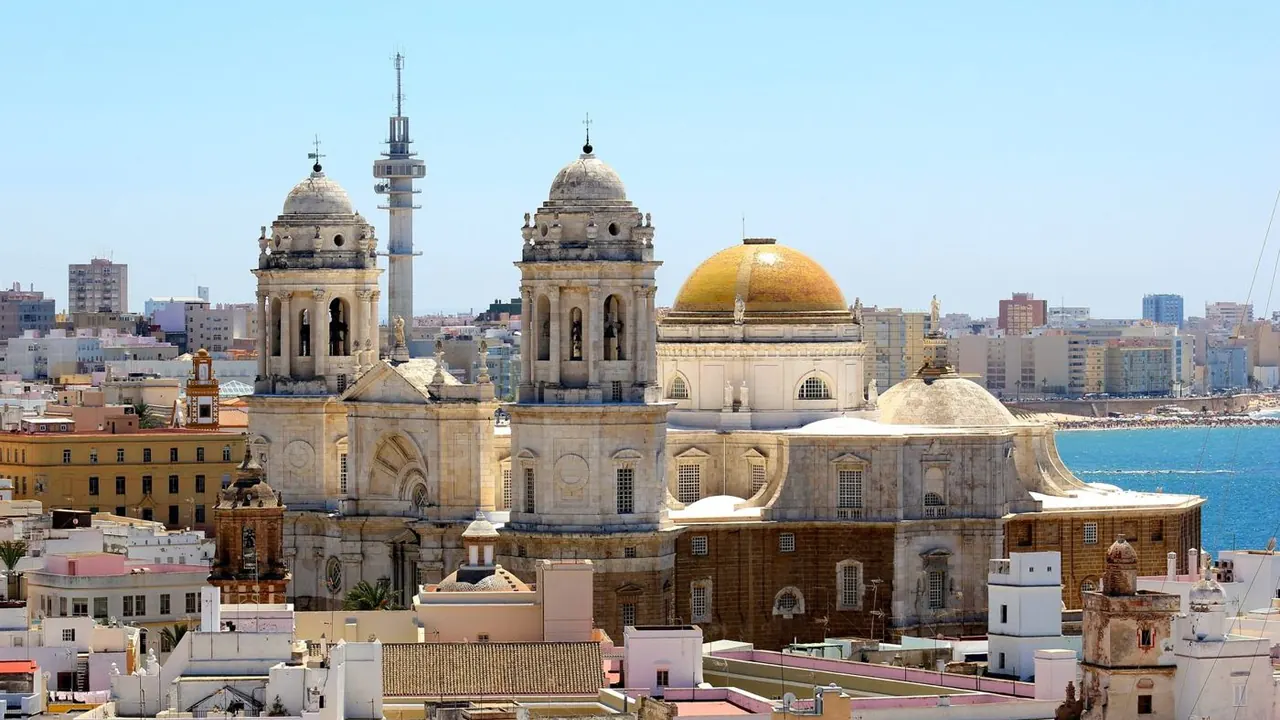

Photos: Cadiz by Bronch, CC BY-SA 3.0 ES, cropped; Santiago de Compostela by Luis Miguel Bugallo Sánchez (Lmbuga), CC BY-SA 3.0, cropped.
Cadiz or Santiago de Compostela?
Our verdict in twelve categories, each scored against the same fixed benchmark cities, and the climate month by month, so you can choose for your trip.
Choose Cadiz for
- beaches
- families
- live music and the arts
Choose Cadiz for a sunny trip built around the sea. The beaches are on the doorstep and the summers are dry, and children get sand, flat streets and shady parks. It is also the better base for exploring, with the sherry towns, the white villages and Seville all within reach. Flamenco and Carnival give its evenings more music than Santiago can offer.
Choose Santiago de Compostela for
- culture and sights
- prices
Santiago suits travellers who come for one great monument and the old town around it, and who don't mind rain. The cathedral and the granite streets make for richer sightseeing, Galician shellfish is every bit as good as the fried fish of the south, and it is the slightly cheaper place to sleep and eat. Beaches here mean an excursion, not a daily habit.
Scoreboard
Twelve categories on one fixed scale from 0 to 100. The shaded stretch is the gap between the two.
Your match
Pick a travel style or drag the sliders, and both match scores follow your weighting.
Wins on beaches and families with your weighting.
Wins on culture and sights and prices with your weighting.
What matters to you?
Category by category
What the scores mean for a trip.
Beaches & swimming
Cadiz is a beach city in a way Santiago is not. The sea surrounds it: La Caleta sits between two castles in the old town, Playa Victoria offers kilometres of golden sand a short bus ride away, and the empty beaches of the Costa de la Luz lie beyond. The water is warm enough to swim in comfortably all summer, though the levante wind can blow sand across the beach for days.
Santiago lies about 35km inland, so swimming means a day out to the sheltered white-sand inlets of the Ría de Muros e Noia or the Ría de Arousa. The rías are calm and pretty, but the water stays chilly and the summer is short, so they are an outing rather than the point of the trip.
Food & drink
Both cities eat superbly from the sea, and neither offers much beyond its own region, so the choice is between two cuisines. In Cadiz the fish is fried: paper cones from the freidurías, shrimp tortillitas and marinated dogfish, plus almadraba bluefin tuna in the tapas bars of La Viña, all with a chilled manzanilla or fino.
Santiago keeps it simpler: octopus with paprika, scallops, razor clams and goose barnacles, with Padrón peppers, empanada and tetilla cheese, and Albariño to drink. Its granite Mercado de Abastos, where counters will cook what you have just bought, is a meal in itself, and tarta de Santiago gives the city a sweet to remember.
Culture & sights
Santiago has the stronger sightseeing, even though Cadiz has the older story. Cadiz goes back to the Phoenicians and saw the signing of the 1812 constitution. You can climb the cathedral's bell tower, watch the rooftops in Torre Tavira's camera obscura and find the Roman theatre in the Barrio del Pópulo. Each is enjoyable, but they are separate visits rather than one great ensemble.
Santiago's cathedral, with the Pórtico da Gloria, the botafumeiro and the shrine of Saint James, opens onto the grand Praza do Obradoiro. The UNESCO-listed granite old town of arcades, monasteries and convent squares holds together around it. The Museo do Pobo Galego and the Cidade da Cultura add depth that Cadiz's museums do not quite match.
Nightlife
Neither city is a clubbing destination, and their evenings peak at opposite times of year. Cadiz is at its liveliest in summer, when late tapas in La Viña lead on to the terraces along Playa Victoria. In February, Carnival turns the whole city into a ten-day street party.
Santiago is busiest during the university term, with pub-like bars around Rúa da Raíña, Galician folk sessions and a big student Thursday night. In summer, when the students leave, the crowd is mostly pilgrims, and it goes to bed early.
Nature & outdoors
Both have plenty of nature close by, but the landscapes could hardly be more different. Around Cadiz it is sun, wind and water: the flat salt pans of the Bahía de Cádiz full of flamingos and spoonbills, kitesurfing and whale-watching from Tarifa, and real mountain walking in the Sierra de Grazalema, with Doñana across the Guadalquivir.
Santiago is green and wet. Camino paths lead straight out of town through oak woods and stone-walled fields, and within a couple of hours lie the cliffs and lighthouses of the Costa da Morte and the ancient Fragas do Eume woodland. Bring a waterproof here and sun cream there.
Day trips
Cadiz has the wider choice of outings. Jerez is half an hour away by train, a ferry crosses the bay to El Puerto de Santa María, and Seville is under two hours away. By car you can reach the hilltop towns of Vejer and Arcos, and the Roman ruins of Baelo Claudia beside Bolonia beach.
Santiago is a good base too. A Coruña's Tower of Hercules, Lugo's complete Roman walls, Ourense and Pontevedra are all easy by train, and the Rías Baixas wine country and Fisterra are a drive away. What it can't offer is a day in a great city like Seville, with a cathedral, a royal palace and whole quarters to wander. Porto is just too far for a comfortable return trip.
Good for families
Cadiz is much easier with children. Playa Victoria is wide, sandy and has lifeguards, La Caleta is sheltered, and the flat, mostly car-free old town and the Alameda and Genovés parks suit pushchairs and children who want to run. Midday heat and the levante are the main things to plan around.
In Santiago the sights are mostly churches and museums, the cobbled lanes are hilly, and rain can keep everyone indoors for days. The aquarium in A Coruña helps, but most families will move on to the coast after a day or two.
Getting around
Both centres are compact and best explored on foot, and both need a car for the countryside. The difference is the ground underfoot. Cadiz's old town is a flat grid closed to most traffic, buses run along the isthmus to the beach, and a catamaran crosses the bay.
Santiago's granite lanes have short climbs and turn slippery in the rain, but you can cross the centre in twenty minutes, and buses go to the station and the airport. Trains link both cities to their neighbours, but neither reaches the coast and villages well.
Shopping & style
What you bring home from Cadiz comes from the Andalusian south: hand-painted fans, ceramics, flamenco dresses and bottles of sherry. The best places to look are the streets around Plaza de las Flores and the Mercado Central. For anything more ambitious, go to Seville.
Santiago's crafts have more history behind them. Black jet, the pilgrim's old amulet and often set in silver, is still sold on the Azabachería beside the cathedral. You will also find blue-and-white Sargadelos ceramics, and delicatessens selling tetilla cheese and tinned seafood. Expect plenty of scallop-shell trinkets alongside them, and an ordinary high street in the Ensanche.
Affordability
Santiago is the slightly cheaper stay. Tapas often come free with a drink, set lunches are generous, entry to the cathedral is free, and pensiones and pilgrim hostels keep rooms affordable outside the feast of Saint James in July.
Cadiz is just as good for eating and drinking cheaply at freidurías and market counters. The cost is the room: the old town has few hotels, and they fill up and cost more in high summer and Carnival week. Staying near Playa Victoria or coming in spring or autumn makes a big difference.
Live music & performing arts
Cadiz has more live music and theatre worth travelling for. It is one of the homes of flamenco, and the peñas of the Santa María quarter put on alegrías for audiences who know the art well. The Gran Teatro Falla hosts the satirical chirigotas at Carnival and an autumn festival of Ibero-American theatre.
Santiago's highlights are traditional bagpipe sessions in old-town bars and student tunas singing in the streets in black capes. It does have something Cadiz lacks: an orchestra, the Real Filharmonía de Galicia, which plays a season at the Auditorio de Galicia.
Wellness & relaxation
Cadiz relaxes you through its pace. Santiago does it through the hot springs around it. In Cadiz you walk the sea walls, sleep a siesta through the hottest hours and watch the sunset over La Caleta. For treatments you have to drive to the resort spas at Novo Sancti Petri or the Arab-style baths in Jerez.
Santiago itself is quiet once the day's pilgrims have arrived, but its real draw is the thermal water nearby. Caldas de Reis and Cuntis are old spa towns about half an hour away. Ourense's riverside thermal pools, some of them free, are about forty minutes by train, which makes a good rest for tired walking legs.
When should you go?
Pick your month. The climate figures are measured averages, not a forecast.
Cadiz in July
Santiago de Compostela in July
Daytime high, °C
Rainfall in the month, mm
Temperature and rainfall are climate normals, averaged over the years shown. Cadiz: 1991-2020 normals, Cadiz Bay / Puntales (5.2 km from centre). Santiago de Compostela: 1991-2020 normals, Santiago / Labacolla (8.4 km from centre).
Cadiz is warm and sunny for most of the year. Beach weather runs from June to September, when highs reach 28°C, rain all but stops and the sea warms to 23°C. May and October are pleasant for walking and sightseeing, and even midwinter stays mild and fairly bright. The rain comes back in autumn and is heaviest from October to December.
Santiago is cooler and much wetter. Summer is its best season. July and August bring highs of around 25°C, the least rain and the most sunshine, which is comfortable for walking the old town but rarely beach weather. The sea off the rías stays near 17°C. From October to January more than 200mm of rain falls each month and there is little sun, so a winter visit means seeing the cathedral and the wet granite under an umbrella.
Which traveller are you?
On a beach and sun trip, Cadiz is the clear choice. La Caleta and Playa Victoria are in the city itself, the Costa de la Luz is close, and the summers are long and dry. Santiago's beaches are a cold-water bus ride away.
On a family trip with children, Cadiz again works better. It has a wide beach with lifeguards, a flat old town with few cars, and parks to run in. Santiago's cobbles, hills, frequent rain and church-heavy sights wear thin with young children.
On a trip with a tight budget, Santiago comes out a little ahead. Tapas often come free with a drink, entry to the cathedral is free, and there are plenty of pensiones and pilgrim hostels. Rooms in Cadiz's old town are scarce and cost more in summer.
Before you go
| Measure | Cadiz | Santiago de Compostela |
|---|---|---|
| Official language | Spanish | Spanish |
| Currency | Euro (EUR) | Euro (EUR) |
| Sockets | CF230 V, 50 Hz | CF230 V, 50 Hz |
| Driving side | Right | Right |
| Time zone | UTC+1, UTC+2 in summer | UTC+1, UTC+2 in summer |
| Emergency number | 112 | 112 |
| Elevation | 11 m | 260 m |
| Main airport | Jerez Airport (XRY)31 km from centre25 non-stop destinations | Santiago-Rosalía de Castro Airport (SCQ)10 km from centre29 non-stop destinations |
| Public holidays this year | 12 days | 13 days |
By the numbers
| Measure | Cadiz | Santiago de Compostela |
|---|---|---|
| City population | 109,950 | 100,965 |
| People per km² | 9,087 | 459 |
| Museums within 10 km | 11 | 6 |
| UNESCO World Heritage sites within 50 km | 0 | 2 |
| Swim season, months above 21 °C | 3 months | None |
Where else could you go?
Every comparison below shares a destination with this one, so you can follow Cadiz or Santiago de Compostela somewhere new.