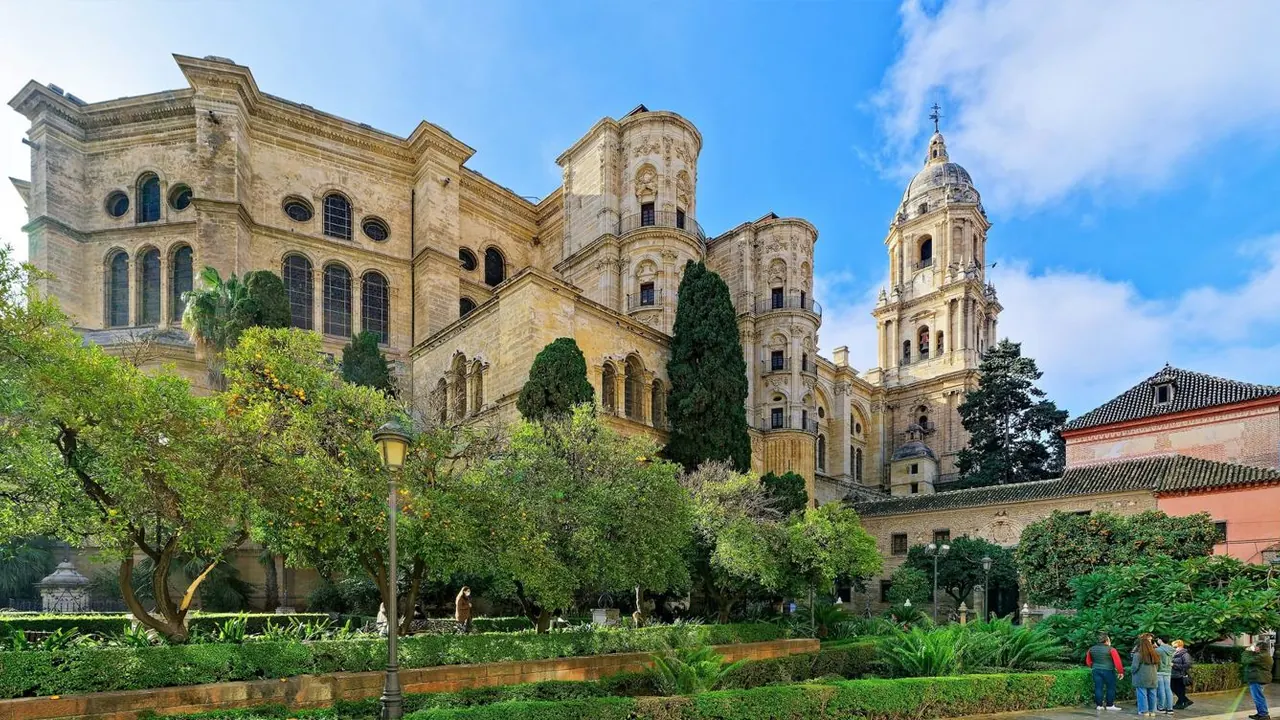
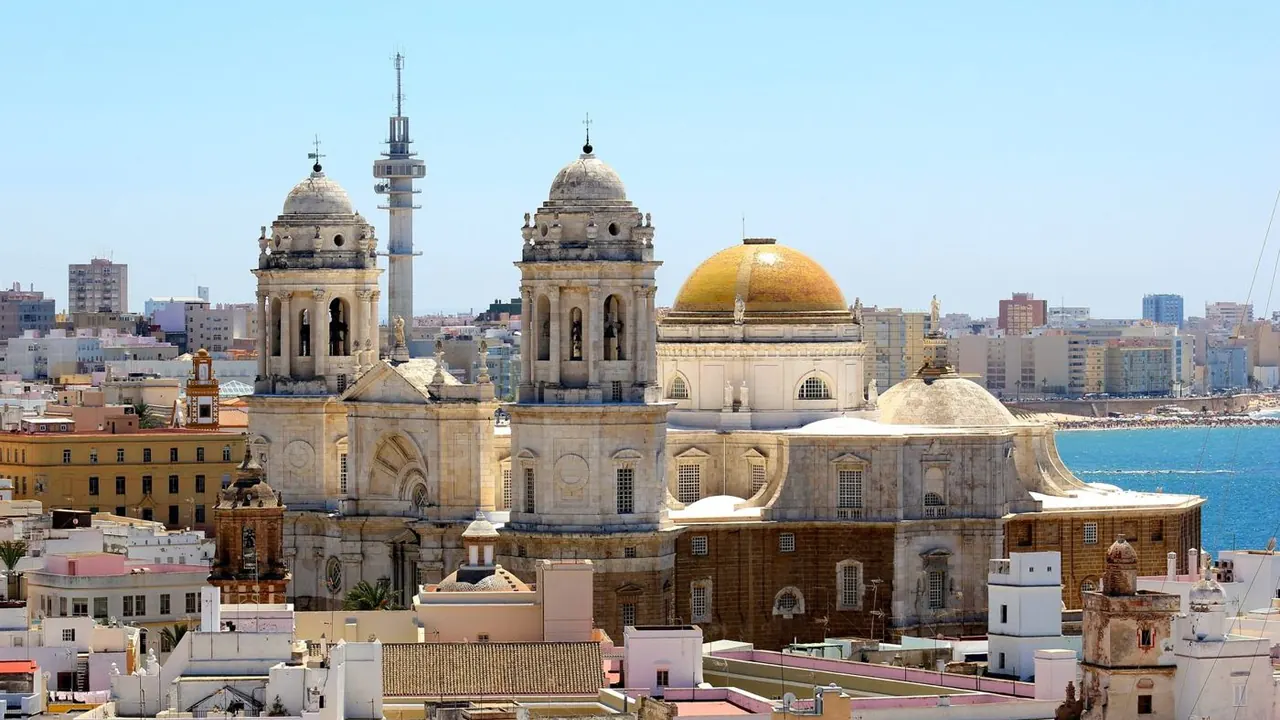
Photos: Malaga by Holger Uwe Schmitt, CC BY-SA 4.0, cropped; Cadiz by Bronch, CC BY-SA 3.0 ES, cropped.
Malaga or Cadiz?
Our verdict in twelve categories, each scored against the same fixed benchmark cities, and the climate month by month, so you can choose for your trip.
Choose Malaga for
- shopping
- nightlife
- families
Malaga is the better pick for a busier, more varied stay. It has more going on after dark, more for children along the coast, better shopping and a wider spread of day trips, with Granada, Cordoba and Ronda all within easy reach. Hills and gorges start close to the city, the Picasso Museum and the Alcazaba anchor its sights, and the airport is a short train ride from the centre, which makes it easy to arrive and get going.
Choose Cadiz for
- live music and the arts
- beaches
- prices
Cadiz suits a slower trip built around the sea. The old town sits on a peninsula with water on almost every side, Playa Victoria offers proper golden sand within the city, and the empty Atlantic strands of the Costa de la Luz are close by. Add the flamenco peñas of Santa María, the sherry towns across the bay and a February Carnival unlike anything else in Spain, and it rewards travellers who want a beach, good fish and a place with a strong character of its own.
Scoreboard
Twelve categories on one fixed scale from 0 to 100. The shaded stretch is the gap between the two.
Your match
Pick a travel style or drag the sliders, and both match scores follow your weighting.
Wins on shopping and nightlife with your weighting.
Wins on live music and the arts and beaches with your weighting.
What matters to you?
Category by category
What the scores mean for a trip.
Beaches & swimming
These are two strong beach cities, but the beaches are different in kind. Cadiz has the better sand: Playa Victoria runs for kilometres of wide golden beach, La Caleta is a sheltered cove in the old town, and beyond the city the Costa de la Luz offers long, empty Atlantic strands backed by dunes. The price is the levante, which can whip sand across them for days.
Malaga's city beaches are grey-brown and practical, with La Malagueta a short walk from the cathedral and the old fishing quarters of Pedregalejo and El Palo just east. West of the city the shore becomes a continuous resort coast reached by suburban train, and for clear water and coves you head to Nerja and Maro. The sea is about as warm in August in both.
Food & drink
Both are cities of fish and tapas, and either will feed you very well. Cadiz leans on fried fish from the freidurías, shrimp fritters and almadraba bluefin tuna, washed down with manzanilla and fino from the nearby sherry towns, though its range beyond that is narrow.
Malaga's signature is the espeto, sardines roasted over driftwood on the beach, with its own sweet moscatel and Pedro Ximénez wines poured from the barrel in old bodegas. It also has slightly more ambitious cooking, while the Atarazanas market plays the same role as the Mercado Central in Cadiz.
Culture & sights
The two are evenly matched as sightseeing cities, and neither needs more than a few days. Cadiz is about deep history and atmosphere: Phoenician sarcophagi in the Museo de Cádiz, a half-buried Roman theatre in the Barrio del Pópulo, merchant houses topped with watchtowers from the Americas trade, and the oratory where the 1812 constitution was signed.
Malaga leans more on museums and monuments. The Moorish Alcazaba and Gibralfaro castle rise above its own Roman theatre, and Picasso is the big draw in two separate places: the Picasso Museum, in a palace off Calle San Agustín, shows his work across his whole life, and the house where he was born stands on Plaza de la Merced. The Carmen Thyssen collection and the CAC for contemporary art add to the list.
Nightlife
Malaga has the livelier nights. The old town around Plaza de la Merced and Calle Granada stays full well past two on summer weekends, and Torremolinos and Marbella are close for clubbing and the gay scene.
Cadiz is quieter for most of the year, with tapas bars in La Viña and seafront terraces along Playa Victoria in summer, and only a small, student-led club scene. Its great exception is Carnival, ten days in February when the whole city parties through the night.
Nature & outdoors
Malaga has wilder country closer to hand. The Montes de Malaga start at the city's edge, and within an hour or two lie the Caminito del Rey gorge walkway, the limestone stacks of El Torcal, the Sierras above Nerja and the Sierra Nevada with skiing in winter.
The outdoors around Cadiz is flatter and more about water: the salt pans and marshes of the bay natural park for flamingos and kayaking, the cliff-top pines of La Breña, and the wind and whale-watching at Tarifa. Real mountain walking means the Sierra de Grazalema, about two hours inland.
Day trips
Both make excellent bases, but Malaga reaches more of Andalusia's great sights. Granada's Alhambra, Cordoba's Mezquita, Ronda and the Antequera dolmens are all within easy range, with Nerja, Frigiliana and Gibraltar along the coast.
From Cadiz the trips are closer and more local in flavour: Jerez and its riding school, the sherry towns of El Puerto and Sanlúcar, the white towns of Vejer and Arcos, and the Roman ruins at Bolonia. Seville is within reach of either.
Good for families
Malaga is the stronger choice with children, mainly because the attractions built for them are a short suburban train ride away: the Bioparc in Fuengirola, an aquarium and dolphin park in Benalmadena, and a safari park near Estepona. The city beaches shelve gently and the Alcazaba ramparts suit older children.
Cadiz works well for a simple beach vacation, with lifeguarded sand at Playa Victoria and shady parks in the old town, but beyond the castles and the camera obscura there is little to fill a rainy or windy afternoon. Its milder summer heat is a point in its favour.
Getting around
Getting around is easy in both, with a flat, walkable centre where a car is no use. Cadiz's old town is a car-light grid on a peninsula, with buses down the isthmus to the beach, trains to Jerez and Seville, and a catamaran across the bay.
Malaga adds a suburban train that reaches the airport in minutes and runs along the coast, a short metro and fast trains to Madrid and Cordoba. In both, the villages and wilder coast need a hire car.
Shopping & style
Malaga is the better place to shop. Calle Larios gives it a polished main street of Spanish chains, El Corte Inglés and the Muelle Uno port promenade add more, and Puerto Banús is within reach for luxury.
Cadiz is modest by comparison, with chains and family shops around Calle Ancha and Plaza de las Flores. It is good for fans, ceramics, flamenco dress and sherry, but anyone serious about shopping goes to Seville.
Affordability
Costs are much the same in both: eating and drinking are cheap, while rooms take most of the budget. In Cadiz the squeeze comes from the small number of hotels in the old town, sharpest in July, August and Carnival week, and staying near Playa Victoria helps. In Malaga demand runs from spring right through autumn, so winter or a base just outside the centre is the way to save.
Live music & performing arts
Cadiz has the more distinctive live scene. It is a cradle of flamenco, and the peñas of the Santa María quarter play to knowing local audiences, while the Gran Teatro Falla hosts the Carnival song contest of satirical chirigotas and an autumn Ibero-American theatre festival.
Malaga has more of a conventional stage, with the Teatro Cervantes home to the city's philharmonic, plus small jazz and rock venues and the drama of Semana Santa processions. Its flamenco is weighted more towards tablaos for visitors.
Wellness & relaxation
Neither is a spa destination, and in both the slow Andalusian day of long lunches and siestas does more than any treatment. Malaga has an Arab-style bathhouse in the old town itself, while from Cadiz you drive to the resort spas of Novo Sancti Petri or take the train to the baths in Jerez.
When should you go?
Pick your month. The climate figures are measured averages, not a forecast.
Malaga in July
Cadiz in July
Daytime high, °C
Rainfall in the month, mm
Temperature and rainfall are climate normals, averaged over the years shown. Malaga: 1991-2020 normals, Malaga / Aeropuerto (8.2 km from centre). Cadiz: 1991-2020 (sunshine 1961-1990) normals, Cadiz Bay / Puntales (5.2 km from centre).
Both cities share the same southern Spanish rhythm: dry, hot summers with almost no rain in July, and a wet season from October to March. The difference is in the heat. Cadiz, cooled by the Atlantic on all sides, peaks around 28°C in July and August, while Malaga reaches 32°C in August, which pushes sightseeing and walking into the morning and evening. Cadiz also gets a little more sunshine through the summer months.
For swimming, the sea in both is comfortable from June to early October, reaching about 23°C at its warmest. Rain returns in October and is heaviest in late autumn, with Cadiz wettest in November and Malaga in December, at close to 90mm. Winters are mild in both, Malaga a degree or two warmer. For walking the streets, April, May and October are the most pleasant months in either city, and in high summer Cadiz is the easier of the two.
Which traveller are you?
For a beach and sun trip, Cadiz has the edge in what the beaches are like. Playa Victoria is fine golden sand inside the city, and the long, quiet strands of El Palmar, Conil and Bolonia lie within an hour.
On a food and nightlife trip, Malaga goes further. The eating is as good in both, but Malaga's old town stays busy later and on more nights, and Torremolinos and Marbella add clubs and a larger gay scene a short trip away.
On a family trip with children, Malaga is the easier choice. Its calm city beaches and pedestrian centre are joined by a zoo, an aquarium and a dolphin park along the coast, while Cadiz has sand and parks but little built for children.
Before you go
| Measure | Malaga | Cadiz |
|---|---|---|
| Official language | Spanish | Spanish |
| Currency | Euro (EUR) | Euro (EUR) |
| Sockets | CF230 V, 50 Hz | CF230 V, 50 Hz |
| Driving side | Right | Right |
| Time zone | UTC+1, UTC+2 in summer | UTC+1, UTC+2 in summer |
| Emergency number | 112 | 112 |
| Elevation | 18 m | 11 m |
| Main airport | Málaga-Costa del Sol Airport (AGP)8 km from centre165 non-stop destinations | Jerez Airport (XRY)31 km from centre26 non-stop destinations |
| Public holidays this year | 12 days | 12 days |
By the numbers
| Measure | Malaga | Cadiz |
|---|---|---|
| City population | 599,063 | 109,950 |
| People per km² | 1,517 | 9,087 |
| Museums within 10 km | 32 | 12 |
| UNESCO World Heritage sites within 50 km | 1 | 0 |
| Swim season, months above 21 °C | 3 months | 3 months |
Where else could you go?
Every comparison below shares a destination with this one, so you can follow Malaga or Cadiz somewhere new.