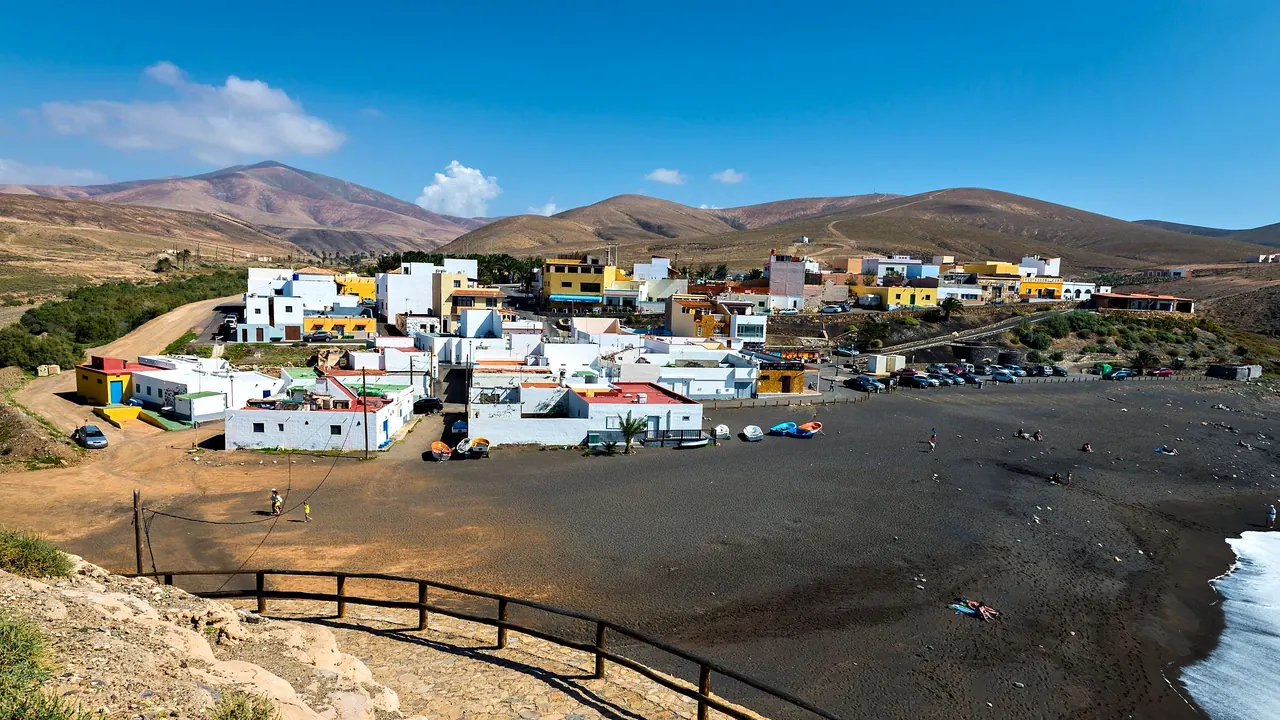
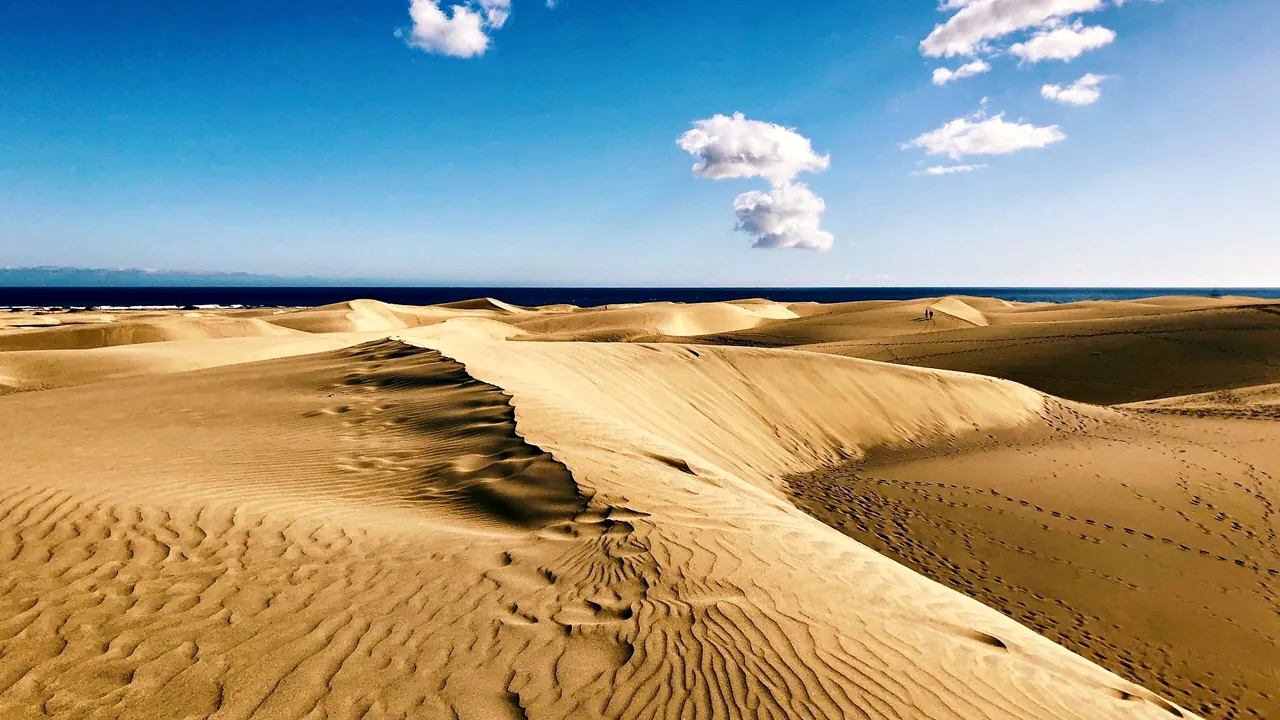
Photos: Fuerteventura by Magic K, Pexels License; Gran Canaria by Marcela Střelcová, CC BY-SA 4.0, cropped.
Fuerteventura or Gran Canaria?
Our verdict in twelve categories, each scored against the same fixed benchmark cities, and the climate month by month, so you can choose for your trip.
Choose Fuerteventura for
- beaches
- prices
Fuerteventura is for travellers who want the beach to be the whole point. It has the dunes of Corralejo, the tidal lagoon at Sotavento, steady wind for windsurfing and kitesurfing, and quiet evenings. It gives up almost everything else, with little to see and not much reason to eat out or go out. For a week of sand, sea and empty roads, that quiet is part of the appeal.
Choose Gran Canaria for
- live music and the arts
- culture and sights
- nightlife
Gran Canaria makes more sense when the trip needs variety. Its southern beaches are nearly as good. Behind them are a capital with a real old quarter, theatre and proper tapas bars, and a mountain interior of ravines and pine forest for walking. Families, couples who like a night out and anyone who gets restless after three days on a sunbed will be better served here.
Scoreboard
Twelve categories on one fixed scale from 0 to 100. The shaded stretch is the gap between the two.
Your match
Pick a travel style or drag the sliders, and both match scores follow your weighting.
Wins on beaches and prices with your weighting.
Wins on live music and the arts and culture and sights with your weighting.
What matters to you?
Category by category
What the scores mean for a trip.
Beaches & swimming
Both islands have excellent beaches, so the difference is in character. Fuerteventura's are wilder and more spread out, with more open sand. There are the dune-backed beaches of Corralejo in the north, the reef-sheltered lagoons of El Cotillo, the long shallow beaches of Jandía and empty Cofete beyond the mountains.
Gran Canaria's beach life is concentrated on the south coast. Maspalomas has its own dune field, and the coves of Amadores, Puerto Rico and Mogán have calm water. It also has a real city beach at Las Canteras. The sea is the same cool Atlantic on both islands, but wind matters more on Fuerteventura, where it pays to pick an east or south-facing beach.
Food & drink
Both islands cook the same Canarian staples: wrinkled potatoes with mojo, gofio, goat stew and fresh fish. On Fuerteventura the best of it is in fishing villages such as El Cotillo and Ajuy, and the protected majorero goat cheese is the speciality. Beyond those harbours there is little worth seeking out.
Gran Canaria has more depth because it has a capital, with tapas bars in Vegueta and Triana and the Mercado de Vegueta. It also makes its own rum and wine. On either island, avoid the resort promenades if you want a good meal.
Culture & sights
Here the gap is wide. Fuerteventura's heritage is small and rural: the old capital of Betancuria, the manor house in La Oliva, the windmills and the sacred mountain of Tindaya. You can see it in an afternoon or two.
Gran Canaria has a real old town in Vegueta, with the cathedral, the Casa de Colón and the Museo Canario. Outside the capital are the painted cave at Gáldar and the UNESCO-listed cave dwellings of Risco Caído. It is still a beach island first, but it repays a few days of sightseeing.
Nightlife
On Fuerteventura, going out mostly means the pubs and cocktail bars of Corralejo, full of surfers after a windy day. Elsewhere on the island, evenings end with dinner.
Gran Canaria offers much more, in two styles. Playa del Inglés has a long-established gay scene and clubs that stay open late all year. Las Palmas keeps Spanish hours, with terrace bars, clubs that fill after midnight and one of Spain's largest carnivals each winter.
Nature & outdoors
Fuerteventura's landscape is stark desert: volcanic hills, lava fields and the two great sand areas at Corralejo and Jandía. Its strongest suit is the water, with serious windsurfing, kitesurfing and winter surf around El Cotillo.
Gran Canaria has more range. Its interior climbs to Pico de las Nieves at about 1,950m, past Roque Nublo and deep ravines, and the pine forest of Tamadaba covers the west. That gives walkers and cyclists far more to do. It still has its own dunes at Maspalomas and a well-known windsurfing spot at Pozo Izquierdo.
Day trips
From Fuerteventura, the best day out is on another island. Lanzarote is about half an hour by ferry from Corralejo, with Teguise and the La Geria vineyards beyond. On Fuerteventura itself there are only a few villages to link, Betancuria and Ajuy among them.
Gran Canaria fills more days without leaving the island: Tejeda, Teror, Arucas, Agaete, Puerto de Mogán and a full day in Las Palmas. Each island can reach the other by sea, but it makes a long day in either direction.
Good for families
Both are easy beach islands for children, with resort pools, kids' clubs and camel rides. Fuerteventura's shallow lagoons at Sotavento and El Cotillo are ideal for small children. Its limits are the wind and the lack of things to do on a gusty day.
Gran Canaria has more to fill the days. There are sheltered coves such as Amadores and Anfi, Palmitos Park, water parks and the aquarium in Las Palmas. Children who get car sick may struggle on its winding mountain roads.
Getting around
On Fuerteventura you will almost certainly need a hire car. The roads are good and quiet, and the drive from one end of the island to the other takes about two hours. Buses run too rarely to reach the beaches comfortably.
Gran Canaria is easier without a car, because the motorway and buses serve the east coast well between Las Palmas and the southern resorts. The interior is slower going, on narrow hairpin roads, and a car for a few days is still the way to see it.
Shopping & style
Fuerteventura has little to offer beyond the surf shops of Corralejo and the weekly craft market in Lajares. The best things to take home are majorero cheese, aloe vera products and local pottery.
Gran Canaria has a proper shopping city in Las Palmas. Calle Mayor de Triana has independent shops in old buildings, and Avenida Mesa y López has the high-street chains and a department store. The Sunday market at Teror is good for cheese and crafts.
Affordability
Costs are much the same on both islands. Winter is the expensive season, the big southern resorts are the priciest places to stay, and lower island taxes keep drinks and fuel cheap.
The difference is in what you have to add. On Fuerteventura you will almost always need a hire car. On Gran Canaria, buses cover the main coastal route, and car hire is usually inexpensive for the days inland. On both islands, village restaurants cost less than places on the seafront, and so do the local bars of Las Palmas.
Live music & performing arts
Fuerteventura has almost nothing to go to beyond folk groups playing the timple at village fiestas and occasional concerts in Puerto del Rosario.
Gran Canaria has a real season in Las Palmas. The philharmonic orchestra plays at the Auditorio Alfredo Kraus overlooking Las Canteras, the Teatro Pérez Galdós stages opera and drama, and the Canary Islands Music Festival runs in winter. If you stay in the southern resorts, any of these means an evening trip into town.
Wellness & relaxation
Neither island has a bathing tradition, and both offer rest more than treatments. Fuerteventura's appeal is emptiness: quiet villages, long days, and yoga and surf retreats around Lajares and El Cotillo.
Gran Canaria gives a little more choice. There are large hotel spas at Meloneras and Maspalomas, and seawater thalassotherapy centres are a local speciality. Rural houses in the inland villages offer silence and cooler air.
When should you go?
Pick your month. The climate figures are measured averages, not a forecast.
Fuerteventura in July
Gran Canaria in July
Daytime high, °C
Rainfall in the month, mm
Where the figures come from
Fuerteventura's temperatures are measured 31 km from the centre, at Fuerteventura / Aeropuerto.
Fuerteventura has no rain gauge within 25 km of the centre, so its rainfall comes from a gridded climate dataset read at the destination rather than from a gauge further away.
Gran Canaria's temperatures are measured 28 km from the centre, at Gran Canaria - Canary Islands.
Gran Canaria has no rain gauge within 25 km of the centre, so its rainfall comes from a gridded climate dataset read at the destination rather than from a gauge further away.
Temperature and rainfall are climate normals, averaged over the years shown. Fuerteventura: 1991-2020 normals, Fuerteventura / Aeropuerto (31.1 km from centre). Gran Canaria: 1991-2020 normals, Gran Canaria - Canary Islands (27.7 km from centre).
The two islands have almost the same climate, and both are warm enough for the beach in every month. Daytime highs run from about 21°C in winter to 28°C in late summer, so the streets are never too cold to walk and rarely too hot. What little rain there is falls between November and February, most of it in December, and the summer months are close to completely dry on both islands.
The Atlantic stays cool on both, from about 19°C in late winter to 23°C in September and October, so autumn is the most comfortable time to swim. Where most visitors stay, Fuerteventura gets slightly more sunshine from spring through summer and is a touch drier in winter. Gran Canaria's mountain interior is best walked in the cooler months, because hiking under the summer sun is hard going there.
Which traveller are you?
On a beach and sun trip, Fuerteventura edges ahead. Its sands are longer and emptier, from the Corralejo dunes to the tidal lagoon at Sotavento. It gets slightly more sunshine through spring and summer, and the trade winds bring windsurfing and kitesurfing.
For a culture and arts trip, Gran Canaria wins clearly. Vegueta's cathedral and the Museo Canario, the painted cave at Gáldar and evenings of opera or orchestral music in Las Palmas fill several days. Fuerteventura's heritage takes an afternoon in Betancuria.
On a food and nightlife trip, Gran Canaria is the better choice. Las Palmas has tapas bars in Vegueta and Triana, late terraces and weekend clubs, and Playa del Inglés stays open late all year. On Fuerteventura, evenings outside Corralejo mostly end after dinner.
Before you go
| Measure | Fuerteventura | Gran Canaria |
|---|---|---|
| Official language | Spanish | Spanish |
| Currency | Euro (EUR) | Euro (EUR) |
| Sockets | CF230 V, 50 Hz | CF230 V, 50 Hz |
| Driving side | Right | Right |
| Time zone | UTC, UTC+1 in summer | UTC, UTC+1 in summer |
| Emergency number | 112 | 112 |
| Main airport | Fuerteventura Airport (FUE)70 non-stop destinations | Gran Canaria Airport (LPA)122 non-stop destinations |
| Public holidays this year | 12 days | 12 days |
By the numbers
| Measure | Fuerteventura | Gran Canaria |
|---|---|---|
| Population | 127,043 | 863,943 |
| People per km² | 78 | 554 |
| Swim season, months above 21 °C | 5 months | 6 months |
Where else could you go?
Every comparison below shares a destination with this one, so you can follow Fuerteventura or Gran Canaria somewhere new.
- Lanzarotevs Fuerteventura
- Tenerifevs Gran Canaria
- La Gomeravs Gran Canaria
- Lanzarotevs Gran Canaria
- La Palmavs Gran Canaria
- Tenerifevs Fuerteventura