Canada
Winnipeg
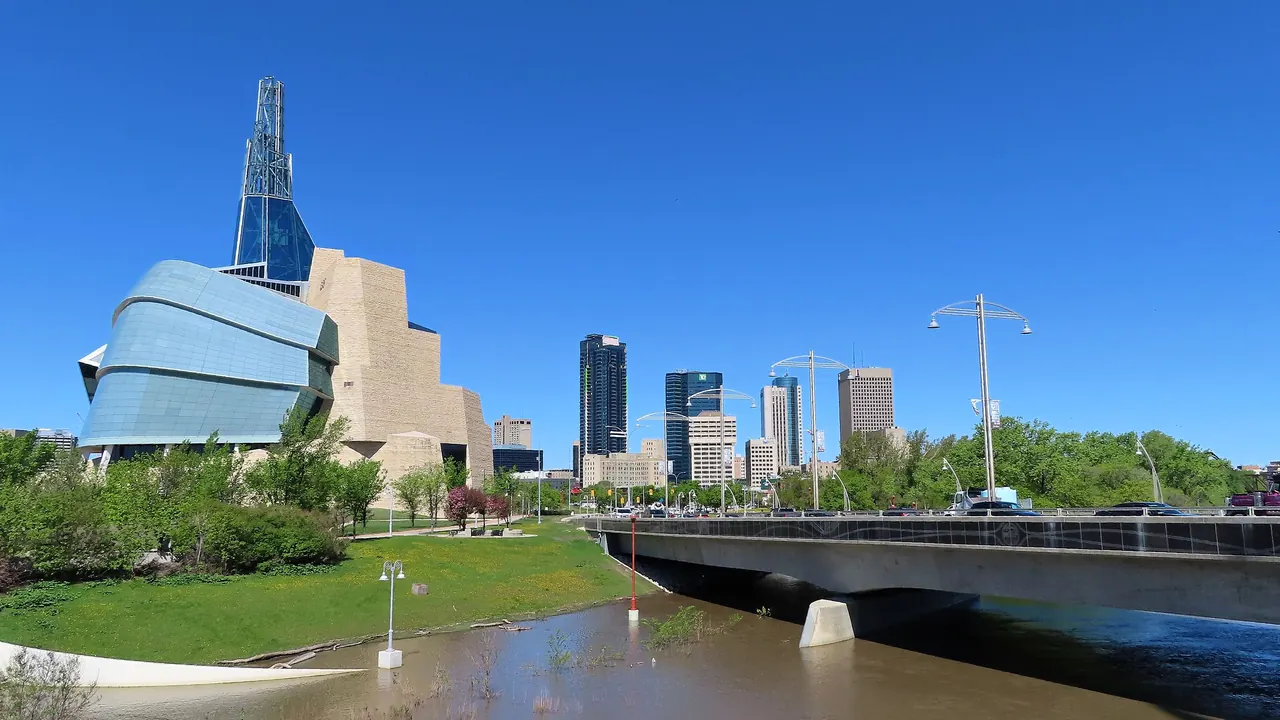
The Canadian Museum for Human Rights at The Forks, with the skyline
- Families60
- Live music & the arts55
- Culture & sights50
Photo: Dennis Sylvester Hurd, CC BY 2.0, cropped
Match
42
Every category weighted equally
- Beach & sun41
- Culture & arts43
- Food & nightlife40
- Family trip44
- Outdoors42
- Relax & unwind42
- Shopping & style41
- On a budget43
Winnipeg in twelve categories
Our verdict on each, scored 0 to 100 against the same fixed benchmark cities, so a score means the same thing on every page.
Beaches & swimming. Scores 33 out of 100.
Food & drink. Scores 42 out of 100.
Culture & sights. Scores 50 out of 100.
Nightlife. Scores 32 out of 100.
Nature & outdoors. Scores 47 out of 100.
Day trips. Scores 28 out of 100.
Good for families. Scores 60 out of 100.
Getting around. Scores 38 out of 100.
Shopping & style. Scores 30 out of 100.
Affordability. Scores 48 out of 100.
Live music & performing arts. Scores 55 out of 100.
Wellness & relaxation. Scores 43 out of 100.
Winnipeg category by category
Beaches & swimming
33Winnipeg is a prairie city, and its only swimming is in the lakes to the north. Lake Winnipeg is shallow, so by midsummer the water reaches about 20°C. Grand Beach, on the eastern shore, is the best of its beaches, with fine white sand backed by dunes, and it is a little over an hour's drive away. On the western shore, Winnipeg Beach and Gimli have older resort-town beaches with piers and boardwalks.
The season is short, running from about early July to late August. Algae blooms sometimes spoil the water late in summer, and getting to any of these beaches needs a car. In the city itself there are outdoor pools and the rivers, which nobody swims in.
Food & drink
42Eating in Winnipeg reflects the people who settled the prairies. Ukrainian and Mennonite families brought perogies, cabbage rolls, kielbasa and farmer sausage, and these still turn up everywhere, from church-basement suppers to diner menus. The city has a few odd specialities of its own: honey dill sauce with chicken fingers, the dense rye bread baked locally, and old-fashioned diners serving fried eggs and chips at any hour. Large Filipino, Punjabi and Ethiopian communities give the suburbs some honest, cheap cooking.
The Forks Market is the obvious place to graze, with food stalls and a beer hall by the rivers. Some of the better independent restaurants are in the Exchange District and along Corydon and Osborne. It is a good, unpretentious place to eat, but the range is limited and few people would plan a trip around it.
Culture & sights
50Winnipeg's sights tell the story of the prairies and the north, and a few of them are better than a visitor might expect. The Canadian Museum for Human Rights is a national museum in a striking stone and glass building, and its galleries spiral up to a tower above the rivers. The Winnipeg Art Gallery holds the largest public collection of contemporary Inuit art in the world. The Manitoba Museum is good on fur-trade history and includes a full-size replica of the ketch Nonsuch.
The Exchange District is the best piece of townscape: blocks of early twentieth-century terracotta and brick warehouses from the city's grain-boom years. Other stops include the domed Legislative Building, the ruined facade of St Boniface Cathedral in the old French quarter, and the Royal Canadian Mint. A curious visitor can see most of it in two or three days.
Nightlife
32Going out in Winnipeg is low-key. Most of it happens in the Exchange District, where craft-beer bars and cocktail rooms sit in the old warehouses, and in Osborne Village, which has pubs and a younger crowd. There are a handful of clubs, and big games at the arena fill the downtown bars, but the city is mostly quiet by the early hours.
Summer evenings at The Forks and on patios are the liveliest time. In deep winter, at around -25°C, most people stay in, and a night out means one warm bar rather than a crawl between several.
Nature & outdoors
47The city sits on flat prairie where the Red and Assiniboine rivers meet, and the outdoors starts with those rivers. In summer the riverbank paths are good for walking and cycling, and Assiniboine Park and the larger Assiniboine Forest offer prairie oak woods and deer. On the southern edge, FortWhyte Alive keeps a bison herd and lakes for canoeing, and in autumn Oak Hammock Marsh, half an hour north, fills with migrating geese.
For real landscape you drive east about an hour and a half to Whiteshell Provincial Park. There, granite, pine forest and hundreds of lakes make good canoeing and hiking country. Winter is the city's unusual season: cross-country skiing, and skating trails cut into the frozen rivers when the ice allows. Summer mosquitoes are fierce.
Day trips
28The country around Winnipeg is mostly farmland, and the towns within reach are small. Lower Fort Garry, a stone fur-trade post on the Red River about forty minutes north, is the best heritage site nearby, with restored buildings and costumed interpreters in summer. Further up the lake, Gimli is an Icelandic-settled fishing town with a harbour and a heritage museum, and it makes a pleasant summer outing combined with the lakeshore.
To the south, the Mennonite Heritage Village in Steinbach recreates a prairie settlement, complete with a working windmill. That is roughly the whole list. Every trip needs a car, and none is a reason to come.
Good for families
60Winnipeg is an easy, unhurried city to visit with children, and it has more for them than its size suggests. The Assiniboine Park Zoo is the highlight. Its large northern section has polar bears that can be watched swimming overhead from an underwater tunnel, along with seals and muskoxen. The Manitoba Children's Museum at The Forks is hands-on and well designed, and the Manitoba Museum and its planetarium hold older children's interest.
The Forks is easy to manage with a pushchair, and FortWhyte Alive lets children see bison and try snowshoeing. In summer there are wading pools and playgrounds across the parks. Winter is the hard part, because the cold means days spent going from one indoor place to the next by car.
Getting around
38Downtown, the Exchange District and The Forks are close together and can be walked in summer. Over the cold months a network of enclosed skywalks links many downtown buildings. Beyond that core, Winnipeg is spread-out and built around the car. Public transport is buses only, with a dedicated busway running south towards the university. They work, but they are slow for crossing the city.
The zoo, Assiniboine Park and St Boniface are reachable by bus or bike, and the riverside paths are pleasant for cycling in summer. FortWhyte, the beaches and every day trip need a car. Most visitors who want more than the centre end up renting one.
Shopping & style
30Shopping in Winnipeg is mostly what locals need: a big enclosed mall near the airport and chain retail along the main roads. The more interesting browsing is in the Exchange District, which has independent clothing, record and design shops in the old warehouses, and along Corydon Avenue and Osborne Village.
The Forks Market has local food and craft stalls, and the best things to take home are Inuit and First Nations art from the galleries that deal in it. There is no luxury fashion street to speak of.
Affordability
48For a Canadian city, Winnipeg is fairly easy on the budget. Downtown hotel rooms cost noticeably less than in the big coastal cities, and parking and the main sights are moderately priced. Eating out is middling, because sales tax and a tip go on top of the menu price, and drinks in bars add up.
The cost that catches visitors out is getting around. Anything beyond the centre usually means renting a car or paying for taxis, so overall prices sit around the middle for a Western travel destination.
Live music & performing arts
55For a city of its size, Winnipeg takes the stage seriously, and long winters probably help. The Royal Winnipeg Ballet is the oldest ballet company in the country. It performs at the Centennial Concert Hall, which it shares with the Winnipeg Symphony Orchestra and Manitoba Opera. The Royal Manitoba Theatre Centre stages a full drama season, and in St Boniface a long-established company performs in French.
Summer is festival time. The Fringe takes over the Exchange District with hundreds of small shows, and the Winnipeg Folk Festival fills Birds Hill Park, just outside the city, with stages and campers. Through the year, a handful of small clubs keep live rock, folk and jazz going.
Wellness & relaxation
43Winnipeg has no bathing tradition of its own, but it does have one place people come for. A large Nordic-style spa in the south of the city, set among trees by a park near the university, has outdoor hot pools, saunas and cold plunges. Sitting in steaming water at -20°C is a memorable experience, and many visitors find winter the best time to go. Apart from that, the options are hotel spas and day spas.
The city's pace is unhurried, with little traffic or crowding. A slow summer afternoon in Assiniboine Park's English garden is restful, though Winnipeg is not a destination built around rest.
When should you go?
Pick a month to see what it is like. The climate figures are measured averages, not a forecast.
Winnipeg in July
Daytime high, °C
Rainfall in the month, mm
The whole year
Shaded against this city’s own year: the deepest cell is its best month for that figure and the palest its weakest.
Temperature and rainfall are climate normals, averaged over the years shown. Winnipeg: 1991-2020 normals, Winnipeg The Forks (0.9 km from centre).
Before you go
| Measure | Winnipeg |
|---|---|
| Official language | French, English |
| Currency | Canadian Dollar (CAD) |
| Sockets | AB120 V, 60 Hz |
| Driving side | Right |
| Time zone | UTC-6, UTC-5 in summer |
| Emergency number | 911 |
| Elevation | 238 m |
| Main airport | Winnipeg / James Armstrong Richardson International Airport (YWG)7 km from centre41 non-stop destinations |
| Public holidays this year | 10 days |
By the numbers
| Measure | Winnipeg |
|---|---|
| City population | 749,607 |
| People per km² | 1,670 |
| Museums within 10 km | 30 |
| UNESCO World Heritage sites within 50 km | 0 |
Compare Winnipeg with
Every comparison with a written verdict behind it.