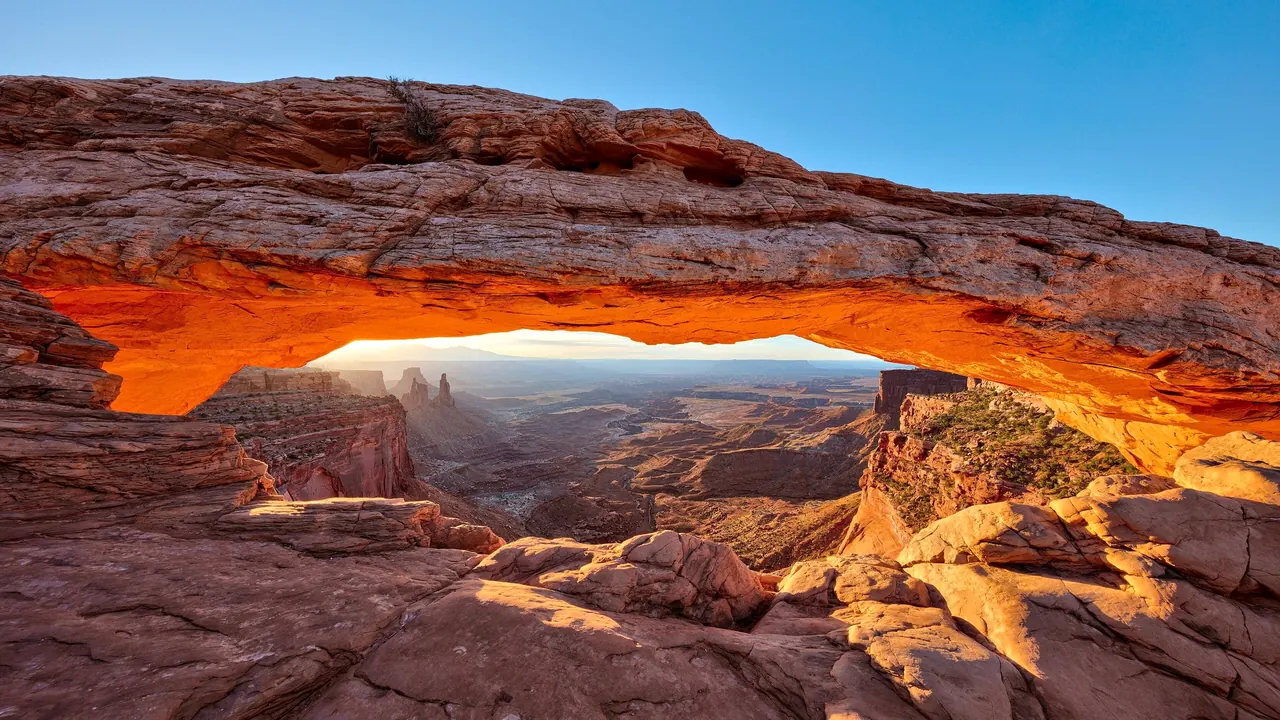
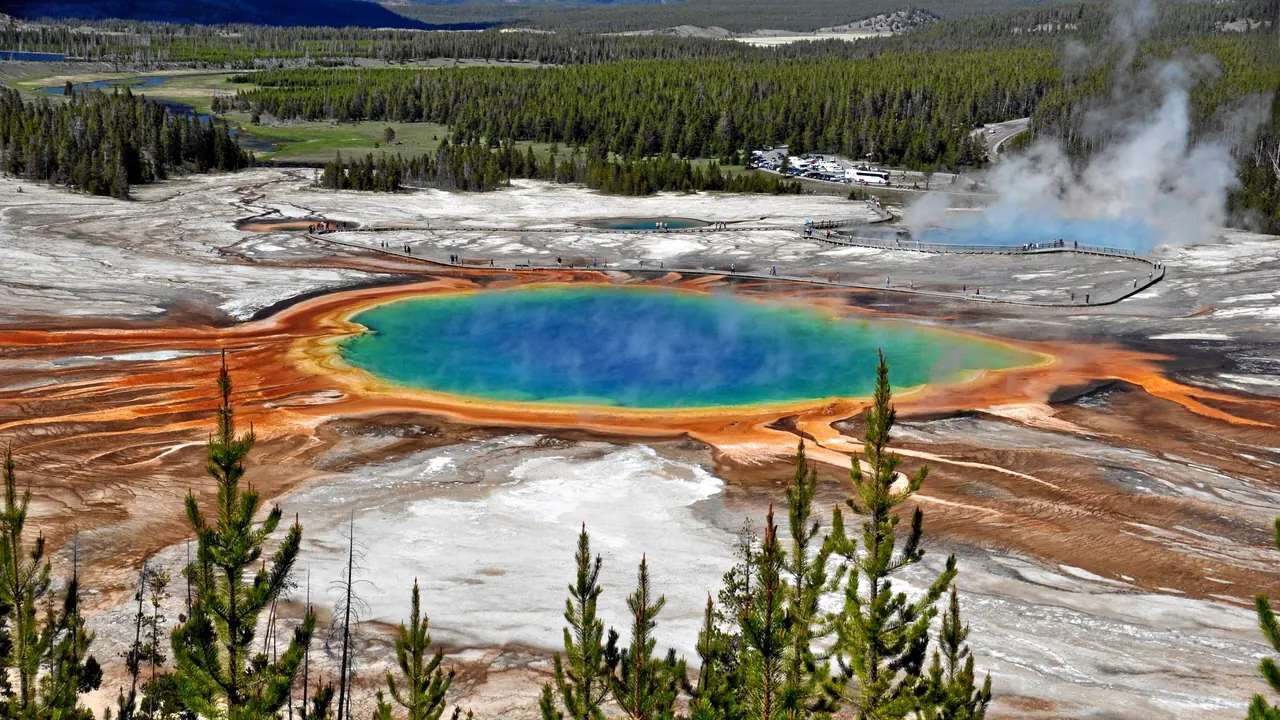
Photos: Canyonlands by Thomas Wolf, www.foto-tw.de, CC BY-SA 3.0, cropped; Yellowstone by James St. John from Newark, Ohio, CC BY 2.0, cropped.
Canyonlands or Yellowstone?
Our verdict in twelve categories, each scored against the same fixed benchmark cities, and the climate month by month, so you can choose for your trip.
Choose Canyonlands for
- getting around
- prices
- shopping
Canyonlands is the choice for travellers who want to use the landscape hard: mountain biking on slickrock, rafting through Cataract Canyon, climbing at Indian Creek, or hiking among the arches and spires. It is also easier to run as a trip. Moab works as a single base, Arches starts at the edge of town, and the main mesa overlooks are under an hour away on good roads. Come in spring or autumn and you get desert light, dry weather and very dark night skies.
Choose Yellowstone for
- families
- culture and sights
- wellness
Yellowstone suits people who come to watch the land move: geysers erupting, mud pots bubbling, and bison and wolves in the valleys at dawn. It is the better pick with children, since Old Faithful and roadside wildlife hold their attention, and it has more history in its old lodges and in Fort Yellowstone. The price is long hours on the Grand Loop Road and a short season, as most of the park is effectively a summer destination.
Scoreboard
Twelve categories on one fixed scale from 0 to 100. The shaded stretch is the gap between the two.
Your match
Pick a travel style or drag the sliders, and both match scores follow your weighting.
Too close to call, 1 point apart
Wins on getting around and prices with your weighting.
Wins on families and culture and sights with your weighting.
What matters to you?
Category by category
What the scores mean for a trip.
Beaches & swimming
Neither region is any use for a beach vacation. In canyon country the rivers are for rafting, and on hot days people cool off in a hill reservoir above Moab, a calm river eddy or a motel pool.
Yellowstone's version of a swim is a cold plunge in the Firehole River or a soak in a commercial hot-spring pool outside the park. The lake looks inviting, but it stays dangerously cold even in August.
Food & drink
Food is functional in both, and neither is worth the trip for it. Moab gives you everything in one small town: Tex-Mex and Southwestern plates, pizza, food trucks, craft-beer taprooms and breakfast places that open before dawn.
Yellowstone's meals are spread between historic lodge dining rooms and gateway-town steakhouses. It has more of a regional flavour, with bison, elk, trout and huckleberry pie. The serious cooking is in Jackson and Bozeman, a long drive from the geysers, and park kitchens close early.
Culture & sights
Yellowstone has more heritage to see. As the world's first national park, it has the great log lobby of the Old Faithful Inn, the Roosevelt Arch and the stone army buildings of Fort Yellowstone. The Buffalo Bill Center of the West in Cody adds a museum of real depth.
Canyonlands has almost no built heritage. Its culture is painted and carved on rock: Newspaper Rock, the panels along Potash Road, and the life-size figures of the Great Gallery, which take a dirt drive and a hike to reach.
Nightlife
Both regions go to bed early. Moab is marginally livelier, with brewpubs where rafting guides and bikers fill the room on a spring weekend. In Yellowstone an evening means a lodge lounge or a ranger talk, then an early night before dawn wildlife watching. In both, the best thing to do after dark is look at the stars.
Nature & outdoors
Both are among the great natural landscapes of North America, but they are different in kind. Canyonlands is red-rock desert to be explored actively: Arches, the drop from Island in the Sky to the White Rim, the gooseneck at Dead Horse Point and the remote Maze. You ride, raft, climb or drive four-wheel-drive tracks through it.
Yellowstone is a living volcanic plateau. It has Grand Prismatic Spring, the Mammoth terraces, the yellow canyon at Lower Falls, and wildlife on a scale the desert cannot match, with wolves and grizzlies in Lamar Valley and bison herds in Hayden Valley. Here a day is spent watching rather than climbing.
Day trips
Outings beyond the main attraction are thin in both regions, and each mostly leads to more landscape. From Moab you can visit small Bluff and the Ancestral Puebloan pottery at Edge of the Cedars in Blanding, or cross into Colorado for the Palisade orchards.
From Yellowstone the options are Western towns with more character, such as Jackson, Cody and the gold-rush streets of Virginia City, or the Beartooth Highway. Each is a full day's drive for a single stop.
Good for families
Yellowstone is the easier sell to children. A geyser that erupts on time, belching mud pots, bison beside the road and a Junior Ranger badge give them something to see at every stop. Supervision on the boardwalks is constant, though, and in-park lodging books up far ahead.
Canyonlands can work for outdoorsy families, with short walks to Sand Dune Arch, dinosaur tracks and gentle float trips on the Colorado. However, the sheer unfenced drops at overlooks and the dangerous heat of summer afternoons mean parents need to be much more careful.
Getting around
Both need a car, but Canyonlands is far simpler to drive. Moab sits on the main highway, Arches begins just outside town, and the Island in the Sky overlooks are under an hour away. A paved bike path even runs towards the Arches gate. Only the Maze and the White Rim call for high clearance or a tour.
Yellowstone's sights are strung around the 230km Grand Loop Road, with low speed limits, bison jams and full car parks, so getting between basins takes hours. The airports are an hour or two outside the gates, and from November to April most of the interior is reachable only by snowcoach.
Shopping & style
Neither is a shopping destination, and the differences are in what you bring home. Around Bluff and Blanding, trading posts sell Navajo rugs, silver jewellery and pottery, while Moab's Main Street is good for bike and climbing gear and fossil shops. The Yellowstone side offers cowboy boots, hats and wildlife bronzes in Cody and Jackson, and fly-fishing shops in the gateway towns.
Affordability
Both are expensive in season, with ordinary motels priced well above their comfort, and both get cheap mainly if you camp and cook. Canyonlands has a small advantage here, because the public land around the parks has plenty of campgrounds and free dispersed camping, though guided rafting and jeep trips add up quickly.
In Yellowstone, July and August push up lodge and motel rates. Jackson is one of the costliest small towns in the country, and fuel and meals are priced for a captive market. Spring and autumn ease the bill.
Live music & performing arts
There is little on stage in either, but each has one event worth planning around. The Moab Music Festival holds chamber concerts from late summer, some of them in sandstone grottoes reached by jet boat. Near Yellowstone, the Grand Teton Music Festival offers a summer orchestral season, and Cody's nightly summer rodeo is a lively piece of Western tradition.
Wellness & relaxation
Yellowstone offers more ways to unwind. It cannot offer bathing inside the park, but the open-air hot-spring pools near Gardiner and in Paradise Valley make a real soak after a long drive. Early mornings by the lake and the quieter weeks of September and October add stillness.
In Canyonlands, rest comes down to a few massage studios in Moab, which mostly serve sore cyclists. What restores you there is the desert silence and a sunrise from a canyon rim.
When should you go?
Pick your month. The climate figures are measured averages, not a forecast.
Canyonlands in July
Yellowstone in July
Daytime high, °C
Rainfall in the month, mm
Where the figures come from
Canyonlands has no weather station within reach, so its figures come from a gridded climate model rather than a measured record, and read a broad area rather than one spot.
Yellowstone has no weather station within reach, so its figures come from a gridded climate model rather than a measured record, and read a broad area rather than one spot.
Temperature and rainfall are climate normals, averaged over the years shown. Canyonlands: 2001-2020 normals, NASA POWER reanalysis grid, no weather station within 90 km. Yellowstone: 2001-2020 normals, NASA POWER reanalysis grid, no weather station within 90 km.
Around Moab the desert is at its best in April and May and again from late September into October, with warm, dry days ideal for hiking and biking. High summer is fierce, with July reaching about 36°C, so you can only be active at dawn and in the evening. Winters are cold but still dry. Rain is light all year, with a little more in late summer and early autumn.
Yellowstone runs almost the opposite way. July and August are the warm months, with daytime highs of about 25°C, and they are also the driest, with roughly 36mm in July. From November to April the plateau sits around or below freezing, falling to about -6°C in midwinter, with steady snow, and most roads close to cars. So the two cover different parts of the year: canyon country in the shoulder seasons, Yellowstone in the height of summer.
Which traveller are you?
On a family trip with children, Yellowstone has the edge. Old Faithful erupts on schedule, the boardwalks are flat and short, and bison wander past the car. Canyonlands has easy arch walks and dinosaur tracks, but it also has unfenced drops and dangerous summer heat.
For a relaxing and wellness trip, Yellowstone does more. Open-air hot-spring pools near Gardiner and in Paradise Valley make for slow evenings with mountain views. Around Moab, the choice is a few day spas, plus the silence of the desert.
For mountain bikers and river rafters, Canyonlands is the place to go. Moab's slickrock trails are world-famous, and multi-day trips run through Cataract and Westwater canyons. Yellowstone has no comparable riding or whitewater, so it is built for walking and watching instead.
Before you go
| Measure | Canyonlands | Yellowstone |
|---|---|---|
| Currency | US Dollar (USD) | US Dollar (USD) |
| Sockets | AB120 V, 60 Hz | AB120 V, 60 Hz |
| Driving side | Right | Right |
| Time zone | UTC-7, UTC-6 in summer | UTC-7, UTC-6 in summer |
| Emergency number | 911 | 911 |
| Main airport | Canyonlands Regional Airport (CNY)2 non-stop destinations | Bozeman Yellowstone International Airport (BZN)27 non-stop destinations |
| Public holidays this year | 12 days | 11 days |
Where else could you go?
Every comparison below shares a destination with this one, so you can follow Canyonlands or Yellowstone somewhere new.
- Archesvs Canyonlands
- Grand Tetonvs Yellowstone
- Bryce Canyonvs Canyonlands
- Zionvs Canyonlands
- Grand Canyonvs Canyonlands
- Rocky Mountain National Parkvs Canyonlands