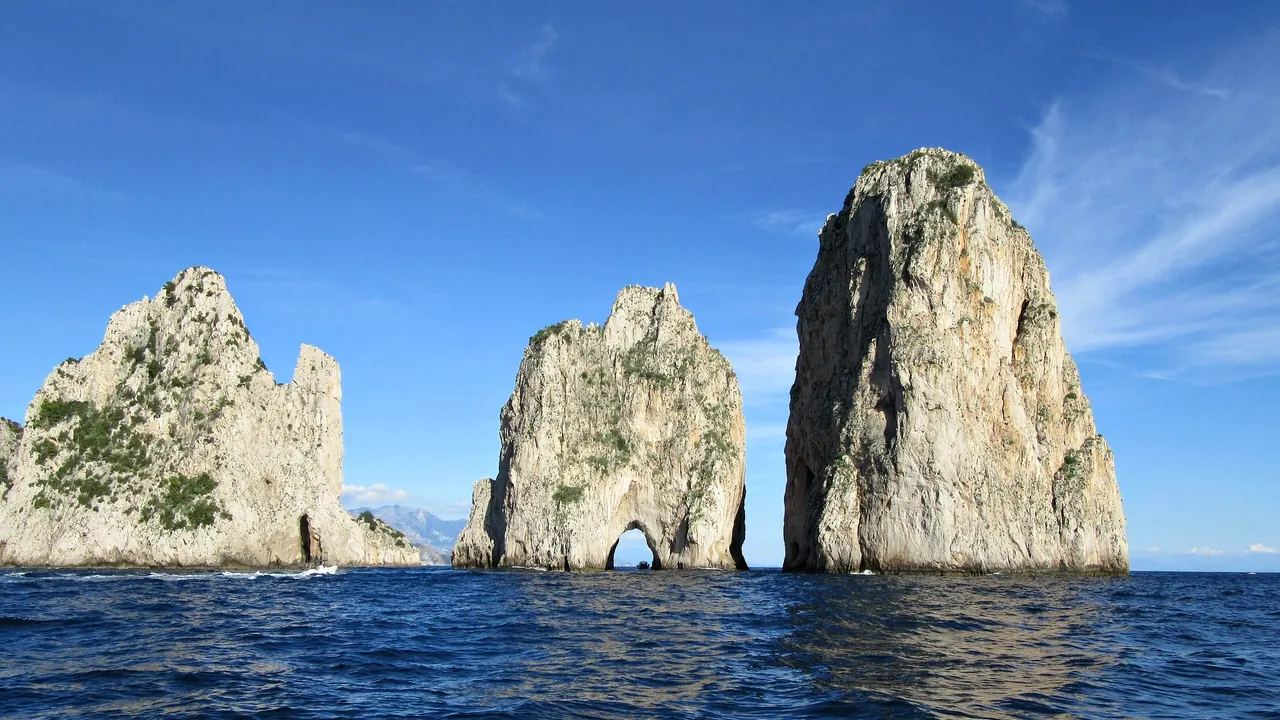
Photos: Capri by Sheeba Samuel, CC BY-SA 4.0, cropped.
Capri or Umbria?
Our verdict in twelve categories, each scored against the same fixed benchmark cities, and the climate month by month, so you can choose for your trip.
Choose Capri for
- beaches
- shopping
- nightlife
Capri suits a short, well-funded stay built around the sea. You swim off rocks into very clear water, take a boat round the Faraglioni and the grottoes, and spend dressed-up evenings on the Piazzetta, with the luxury lanes just off it. It works best for a few nights of doing very little, as long as the budget is generous and nobody needs sand or a programme for small children.
Choose Umbria for
- prices
- culture and sights
- live music and the arts
For a longer, slower trip by car, Umbria gives far more to fill the days. Each morning can bring a different hill town: Giotto in Assisi, Orvieto's cathedral on its cliff, Gubbio or Spello. Each evening ends with truffle pasta and Sagrantino, at prices well below the island's. What it gives up is the sea. Swimming means a farmhouse pool or Lake Trasimeno, and outside Perugia the nights are quiet.
Scoreboard
Twelve categories on one fixed scale from 0 to 100. The shaded stretch is the gap between the two.
Your match
Pick a travel style or drag the sliders, and both match scores follow your weighting.
Wins on beaches and shopping with your weighting.
Wins on prices and culture and sights with your weighting.
What matters to you?
Category by category
What the scores mean for a trip.
Beaches & swimming
Capri has no sand to speak of, but the swimming is superb. Pebble coves, rock platforms with ladders, and moorings under the Faraglioni all give onto deep blue water that is warm enough from June into October.
Umbria is landlocked, so the nearest equivalent is a lido on Lake Trasimeno. The water there is shallow and warm but often cloudy, with reeds and mud underfoot. Most visitors end up in the farmhouse pool, and the sea is a drive of two hours or more away.
Food & drink
Umbria is the place to travel for food. It has black truffle over handmade strangozzi, Norcia's pork butchery, porchetta vans at the markets, and Sagrantino tasted at the estates around Montefalco. Its one weakness is fish.
Capri's table is narrower: insalata caprese, ravioli capresi, torta caprese, and clams and anchovies. Much of the cooking near the Piazzetta is aimed at day-trippers. The better meals are found in the Anacapri trattorias, and there are no markets to explore.
Culture & sights
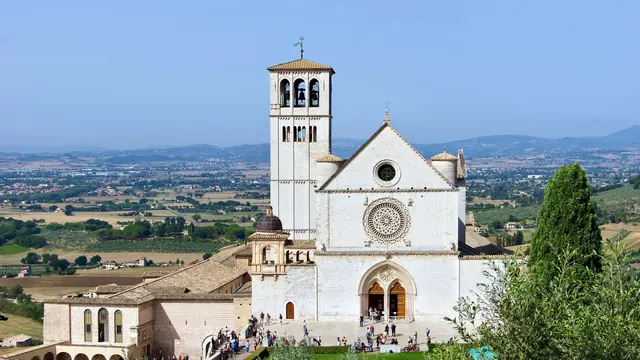
Umbria has art of the first rank spread across a chain of hill towns. There are frescoes by Giotto and Cimabue in Assisi, Signorelli's Last Judgement in Orvieto, Perugino in Perugia's Galleria Nazionale, and Gubbio, Spoleto and Spello to see on slower days. You could spend a week on it without repeating yourself.
Capri has a handful of good sites rather than a historic town: Tiberius's Villa Jovis on its headland, Villa San Michele, the Certosa and the Gardens of Augustus. They are worth seeing, and two days covers them.
Nightlife
Neither place has clubs. Capri still offers more of an evening out. When the last ferries leave, the Piazzetta fills with a well-dressed aperitivo crowd, and later the piano taverns keep Neapolitan songs going into the early hours, though only from about May to September.
In Umbria the night is usually a long dinner and a stroll. Perugia is the exception, where students crowd the cathedral steps and the wine bars around the old centre.
Nature & outdoors
Both reward time outdoors, but on very different scales. Capri is one limestone block with sheer sea cliffs, the Arco Naturale and the Sentiero dei Fortini. It is seen on short walks and by boat, kayak and snorkel, and a few days covers it.
Umbria is green, rolling and much larger, rising to the Monti Sibillini in the east. There you find the flowering plain of Castelluccio, rafting and canyoning in the Valnerina, the Marmore Falls, and a cycle path along the old Spoleto to Norcia railway.
Day trips
Umbria is built for outings. From a base near Perugia or Spoleto, there is a different hill town within easy reach every day, Cortona and Montepulciano are just over the Tuscan border, and Rome is a little over an hour by train from Orvieto.
Capri's outings are good too, with Naples, Sorrento, Positano and Ischia all reached by boat. They depend on the sea, though, and rough weather or the end of the season can cancel sailings. Pompeii makes for a long day.
Good for families
Umbria is the easier of the two with children. A farmhouse with a pool and animals, Lake Trasimeno's shallow water, the Marmore Falls and the amusement park near Perugia make for gentle days. The frescoed churches will test young patience.
Capri suits only older children who swim well and will enjoy the Blue Grotto, snorkelling and the Monte Solaro chairlift. Deep water off ladders, endless steps and packed summer buses make it hard work with small ones.
Getting around
Both are manageable, in opposite ways. On Capri you never need a car. The funicular, small orange buses and open taxis link everything over short distances, though the steep lanes and the July and August queues take patience.
In Umbria a hire car is close to essential. The roads are easy, and you park below each hill town and ride up by escalator or lift. The regional railway reaches Assisi, Spello and Spoleto but not the countryside.
Shopping & style
Capri is the stronger choice for clothes and style. Via Camerelle and the lanes off the Piazzetta hold a surprising number of luxury boutiques, alongside sandals made to measure while you wait, linen, and perfumes made on the island.
Umbria's shopping is about crafts and food instead. There is majolica from Deruta's workshops, hand-loomed linen in Montefalco, cashmere outlets near Perugia, Norcia's hams and truffles, and wine bought at the estates.
Affordability
The price gap is wide. Capri's few rooms command some of the highest summer rates in the Mediterranean, and sunbeds, boat hire and drinks with a view are all priced for wealthy visitors. Saving money there means walking and eating in Anacapri.
Umbria costs noticeably less than neighbouring Tuscany, never mind Capri. Farmhouse stays and village set lunches are good value, and most churches are free. The car hire and truffle dishes are where the bills add up.
Live music & performing arts
Umbria has two summer festivals worth planning a trip around. Umbria Jazz fills Perugia's squares in July, and the Festival dei Due Mondi brings opera, theatre and dance to Spoleto's Roman theatre. There are also small seasons at the Teatro Morlacchi.
Capri offers the odd summer concert in the Certosa cloisters or at Villa San Michele, and late-night Neapolitan song in the taverns. For anything more, you take the boat to Naples.
Wellness & relaxation
Neither place has a serious thermal tradition. Umbria makes slowing down easier, with country houses offering pools, massage and yoga, the silence of Assisi's hermitages on Monte Subasio, and small historic spas such as Fontecchio.
Capri's calm comes in two daily windows, the early morning and the evening, after the day-trippers have gone. The rest is hotel spas and garden terraces, and Ischia's thermal pools are across the bay.
When should you go?
Pick your month. The climate figures are measured averages, not a forecast.
Capri in July
Umbria in July
Daytime high, °C
Rainfall in the month, mm
Where the figures come from
Capri has no rain gauge within 25 km of the centre, so its rainfall comes from a gridded climate dataset read at the destination rather than from a gauge further away.
Capri's sunshine is measured 58 km from the centre, at Grazzanise.
Umbria's temperatures are measured 53 km from the centre, at Frontone.
Umbria has no rain gauge within 25 km of the centre, so its rainfall comes from a gridded climate dataset read at the destination rather than from a gauge further away.
Temperature and rainfall are climate normals, averaged over the years shown. Capri: 2005-2025 (sunshine 1991-2020, rainfall 1991-2020) normals, Capri (3.6 km from centre). Umbria: 1991-2020 normals, Frontone (52.9 km from centre).
Capri's beach season runs from June to early October. July and August are the driest and sunniest months, with the sea at about 26°C in August. Rain returns in September and builds to a wet November of around 146mm. Winters are mild but grey, so the island is better for walking in spring than for swimming.
Umbria lies inland and has a much wider swing between seasons. Winter highs of about 7°C make the hill towns chilly, and July reaches 30°C, which is hard going on steep streets and in the valleys. May, June, September and early October are the best months for touring. Rain is spread more evenly through the year, with the wettest spell in autumn.
Which traveller are you?
On a beach and sun trip, choose Capri. Umbria has no coast at all. Capri has deep, clear water off the rocks at Punta Carena, boats moored under the Faraglioni, and a long, dry summer of sunshine to go with them.
For a culture and arts trip, Umbria wins clearly. Assisi's frescoed basilica, Orvieto's cathedral, the Perugino paintings in Perugia, and the Umbria Jazz and Spoleto festivals in summer add up to far more than Capri's two days of villas and gardens.
On a trip with a tight budget, Umbria is the sensible choice. Farmhouse stays, set lunch menus and cheap local wine all keep costs down. Capri ranks among the most expensive places to sleep in Italy, and staying on the mainland means missing its evenings.
Before you go
| Measure | Capri | Umbria |
|---|---|---|
| Official language | Italian | Italian |
| Currency | Euro (EUR) | Euro (EUR) |
| Sockets | CFL230 V, 50 Hz | CFL230 V, 50 Hz |
| Driving side | Right | Right |
| Time zone | UTC+1, UTC+2 in summer | UTC+1, UTC+2 in summer |
| Emergency number | 112 | 112 |
| Main airport | Naples International Airport (NAP)131 non-stop destinations | Perugia San Francesco d'Assisi – Umbria International Airport (PEG)17 non-stop destinations |
| Public holidays this year | 13 days | 13 days |
By the numbers
| Measure | Capri | Umbria |
|---|---|---|
| Population | 12,903 | 852,085 |
| People per km² | 1,241 | 101 |
| Swim season, months above 21 °C | 5 months | - |
Where else could you go?
Every comparison below shares a destination with this one, so you can follow Capri or Umbria somewhere new.
- Positanovs Capri
- Amalfi Coastvs Capri
- Ischiavs Capri
- Tuscanyvs Umbria
- Cinque Terrevs Umbria
- Pugliavs Capri