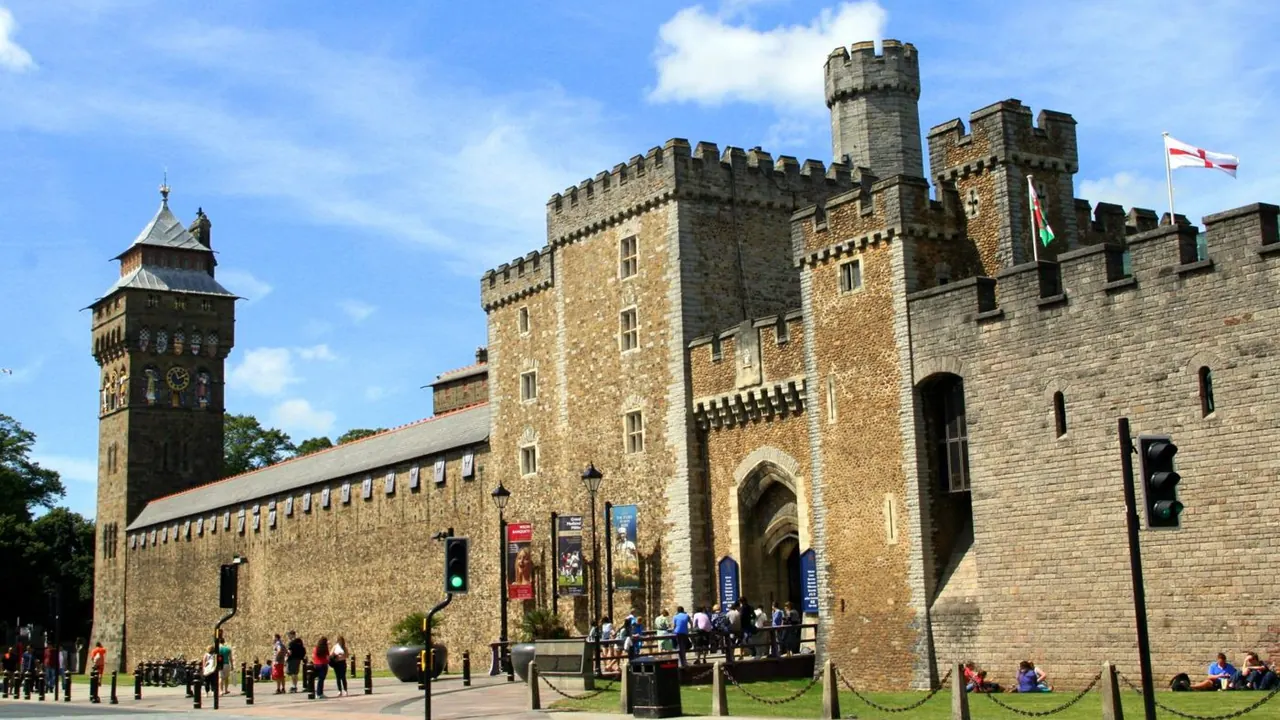

Photos: Cardiff by Tevfik Teker, CC BY 3.0, cropped; York by PAUL FARMER, CC BY-SA 2.0, cropped.
Cardiff or York?
Our verdict in twelve categories, each scored against the same fixed benchmark cities, and the climate month by month, so you can choose for your trip.
Choose Cardiff for
- live music and the arts
- beaches
- nightlife
Cardiff is the livelier pick. Choose it if your evenings matter as much as your days: opera and orchestral concerts at the Wales Millennium Centre, rising bands on Womanby Street, and a Saturday crowd that goes out hard. The coast and the hills are close, with Penarth and Barry Island a short train ride away and Pen y Fan within an hour's drive. Free national museums keep the cost down, so it suits a trip where you want a capital city's energy without paying much for it.
Choose York for
- culture and sights
- day trips
- wellness
York is for travellers who want history thick on the ground and easy to walk. The Minster, the medieval walls, the Viking and Roman layers and the National Railway Museum all sit in a centre you can cross on foot. It also makes the better base for exploring, with Durham, Harrogate, Castle Howard and Fountains Abbey all within reach. Nights are quieter and mostly spent in very old pubs, which suits a slower trip built around sightseeing.
Scoreboard
Twelve categories on one fixed scale from 0 to 100. The shaded stretch is the gap between the two.
Your match
Pick a travel style or drag the sliders, and both match scores follow your weighting.
Wins on live music and the arts and beaches with your weighting.
Wins on culture and sights and day trips with your weighting.
What matters to you?
Category by category
What the scores mean for a trip.
Beaches & swimming
Neither city has a beach of its own, but Cardiff is closer to the sea. Barry Island's sandy bay and funfair promenade are about half an hour away by train, and Penarth's pebble shore and Victorian pier are just along the coast. The Gower's wide sands and Porthcawl's surf are a longer drive.
From York the nearest sand is at Scarborough, about an hour away by train, with Filey and Whitby further on. The North Sea there is colder still, so that trip is a seaside day out rather than a swim.
Food & drink
Neither city is a destination for food, but they eat in different ways. Cardiff has more variety. There are Welsh cakes off the griddle and laverbread with cockles in the Victorian market, neighbourhood bistros in Pontcanna and Canton, and a long run of Middle Eastern and South Asian kitchens along City Road.
York sticks to tradition. You will find tearooms serving afternoon tea and fat rascals, Sunday roasts with Yorkshire pudding, and pies and cheese at the Shambles Market. There is little international cooking, and much of the food around the Minster is aimed at tourists.
Culture & sights
York has the deeper heritage. Two thousand years of history are packed inside its walls: the medieval stained glass of the Minster, a Viking street excavated beneath Jorvik, the ruins of St Mary's Abbey and the timber-framed lanes of Stonegate. The National Railway Museum adds a collection that is among the largest of its kind.
Cardiff's highlights are fine but younger. Cardiff Castle's lavish Victorian Gothic rooms, the strong Impressionist paintings in the National Museum and the rebuilt Welsh buildings at St Fagans fill a couple of days. Away from the castle walls, though, very little of the city is older than the Victorian era.
Nightlife
Cardiff is the bigger night out. St Mary Street packs with groups at weekends, Womanby Street opposite the castle has alternative bars and late venues, and on rugby international days the whole centre fills with fans in red. Pontcanna's wine bars are there if you want something gentler.
York's evenings revolve around its centuries-old inns on Stonegate, Micklegate and the riverside, and a slow pub crawl is the highlight. Weeknights go quiet early, and anyone after real clubbing takes the train to Leeds.
Nature & outdoors
Cardiff puts the outdoors closer to hand. You can walk or cycle straight out of the centre through Bute Park and onto the Taff Trail up the valley. The Wales Coast Path passes the Penarth cliffs, and Pen y Fan's moorland ridges in the Bannau Brycheiniog are about an hour's drive away.
York stands on flat farmland, so near the city you get riverside paths along the Ouse and the open Strays. The heather of the North York Moors, the sea cliffs at Robin Hood's Bay and the limestone scars of the Dales are all fine walking country, but they lie further out and are much easier with a car.
Day trips
Both cities are good bases, and York's range is wider. Harrogate and Leeds are half an hour away by train, and Durham's cathedral and castle on their river bend take under an hour. By road you can reach Castle Howard, Fountains Abbey, Rievaulx and the steam railway out of Pickering.
Cardiff's day trips centre on castles. Caerphilly is twenty minutes away by train, Castell Coch is just north of the city, and Chepstow pairs well with Tintern Abbey. Bath and Bristol across the Severn, and Blaenavon's mining heritage, add variety.
Good for families
The two are about equally good with children, but the attractions differ. Cardiff has Techniquest's hands-on science, the farm animals and craft demonstrations at St Fagans, rowing boats on Roath Park lake, and Barry Island's sands and funfair in summer.
York's draws are about history: walking among real locomotives at the National Railway Museum, Jorvik, the Victorian street in the Castle Museum, and ghost walks for older children. Its zoo, theme park and seaside are about an hour away.
Getting around
York is slightly easier on foot. Almost everything worth seeing lies inside or just outside the walls, it is about fifteen minutes from the station to the Minster, and cycling is common. The catch comes beyond the city, where sparse rural buses send many visitors to a hire car or a tour.
Cardiff's centre is just as flat and compact, but Cardiff Bay is a half-hour walk away, so you will often use the shuttle train, a bus or the water taxi on the Taff. Local trains reach the valleys and the coast well.
Shopping & style
Both cities offer chains plus independents, without luxury, but the settings differ. In Cardiff the independents sit in glass-roofed Victorian and Edwardian arcades selling records, vintage clothes and books, alongside a large central mall, with lovespoons and slate as the Welsh souvenirs.
York's boutiques, jewellers and antiques dealers fill the medieval streets of Stonegate and Petergate. Its Christmas markets are a reason to visit in themselves, though the Shambles leans towards souvenirs.
Affordability
Cardiff is the cheaper stay. Its national museums, including St Fagans, are free, and the train trips to the coast and the castles are short and inexpensive. Hotels are moderate unless a rugby international or a stadium concert is on.
York costs more, mainly because rooms inside the walls are in heavy demand and rates climb at weekends, on race days and at Christmas. The Minster, Jorvik and the castle museums all charge admission, though the Railway Museum and the walls are free.
Live music & performing arts
Cardiff is a real arts capital. The Wales Millennium Centre is home to Welsh National Opera, the BBC National Orchestra of Wales is based in the city, and the Royal Welsh College of Music and Drama keeps student performances coming. Small venues around Womanby Street book bands most nights, and the stadium takes the big tours.
York's programme is smaller but distinctive. There is drama and pantomime at the historic Theatre Royal, early music in a medieval church, free choral evensong at the Minster, and the Mystery Plays when they are revived on wagons in the streets.
Wellness & relaxation
In Cardiff, relaxing means a hotel spa, a leisure pool at the Bay, or slow coffee in Pontcanna followed by a walk along the Taff.
York has the edge, mostly thanks to a neighbour. Harrogate is half an hour away by train, and its Royal Baths have a Victorian Turkish bath with Moorish tiled hot rooms, steam rooms and plunge pools. Back in the city, early mornings on the walls and long afternoon teas set a gentle pace.
When should you go?
Pick your month. The climate figures are measured averages, not a forecast.
Cardiff in July
York in July
Daytime high, °C
Rainfall in the month, mm
Where the figures come from
Cardiff has no rain gauge within 25 km of the centre, so its rainfall comes from a gridded climate dataset read at the city rather than from a gauge further away.
Cardiff's sunshine is measured 83 km from the centre, at Lyneham.
York has no rain gauge within 25 km of the centre, so its rainfall comes from a gridded climate dataset read at the city rather than from a gauge further away.
York's sunshine is measured 48 km from the centre, at Leeming.
Temperature and rainfall are climate normals, averaged over the years shown. Cardiff: 1991-2020 normals, Cardiff-Wales Airport (14.9 km from centre). York: 1991-2020 normals, Linton-On-Ouse (14.9 km from centre).
The two cities follow almost the same temperature curve. Daytime highs reach about 20°C in July and August and fall to single figures from December to February, so late spring to early autumn is the comfortable season for walking the streets and the hills in both. Neither is ever too hot for sightseeing. Cardiff is the sunnier of the two in summer, with around 208 hours of sunshine in July against noticeably less in York. Its sea peaks at about 18°C in August, which means paddling more than real swimming.
The difference shows in autumn and winter. Cardiff turns wet from October, with about 118mm that month and similar totals until January, while York stays drier through the darker months. If you are going between October and March, York's dry spells make a stroll on the walls easier to plan. In summer, Cardiff's longer sunny spells suit a day on the coast or a hike in the Beacons better.
Which traveller are you?
On a food and nightlife trip, Cardiff has more to offer. City Road's long run of Middle Eastern and South Asian cooking widens the menu, and after dinner Womanby Street's small bars and gig venues stay busy, where York mostly settles into its old pubs.
On a trip on a tight budget, Cardiff goes further. A good day there can cost nothing: the barrage loop at the Bay, the lake in Roath Park, a browse through the arcades. In York, savings come mainly from staying midweek or outside the walls.
For a short city break, York is the easier choice. Cardiff is split between its centre and the Bay, half an hour's walk apart. York's Minster, Shambles, Jorvik and walls all lie within about fifteen minutes' walk of the station, so two days need no transport.
Before you go
| Measure | Cardiff | York |
|---|---|---|
| Official language | English | English |
| Currency | Pound Sterling (GBP) | Pound Sterling (GBP) |
| Sockets | G230 V, 50 Hz | G230 V, 50 Hz |
| Driving side | Left | Left |
| Time zone | UTC, UTC+1 in summer | UTC, UTC+1 in summer |
| Emergency number | 112 or 999 | 112 or 999 |
| Elevation | 41 m | 25 m |
| Main airport | Cardiff International Airport (CWL)15 km from centre30 non-stop destinations | Leeds Bradford Airport (LBA)39 km from centre69 non-stop destinations |
| Public holidays this year | 8 days | 8 days |
By the numbers
| Measure | Cardiff | York |
|---|---|---|
| City population | 383,536 | 208,400 |
| People per km² | 2,734 | 766 |
| Museums within 10 km | 9 | 24 |
| UNESCO World Heritage sites within 50 km | 1 | 2 |
| Swim season, months above 21 °C | None | - |
Where else could you go?
Every comparison below shares a destination with this one, so you can follow Cardiff or York somewhere new.