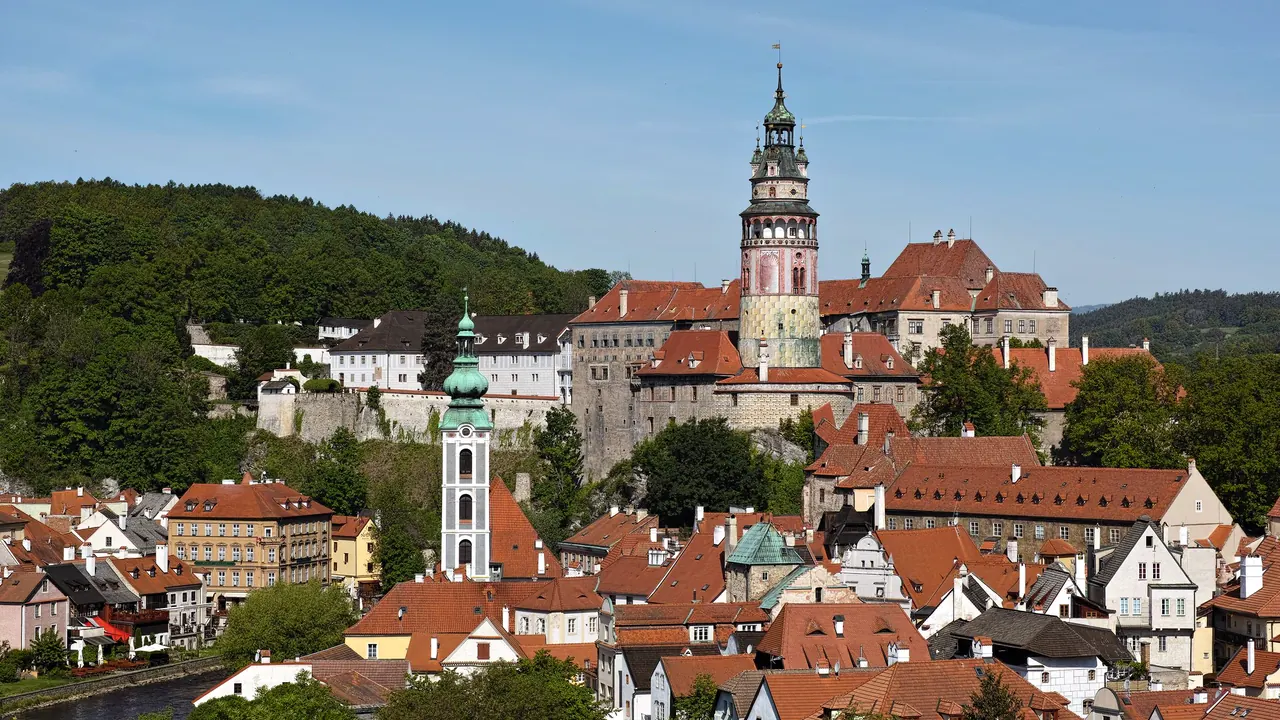
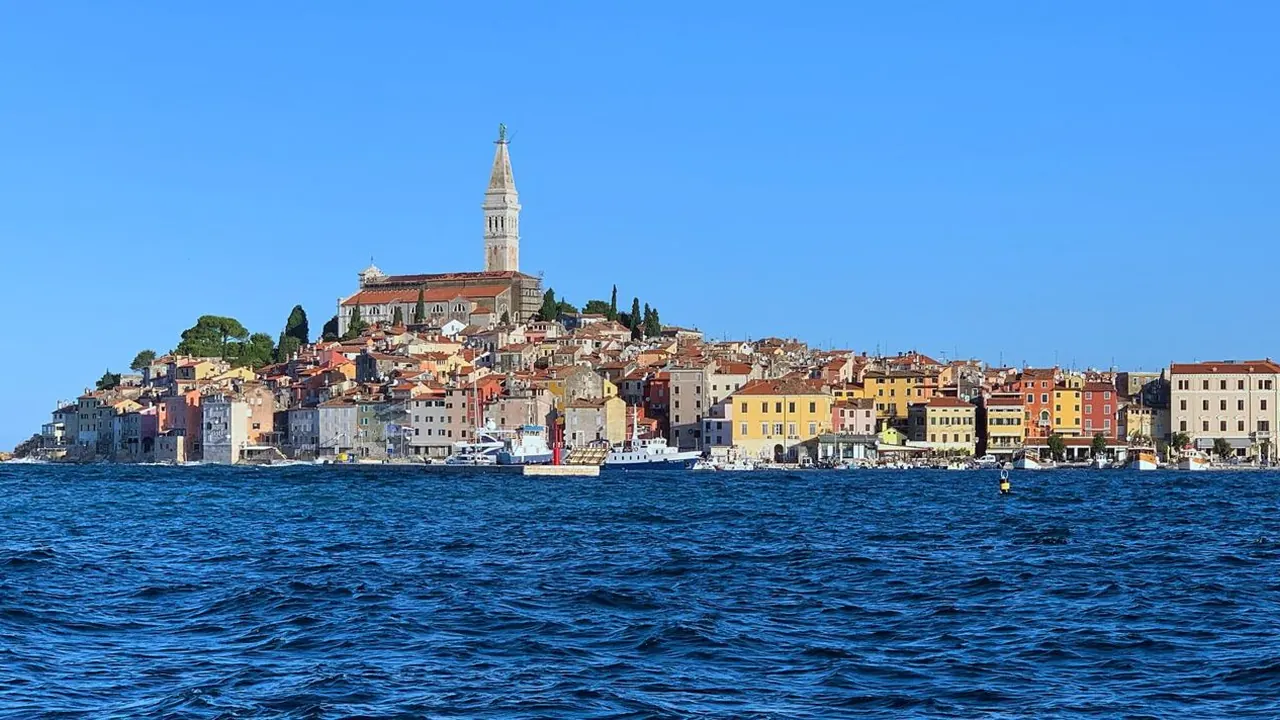
Photos: Cesky Krumlov by Xth-Floor, CC BY-SA 4.0, cropped; Rovinj by Vyacheslav Bukharov, CC BY-SA 4.0, cropped.
Cesky Krumlov or Rovinj?
Our verdict in twelve categories, each scored against the same fixed benchmark cities, and the climate month by month, so you can choose for your trip.
Choose Cesky Krumlov for
- culture and sights
- prices
- live music and the arts
Cesky Krumlov suits travellers who come for an intact historic town: a castle above a river bend, painted Renaissance houses, canoe trips on the Vltava and walks in the Bohemian Forest. Your money goes further here too. It works best as a stay of two or three days on a central European route, for people who are happy with quiet evenings, hearty food and a beer by the water.
Choose Rovinj for
- beaches
- food and drink
- wellness
Rovinj is the choice when the sea matters. You can swim off the rocks below the old town, take boats to the islands, eat Istrian fish and truffles, and set out to Roman Pula or the inland hill towns, which makes it a better base for a summer week, especially for couples and families. Expect to pay more, and to swim from stone rather than sand.
Scoreboard
Twelve categories on one fixed scale from 0 to 100. The shaded stretch is the gap between the two.
Your match
Pick a travel style or drag the sliders, and both match scores follow your weighting.
Wins on culture and sights and prices with your weighting.
Wins on beaches and food and drink with your weighting.
What matters to you?
Category by category
What the scores mean for a trip.
Beaches & swimming
Swimming barely features in Cesky Krumlov. The Vltava is for rafting, not bathing, and the nearest swim is at the Lipno reservoir, about half an hour south, where grassy and sandy shores meet lake water of around 20°C in high summer.
In Rovinj the sea is a large part of the stay. You can swim off limestone ledges and concrete platforms right below the old town or along the Golden Cape, or take a boat to the quieter coves on St Catherine and Red Island. The catch is that there is no sand, so bring water shoes.
Food & drink
Rovinj eats better. You get grilled fish, scampi buzara, truffle pasta, Istrian olive oil and Malvazija and Teran wines, and the konobas inland are worth the drive for slow-cooked meat.
Cesky Krumlov serves heavy South Bohemian food, roast pork, duck and dumplings in vaulted cellars, and the locally brewed beer is the best thing on the table. Both towns have plenty of menus aimed at passing visitors, but Rovinj's regional ingredients give a week of meals more variety.
Culture & sights
Cesky Krumlov is the stronger choice for sightseeing. The whole old town is UNESCO-listed, and the castle adds courtyards, state rooms, the triple-arched Cloak Bridge and a Baroque theatre with its original stage machinery, with the Egon Schiele art centre below.
Rovinj's appeal is mostly its setting. Venetian houses climb a former island to St Euphemia, whose bell tower you can climb, and the Batana House tells the story of the local fishing boats. You can see it all in an afternoon, while Cesky Krumlov's castle alone can fill a day.
Nightlife
Neither town is for a big night out. Rovinj has a little more going on: waterfront cocktail and wine bars, drinks on the rocks at sunset and a couple of places to dance in high season. Cesky Krumlov stops at cellar pubs and riverside terraces, has no clubs, and its lanes empty early outside summer.
Nature & outdoors
The outdoors is gentle in both, with a slight edge to Cesky Krumlov, though the settings differ. Here the classic day is a canoe or raft trip down the wooded Vltava. The Bohemian Forest national park offers long walks and bike rides, Klet has views towards the Alps, and in winter there is cross-country skiing.
Rovinj's outdoors is on the water. You can walk or cycle the pine and cedar paths of the Golden Cape, kayak or dive around the islands, and take a boat up the steep green Lim Fjord to its mussel farms.
Day trips
Rovinj has the richer surroundings. Pula's Roman amphitheatre, the sixth-century mosaics in Porec and the hill towns of Motovun and Groznjan are all within easy reach, and Piran and Trieste make longer outings across the border.
Cesky Krumlov has good trips of its own: the arcaded square of České Budějovice, the white castle at Hluboká, the Baroque farmhouses of Holašovice and the pond-ringed spa town of Třeboň. Prague, though, is too far for a comfortable day. Around both towns a car makes most of these trips far easier.
Good for families
Rovinj works a little better with children. There are boat rides to the islands, flat shady paths in the Golden Cape for pushchairs and bikes, and large campsites with pools and playgrounds. Younger children need watching on the rocky shore.
Cesky Krumlov has its own appeal: the bears in the castle moat, the tower climb and a gentle family raft trip, with Lipno's treetop walk nearby. But the castle interior tours are aimed at adults. In both towns the steep cobbled lanes are hard going with a pushchair.
Getting around
Getting around is much the same in both. Each has a small, car-free centre that you walk across in minutes on steep, uneven cobbles, and each needs a car for its countryside.
The differences are in how you leave. Cesky Krumlov has a railway station on the hill above town with regional trains to České Budějovice. Rovinj has no railway, but it has intercity buses to Pula, Porec and Zagreb, a promenade and coast paths that are easy by bike, and taxi boats to the islands.
Shopping & style
Shopping is small-scale in both, with Rovinj a little ahead. It sells food and drink from the region, such as truffle products, olive oil, Malvazija and lavender, and the steep Grisia lane is lined with artists' studios and galleries. Cesky Krumlov's lanes offer Bohemian glass, garnet jewellery, marionettes and moldavite, plus a few ceramics workshops. Neither has fashion streets or department stores.
Affordability
Cesky Krumlov is much cheaper. Family guesthouses fill the old houses, Czech meals and beer cost little, and only rooms with castle views and restaurants on the main lanes charge extra for the location.
Rovinj is one of the dearer resorts on the Croatian coast. Harbour restaurants charge for the view, and fish sold by weight adds up quickly. Private apartments, campsites and a visit in late spring or September bring the costs down, but rarely to Czech levels.
Live music & performing arts
Neither town has much on outside summer, but Cesky Krumlov has more to see in season. The castle garden's open-air theatre has a revolving auditorium that turns between scenes and stages plays and opera, and an international music festival brings classical concerts to the castle and churches.
Rovinj offers occasional concerts in St Euphemia, music on the squares and the bitinada, the town's tradition of unaccompanied singing. For a big show you have to go to the Roman arena in Pula.
Wellness & relaxation
Rovinj is the easier place to unwind. The resort hotels along the Golden Cape have pools, saunas and treatments open to outside guests, and May, June and September bring a slow rhythm of long lunches, swims and walks in the pines.
Cesky Krumlov offers little more than a few hotel wellness rooms and beer baths. Its calm comes from the still old town once the day visitors have gone, and proper peat baths in Třeboň are a day trip away.
When should you go?
Pick your month. The climate figures are measured averages, not a forecast.
Cesky Krumlov in July
Rovinj in July
Daytime high, °C
Rainfall in the month, mm
Where the figures come from
Cesky Krumlov's temperatures are measured 50 km from the centre, at Grainet-Rehberg.
Cesky Krumlov has no rain gauge within 25 km of the centre, so its rainfall comes from a gridded climate dataset read at the city rather than from a gauge further away.
Rovinj's temperatures are measured 64 km from the centre, at Trieste.
Rovinj has no rain gauge within 25 km of the centre, so its rainfall comes from a gridded climate dataset read at the city rather than from a gauge further away.
Temperature and rainfall are climate normals, averaged over the years shown. Cesky Krumlov: 1991-2020 normals, Grainet-Rehberg (50.3 km from centre). Rovinj: 1991-2020 normals, Trieste (63.7 km from centre).
Cesky Krumlov has a short warm season. Days reach about 23°C in July and August, which is comfortable for walking the lanes and floating down the river, although high summer is also its wettest stretch, with frequent showers. Winter is cold, with highs near 2°C and little sun, so it suits only a quiet off-season stay. Late spring and September are the easiest months for walking without the summer rain.
Rovinj is warmer and sunnier all year. From June to September the days are beach weather, with highs around 29°C at the peak and a sea that reaches about 26°C in August. May and late September are softer and good for walking and cycling. The rain arrives in autumn and peaks in November at about 102mm, and winter is mild but grey. For a single trip, high summer suits Rovinj better, while Cesky Krumlov is fine from May to September.
Which traveller are you?
On a beach and sun trip, Rovinj is the clear pick. Clear Adriatic water, rocky coves in the Golden Cape park and taxi boats to the islands give you a summer of swimming, while Cesky Krumlov only has a reservoir half an hour's drive away.
For a culture and arts trip, Cesky Krumlov gives more. Its UNESCO-listed old town, its huge castle with a working Baroque theatre and the summer concerts in the castle grounds go well beyond Rovinj's lovely but short list of sights.
On a trip with a tight budget, Cesky Krumlov makes the money last. Family guesthouses, moderately priced Czech meals and cheap local beer are easy on the wallet, whereas Rovinj is among the costlier towns on the Croatian coast, especially in high summer.
Before you go
| Measure | Cesky Krumlov | Rovinj |
|---|---|---|
| Official language | Czech | Croatian |
| Currency | Czech Koruna (CZK) | Euro (EUR) |
| Sockets | CE230 V, 50 Hz | CF230 V, 50 Hz |
| Driving side | Right | Right |
| Time zone | UTC+1, UTC+2 in summer | UTC+1, UTC+2 in summer |
| Emergency number | 112 | 112 |
| Elevation | 492 m | 0 m |
| Main airport | Václav Havel Airport Prague (PRG)143 km from centre178 non-stop destinations | Pula Airport (PUY)31 km from centre34 non-stop destinations |
| Public holidays this year | 13 days | 14 days |
By the numbers
| Measure | Cesky Krumlov | Rovinj |
|---|---|---|
| City population | 12,797 | 12,968 |
| People per km² | 576 | - |
| Museums within 10 km | 4 | 1 |
| UNESCO World Heritage sites within 50 km | 2 | 1 |
| Swim season, months above 21 °C | - | 4 months |
Where else could you go?
Every comparison below shares a destination with this one, so you can follow Cesky Krumlov or Rovinj somewhere new.
- Triestevs Rovinj
- Venicevs Rovinj
- Ljubljanavs Rovinj
- Praguevs Cesky Krumlov
- Salzburgvs Cesky Krumlov
- Bledvs Rovinj