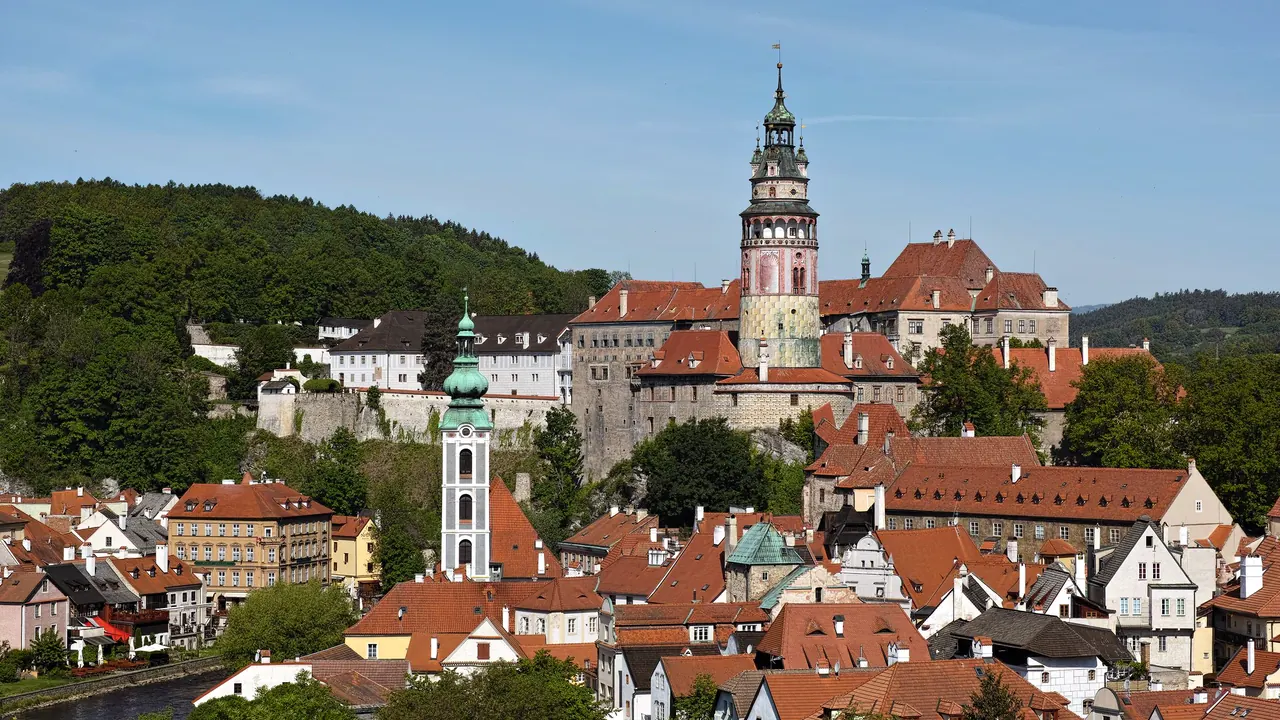
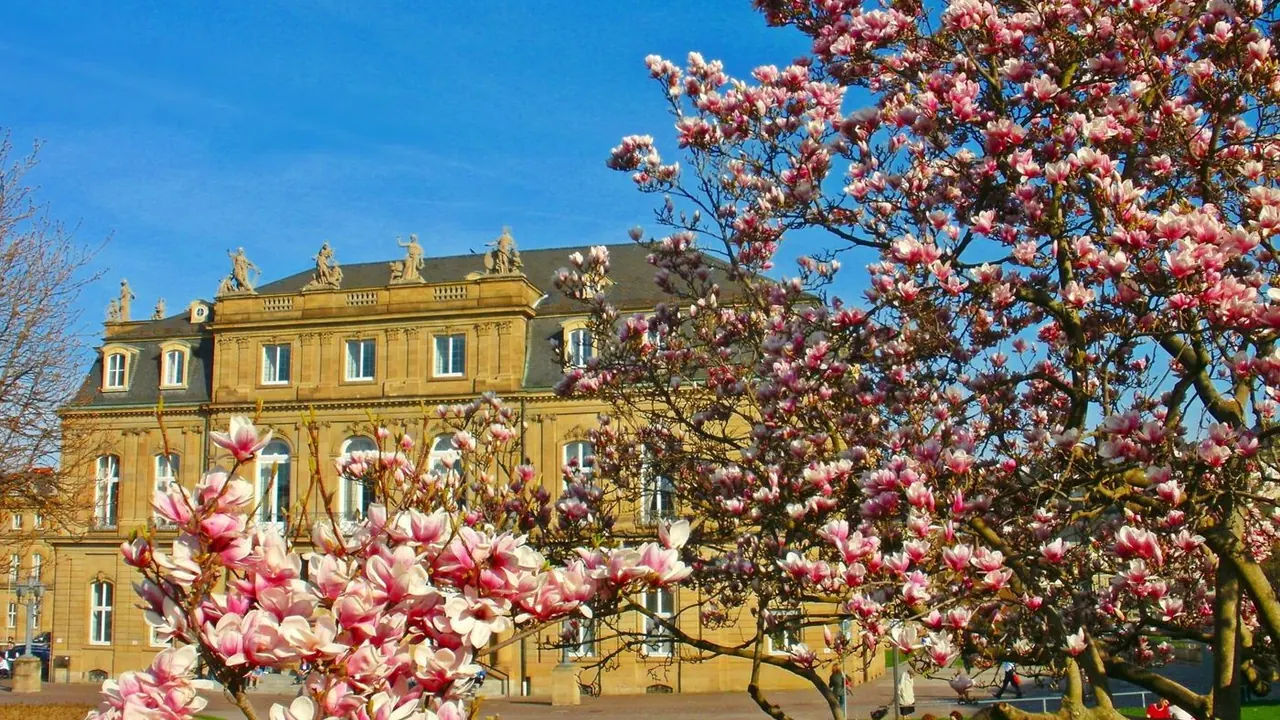
Photos: Cesky Krumlov by Xth-Floor, CC BY-SA 4.0, cropped; Stuttgart by Baden de, CC BY 3.0, cropped.
Cesky Krumlov or Stuttgart?
Our verdict in twelve categories, each scored against the same fixed benchmark cities, and the climate month by month, so you can choose for your trip.
Choose Cesky Krumlov for
- prices
- beaches
- nature and the outdoors
Cesky Krumlov suits travellers who want one small, intact historic town and are happy to slow down in it. The castle, the painted houses on the river bend and a day floating down the Vltava are the trip, and evenings end with a beer by the water rather than a show or a club. It is also the cheaper of the two, and couples or walkers who come for two or three quiet days will get the most from it.
Choose Stuttgart for
- live music and the arts
- shopping
- wellness
Stuttgart is the better pick for a fuller city stay with more to do after dark and more within reach by train. The opera and ballet, the car museums, the mineral baths, better food and shopping, and fast trains to Heidelberg, Tübingen and Ludwigsburg give it range that the Czech town cannot match. It suits families, arts lovers and anyone who wants a base rather than a single sight, as long as they accept higher prices.
Scoreboard
Twelve categories on one fixed scale from 0 to 100. The shaded stretch is the gap between the two.
Your match
Pick a travel style or drag the sliders, and both match scores follow your weighting.
Wins on prices and beaches with your weighting.
Wins on live music and the arts and shopping with your weighting.
What matters to you?
Category by category
What the scores mean for a trip.
Beaches & swimming
Neither is a place for a beach trip, but Cesky Krumlov at least has a summer lake close by. Lipno reservoir, about half an hour south, has grassy and sandy shores and water near 20°C in high summer, while the Vltava in town is for rafting, not swimming.
From Stuttgart the nearest proper swimming lake is Lake Constance, more than two hours away, so a hot day there means the city's outdoor pools, some fed by mineral springs.
Food & drink
Both serve hearty regional cooking, but Stuttgart gives a food lover far more to work with. Beyond Maultaschen and Käsespätzle in the wine taverns, it has the Art Nouveau Markthalle, vineyards inside the city producing Trollinger and Riesling, seasonal Besen taverns in growers' homes and a serious fine-dining tier.
Cesky Krumlov's table is roast pork, duck with dumplings and river trout in vaulted cellars, with the town's own beer as the highlight. The range is narrow and many menus are aimed at day visitors, so meals here are pleasant rather than memorable.
Culture & sights
The two are broadly level, but the culture is very different. Cesky Krumlov is a whole UNESCO-listed townscape: painted Renaissance and Baroque houses, one of the country's largest castles, the Cloak Bridge and a Baroque theatre with its original stage machinery. The town itself is the exhibit, and a day or two covers it.
Stuttgart's draw is modern design and collections, from the Mercedes-Benz and Porsche museums to the Staatsgalerie and the Le Corbusier houses at the Weissenhof Estate. Its bombed old core survives only in pockets around Schlossplatz, so it rewards museum-goers more than those who come to wander old streets.
Nightlife
Stuttgart is the clear choice for a night out, with bars and lounges along Theodor-Heuss-Strasse, basement clubs with an electronic following and wine bars in the Bohnenviertel. The Cannstatter Volksfest beer tents and the late-summer wine village make autumn and late summer its liveliest times.
Cesky Krumlov has no clubs at all. A few cellar bars and summer riverside terraces stay open late, but outside the peak months the lanes are empty soon after dinner.
Nature & outdoors
Cesky Krumlov has a slight edge, mostly because its signature outing is so good: a day by canoe or raft down the wooded meanders of the Vltava. The Bohemian Forest national park, with spruce woods, peat bogs and cross-country skiing in winter, starts about half an hour away, and Klet hill gives views towards the Alps.
Stuttgart's green is closer to hand, with vineyard trails and deer forests reached on foot or by tram. The Swabian Jura cliffs and the northern Black Forest each lie about an hour out, which suits walkers and cyclists who prefer not to drive.
Day trips
Stuttgart is much the stronger base, largely because the rail network does the work. Ludwigsburg's palace and Esslingen are short S-Bahn rides, Heidelberg and Tübingen are under an hour, and Maulbronn, Hohenzollern, Ulm, Baden-Baden and even Strasbourg are all feasible.
From Cesky Krumlov there are good South Bohemian outings to České Budějovice, Hluboká castle, the farmhouse village of Holašovice and the spa town of Třeboň. Most of them are far easier with a car, and Prague is too far for a comfortable day.
Good for families
Stuttgart is the easier family city. Wilhelma, the zoological and botanical garden among Moorish-style pavilions, fills a whole day, and the car museums, the Killesberg park railway and the little rack railway keep children busy, with outdoor pools and beer gardens for breaks.
Cesky Krumlov has a storybook castle with bears in the moat and a gentle family raft trip that most children love. It is short on further activities, though, and steep cobbles make pushchairs hard work.
Getting around
Inside town, Cesky Krumlov needs nothing but your feet: the old centre can be crossed in a quarter of an hour, with only the castle climb and cobbles to slow you. Leaving it is the problem, as buses and trains to the forest and smaller castles are thin and most visitors hire a car.
Stuttgart's flat centre is just as walkable, and one integrated ticket then covers light rail, S-Bahn, buses, a rack railway and a funicular up the steep basin sides. A car is only needed for the countryside.
Shopping & style
Souvenir hunters will find plenty in Cesky Krumlov's lanes: Bohemian glass, garnet jewellery, marionettes and green moldavite, plus a few ceramics workshops. Once the gifts are bought, though, there is nothing else to shop for.
Anyone after clothes or brands needs Stuttgart. Königstrasse, one of Germany's longest pedestrian streets, runs through the centre, Breuninger covers luxury fashion, and the Metzingen outlet town is half an hour away.
Affordability
Cesky Krumlov is the more affordable stay. Family guesthouses, Czech meals and local beer keep costs moderate, though castle-view rooms, main-lane restaurants and separately priced castle tours add up, and staying just outside the centre helps.
Stuttgart is a prosperous business city where hotels charge heavily during trade fairs. Weekends and quieter months bring room prices down, and tavern meals and day tickets for transport are fair value.
Live music & performing arts
Here the gap is widest. Stuttgart has the Staatsoper and the Stuttgart Ballet, one of Europe's most respected companies since John Cranko's era, along with serious drama, orchestras and Bach at the Liederhalle, long-running musicals and live jazz through the week. Ballet tickets need booking early.
Cesky Krumlov's performances are seasonal: plays and opera in the castle garden's revolving open-air theatre and a summer music festival in the castle and churches. Outside summer there is very little on.
Wellness & relaxation
Stuttgart has a real bathing culture, with some of Europe's most productive mineral springs feeding public baths in Bad Cannstatt and Berg, where you soak in warm carbonated water indoors and out. It makes for a restorative afternoon rather than a full retreat.
Cesky Krumlov relaxes you through quiet rather than treatments, especially once the day visitors leave the old town. Its spa options are only hotel wellness rooms and beer baths, and anyone wanting proper treatments heads to Třeboň's peat baths for the day.
When should you go?
Pick your month. The climate figures are measured averages, not a forecast.
Cesky Krumlov in July
Stuttgart in July
Daytime high, °C
Rainfall in the month, mm
Where the figures come from
Cesky Krumlov's temperatures are measured 50 km from the centre, at Grainet-Rehberg.
Cesky Krumlov has no rain gauge within 25 km of the centre, so its rainfall comes from a gridded climate dataset read at the city rather than from a gauge further away.
Temperature and rainfall are climate normals, averaged over the years shown. Cesky Krumlov: 1991-2020 normals, Grainet-Rehberg (50.3 km from centre). Stuttgart: 1991-2020 normals, Stuttgart / Neckartal (2.8 km from centre).
Both are at their best from late May to September, but Stuttgart runs a few degrees warmer all year, reaching about 26°C in July and August against 23°C in Cesky Krumlov. Summer is also the wettest season in both, and much more so in the Czech town, where July brings around 111mm of rain, often in showers. Only in July and August is Lipno's water warm enough for a comfortable swim, and the long sunny days then suit rafting and forest walks.
Winter is colder in Cesky Krumlov, where daytime highs hover around 2°C from December to February and the cobbled lanes can be icy, though a still, snowy old town has its own appeal. Stuttgart stays a little milder and drier through winter, so museums, theatres and the mineral baths make it the easier cold-season choice. Spring and autumn are pleasant for walking in both, with October often bright in Stuttgart's vineyards.
Which traveller are you?
For a short city break, Cesky Krumlov fits neatly into two or three days. Everything lies within a short walk, the townscape itself is the attraction, and early mornings and evenings in the emptied lanes give a weekend its best moments.
An outdoors trip leans towards Cesky Krumlov, where river, forest and lake lie within half an hour of each other. A canoe day on the Vltava pairs with Bohemian Forest trails and Lipno's lakeside cycle path. Stuttgart's hills suit walkers without a car.
Lovers of culture and the arts get more from Stuttgart, where a day at the Staatsgalerie or the car museums can end at the opera, the ballet or a concert at the Liederhalle. Cesky Krumlov's castle is beautiful, but its evenings offer little.
Before you go
| Measure | Cesky Krumlov | Stuttgart |
|---|---|---|
| Official language | Czech | German |
| Currency | Czech Koruna (CZK) | Euro (EUR) |
| Sockets | CE230 V, 50 Hz | CF230 V, 50 Hz |
| Driving side | Right | Right |
| Time zone | UTC+1, UTC+2 in summer | UTC+1, UTC+2 in summer |
| Emergency number | 112 | 112 |
| Elevation | 492 m | 245 m |
| Main airport | Václav Havel Airport Prague (PRG)143 km from centre178 non-stop destinations | Stuttgart Airport (STR)10 km from centre124 non-stop destinations |
| Public holidays this year | 13 days | 12 days |
By the numbers
| Measure | Cesky Krumlov | Stuttgart |
|---|---|---|
| City population | 12,797 | 609,365 |
| People per km² | 576 | 2,938 |
| Museums within 10 km | 4 | 42 |
| UNESCO World Heritage sites within 50 km | 2 | 3 |
Where else could you go?
Every comparison below shares a destination with this one, so you can follow Cesky Krumlov or Stuttgart somewhere new.
- Baden-Badenvs Stuttgart
- Heidelbergvs Stuttgart
- Strasbourgvs Stuttgart
- Praguevs Cesky Krumlov
- Salzburgvs Cesky Krumlov
- Hallstattvs Cesky Krumlov