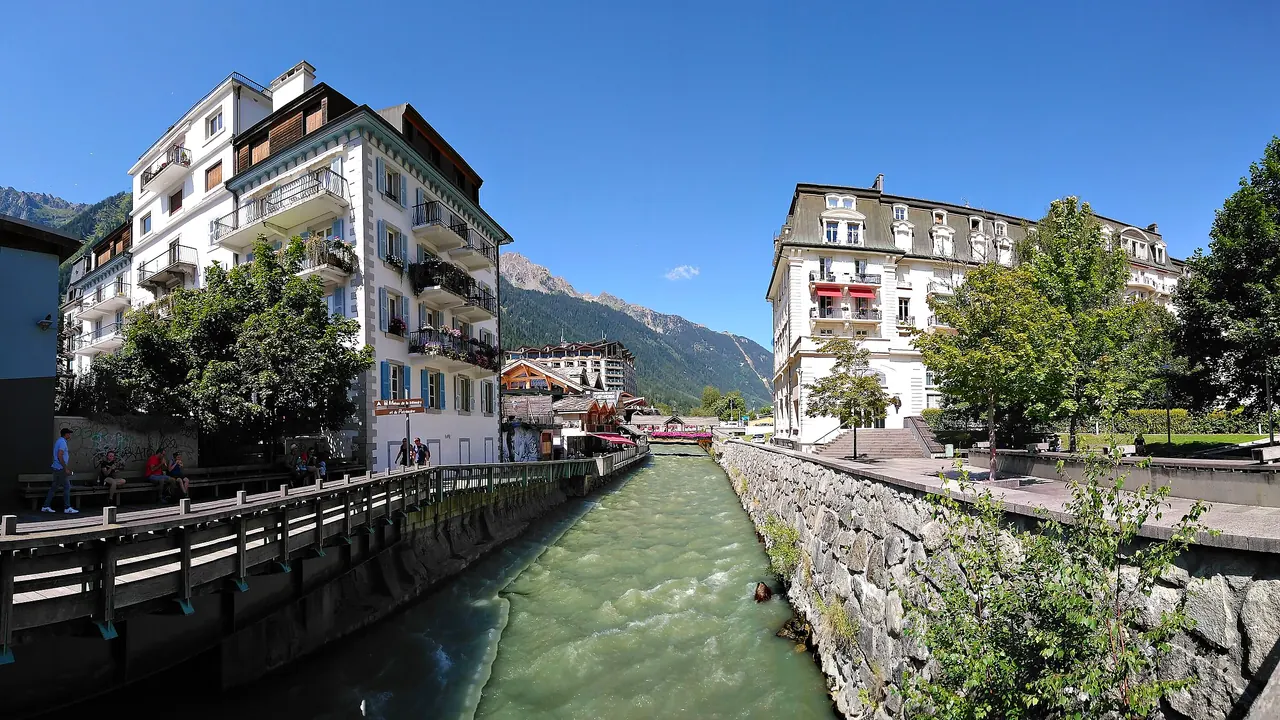
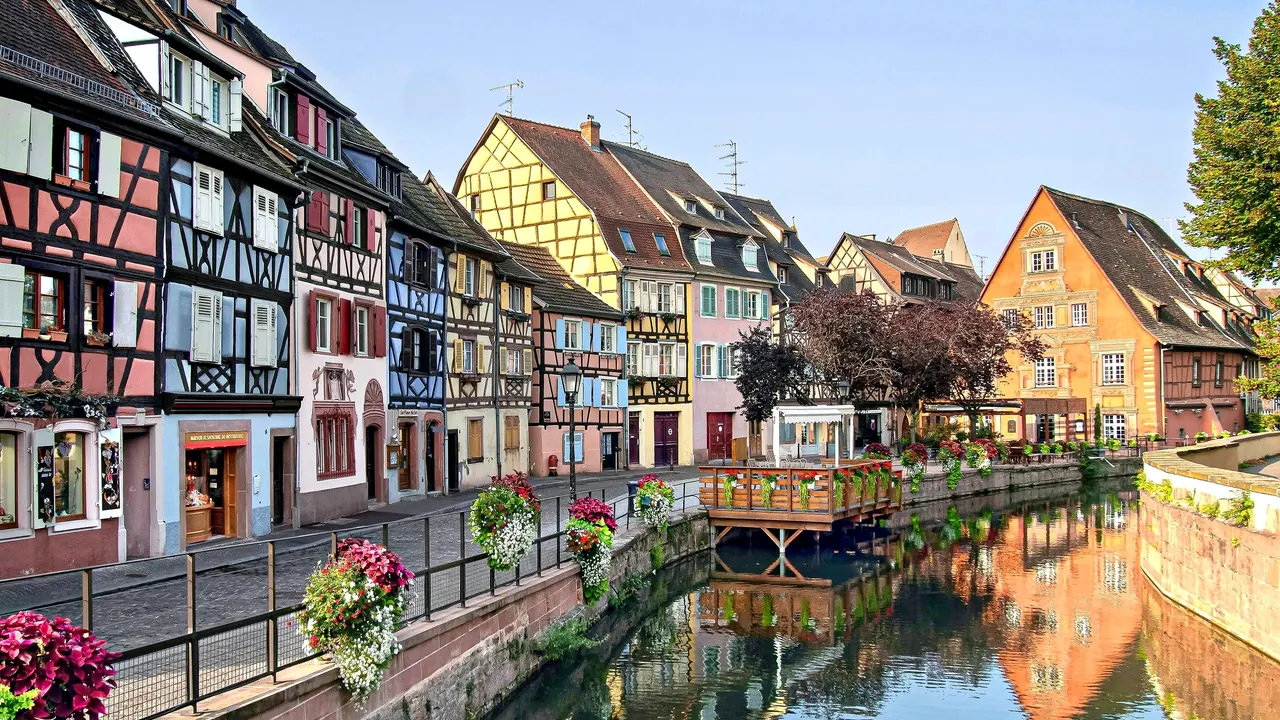
Photos: Chamonix by Tiia Monto, CC BY-SA 3.0, cropped; Colmar by Rolf Kranz, CC BY-SA 4.0, cropped.
Chamonix or Colmar?
Our verdict in twelve categories, each scored against the same fixed benchmark cities, and the climate month by month, so you can choose for your trip.
Choose Chamonix for
- nature and the outdoors
- nightlife
- wellness
Chamonix is for travellers who want to spend their days high in the mountains. In winter that means steep skiing along the valley and the Vallée Blanche, and in summer the Aiguille du Midi cable car, the Grand Balcon trails and climbing with a guide. Evenings are livelier too, with après-ski and a late lane of bars, and a spa looking up at the glaciers to finish the day. In return you pay resort prices, and there is little culture beyond the history of alpinism.
Choose Colmar for
- culture and sights
- prices
- day trips
Colmar suits a slower trip built around old streets, great painting and wine. The half-timbered old town and the Isenheim Altarpiece give it a depth Chamonix cannot match, and the winstubs and cellar tastings make every meal worth planning. Strasbourg, Basel, Freiburg and the Route des Vins villages are all within easy reach. It costs noticeably less, though the streets go quiet soon after dinner.
Scoreboard
Twelve categories on one fixed scale from 0 to 100. The shaded stretch is the gap between the two.
Your match
Pick a travel style or drag the sliders, and both match scores follow your weighting.
Wins on nature and the outdoors and nightlife with your weighting.
Wins on culture and sights and prices with your weighting.
What matters to you?
Category by category
What the scores mean for a trip.
Beaches & swimming
Neither place is for swimming, but Chamonix has the better options for a summer afternoon. Lac de Passy has a grassy shore facing the Mont Blanc massif, and Lake Annecy is a little over an hour away.
Colmar, out on the Alsace plain, has municipal pools and a few small lakes up in the Vosges valleys, and not much else.
Food & drink
Colmar is the place for a trip planned around meals. Its wood-panelled winstubs serve baeckeoffe, choucroute and tarte flambée, with Riesling and Gewurztraminer from the slopes just outside town and cellar tastings in the wine villages.
Chamonix has hearty Savoyard cooking, fondue, tartiflette and raclette made with alpine cheeses, and it tastes best on a mountain terrace. In town, though, the menus are those of a resort, often alike from one place to the next, and many kitchens close outside the main seasons.
Culture & sights
Chamonix tells one story well, the birth of alpinism and the first Winter Olympics, through the Musée Alpin, the pioneers' statues and the climbers' cemetery. Half a day covers all of it.
Colmar's old town is a complete late-medieval and Renaissance townscape, with Maison Pfister, the Koïfhus and the canals of Petite Venise. On top of that, the Unterlinden Museum holds the Isenheim Altarpiece, a painting people travel across Europe to see. It is worth two full days.
Nightlife
Chamonix has the livelier evenings. Après-ski starts in the late afternoon, then guides, seasonal workers and visitors move on to the bars of the old town's narrow lane, and a couple of small clubs stay open into the early hours in winter. It is a young, mostly English-speaking scene, and it shrinks in the shoulder seasons.
Colmar's evenings are a long dinner and a glass of wine by the canals, and the streets are quiet well before midnight.
Nature & outdoors
Chamonix sits at the foot of the highest mountain in Western Europe. Glaciers, granite needles and the Aiguille du Midi at 3,842m are a cable-car ride from the centre, and there is world-class skiing, mountaineering and trail running straight from the valley.
Colmar's countryside is gentler but still very good. There are vineyard paths between wine villages, the Route des Crêtes over the forested Vosges, and good cycling on the plain. Autumn, with the harvest, is its finest season, though you will want a car to get the most from it.
Day trips
From Chamonix, the best outings cross borders. Courmayeur and Roman Aosta are through the Mont Blanc Tunnel, and the Mont Blanc Express runs to Martigny, while Annecy and Geneva are about an hour away. Beyond those, most places within reach are other ski resorts, and mountain roads make journeys slow.
Colmar is the stronger base by some way. Strasbourg is half an hour by train, Riquewihr, Eguisheim and Kaysersberg are a few kilometres apart along the wine route, and Basel and Freiburg are both about an hour away.
Good for families
Both work well with children, in different ways. Chamonix suits active families, with nursery slopes, sledging, a summer luge, ibex and marmots at the Merlet park and the little red train to the Mer de Glace. The high cable cars are not for toddlers, though, and there is little to do on wet days.
Colmar is gentler: boat rides through Petite Venise, storks on the rooftops and, beyond town, the monkey park at Kintzheim, the Mulhouse museums and Europa-Park. Most of those need a car.
Getting around
Chamonix makes it slightly easier to get around without a car. The guest card gives free travel on the buses and the Mont Blanc Express along the whole valley, and the main cable-car stations are in town, though the ski buses are crowded in winter.
Colmar's compact centre and fast trains to Strasbourg and Mulhouse are easy, but the wine villages and the Vosges are poorly served by buses. Most visitors hire a car or a bike.
Shopping & style
Neither is a shopping destination, but Colmar has more to browse. There is wine bought from the producers, Soufflenheim pottery, Alsatian linen and gingerbread, and in December the Christmas markets spread across several squares.
Chamonix's strength is narrower. Its long-established climbing and ski shops are where serious mountaineers buy technical gear, and beyond that it is mostly cheese, génépi and souvenirs.
Affordability
The real gap between the two lies in what an ordinary day costs, more than in the meals. In Chamonix the main attraction has to be paid for: getting up into the high mountains, or doing anything serious once you are there, means paying for the ride up or for someone to lead you, and resort prices follow you back down to dinner. Its expensive weeks also come in both winter and summer, so it has two peak seasons rather than one. Shopping at the supermarket and walking the trails that start from the valley floor keep a stay under control, and late spring and autumn are gentler on the wallet, though some lifts are shut then.
Colmar is clearly the cheaper of the two, because most of what people come for costs nothing to enjoy: the painted lanes of the old town, the canals of Petite Venise and the paths through the vines between villages. The money goes on a bed and, for the wine route, a hire car. The bed is what needs planning, since a town this size fills up fast in summer and at Christmas, and a room in Eguisheim or Turckheim is often the easier choice than one in the old town.
Live music & performing arts
Colmar has a small Italian-style theatre with plays and touring opera, and a classical music festival in early July. Chamonix's offer is a summer jazz festival with some sets played up in the mountains, plus mountain film evenings. For an orchestra or a full opera season you leave either town, for Strasbourg or Basel from Colmar, or Geneva from Chamonix.
Wellness & relaxation
Chamonix is better for real pampering. Its large day spa has hot outdoor pools facing the glaciers, which are ideal after a day's skiing, and Saint-Gervais has warm springs in a wooded gorge down the valley. The town itself is busy and starts early.
Colmar has only hotel spas, but its pace is calmer: quiet canal-side evenings and slow walks through the vines once the day-trippers have gone home.
When should you go?
Pick your month. The climate figures are measured averages, not a forecast.
Chamonix in July
Colmar in July
Daytime high, °C
Rainfall in the month, mm
Where the figures come from
Chamonix's temperatures are measured 35 km from the centre, at Bourg-St-Maurice.
Chamonix has no rain gauge within 25 km of the centre, so its rainfall comes from a gridded climate dataset read at the city rather than from a gauge further away.
Temperature and rainfall are climate normals, averaged over the years shown. Chamonix: 1999-2020 (rainfall 1991-2020) normals, Bourg-St-Maurice (34.9 km from centre). Colmar: 1991-2020 normals, Ihringen (21.1 km from centre).
Chamonix has two seasons. From June to September the valley is warm enough for long days on the trails, with highs around 27°C in July, and Lac de Passy is only warm enough to swim in July and August. The cold months belong to skiing. Rain falls heavily all year and peaks in late autumn and early winter, with about 169mm in December, so the weather in the mountains needs watching in every month.
Colmar is much drier and sunnier. Even its wettest months get far less rain than Chamonix, and winter brings as little as 32mm. Summer is bright, with about 247 hours of sunshine in July, and pleasant for walking the old town and the vineyards, though the hottest weeks can feel close on the plain. September and October are mild and quieter. Winters are cold and grey in both places, but in Colmar that is when the streets fill with Christmas markets rather than skiers.
Which traveller are you?
For an outdoors trip, choose Chamonix. Cable cars lift you straight onto glaciers below Mont Blanc, the Tour du Mont Blanc and Lac Blanc trails start in town, and there is serious skiing, climbing and paragliding. Colmar's rounded Vosges and vineyard paths are much gentler.
On a culture and arts trip, Colmar is clearly the better choice. It has an intact late-medieval old town, the Unterlinden Museum with Grünewald's altarpiece, Schongauer in the Dominican church and a municipal theatre with a festival season. Chamonix's heritage fits into a morning at the Musée Alpin.
On a tight budget, Colmar goes much further. Set lunches, regional wine and village tastings are reasonable, and rooms are cheaper outside the Christmas weeks. In Chamonix, lift passes, cable cars and accommodation add up fast, even with free valley transport.
Before you go
| Measure | Chamonix | Colmar |
|---|---|---|
| Official language | French | French |
| Currency | Euro (EUR) | Euro (EUR) |
| Sockets | CE230 V, 50 Hz | CE230 V, 50 Hz |
| Driving side | Right | Right |
| Time zone | UTC+1, UTC+2 in summer | UTC+1, UTC+2 in summer |
| Emergency number | 112 | 112 |
| Elevation | 995 m | 185 m |
| Main airport | Geneva International Airport (GVA)68 km from centre150 non-stop destinations | EuroAirport Basel–Mulhouse–Freiburg (BSL)55 km from centre112 non-stop destinations |
| Public holidays this year | 11 days | 11 days |
By the numbers
| Measure | Chamonix | Colmar |
|---|---|---|
| City population | 8,705 | 66,970 |
| People per km² | 75 | 1,006 |
| Museums within 10 km | 3 | 9 |
| UNESCO World Heritage sites within 50 km | 0 | 3 |
Where else could you go?
Every comparison below shares a destination with this one, so you can follow Chamonix or Colmar somewhere new.
- Annecyvs Chamonix
- Baselvs Colmar
- Strasbourgvs Colmar
- Genevavs Chamonix
- Lausannevs Chamonix
- Baden-Badenvs Colmar