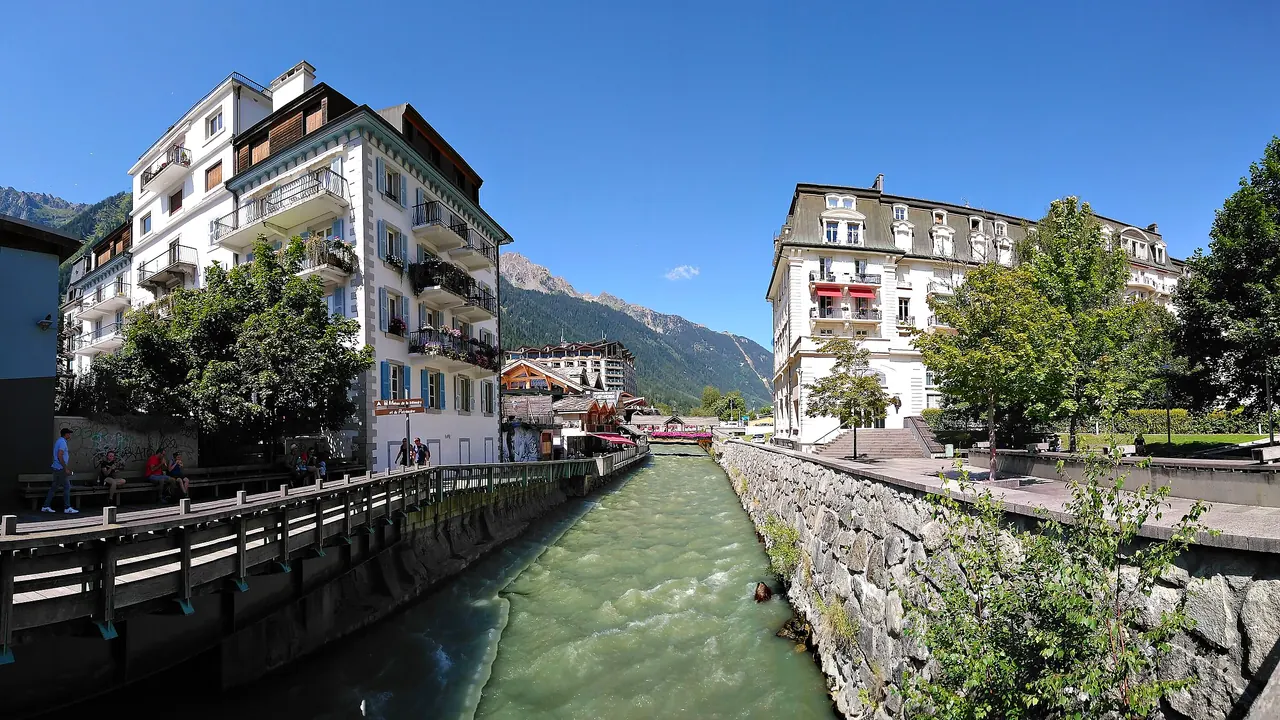
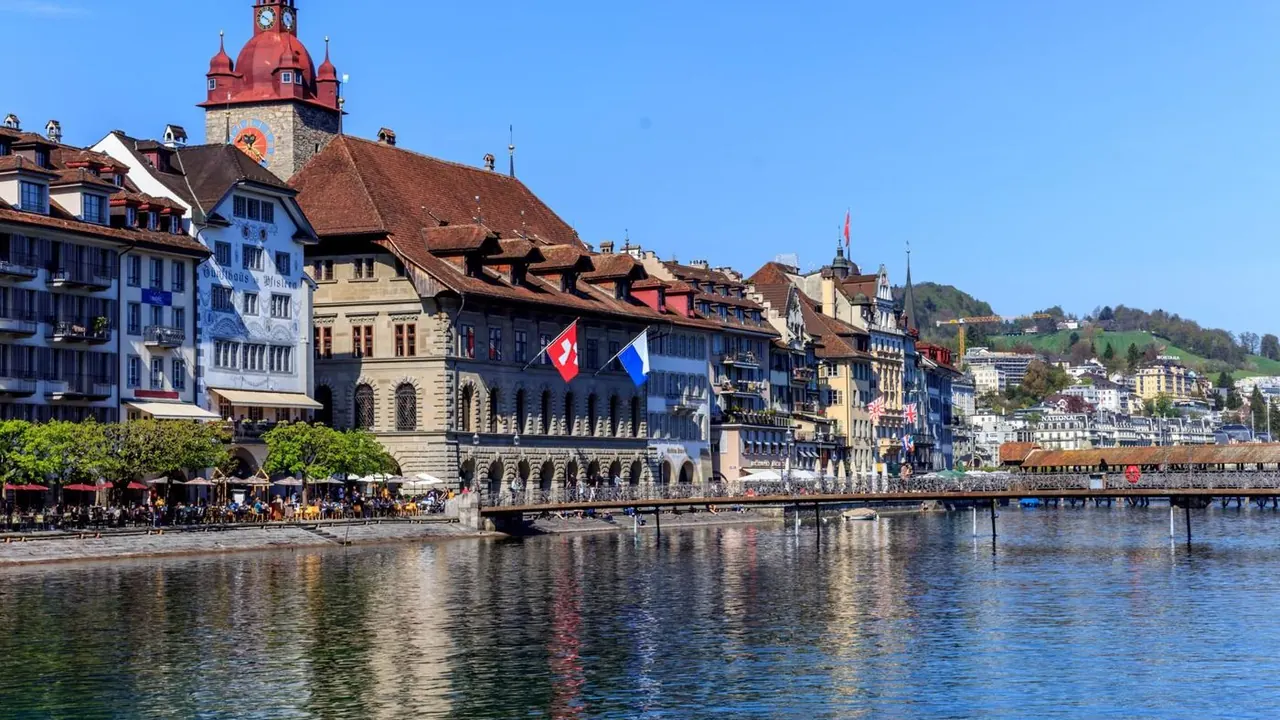
Photos: Chamonix by Tiia Monto, CC BY-SA 3.0, cropped; Lucerne by ILOVESwitzerland, Pexels License.
Chamonix or Lucerne?
Our verdict in twelve categories, each scored against the same fixed benchmark cities, and the climate month by month, so you can choose for your trip.
Choose Chamonix for
- nightlife
- prices
- nature and the outdoors
Chamonix is for travellers whose trip is the mountain itself. Cable cars lift you from the town centre into glaciers and granite spires, and the valley has steep skiing, guided mountaineering, the Vallée Blanche and the Tour du Mont Blanc on the doorstep. After a long day outside, the evenings are livelier than Lucerne's. In return there is very little culture, and you pay resort prices.
Choose Lucerne for
- live music and the arts
- culture and sights
- beaches
Lucerne suits a broader trip, where mountains are part of the plan rather than the whole of it. You get a medieval Old Town, the Chapel Bridge, a concert hall with a festival of world standing and lake steamers leaving from in front of the station. Bern, Basel and Zurich are all an easy train ride away. The peaks here are gentler and more for looking at than for climbing, and the town is quieter at night.
Scoreboard
Twelve categories on one fixed scale from 0 to 100. The shaded stretch is the gap between the two.
Your match
Pick a travel style or drag the sliders, and both match scores follow your weighting.
Wins on nightlife and prices with your weighting.
Wins on live music and the arts and culture and sights with your weighting.
What matters to you?
Category by category
What the scores mean for a trip.
Beaches & swimming
Lucerne has a genuine summer swimming culture right in town. In July and August locals swim from the Lido, the old wooden lake baths and the lawns at Ufschötti, and boats run to the bathing spots in the lakeside villages. The shore is grass and jetties, not sand, but the water is clean and the mountains frame it.
In Chamonix a swim takes planning. The nearest lake is Lac de Passy, down the Arve valley, Lake Annecy is over an hour's drive away, and in town there is the municipal pool. In both places a swim is an afternoon off, but in Lucerne it is a short walk from your hotel.
Food & drink
Both places lean on melted cheese, and neither is a reason to travel on its own. The difference is in setting and style. Chamonix serves Savoyard food made with Reblochon and Beaufort, eaten on refuge terraces facing the glaciers, and its cheese shops and charcuteries are good for building a picnic for the hills. Many places close outside the winter and summer seasons.
Lucerne eats in town: Chügelipastete, perch and whitefish from the lake, and rösti in wood-panelled guild houses and riverside terraces along the Reuss. Some menus around the Chapel Bridge are aimed at coach tours, but the Saturday market adds some variety.
Culture & sights
Lucerne is clearly the place for sightseeing. The covered Chapel Bridge and Water Tower, the frescoed squares of the Old Town, the towers of the Musegg Wall, the carved Lion Monument and a strong Picasso and Klee collection at the Rosengart easily fill a day or two.
Chamonix's heritage is mountaineering: the first ascent of Mont Blanc, the first Winter Olympics, the Musée Alpin and the climbers' cemetery. It is interesting for an hour or two, but it will not hold anyone who came for architecture or art.
Nightlife
Chamonix has the livelier evenings, especially in winter. Après-ski starts at the foot of the slopes in the late afternoon, then moves to a lane of pubs in the old town where guides, seasonal workers and visitors stay out late. On busy nights a couple of small clubs keep going. The crowd is young and mostly English-speaking.
Lucerne is a place for a glass of wine by the river and an early night. It has a few cocktail bars in the Neustadt and a little student life at weekends, but the lakefront is quiet by midnight. Fasnacht is the one time the whole town is out until dawn.
Nature & outdoors
Both are superb mountain bases, but Chamonix is the real high mountains. The Mont Blanc massif rises almost 4km above the valley, the Aiguille du Midi lifts you to 3,842m among hanging glaciers, and mountaineering, steep skiing and the Vallée Blanche descent are all on the doorstep.
Lucerne's landscape is about lake and peaks together. The cogwheel railway up Pilatus, the ridge walks on Rigi and the paddle steamers make it easy to combine boat, train and hike in one relaxed day, and Titlis adds glacier snow about an hour away. It is more for scenery than for serious climbing.
Day trips
Lucerne has the wider range of day trips, because it sits at the centre of the Swiss rail network. Bern's arcaded old town, Basel's art museums and Zurich are each under an hour by train, and the lake itself makes an outing to the Rütli meadow and the William Tell country around Altdorf.
Chamonix's appeal is crossing borders. Courmayeur and the Roman remains of Aosta are through the tunnel in Italy, and Annecy and Geneva are a little over an hour by road. Beyond those, mountain roads are slow and most places within reach are other resorts.
Good for families
Lucerne has a slight edge with children, mainly thanks to the Swiss Museum of Transport, which fills a whole day whatever the weather. Steamers and cogwheel trains turn the journeys into the fun, and the lakeside lawns are good for play and picnics.
Chamonix is better for active families who want to be outdoors, with nursery slopes, sledging, the Merlet animal park and the little red train to the Mer de Glace. The high cable cars do not suit small children, though, and on a wet day there is less to fall back on.
Getting around
Lucerne is easier to get around. The station, the boat piers and the Old Town sit together on the lakefront, and integrated tickets cover buses, steamers, cogwheel railways and cable cars, so you never need a car, even for excursions.
Chamonix's centre is just as easy to walk, and guests ride the valley buses and the Mont Blanc Express free. The ski areas are spread out, though, so winter means crowded ski buses and thin evening services, and a car helps for trips over the border.
Shopping & style
Lucerne has more to browse. Watch and jewellery houses line Schwanenplatz and the lakefront, alongside chocolate, army knives and cuckoo clocks, with a few independent boutiques in the Old Town lanes. Fashion and design are thin, though.
Chamonix's shops are almost all about mountain gear. Its family-run climbing and ski shops are worth the trip for anyone buying serious equipment, and the food shops sell cheeses and génépi. For anything else you would go to Geneva or Annecy.
Affordability
Neither place is cheap, but Chamonix gives you more ways to keep costs down. Valley transport is free with the guest card, self-catering apartments are common, many trails start from the valley floor without a lift, and the shoulder seasons are noticeably cheaper.
Lucerne is costly from hotel to simple lunch, and the mountain railways that make the stay worthwhile take a large share of the budget. A Swiss travel pass and picnics by the lake help a little, but this is never a budget trip.
Live music & performing arts
Here Lucerne is in a different league. The Lucerne Festival brings leading orchestras and soloists to Jean Nouvel's concert hall, which is famous for its acoustics and has concerts all year. The Lucerne Symphony Orchestra plays there, and the city theatre stages opera and dance.
Chamonix has a summer jazz festival with some sets played high in the mountains, plus the odd church concert or mountain film evening. For opera or an orchestra you would drive to Geneva.
Wellness & relaxation
Chamonix has the better place for a soak. Its large day spa has hot outdoor pools facing the glaciers, and Saint-Gervais, down the valley, has warm thermal springs in a wooded gorge. The town itself is busy, with early starts and crowded high seasons.
Lucerne's relaxation is calmer and slower: quiet evenings, walks along the lake promenades, an afternoon on a steamer and the wooden lake baths in summer. For a proper mineral bath you take the boat and cogwheel train to the Botta-designed bath on the Rigi.
When should you go?
Pick your month. The climate figures are measured averages, not a forecast.
Chamonix in July
Lucerne in July
Daytime high, °C
Rainfall in the month, mm
Where the figures come from
Chamonix's temperatures are measured 35 km from the centre, at Bourg-St-Maurice.
Chamonix has no rain gauge within 25 km of the centre, so its rainfall comes from a gridded climate dataset read at the city rather than from a gauge further away.
Lucerne has no rain gauge within 25 km of the centre, so its rainfall comes from a gridded climate dataset read at the city rather than from a gauge further away.
Lucerne's sunshine is measured 42 km from the centre, at Zurich Town / Ville..
Temperature and rainfall are climate normals, averaged over the years shown. Chamonix: 1999-2020 (rainfall 1991-2020) normals, Bourg-St-Maurice (34.9 km from centre). Lucerne: 2005-2025 (sunshine 1991-2020, rainfall 1991-2020) normals, Emmen (4.2 km from centre).
Chamonix is at its best from June to September, when the valley reaches about 27°C in July and the high trails and lifts are open. Rain or snow falls in every month and is heaviest in late autumn and early winter, about 169mm in December. That is the snow season on the slopes, though daytime highs in the valley stay in single figures through the cold months. Spring and late autumn are cool and often damp, so they are the weakest times for either walking or skiing.
Lucerne runs a little cooler, peaking around 24°C in July and August, the only stretch warm enough for a swim in the lake. Its rain comes mostly in summer, so a sudden shower is likely in July, but summer is also when it gets the most sun, about 225 hours in July. From November to January the town is cold and grey, with barely 43 hours of sun in December, which makes it a time for the Old Town and the concert hall rather than the viewpoints. For mountain walking without the summer heat, September is the best balance in both places, still mild and drier than early summer in Lucerne and late autumn in Chamonix.
Which traveller are you?
On an outdoors trip, Chamonix is the stronger choice. Cable cars reach high glacier terrain straight from town, and the valley offers mountaineering with historic guides, steep ski areas, via ferrata, paragliding and the Tour du Mont Blanc, all serious mountain sport that Lucerne's gentler peaks cannot quite match.
For a culture and arts trip, choose Lucerne. It has a well-kept medieval Old Town, the Chapel Bridge, the Lion Monument, Picasso and Klee at the Rosengart and the Lucerne Festival in its lakefront hall. Chamonix has the story of alpinism, and you will have seen it in half a day.
On a trip with a tight budget, Chamonix is the easier of two expensive places. Valley buses and trains are free with the guest card, apartments and supermarkets make self-catering simple, and many trails start without a lift. Lucerne offers fewer ways to keep costs down.
Before you go
| Measure | Chamonix | Lucerne |
|---|---|---|
| Official language | French | French, German, Italian, Romansh |
| Currency | Euro (EUR) | Swiss Franc (CHF) |
| Sockets | CE230 V, 50 Hz | CJ230 V, 50 Hz |
| Driving side | Right | Right |
| Time zone | UTC+1, UTC+2 in summer | UTC+1, UTC+2 in summer |
| Emergency number | 112 | 112 |
| Elevation | 995 m | 436 m |
| Main airport | Geneva International Airport (GVA)68 km from centre150 non-stop destinations | Zürich Airport (ZRH)49 km from centre226 non-stop destinations |
| Public holidays this year | 11 days | 12 days |
By the numbers
| Measure | Chamonix | Lucerne |
|---|---|---|
| City population | 8,705 | 86,234 |
| People per km² | 75 | 2,963 |
| Museums within 10 km | 3 | 14 |
| UNESCO World Heritage sites within 50 km | 0 | 1 |
Where else could you go?
Every comparison below shares a destination with this one, so you can follow Chamonix or Lucerne somewhere new.
- Zurichvs Lucerne
- Interlakenvs Lucerne
- Annecyvs Chamonix
- Genevavs Chamonix
- Bernvs Lucerne
- Lausannevs Chamonix