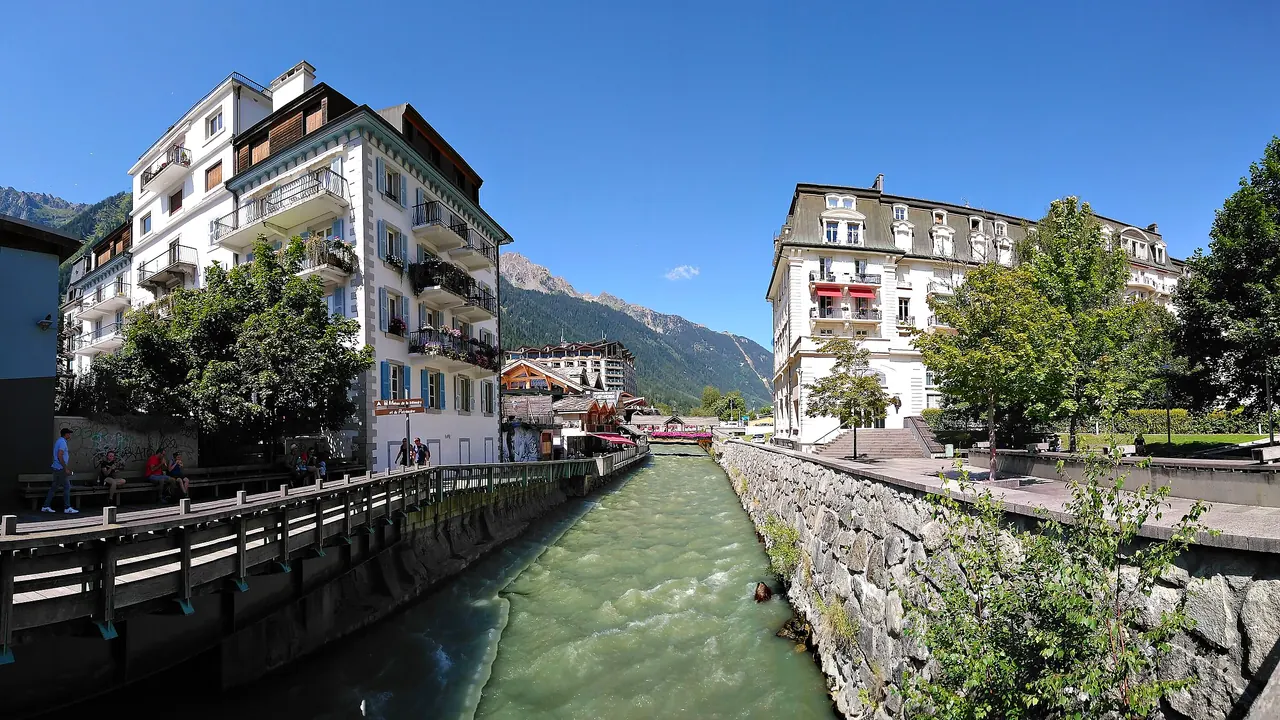
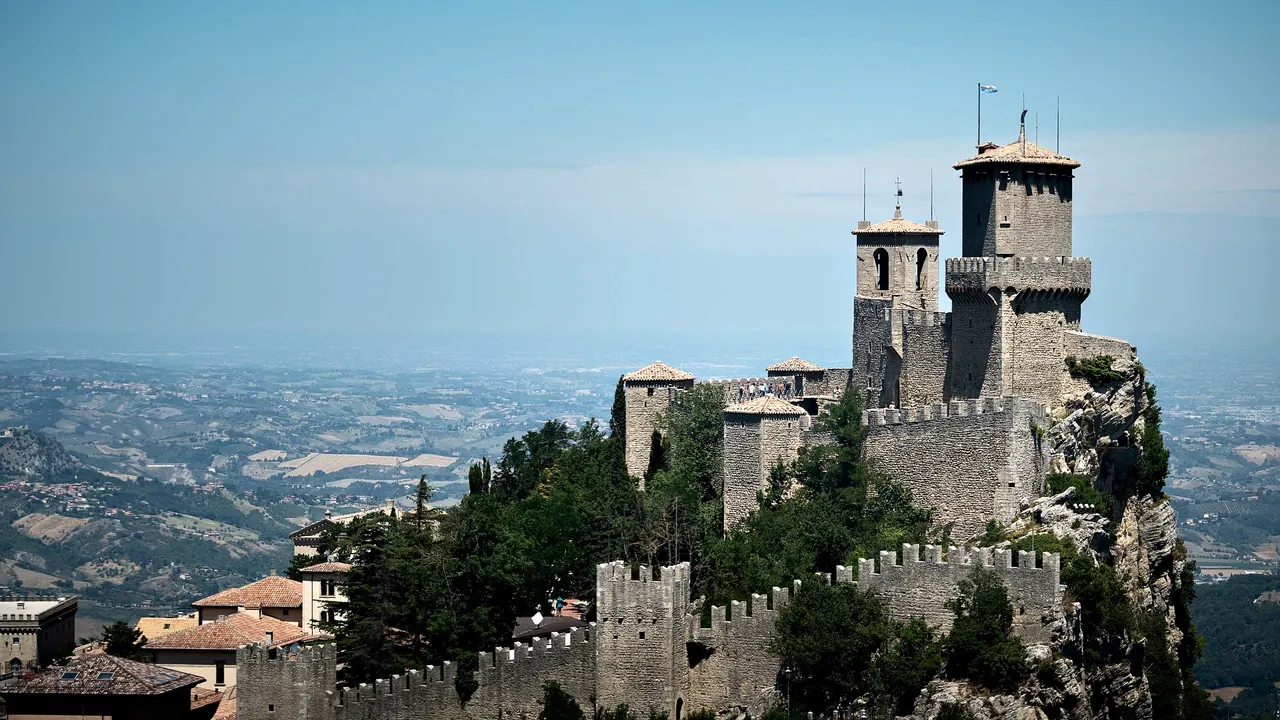
Photos: Chamonix by Tiia Monto, CC BY-SA 3.0, cropped; San Marino by Tibor Szabo, Pexels License.
Chamonix or San Marino?
Our verdict in twelve categories, each scored against the same fixed benchmark cities, and the climate month by month, so you can choose for your trip.
Choose Chamonix for
- nature and the outdoors
- nightlife
- getting around
Chamonix is the choice when the mountains themselves are the trip. Cable cars lift you from the town onto glacier terrain, trails start at the edge of town, and in winter the valley is one long ski area. It also has livelier evenings, a proper spa for tired legs and a valley that is easy to get around without a car. Expect to pay for all this, and don't come for museums.
Choose San Marino for
- prices
- beaches
- culture and sights
San Marino suits a slower, cheaper trip, where the hilltop republic is as much a base as a destination. The walled town and its towers fill half a day, and the rest of the reward lies below: Rimini's beaches, the fortress at San Leo, Urbino and Ravenna. Prices are those of provincial Italy, and summer brings drier weather and a warm sea within reach. Bring a car, and expect quiet nights.
Scoreboard
Twelve categories on one fixed scale from 0 to 100. The shaded stretch is the gap between the two.
Your match
Pick a travel style or drag the sliders, and both match scores follow your weighting.
Wins on nature and the outdoors and nightlife with your weighting.
Wins on prices and beaches with your weighting.
What matters to you?
Category by category
What the scores mean for a trip.
Beaches & swimming
Neither is a beach town, but San Marino has the sea within reach. The sandy Romagna shore at Rimini and Riccione is about half an hour down the hill, with shallow water and rows of umbrellas from July to early September.
In Chamonix, swimming means a lake. Lac de Passy down the valley works in midsummer, and Lake Annecy, a little over an hour away, makes a full day out. The town pool covers the rest.
Food & drink
Both cities eat well rather than memorably, and the difference is in what is on the plate. Chamonix is melted-cheese country, with fondue, raclette and tartiflette at their best on a refuge terrace facing the glaciers, and an international run of bistros and pizza places in town.
San Marino cooks like the Romagna hills around it: hand-rolled pasta, passatelli, grilled meat, piadina and the republic's own small-vineyard Sangiovese. In both places the setting lets kitchens coast, and in San Marino the honest meals are in the family trattorias of Borgo Maggiore rather than on the summit.
Culture & sights
San Marino has more to see because the whole summit is the sight. It is a medieval walled town on the crest of Monte Titano, with towers you can climb along a cliff path and the Palazzo Pubblico of one of the oldest surviving republics. It is compact, but it is a real historic place.
Chamonix's culture is the history of climbing, told well in the Musée Alpin, the guides' quarter and the climbers' cemetery. Anyone who loves mountains will find it absorbing, and anyone else will be done with it quickly.
Nightlife
Chamonix is the one with a night out. In winter, après-ski fills the bars from late afternoon, then moves on to the pubs along a narrow lane in the old town and a couple of small clubs. The crowd of guides, seasonal workers and visitors is young and mostly English-speaking.
San Marino goes quiet once the coaches leave, and an evening means dinner and a glass of wine with the coast lit up below. For anything later, you drive down to the Riviera clubs of Rimini and Riccione.
Nature & outdoors
This is the widest gap between the two. Chamonix sits under the Mont Blanc massif, with cable cars up to the Aiguille du Midi at 3,842m, the rack railway to the Mer de Glace and the Tour du Mont Blanc on the doorstep. Mountaineering, skiing, climbing and paragliding are all world-class.
San Marino's Monte Titano is a limestone ridge of about 740m. It has fine views to the Adriatic, woodland paths around the towers and gentle cycling in the Montefeltro hills. That makes a pleasant morning, but there is no high country or adventure sport to build a trip around.
Day trips
San Marino has the richer surroundings. Roman Rimini lies just below, and the rock fortress of San Leo, Urbino's Renaissance court and Ravenna's mosaics are all within about an hour or so, with Bologna further on. Most of the hill towns need a car.
Chamonix's outings come from its borders: Courmayeur and Roman Aosta through the tunnel, Annecy and Geneva a little over an hour away, and Martigny by the Mont Blanc Express. Beyond those, slow mountain roads and other ski resorts limit the choice.
Good for families
Chamonix is the better family base for children who like being outside. Winter has nursery slopes and sledging. Summer brings easy lake walks, a luge, treetop courses, the marmots and ibex of the Merlet park and the little red train to the Mer de Glace. The weak points are the highest cable cars and wet days.
San Marino gives children towers, battlements and a cable car ride, but little else on the summit, and the steps are hard going with a pushchair. Its family attractions are on the coast, at Italia in Miniatura, Fiabilandia, the waterparks and the shallow beaches, which are easy to reach with a car.
Getting around
Chamonix is easier. The centre is flat and walkable, with the big lift stations in town, and the guest card gives free buses and trains along the valley from Les Houches to Vallorcine. The one drawback is the packed ski buses in winter.
San Marino's car-free core is small but steep, all steps and slopes, and a cable car links it to Borgo Maggiore. The bus from Rimini is the one dependable link, so exploring the surrounding hills means hiring a car.
Shopping & style
Neither is a shopping destination, and each has one speciality. Chamonix sells serious mountain equipment in long-established shops where climbers and skiers buy their big gear, along with Savoyard cheese and génépi.
San Marino relies on its lower taxes, with perfume, watches, leather and spirits along the main streets, an outlet centre in the valley, and stamps and coins for collectors. For fashion, Chamonix looks to Geneva and San Marino to Bologna.
Affordability
San Marino is much the cheaper stay, priced like provincial central Italy. Hotels are moderate outside August, the trattorias in the lower villages are fairly priced and the sights cost little. Only the summit view terraces charge extra.
Chamonix is a famous resort and charges like one, with expensive high-season rooms, lift passes, guides and paragliding flights. Free valley transport, self-catering, trails that start from the valley floor and the quieter shoulder seasons all help.
Live music & performing arts
Live performance in both places is mostly a summer affair, and the difference is in its character. Chamonix takes its music up the mountain: a long-running jazz festival plays some of its sets high on the slopes, and the rest of the year offers little beyond mountain film evenings and the odd concert in a church or hall.
San Marino's summer is all pageantry. During the Medieval Days festival the summit town fills with musicians in period costume, crossbow contests and flag-throwers, and a small theatre adds occasional local concerts. Anyone hoping for opera will find the nearest real season down the coast in Pesaro, Rossini's home town and the seat of his festival.
Wellness & relaxation
Chamonix is the better place to unwind, once you have earned it. It has a large day spa with hot outdoor pools under the glaciers, saunas in many chalets and the thermal springs of Saint-Gervais down the valley. The town itself is busy in high season.
San Marino has no bathing culture, only a few hotel spas. What it offers instead is evening calm on the walls once the day visitors have gone.
When should you go?
Pick your month. The climate figures are measured averages, not a forecast.
Chamonix in July
San Marino in July
Daytime high, °C
Rainfall in the month, mm
Where the figures come from
Chamonix's temperatures are measured 35 km from the centre, at Bourg-St-Maurice.
Chamonix has no rain gauge within 25 km of the centre, so its rainfall comes from a gridded climate dataset read at the city rather than from a gauge further away.
San Marino's temperatures are measured 52 km from the centre, at Frontone.
San Marino has no rain gauge within 25 km of the centre, so its rainfall comes from a gridded climate dataset read at the city rather than from a gauge further away.
Temperature and rainfall are climate normals, averaged over the years shown. Chamonix: 1999-2020 (rainfall 1991-2020) normals, Bourg-St-Maurice (34.9 km from centre). San Marino: 1991-2020 normals, Frontone (51.5 km from centre).
Chamonix is wet all year, with more than 100mm of rain in every month, so even in its best season you plan around showers. Summer is the time for hiking, climbing and the high lifts, with July reaching about 27°C in the valley and the mountain lakes just warm enough to swim. Late autumn and early winter are the dampest stretch, and winter belongs to the skiers.
San Marino is warmer and much drier in summer. July reaches about 30°C, which makes the steep streets hard work at midday, but the Adriatic below warms to about 25°C from July into early September. Late spring and September are the most comfortable for walking the walls. From September the rain builds, peaking at about 105mm in November, which makes late autumn the dullest time to go.
Which traveller are you?
On an outdoors trip, Chamonix wins outright. Cable cars reach high glacier terrain from the town centre, the Tour du Mont Blanc and Lac Blanc trails start nearby, and climbing, ski touring and paragliding are all on hand. San Marino offers only gentle ridge walks.
For a beach and sun trip, San Marino is the only real option. Rimini's sandy shore is half an hour down the hill, the summer sea is warm and July and August are dry, while Chamonix's swimming means a cool mountain lake.
On a tight budget, San Marino goes further. Hotels and trattorias are priced like provincial Italy, the sights cost little and lower taxes make fuel cheaper. In Chamonix, lift passes, guides and peak-season rooms quickly strain a small budget.
Before you go
| Measure | Chamonix | San Marino |
|---|---|---|
| Official language | French | Italian |
| Currency | Euro (EUR) | Euro (EUR) |
| Sockets | CE230 V, 50 Hz | CFL230 V, 50 Hz |
| Driving side | Right | Right |
| Time zone | UTC+1, UTC+2 in summer | UTC+1, UTC+2 in summer |
| Emergency number | 112 | 112 |
| Elevation | 995 m | 675 m |
| Main airport | Geneva International Airport (GVA)68 km from centre150 non-stop destinations | Bologna Guglielmo Marconi Airport (BLQ)114 km from centre98 non-stop destinations |
| Public holidays this year | 11 days | 18 days |
By the numbers
| Measure | Chamonix | San Marino |
|---|---|---|
| City population | 8,705 | 4,040 |
| People per km² | 75 | 569 |
| Museums within 10 km | 3 | 19 |
| UNESCO World Heritage sites within 50 km | 0 | 2 |
| Swim season, months above 21 °C | - | 4 months |
Where else could you go?
Every comparison below shares a destination with this one, so you can follow Chamonix or San Marino somewhere new.
- Annecyvs Chamonix
- Genevavs Chamonix
- Zermattvs Chamonix
- Lausannevs Chamonix
- Assisivs San Marino
- Florencevs San Marino