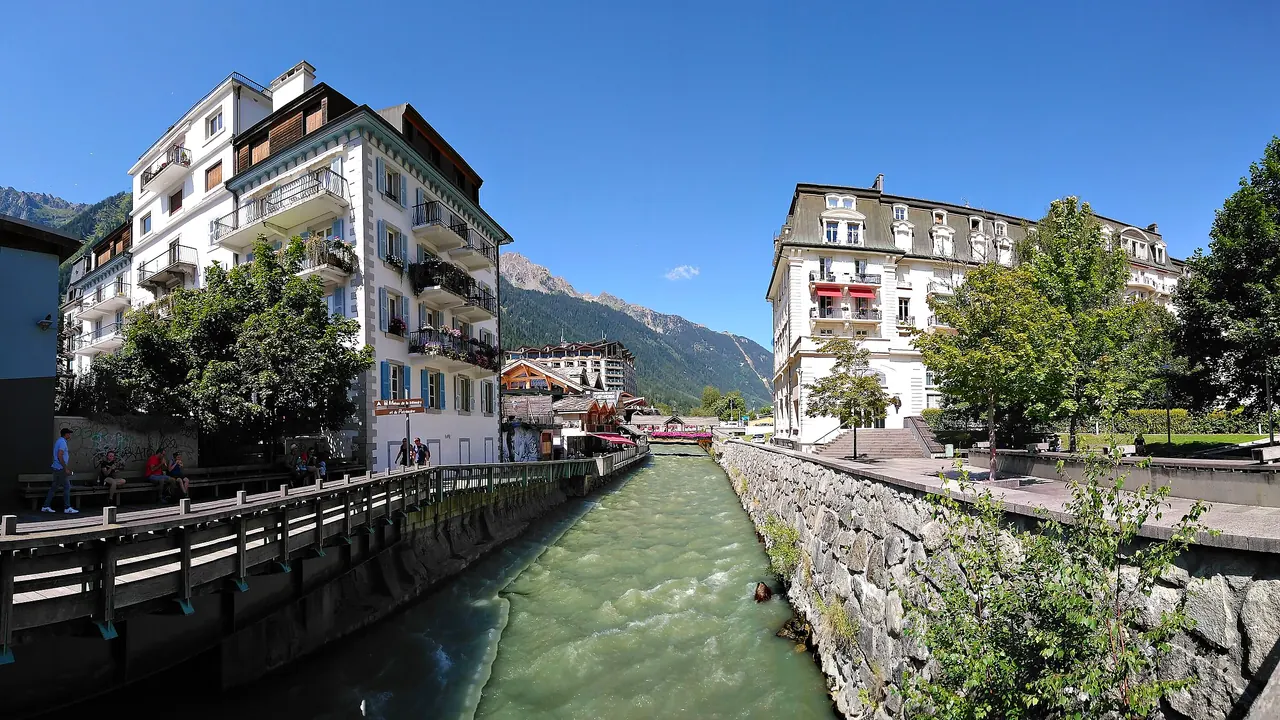
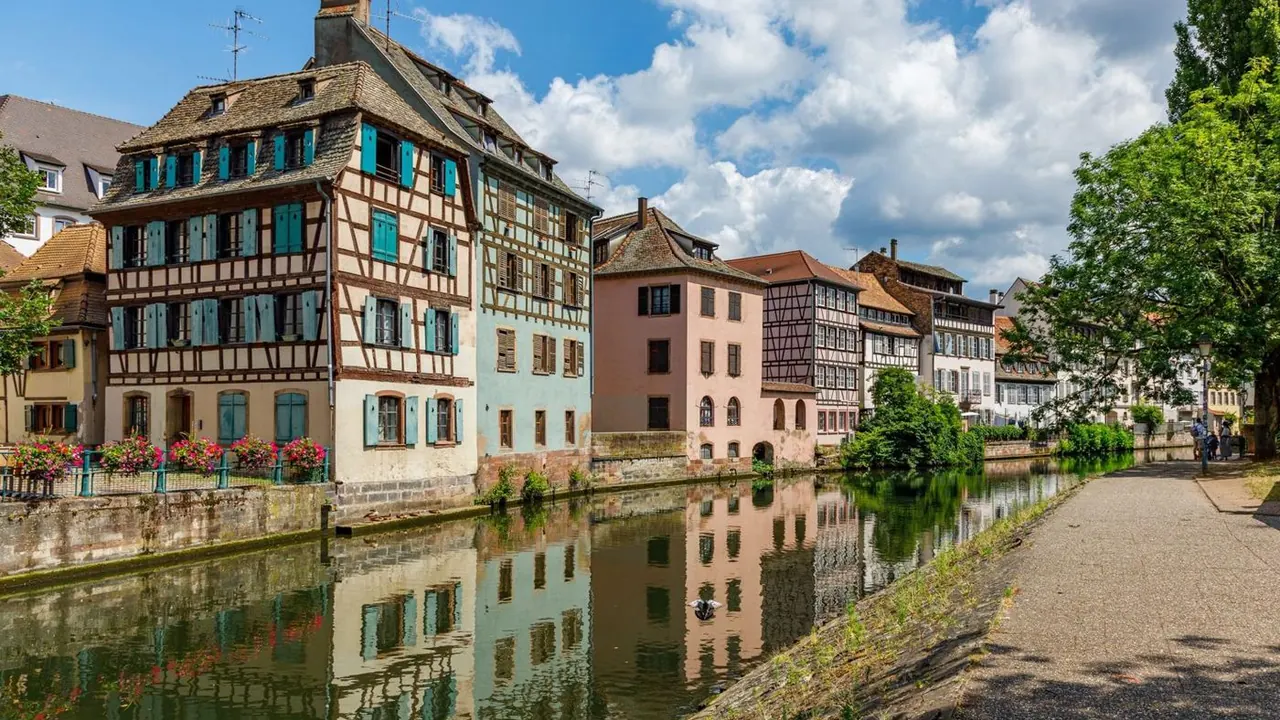
Photos: Chamonix by Tiia Monto, CC BY-SA 3.0, cropped; Strasbourg by Edoardo Colombo, Pexels License.
Chamonix or Strasbourg?
Our verdict in twelve categories, each scored against the same fixed benchmark cities, and the climate month by month, so you can choose for your trip.
Choose Chamonix for
- nature and the outdoors
- beaches
Chamonix is for people who travel to be in the mountains and spend each day doing something there. Cable cars take you from the town centre straight into glacier country, the Tour du Mont Blanc and the Lac Blanc trails start on the valley floor, and in winter there is steep skiing and the Vallée Blanche. Go there if the mountains are the whole point of the trip and you can accept high costs, a small town and little to do indoors.
Choose Strasbourg for
- culture and sights
- live music and the arts
- food and drink
Strasbourg is the better choice for a city vacation that mixes sights, food and short trips out. The cathedral, Petite France and the Neustadt are an afternoon's walk apart, winstubs serve choucroute with a pichet of Riesling, and the opera, theatre and orchestra give the evenings some substance. It costs noticeably less, the tram and cycle lanes make the city easy to get around, and the wine route, Colmar and the Black Forest are close enough for day trips.
Scoreboard
Twelve categories on one fixed scale from 0 to 100. The shaded stretch is the gap between the two.
Your match
Pick a travel style or drag the sliders, and both match scores follow your weighting.
Wins on nature and the outdoors and beaches with your weighting.
Wins on culture and sights and live music and the arts with your weighting.
What matters to you?
Category by category
What the scores mean for a trip.
Beaches & swimming
Neither place is a swimming destination, and the water in both is fresh water in summer only. Chamonix's swims come with mountain scenery: Lac de Passy has Mont Blanc behind it, and Lake Annecy, clear and warm, is a day's outing by car. Strasbourg's are lifeguarded gravel-pit lakes such as the Baggersee, with grassy banks, and you can reach it by tram for a hot afternoon.
Food & drink
Strasbourg is the better place to eat. Alsatian cooking is richer and more varied than Savoyard, with baeckeoffe, choucroute, foie gras and morning kougelhopf. The winstub, with local Riesling or Pinot Gris, gives meals a setting of their own, and there is serious fine dining in the city and the villages nearby.
Chamonix eats well on cheese: fondue, raclette and tartiflette on a terrace facing the glaciers after a day outdoors. Beyond that, the menus look much the same, and outside the main seasons a good number of kitchens close.
Culture & sights
Strasbourg is far ahead here. The pink sandstone cathedral, the timber-framed Grande Ile, Petite France with its locks and covered bridges, and the imperial avenues of the Neustadt fill two or three days, with the Palais Rohan, the Alsatian Museum and the modern art museum by the river on top.
Chamonix's heritage is narrower but has a clear focus. It is the town where alpinism began, and the Musée Alpin, the climbers' cemetery and the statues of the first ascent tell that story well. A morning covers it.
Nightlife
Neither is a late-night town, but the evenings feel different. Chamonix's nights centre on winter après-ski, then a lane of pubs in the old town and a couple of small clubs, with a young, mostly English-speaking crowd of guides and seasonal workers. Strasbourg's are student bars and beer cellars in the Krutenau and around Place Saint-Étienne, then riverside terraces in summer. It is calmer, more local, and the city is mostly asleep by midnight midweek.
Nature & outdoors
Chamonix is in another league here. The Mont Blanc massif rises almost 4km above the valley floor, and cable cars and the rack railway carry you straight up to hanging glaciers and granite needles. Summer brings climbing, trail running and paragliding, and winter brings off-piste skiing and ski touring.
Strasbourg's outdoors is gentler and mostly involves getting out of the city. There are flat bike routes along the Rhine with storks and beavers, then the vineyard-backed Vosges to the west and the higher Black Forest to the east, each about an hour away.
Day trips
Strasbourg has more good day trips, and they are more varied. Colmar and the wine villages of the Alsace route are close by, and across the Rhine are Baden-Baden, Freiburg and Heidelberg, with Basel and Nancy also in range. Trains cover most of the cities.
Chamonix's best trips cross borders too: Courmayeur and Roman Aosta through the tunnel, Annecy and Geneva by road, and Martigny by mountain railway. After those, most places within reach are other ski resorts, and the winding roads add time.
Good for families
Strasbourg is slightly easier with children, mainly because it works in any weather. It has the flat, car-free centre, boat trips, storks and rowing boats in the Orangerie, and the Le Vaisseau science centre, with Europa-Park about an hour away.
Chamonix suits outdoor families, especially with older children. The Mer de Glace train, the Merlet animal park, the summer luge and nursery ski slopes are all a hit, but the highest lifts are unsuitable for toddlers and a rainy day leaves few options.
Getting around
Both are easy without a car, and Strasbourg is easier. Its walkable island centre, trams out to the station and across to Kehl, and separated cycle lanes all over the city make every journey simple. Chamonix's free valley buses and the Mont Blanc Express work well in summer, but in winter you spend a lot of time on crowded ski buses between scattered ski areas.
Shopping & style
Chamonix is a shopping town with one subject, and that subject is equipment. If you need crampons, a harness or touring skis fitted properly, its centre is one of the best places in the Alps to buy them, and the people behind the counter know the terrain you are heading into. Beyond the gear there is little else: génépi, Reblochon, some crystals from the massif and a lot of souvenirs. Anyone after clothes or a department store drives to Geneva or Annecy.
Strasbourg is better for an ordinary afternoon of shopping, though it is no fashion destination. Place Kléber and the Grandes Arcades have the high-street names, and the lanes around the cathedral have independent bookshops and delicatessens. What you take home is Alsatian: Soufflenheim pottery, printed linens, a kougelhopf mould or a few bottles from the wine route. The December Christmas market is worth browsing carefully, as plenty of its stalls sell factory-made decorations.
Affordability
Chamonix is by far the dearer of the two, and the mountains themselves are the main reason. Lift passes, the Aiguille du Midi cable car, a day with a guide or a tandem paraglide all come on top of rooms that fill at peak rates at Christmas, in the February school break and through July and August. Self-catering apartments, free buses with the guest card and trails that leave from the valley floor take some of the edge off. So does going in late spring or autumn, when it is cheaper, though some lifts stop running then.
In Strasbourg most of the bill is your hotel, because once you are there the city itself costs little. Room prices jump during the Christmas market and in the weeks when the European Parliament sits, so checking those dates before you book is the biggest saving you can make. Outside those weeks, a stay costs what you would pay in any large French regional city, well below Paris but not a bargain.
Live music & performing arts
Strasbourg has a real arts calendar. The Opéra national du Rhin, the Philharmonic, the Théâtre National de Strasbourg and the autumn Musica festival of contemporary music run through the year, though you need to book around the season. Chamonix offers summer jazz, some of it played up in the mountains, and occasional church concerts and mountain film evenings. For anything more, you go to Geneva.
Wellness & relaxation
Both rely partly on a famous spa nearby, but the kind of relaxation differs. Chamonix's comes after effort: hot outdoor pools looking up at the glaciers after a day's skiing, and the thermal springs of Saint-Gervais in their wooded gorge, while the town itself starts early and feels busy. Strasbourg offers a slower pace, with the tiled Bains municipaux, the Friedrichsbad and Caracalla baths at Baden-Baden, and quiet canal-side walks with long winstub lunches between them.
When should you go?
Pick your month. The climate figures are measured averages, not a forecast.
Chamonix in July
Strasbourg in July
Daytime high, °C
Rainfall in the month, mm
Where the figures come from
Chamonix's temperatures are measured 35 km from the centre, at Bourg-St-Maurice.
Chamonix has no rain gauge within 25 km of the centre, so its rainfall comes from a gridded climate dataset read at the city rather than from a gauge further away.
Temperature and rainfall are climate normals, averaged over the years shown. Chamonix: 1999-2020 (rainfall 1991-2020) normals, Bourg-St-Maurice (34.9 km from centre). Strasbourg: 1991-2020 normals, Strasbourg (9.1 km from centre).
The two places follow almost the same temperature curve. Winter highs are around 5°C in both, and both reach their warmest in July and August, Chamonix at about 27°C and Strasbourg a degree cooler. Rain is where they part. Chamonix gets heavy rain or snow in every month, wettest in late autumn and December at about 169mm. That is good for winter skiing, but even in midsummer you should expect some days lost to cloud on the peaks. July and August are the months for high trails and the lakes, and late spring and autumn are cool and wet in the valley.
Strasbourg is much drier, with only about 35mm in January and its wettest months in early summer, mostly as showers. It gets around 230 hours of sunshine in July, and that is when the lakes and riverside terraces are at their best. Spring and early autumn are the most comfortable months for walking the old town. Winter is grey and short on sun, but dry enough to go out, which suits the December market.
Which traveller are you?
On an outdoors trip, Chamonix is the clear choice. The Aiguille du Midi, the Grand Balcon trails, guided mountaineering, via ferrata and paragliding all start from town. Strasbourg's flat cycle routes and the Vosges forests are pleasant, but they are gentler than anything in the Mont Blanc massif.
For a culture and arts trip, choose Strasbourg. It has a UNESCO-listed old town and Neustadt, the cathedral with its astronomical clock, three museums in the Palais Rohan, and its own opera, orchestra and national theatre. Chamonix's mountaineering heritage takes about half a day to see.
On a trip with a tight budget, Strasbourg goes much further. Tarte flambée and pichets of wine are fairly priced, trams are cheap and many of the main sights are free. In Chamonix, the lift passes, cable cars and guides make even a careful stay expensive.
Before you go
| Measure | Chamonix | Strasbourg |
|---|---|---|
| Official language | French | French |
| Currency | Euro (EUR) | Euro (EUR) |
| Sockets | CE230 V, 50 Hz | CE230 V, 50 Hz |
| Driving side | Right | Right |
| Time zone | UTC+1, UTC+2 in summer | UTC+1, UTC+2 in summer |
| Emergency number | 112 | 112 |
| Elevation | 995 m | 132 m |
| Main airport | Geneva International Airport (GVA)68 km from centre150 non-stop destinations | Strasbourg Airport (SXB)10 km from centre43 non-stop destinations |
| Public holidays this year | 11 days | 11 days |
By the numbers
| Measure | Chamonix | Strasbourg |
|---|---|---|
| City population | 8,705 | 293,771 |
| People per km² | 75 | 3,752 |
| Museums within 10 km | 3 | 21 |
| UNESCO World Heritage sites within 50 km | 0 | 3 |
Where else could you go?
Every comparison below shares a destination with this one, so you can follow Chamonix or Strasbourg somewhere new.
- Baden-Badenvs Strasbourg
- Annecyvs Chamonix
- Colmarvs Strasbourg
- Genevavs Chamonix
- Lausannevs Chamonix
- Stuttgartvs Strasbourg