China
Guangzhou
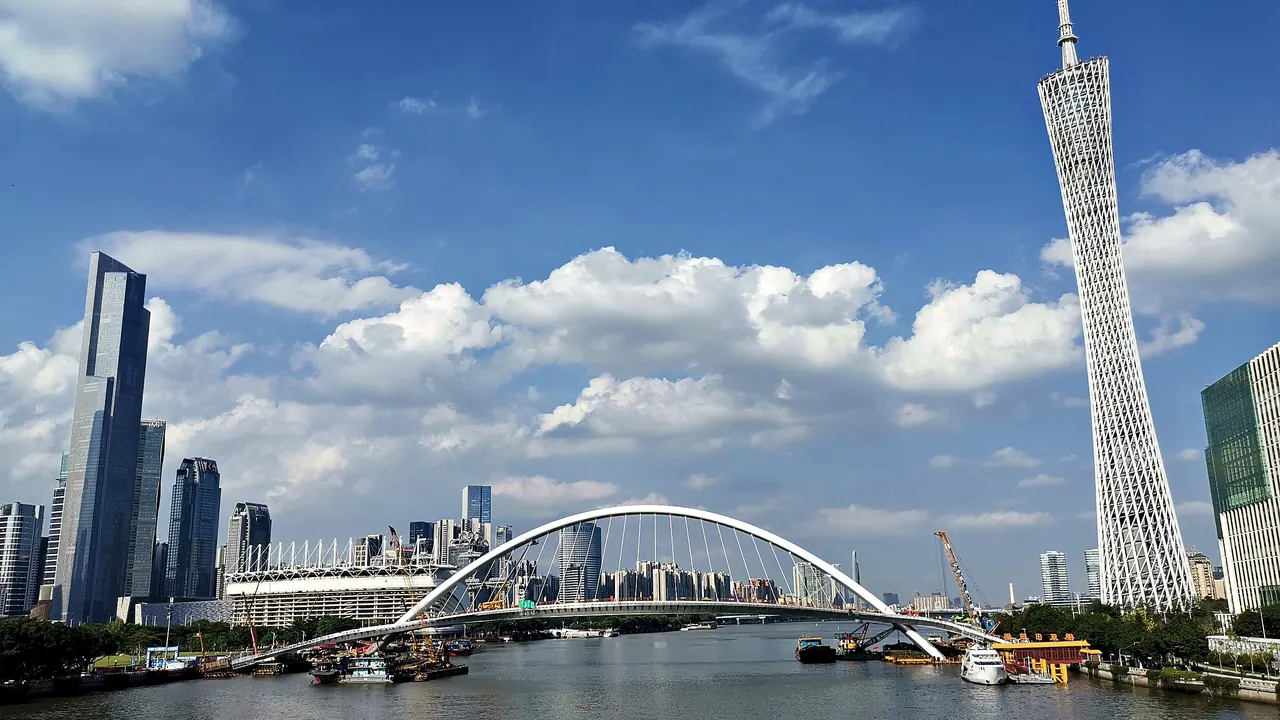
A footbridge over the Pearl River with the Canton Tower
- Food & drink88
- Getting around78
- Day trips76
Photo: Cwek, CC BY-SA 4.0, cropped
Match
60
Every category weighted equally
- Beach & sun56
- Culture & arts65
- Food & nightlife64
- Family trip61
- Outdoors60
- Relax & unwind57
- Shopping & style65
- On a budget61
Guangzhou in twelve categories
Our verdict on each, scored 0 to 100 against the same fixed benchmark cities, so a score means the same thing on every page.
Beaches & swimming. Scores 10 out of 100.
Food & drink. Scores 88 out of 100.
Culture & sights. Scores 60 out of 100.
Nightlife. Scores 50 out of 100.
Nature & outdoors. Scores 45 out of 100.
Day trips. Scores 76 out of 100.
Good for families. Scores 72 out of 100.
Getting around. Scores 78 out of 100.
Shopping & style. Scores 64 out of 100.
Affordability. Scores 72 out of 100.
Live music & performing arts. Scores 52 out of 100.
Wellness & relaxation. Scores 55 out of 100.
Guangzhou category by category
Beaches & swimming
10Guangzhou is a river city, not a beach city. It sits at the head of the Pearl River Delta, and the shore of the estuary to the south is muddy, industrial and not made for swimming. The nearest proper sandy beaches are on the east side of Shenzhen, about two hours away, and the sea is warm there from May to October. For most visitors, swimming here means a hotel pool or a water park in summer.
Food & drink
88Food is the main reason many people come to Guangzhou. This is where Cantonese cooking comes from, and the ritual of morning tea, with baskets of har gow, siu mai and cheung fun over a pot of pu'er, is a way of life here, not a show for visitors. Large dim sum halls fill with families from early morning, and roast goose, char siu, clay-pot rice and wonton noodles cost little at small shops all over the old Xiguan and Liwan districts.
The city also eats late. Night markets and street stalls serve congee, grilled seafood and sweet double-skin milk well past midnight. Fish and seafood are bought alive and cooked to order, and the cooking aims at fresh, clean flavour rather than heat. The Chinese regional kitchens are well represented, the high-end Cantonese restaurants in Tianhe are excellent, and there is international food too, although it goes less deep than the local cooking. Menus without pictures can be hard to read, but pointing at what the next table is eating works well.
Culture & sights
60Guangzhou has more than two thousand years of history, but it shows through individual sights rather than an intact old city. The Chen Clan Ancestral Hall is the highlight, with dense Lingnan carving in wood, brick and ceramic. Near it, the Mausoleum of the Nanyue King keeps a jade burial suit in a museum built over the tomb. The Temple of the Six Banyan Trees and Guangxiao Temple are among the oldest Buddhist sites in southern China, and Yuexiu Park holds the Ming-era Zhenhai Tower.
Shamian Island is a quiet sandbank of colonial-era European villas, banks and consulates under banyan trees. The arcaded shophouse streets of Xiguan show the old merchant city. On the modern side, the Guangdong Museum, the Opera House and the Canton Tower stand around Zhujiang New Town. Two or three days cover the main sights, and the distances between them mean taking the metro.
Nightlife
50Going out in Guangzhou means a mix of things. There are big, loud clubs with bottle service in the entertainment strips along the river and in Tianhe, cocktail and craft beer bars around Zhujiang New Town and the expat areas, and karaoke rooms everywhere. The most local habit is siu yeh, the late supper: friends share seafood, barbecue and beer at plastic tables until two or three in the morning. The scene is large and runs late at weekends, but much of it is aimed at local groups rather than drop-in visitors, and few people plan a trip here for its nights out.
Nature & outdoors
45Guangzhou's main outdoor space is Baiyun Mountain, a forested range of low hills on the northern edge of the city. Its paths, cable car and views over the skyline are busy with walkers at weekends. Along the Pearl River there are long promenades for evening walks, and Haizhu wetland park gives some greenery in the middle of the city.
Further out, the hills and forest streams of Conghua lie about an hour north, and the Dinghu Mountain reserve, with waterfalls and old subtropical forest, is about an hour and a half west. The landscape is green and lush, not dramatic. Summers are hot and very humid with heavy rain, so autumn and early winter are much the best seasons for walking.
Day trips
76Guangzhou is a good base for the Pearl River Delta. Foshan is next door by metro, with its Ancestral Temple, kung fu heritage and Cantonese opera traditions, and Shunde, nearby, is known across China for its home cooking. Zhaoqing, about an hour west by train, has limestone crags rising out of lakes and an old walled town.
The largest trips are across the borders. Hong Kong is about an hour by high-speed rail, and Macau, with its Portuguese old town, takes a little longer, so either works as a full day out. Both mean passing immigration, so check that your visa allows you to come back into mainland China. The fortified diaolou watchtowers of Kaiping, built by returning emigrants, are about two hours by road and well worth a day.
Good for families
72The Chimelong resort in Panyu, on the southern edge of the city, is the main draw for children. Its drive-through safari park, with giant pandas and koalas, is one of the largest in Asia, and the same complex has a theme park, a big water park and a circus. A sister ocean park in Zhuhai makes a longer outing. In the city itself there are the Guangzhou Zoo, a large science centre, and evening boat trips on the Pearl River.
Chinese culture is warm towards children, and the metro has lifts and is easy with a buggy. Against this, summers are hot and humid, the big parks are packed during school breaks and the national Golden Week, and outside the main attractions little is signed in English.
Getting around
78Guangzhou has one of the largest metro systems in the world. It is clean, cheap, signed in English as well as Chinese, and reaches almost everything a visitor wants, including the airport and the high-speed rail stations. Buses and river ferries fill the gaps, and taxis and ride-hailing are easy to find.
The difficulty is size. Sights are spread across many districts, so journeys of forty minutes are normal. The old Xiguan and Yuexiu areas are pleasant to walk, but wide roads and summer heat make longer walks hard elsewhere. Paying is almost entirely by phone, so set up a mobile payment app before you arrive.
Shopping & style
64Guangzhou is a trading city, and its most unusual shopping is in its specialised wholesale markets. Whole districts sell clothing, leather goods, fabrics or electronics. Fangcun has a huge tea market where you can taste pu'er and oolong for hours, and Hualin's jade street sits in the old western quarter. Many stalls sell only in bulk, but plenty will sell a single piece.
For ordinary shopping, the Beijing Road and Shangxiajiu pedestrian streets are lively and mid-market, and the malls around Tianhe and Zhujiang New Town hold the international luxury labels. There is not much independent design shopping, and craft buying is mostly tea, jade and porcelain.
Affordability
72Guangzhou is cheap to visit for a major city. Dim sum, noodle shops and street food cost very little, the metro is inexpensive, and most temples, parks and museums are free or have low entry fees. Comfortable modern hotels cost much less than in Western capitals. Prices rise for imported drinks, cocktail bars and international restaurants. Hotel rates go up sharply during the big trade fair seasons in spring and autumn, so it is worth checking the dates before you book.
Live music & performing arts
52The Guangzhou Opera House, a sculpted building on the river, presents touring opera, ballet and musicals. The Xinghai Concert Hall on Ersha Island is home to the city's symphony orchestra and has good acoustics. The local tradition is Cantonese opera, with painted faces, elaborate costumes and high, stylised singing. It is performed in theatres and in neighbourhood halls in the old western districts, and Foshan nearby has deep roots in the art. A handful of small live venues host Chinese indie and rock bands. Most programmes are aimed at a Chinese-speaking audience, so a visitor has to make some effort to find them.
Wellness & relaxation
55Guangzhou's wellness offer has three parts. The first is the hot springs of Conghua, about an hour north, where resorts built around mineral pools in wooded hills make a good overnight or day escape, especially in the cooler months. The second is massage: reflexology and body massage parlours are found on almost every block, are inexpensive, and stay open late. The third is the slow morning tea, where older locals spend hours over tea and newspapers in the parks and teahouses. The city itself is large, loud and fast, and it has no historic bathhouses.
When should you go?
Pick a month to see what it is like. The climate figures are measured averages, not a forecast.
Guangzhou in July
Daytime high, °C
Rainfall in the month, mm
The whole year
Shaded against this city’s own year: the deepest cell is its best month for that figure and the palest its weakest.
Temperature and rainfall are climate normals, averaged over the years shown. Guangzhou: 1991-2020 normals, Guangzhou (8.5 km from centre).
Before you go
| Measure | Guangzhou |
|---|---|
| Official language | Putonghua |
| Currency | Yuan Renminbi (CNY) |
| Sockets | ACI220 V, 50 Hz |
| Driving side | Right |
| Time zone | UTC+8 |
| Emergency number | Police 110, ambulance 120, fire 119 |
| Elevation | 21 m |
| Main airport | Guangzhou Baiyun International Airport (CAN)29 km from centre195 non-stop destinations |
| Public holidays this year | 6 days |
By the numbers
| Measure | Guangzhou |
|---|---|
| City population | 18,676,605 |
| People per km² | 2,576 |
| Museums within 10 km | 21 |
| UNESCO World Heritage sites within 50 km | 0 |
Compare Guangzhou with
Every comparison with a written verdict behind it.