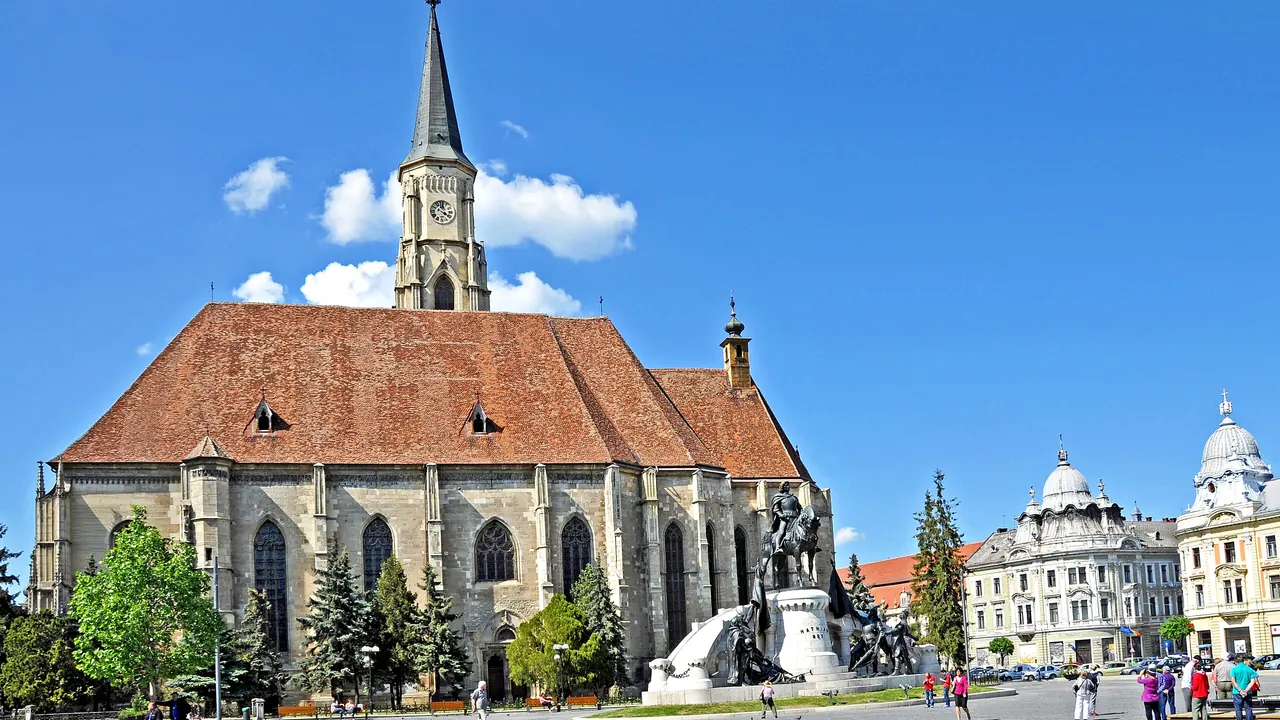
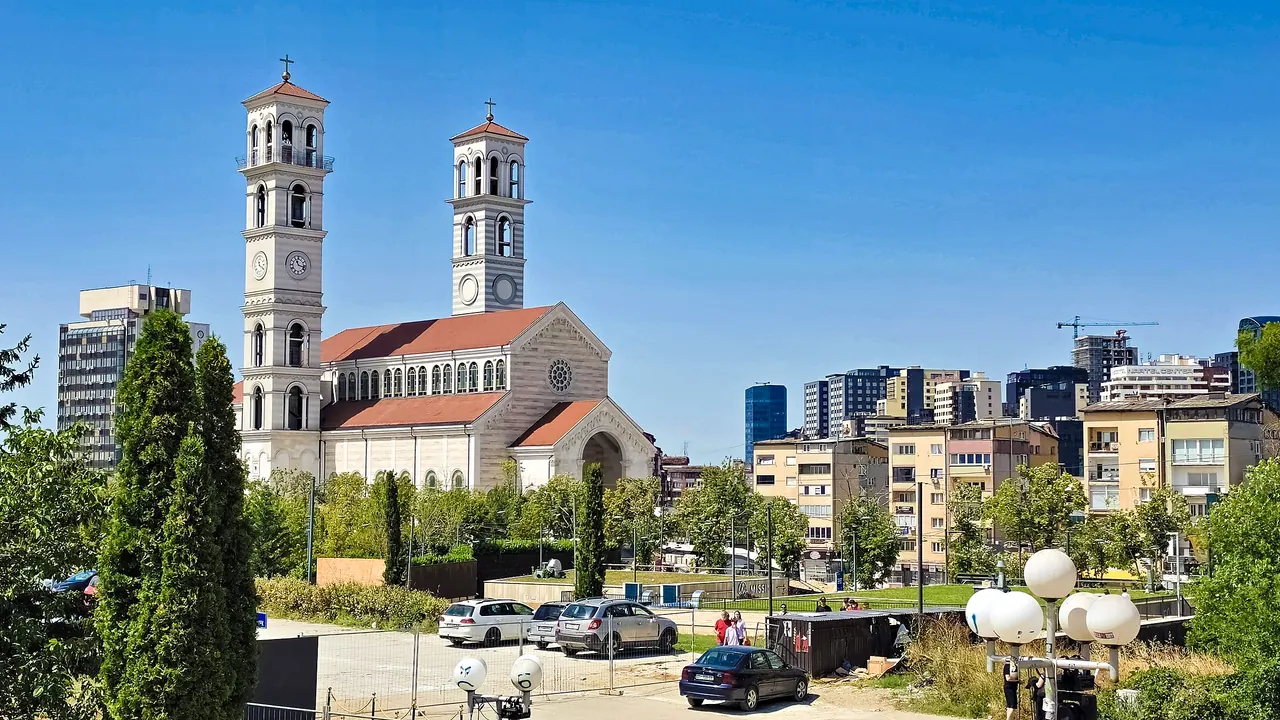
Photos: Cluj-Napoca by Dennis G. Jarvis, CC BY-SA 2.0, cropped; Pristina by Daciana Cristina Visan, Pexels License.
Cluj-Napoca or Pristina?
Our verdict in twelve categories, each scored against the same fixed benchmark cities, and the climate month by month, so you can choose for your trip.
Choose Cluj-Napoca for
- live music and the arts
- culture and sights
- getting around
Cluj-Napoca is the better choice for a trip built around the city itself. Its compact centre has more to see, from St Michael's Church and the Bánffy Palace to the open-air ethnographic museum in the Hoia hills. Two opera houses, two theatres and a philharmonic give it a stage life Pristina cannot match. The forested hills, Turda Gorge and the Apuseni Mountains are close by, and its flat, walkable streets make it the easier city with children.
Choose Pristina for
- prices
- day trips
Pick Pristina if your money has to stretch as far as possible and you plan to use the city as a base. It is cheaper again, and the best of Kosovo is an easy bus ride away: Prizren's Ottoman old town, the frescoed monasteries at Peja and Decani, and Gracanica on the edge of town. The capital itself takes a day of sightseeing and plenty of hours over macchiatos. It suits travellers drawn by the country's recent story more than by monuments.
Scoreboard
Twelve categories on one fixed scale from 0 to 100. The shaded stretch is the gap between the two.
Your match
Pick a travel style or drag the sliders, and both match scores follow your weighting.
Wins on live music and the arts and culture and sights with your weighting.
Wins on prices and day trips with your weighting.
What matters to you?
Category by category
What the scores mean for a trip.
Beaches & swimming
Neither city is a swimming destination, and from both the sea is a separate journey. In Cluj, summer swimming means the outdoor salt lakes at Turda, where you float easily in salty water, or the lidos on the edge of town. Pristina has Lake Batlava, a freshwater reservoir in wooded hills, and a few hotel pools.
Food & drink
The two are evenly matched, and both reward hearty eating more than variety. Cluj cooks where Romanian and Hungarian traditions meet, with varză à la Cluj, ciorbă and papanași. It also has a serious specialty coffee scene around Piața Unirii and Piața Muzeului, and farm cheese and smoked meats at Piața Mihai Viteazul.
Pristina's table is Albanian and Balkan, with flija, tavë and grilled qebapa. Its daily ritual is the macchiato, lingered over for an hour on and around the pedestrian boulevard. Each city has its local wine: Târnave whites in Cluj, wine from the Rahovec valley in Pristina.
Culture & sights
Cluj has more to fill your days. Its old centre is a complete townscape of Gothic church, baroque palaces and medieval bastion. The national art museum in the Bánffy Palace and the open-air ethnographic museum in the Hoia hills are two museums worth planning around.
Pristina's centre can be seen in a day: the Imperial Mosque and the old bazaar quarter, the Emin Gjiku houses and the latticed National Library. Its sight of real weight, the frescoed Gracanica Monastery, lies just outside town. Most visitors come for the city's recent history more than its buildings.
Nightlife
Both scenes are driven by young people and are livelier than the size of either city suggests, but Cluj has more of it. It has cellar bars and terraces around Piața Muzeului and a few clubs playing electronic music in old industrial spaces until early morning. Pristina's evenings centre on café-bars that switch from macchiatos to drinks, sociable rather than wild.
The seasons run opposite ways. Cluj is at its liveliest during term, from October to June, and goes quiet in summer. Pristina is fullest in summer, when the diaspora comes home.
Nature & outdoors
Cluj has the better outdoors on its doorstep. The Făget woods and Hoia forest start at the edge of town, Turda Gorge makes a half-day hike, and the karst plateaus and caves of the Apuseni Mountains are within a day's reach by car.
Pristina has the oak and beech forest of Germia Park on its eastern edge and the Mirusha waterfalls within an hour. Its real mountains, the Sharr range and the Rugova Gorge leading into the Accursed Mountains, are a long day's drive away on less developed roads and trails, so they are not a quick escape.
Day trips
Pristina makes the stronger base for outings, because Kosovo is small and its best places are one easy bus ride away. Prizren's Ottoman old town, the Patriarchate of Pec, the medieval frescoes of Visoki Decani, and Skopje across the border all fit comfortably into a day.
From Cluj, the Turda Salt Mine is the outing everyone takes, and Alba Iulia's star-shaped citadel, the Bánffy Castle at Bonțida and the village of Rimetea all make good days. The famous Transylvanian towns, Sighișoara and Sibiu, are nearer three hours away, though, and work better as overnight stops.
Good for families
Cluj is the easier city with children, mainly because of the Turda Salt Mine, whose underground lake, Ferris wheel and play areas make a memorable day. It also has rowing boats in Central Park, the Botanical Garden and a small zoo.
Pristina welcomes children warmly in cafés and restaurants, and Germia Park has playgrounds and a summer pool. Little else there is made for them, and broken pavements and parked cars make pushchairs hard work.
Getting around
You can cover either centre on foot in about twenty minutes, but Cluj's is flat and easy, and buses, trolleybuses and a tram serve the rest of the city. In Pristina, walking beyond Mother Teresa Boulevard means cars on the pavements and uneven streets, and the buses are hard to work out, so visitors rely on cheap taxis.
Leaving town reverses the picture. Pristina's frequent intercity buses run to Prizren, Peja and Skopje, while from Cluj, slow trains and infrequent buses push you towards a hired car.
Shopping & style
Shopping is a sideline in both cities, but Cluj gives you a little more to browse. It has independent fashion and design shops on its pedestrian streets, folk-art fairs and the ethnographic museum's shop for embroidered blouses and painted ceramics, and a Christmas market on Piața Unirii. In Pristina the boulevard is mostly chains, and the buys worth looking for are silver filigree, plis felt caps and Rahovec wine.
Affordability
Both are cheap by Western European standards, but Pristina is cheaper again: meals, coffee and taxis cost so little you stop counting, and most museums are free or nearly so. Cluj's tech and university economy keeps its prices above the Romanian norm, and rooms sell out and get expensive during the big summer festivals. Its opera and theatre seats are a real bargain, though.
Live music & performing arts
This is where the two cities differ most. Cluj has two parallel stage worlds, Romanian and Hungarian, each with its own opera and theatre, plus the Transylvania State Philharmonic. That means opera, ballet or classical music most of the year, with tickets easy to get, and in summer some of Eastern Europe's largest music festivals.
Pristina has the National Theatre, performing in Albanian, the Kosovo Philharmonic and a small opera and ballet company. On most evenings a visitor will find little beyond weekend bands in bars.
Wellness & relaxation
Neither city is a place to come for rest and recovery, and in both, spa time means hotel wellness centres. The difference is what lies nearby. Cluj has the salty mine air and the salt lakes of Turda, about forty minutes away, while Pristina's thermal springs at Banja e Pejes and Kllokot are old-fashioned resorts more than an hour off.
Within the cities, Cluj's Botanical Garden and park lake are quieter places to slow down than Pristina's cafés, where traffic and building noise get in the way.
When should you go?
Pick your month. The climate figures are measured averages, not a forecast.
Cluj-Napoca in July
Pristina in July
Daytime high, °C
Rainfall in the month, mm
Where the figures come from
Pristina has no weather station within reach, so its figures come from a gridded climate model rather than a measured record, and read a broad area rather than one spot.
Temperature and rainfall are climate normals, averaged over the years shown. Cluj-Napoca: 1991-2020 normals, Cluj-Napoca (2.4 km from centre). Pristina: 2001-2020 normals, NASA POWER reanalysis grid, no weather station within 90 km.
Neither city has a sea, so the year comes down to warmth and rain. Cluj is warm from late May to early September, with highs around 27°C in July and August and its longest, sunniest days. Summer is also its wettest season, and June brings the most rain at about 91mm. Winters are drier but grey and close to freezing, so May and September are the most comfortable months for walking the streets and the hills around them.\n\nPristina gets a little hotter in high summer, around 29°C, and July and August are its driest months, so they are the surest time to sit out on its terraces, though the heat makes long walks tiring at midday.
Its rain has two peaks: May is the wettest month at about 80mm, and October and November are nearly as wet. June and September fall between, mild and in the low to mid twenties, with less rain than May and October, which makes them its best months for walking. From December to February both cities are cold, with highs only a few degrees above freezing.
Which traveller are you?
On a culture and arts trip, Cluj-Napoca is the clear choice. Its old centre, national art museum and open-air ethnographic museum fill two good days. Its Romanian and Hungarian opera houses, theatres and philharmonic fill the evenings in a way Pristina's small stage scene cannot.
On a trip on a tight budget, Pristina goes further. Meals, macchiatos and taxis cost a fraction of Western European prices, and most sights are free or close to it. Frequent intercity buses reach Prizren and the UNESCO-listed monasteries, so you need not hire a car.
On a family trip with children, Cluj-Napoca makes the easier base. Its flat centre and trams make getting about with children simple, and a hired car turns it into the start of a wider Transylvanian loop of castles and citadels. Pristina has little made for children.
Before you go
| Measure | Cluj-Napoca | Pristina |
|---|---|---|
| Official language | Romanian | Albanian, Serbian |
| Currency | Romanian Leu (RON) | Euro (EUR) |
| Sockets | CF230 V, 50 Hz | F230 V, 50 Hz |
| Driving side | Right | Right |
| Time zone | UTC+2, UTC+3 in summer | UTC+1, UTC+2 in summer |
| Emergency number | 112 | 112 |
| Elevation | 356 m | 652 m |
| Main airport | Avram Iancu Cluj International Airport (CLJ)7 km from centre53 non-stop destinations | Priština Adem Jashari International Airport (PRN)15 km from centre42 non-stop destinations |
| Public holidays this year | 17 days | - |
By the numbers
| Measure | Cluj-Napoca | Pristina |
|---|---|---|
| Population | 286,598 | 227,466 |
| People per km² | 1,640 | 435 |
| Museums within 10 km | 6 | 4 |
| UNESCO World Heritage sites within 50 km | 0 | 1 |
Where else could you go?
Every comparison below shares a destination with this one, so you can follow Cluj-Napoca or Pristina somewhere new.
- Skopjevs Pristina
- Sibiuvs Cluj-Napoca
- Ohridvs Pristina
- Sofiavs Pristina
- Tiranavs Pristina
- Budvavs Pristina