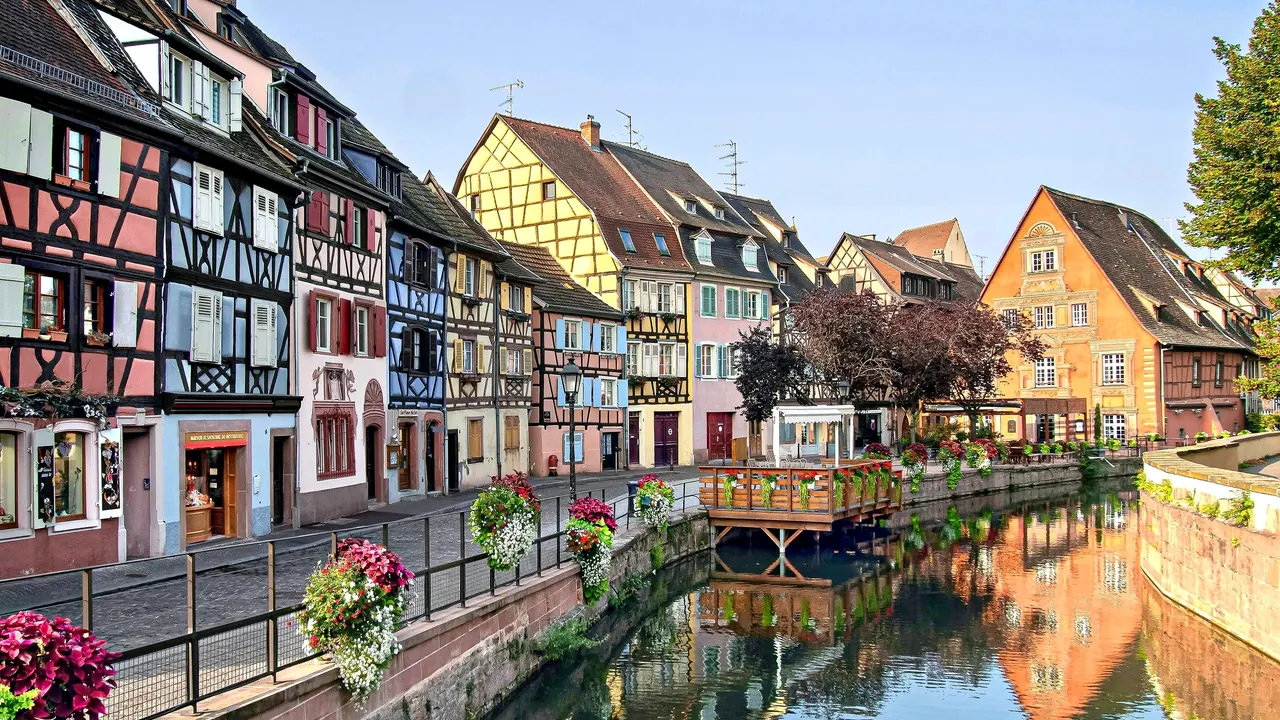
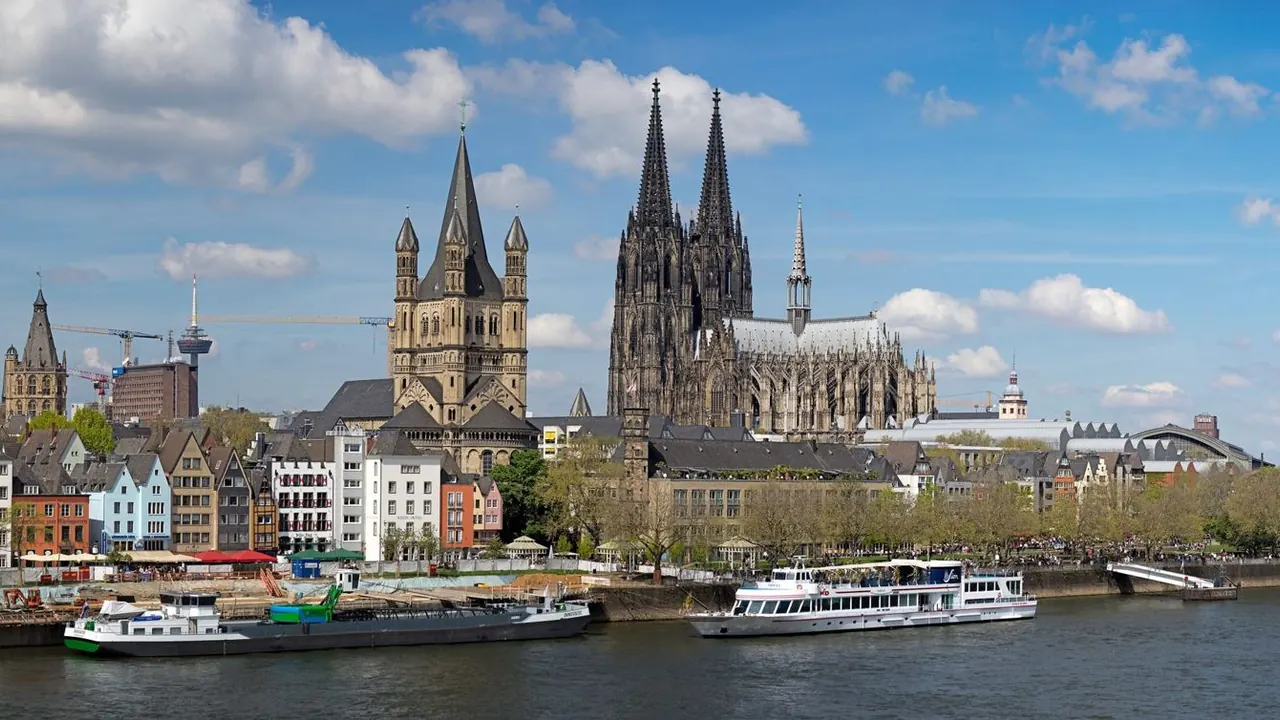
Photos: Colmar by Rolf Kranz, CC BY-SA 4.0, cropped; Cologne by Jörg Braukmann, CC BY-SA 4.0, cropped.
Colmar or Cologne?
Our verdict in twelve categories, each scored against the same fixed benchmark cities, and the climate month by month, so you can choose for your trip.
Choose Colmar for
- nature and the outdoors
- food and drink
- day trips
Colmar is the pick for a slow, rural trip built around wine, food and landscape. Its painted old town survives as one piece, the Alsace wine villages sit a few kilometres apart, and the Vosges rise straight behind the vineyards. It rewards travellers who are happy with long lunches and quiet evenings, and who will hire a car or a bike to reach the countryside.
Choose Cologne for
- nightlife
- live music and the arts
- shopping
For a livelier city stay, Cologne makes more sense. It has proper nights out from the brewhouses to Ehrenfeld's clubs, a serious opera and concert calendar, and better shopping. It also has trams and fast trains, so you never need a car. The cathedral and the museums give it plenty of culture, but the pull here is energy and convenience rather than charm.
Scoreboard
Twelve categories on one fixed scale from 0 to 100. The shaded stretch is the gap between the two.
Your match
Pick a travel style or drag the sliders, and both match scores follow your weighting.
Wins on nature and the outdoors and food and drink with your weighting.
Wins on nightlife and live music and the arts with your weighting.
What matters to you?
Category by category
What the scores mean for a trip.
Beaches & swimming
Neither city is a place for swimming, but Cologne at least gives you a decent summer afternoon in the water. The flooded gravel pits on its edge, such as Fühlinger See and Otto-Maigler-See, have grassy banks and small sandy patches. Colmar has municipal pools and a few small mountain lakes up in the Vosges valleys, which take a drive to reach.
Food & drink
Colmar eats better. Alsace cooking sits between French and German traditions, with choucroute, baeckeoffe, tarte flambée and munster cheese, all served alongside Riesling and Gewurztraminer from the slopes outside town. Cellar tastings are a short drive away, and a few ambitious tables add a fine-dining tier.
Cologne's best food experience is a ritual more than a cuisine. The Köbes keep bringing glasses of Kölsch in the Altstadt brewhouses, and the food is hearty Himmel un Ääd and sauerbraten. Its wider range is better than Colmar's, though, especially the Turkish and Middle Eastern cooking along Venloer Strasse.
Culture & sights
The two are broadly matched, but the experience is quite different. Colmar's strength is the whole townscape: painted half-timbered streets, the Maison Pfister and the canals of Petite Venise. Above all there is Grünewald's Isenheim Altarpiece in the Unterlinden Museum. It is compact, and two days covers it.
Cologne gives you landmarks set in a plain post-war city. The cathedral and its Shrine of the Three Kings come first, followed by the ring of Romanesque churches and the Roman remains. Museums of real depth add more: Museum Ludwig for Pop Art, the Wallraf-Richartz and Kolumba.
Nightlife
This is the widest gap between the two. In Colmar an evening means a long dinner, then perhaps a glass in a wine bar near Petite Venise before the streets go quiet. Anyone who wants more takes the train to Strasbourg.
Cologne likes going out. People start in the brewhouses, move on to the Belgian Quarter's cocktail bars or the student crowds of Zülpicher Strasse, and finish in Ehrenfeld's factory clubs. Its gay scene around Rudolfplatz is one of Germany's largest, and during Carnival the whole city sings in costume from morning to night.
Nature & outdoors
Colmar has much better scenery close at hand. Vineyard paths start within half an hour, and above them the Munster valley climbs to the Hohneck and the Grand Ballon. From the ridge you can see the Black Forest, and on clear days the Alps. There is cycling on the wine route and modest skiing in winter.
Cologne's green space is more urban: the Grüngürtel parks, the Rhine meadows and long riverside cycle paths. The wooded Siebengebirge and the crater lakes of the Eifel make good day hikes, but there are no real mountains.
Day trips
Both make excellent bases, but the trips are of a different kind. From Colmar the outings are mostly small places: Eguisheim, Riquewihr and Kaysersberg, plus Haut-Koenigsbourg on its ridge, are best reached by car or bike. Strasbourg, Basel and Freiburg are each within about an hour.
Cologne's outings are mostly cities, all by fast train. Bonn, Düsseldorf and Aachen's Carolingian chapel are each under forty minutes away, and the Brühl palaces are closer still. You can go further to the castle towns of the Rhine Gorge or to Brussels, all without a car.
Good for families
Cologne is the easier city with children, and most of its attractions are in town. There is the zoo with its elephant park, the Chocolate Museum's working production line and the cable car over the Rhine. Phantasialand is a short trip south. The one period to avoid is Carnival.
Colmar itself is small and gentle, with boat rides through Petite Venise and storks on the rooftops. Its real draws for children, such as the monkey park at Kintzheim, the stork park at Hunawihr and Europa-Park, all need a car.
Getting around
Both centres are flat and walkable, but Cologne is easier once you leave the centre. Trams, the Stadtbahn and S-Bahn trains reach Ehrenfeld, the zoo and the suburbs, even if the network map takes some getting used to.
In Colmar, regional trains handle Strasbourg and Mulhouse well. Buses to the wine villages and the Vosges are thin, though, so a hired car or bike becomes part of the plan.
Shopping & style
In Colmar, shopping is a morning's browse rather than a reason to come. The old-town lanes are better for Soufflenheim pottery, kougelhopf moulds and wine bought from the producer than for clothes, and on the most photographed streets the souvenir shops crowd out the boutiques. Advent is the exception, when the Christmas markets turn the painted squares into one large gift fair.
Cologne has more because it is a big regional city with a high street to match. Hohe Strasse, running south from the cathedral, is one of Germany's busiest pedestrian shopping streets, so department stores and chain stores are a few minutes' walk from the station. The Belgian Quarter adds design shops and concept stores that Colmar has nothing like, and the labels around Mittelstrasse cover the upper end, although luxury is not the city's strength.
Affordability
Overall costs are much the same, moderate for Western Europe in both, and in each the hotel bill is what stretches the budget. In Colmar, rooms get scarce in summer and during the Christmas market weeks, and staying in a nearby wine village helps. In Cologne, rates jump during the trade fairs and Carnival. Free entry to the cathedral and other churches helps offset that.
Live music & performing arts
Cologne is in a different league. The opera and the Schauspiel share Offenbachplatz, and the Philharmonie beside the cathedral is home to two orchestras, with radio ensembles, jazz, electronic music and small clubs filling the rest of the week. The dialect songs of the Carnival sessions are a tradition found nowhere else.
Colmar has a small Italian-style theatre and a calendar built around festivals: classical music in July, jazz in autumn and concerts at the wine fair. Outside those weeks, serious performances mean a trip to Strasbourg or Basel.
Wellness & relaxation
For real spa time Cologne is better equipped. Large German sauna landscapes are an ordinary weekend habit there, the mineral-spring thermal baths in the Rheinpark look across the river to the cathedral, and Aachen's hot springs are close by.
Colmar has hotel spas and little else in the way of facilities. What it offers instead is the slower pace: quiet canals in the evening and unhurried walks through the vines once the day visitors have gone.
When should you go?
Pick your month. The climate figures are measured averages, not a forecast.
Colmar in July
Cologne in July
Daytime high, °C
Rainfall in the month, mm
Temperature and rainfall are climate normals, averaged over the years shown. Colmar: 1991-2020 normals, Ihringen (21.1 km from centre). Cologne: 1991-2020 (sunshine 1981-2010) normals, Köln-Stammheim (5.4 km from centre).
Both cities are comfortable for walking from May to September. Both turn cold and dark from November to February, with daytime highs around 6°C in midwinter. Colmar is the sunnier and slightly warmer of the two in summer, reaching about 27°C in August, which is warm but rarely too hot for the streets. Its winters are much drier, with roughly half Cologne's rainfall in January. Its wet season comes in late spring and summer instead, peaking in May at about 87mm. September, still mild and sunny, is a fine time for the vineyards and the hills.
Cologne's rain is spread evenly through the year, and it gets less sunshine than Colmar in almost every month. Only October is level. Its wettest weeks are in July and August, at around 81mm. Summer highs stay a little lower, so long days of sightseeing are easy going. April and May are drier there than in Colmar, which makes late spring a good time to visit. Neither city is a beach destination, and swimming in either means lakes or pools on warm summer days.
Which traveller are you?
On an outdoors trip, Colmar is the clear choice. Waymarked paths run through the vines between wine villages, and the Route des Crêtes leads up to the Vosges summits and glacial lakes. Cologne's parks, the Siebengebirge and the Eifel are good for walking but much gentler.
For a food and nightlife trip, choose Cologne. Colmar has the better kitchen, with winstub cooking and Alsace wine, but its streets go quiet after dinner. Cologne pairs the Kölsch brewhouses with bars in the Belgian Quarter, clubs in Ehrenfeld, a large gay scene and Carnival.
On a shopping trip, Cologne has far more to offer. There are department stores and chains along Schildergasse, independent fashion on Ehrenstrasse and Eau de Cologne from the historic perfume houses. Colmar is mostly regional gifts: wine, pottery, table linen and gingerbread.
Before you go
| Measure | Colmar | Cologne |
|---|---|---|
| Official language | French | German |
| Currency | Euro (EUR) | Euro (EUR) |
| Sockets | CE230 V, 50 Hz | CF230 V, 50 Hz |
| Driving side | Right | Right |
| Time zone | UTC+1, UTC+2 in summer | UTC+1, UTC+2 in summer |
| Emergency number | 112 | 112 |
| Elevation | 185 m | 59 m |
| Main airport | EuroAirport Basel–Mulhouse–Freiburg (BSL)55 km from centre112 non-stop destinations | Cologne Bonn Airport (CGN)15 km from centre115 non-stop destinations |
| Public holidays this year | 11 days | 11 days |
By the numbers
| Measure | Colmar | Cologne |
|---|---|---|
| City population | 66,970 | 1,025,523 |
| People per km² | 1,006 | 2,532 |
| Museums within 10 km | 9 | 40 |
| UNESCO World Heritage sites within 50 km | 3 | 3 |
Where else could you go?
Every comparison below shares a destination with this one, so you can follow Colmar or Cologne somewhere new.
- Dusseldorfvs Cologne
- Baselvs Colmar
- Strasbourgvs Colmar
- Maastrichtvs Cologne
- Baden-Badenvs Colmar
- Zurichvs Colmar