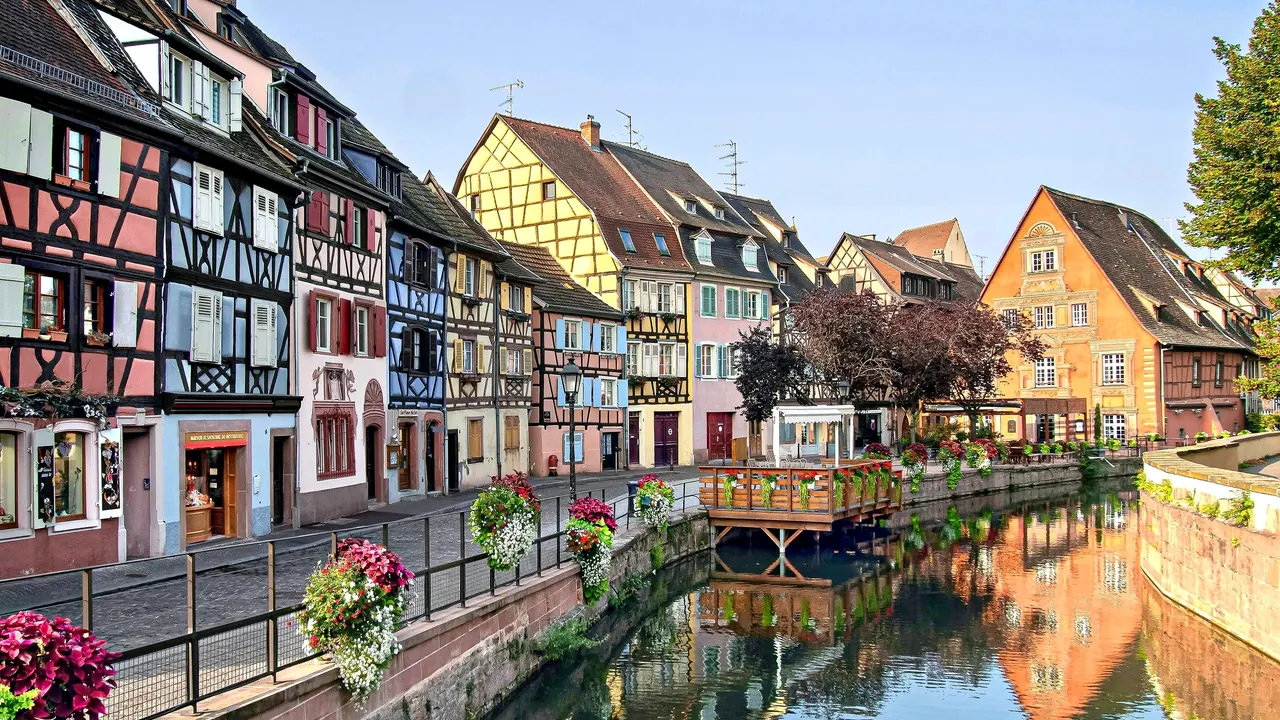
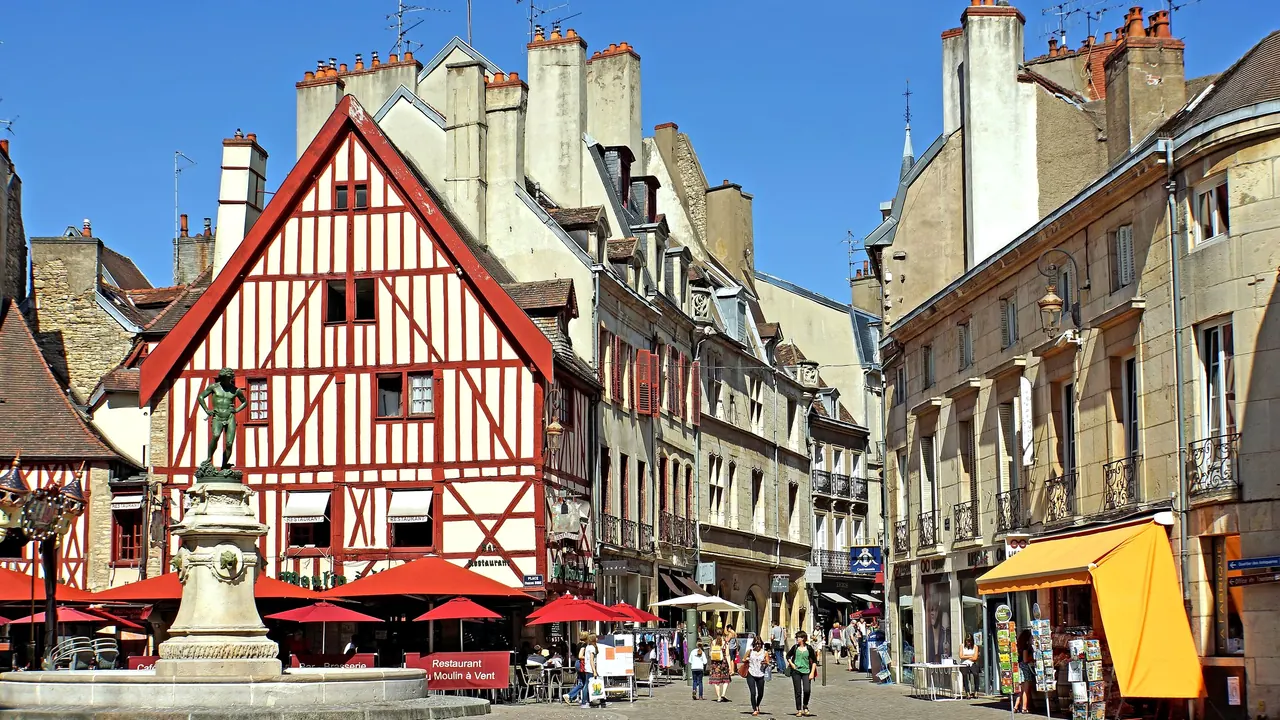
Photos: Colmar by Rolf Kranz, CC BY-SA 4.0, cropped; Dijon by Dennis G. Jarvis, CC BY-SA 2.0, cropped.
Colmar or Dijon?
Our verdict in twelve categories, each scored against the same fixed benchmark cities, and the climate month by month, so you can choose for your trip.
Choose Colmar for
- families
- nature and the outdoors
- day trips
Colmar suits travellers who want the landscape as much as the town. The painted old town and the Isenheim Altarpiece fill a couple of days, and then the wine villages, the Vosges ridges and Strasbourg, Basel and Freiburg are all within easy reach. Families do especially well here, with storks, monkeys, castles and a major theme park nearby, provided they have a car.
Choose Dijon for
- live music and the arts
- nightlife
- getting around
Pick Dijon if you want a proper small city with a life of its own after dark. A university keeps Rue Berbisey busy, the opera and Auditorium give a real season of music and dance, trams and a fast train to Paris make it easy without a car, and Burgundy's great vineyards start at the edge of town.
Scoreboard
Twelve categories on one fixed scale from 0 to 100. The shaded stretch is the gap between the two.
Your match
Pick a travel style or drag the sliders, and both match scores follow your weighting.
Too close to call, level with your weighting
Wins on families and nature and the outdoors with your weighting.
Wins on live music and the arts and nightlife with your weighting.
What matters to you?
Category by category
What the scores mean for a trip.
Beaches & swimming
Neither town is a place for swimming, and the difference between them is small. Colmar's options are municipal pools or a drive up to the small lakes in the Vosges valleys. Dijon has Lac Kir on its western edge, a supervised bathing area with lawn and sand that you can reach by bus, so a hot afternoon by the water takes less effort there.
Food & drink
Both towns eat well, and the difference is in the cooking rather than the standard. Colmar serves the Franco-German food of Alsace in wood-panelled winstubs: choucroute, baeckeoffe, tarte flambée and munster, with Riesling and Gewurztraminer from the slopes outside town. Dijon has the slow-cooked classics of Burgundy, such as boeuf bourguignon, coq au vin and snails, plus its own mustard and cassis.
Dijon's market hall, Les Halles, is ringed by bistros and makes a better food quarter. Its wine bars also pour village Burgundies by the glass, and the gastronomy centre in the old hospital adds tastings and cookery. Both towns are narrow beyond their regional cooking, and in Colmar's most photographed lanes the menus are often tired.
Culture & sights
The two are evenly matched, but they offer different experiences. Colmar's strength is the whole townscape, a painted, half-timbered old town with canals that survived largely intact, and one painting of world importance: Grünewald's Isenheim Altarpiece in the Unterlinden.
Dijon is about the power of the Dukes of Burgundy. Their palace holds one of France's oldest fine arts museums, with the ducal tombs and their sculpted mourners, and around it stand Notre-Dame with its gargoyles and lucky owl, the Romanesque crypt of Saint-Bénigne and Sluter's Well of Moses. Colmar takes about two days and Dijon a little longer.
Nightlife
Dijon has the livelier evenings, and the reason is its university. Rue Berbisey is lined with small bars, there are terraces around Place Émile Zola and the market, and a few clubs stay open, although the streets thin out around midnight outside term time.
Colmar's evenings mostly end with dinner and a last glass of wine by the canals. The streets go quiet early, and anyone wanting a night out takes the train to Strasbourg.
Nature & outdoors
Colmar has the more dramatic surroundings. The vineyards climb straight into the Vosges, and a short drive up the Munster or Kaysersberg valleys brings you to the Route des Crêtes, the Grand Ballon, glacial lakes and views across to the Black Forest. There are dense trail networks for walkers and modest skiing in winter.
Dijon's countryside is gentler. There are climbing cliffs and walks in the combes just west of town, a long flat towpath along the Burgundy Canal, and the cycle route through the Côte de Nuits. For wilder ground you need to drive to the Morvan, about an hour and a half away.
Day trips
Both make excellent bases, but Colmar has more within close reach. The storybook villages of Eguisheim, Riquewihr and Kaysersberg are only a few kilometres apart, Strasbourg is about half an hour by train, and three countries meet nearby, with Basel and Freiburg each about an hour away.
Dijon's outings run along the Route des Grands Crus to Vougeot and Beaune. Further afield are Fontenay Abbey, Semur-en-Auxois, Alésia and Vézelay, which are more spread out and suit a longer day. In both places, buses and trains miss most of the wine villages.
Good for families
Colmar is clearly the better choice with children. The town itself has boat rides, a little tourist train and storks on the rooftops. The surrounding area adds the stork and otter park at Hunawihr, free-roaming monkeys and an eagle show at Kintzheim, a hilltop castle, Mulhouse's train and car museums and Europa-Park, though most of these need a car.
Dijon is relaxed and pedestrian-friendly, but its family list is short. It runs to the Arquebuse garden with its natural history museum and planetarium, the Colombière park and summer paddling at Lac Kir, while the rest of a typical visit is aimed at adults.
Getting around
Dijon is easier to get around without a car. Two tram lines and buses serve the outskirts, trains run along the wine route to Beaune, and the TGV gets to Paris in well under two hours.
Colmar's centre is just as easy on foot, and trains run quickly to Strasbourg and Mulhouse. However, the villages and mountains that are the reason to come have only thin bus services, so a hire car or bicycle matters more here.
Shopping & style
Neither is a shopping destination, and in both the best purchases are edible. Colmar leans towards Alsatian crafts, such as Soufflenheim pottery, kougelhopf moulds and printed table linen, along with wine bought from the grower. Dijon has mustard in dozens of flavours, cassis and pain d'épices. Its Rue de la Liberté adds a department store and French chains, which Colmar's souvenir-heavy lanes lack.
Affordability
Dijon is a little easier on the budget, mostly because it is a working regional city with a steady supply of moderately priced rooms. In both, set lunch menus are a fair way to eat well, and in Dijon the bill climbs when you add serious restaurants and guided wine tours.
Colmar is small and in demand, so beds near the old town are expensive in summer and in the Christmas market weeks. Staying in a nearby village helps, and the free or cheap tastings in the wine villages make up for some of the cost.
Live music & performing arts
Dijon has a real year-round season. The Opéra de Dijon stages opera, concerts and dance in the old Grand Théâtre and the acoustically fine Auditorium, and there is also a national drama centre and a venue for touring bands, although things thin out in summer.
Colmar works the other way round. Its small Italian-style theatre is quiet for much of the year, and its musical life comes in festival bursts: classical in early July, jazz in autumn and big concerts at the summer wine fair.
Wellness & relaxation
Neither town has thermal baths or a spa culture, so in both, relaxing means hotel spas, long lunches and slow walks. Colmar is quietest in the evenings by the canals once the day-trippers leave. Dijon's version is quiet squares, unhurried vineyard afternoons and, in a few wine-village hotels, grape-based treatments.
When should you go?
Pick your month. The climate figures are measured averages, not a forecast.
Colmar in July
Dijon in July
Daytime high, °C
Rainfall in the month, mm
Temperature and rainfall are climate normals, averaged over the years shown. Colmar: 1991-2020 normals, Ihringen (21.1 km from centre). Dijon: 1991-2020 normals, Dijon (7 km from centre).
The two towns have almost the same climate. Both are cold and grey from December to February, with highs around 6°C, and both reach about 26°C to 27°C in July and August. That is warm enough for long days among the vines and a dip in a lake, though rarely too hot for walking the streets. Late spring and September are the most comfortable months for walking and cycling in either place.
The difference is in the rain. Colmar sits in the rain shadow of the Vosges and stays fairly dry through winter, with its wettest weather in late spring and summer storms, peaking around 87mm in May. Dijon is damper through autumn and winter, so a grey November or January visit is more likely to be wet there, while Colmar's harvest autumn tends to stay drier. Sunshine follows the same pattern in both, generous from May to August and scarce in the depths of winter.
Which traveller are you?
On a family trip with children, Colmar is the better choice. Boat rides through Petite Venise and rooftop storks keep the town entertaining, and the otter park, macaque forest, eagle show, Haut-Koenigsbourg and Europa-Park are all a drive away. Dijon has parks and a planetarium, but not much more.
For an outdoors trip, choose Colmar. The Vosges rise straight behind the vineyards, with the Route des Crêtes, glacial lakes, dense waymarked trails and some winter skiing. Dijon's combes, canal towpath and vineyard cycle route are pleasant, but gentle by comparison.
On a food and nightlife trip, Dijon pulls ahead. Burgundy cooking and village wines by the glass are as good as Colmar's Alsace table, and the student bars of Rue Berbisey and the market terraces keep evenings going well after Colmar has gone quiet.
Before you go
| Measure | Colmar | Dijon |
|---|---|---|
| Official language | French | French |
| Currency | Euro (EUR) | Euro (EUR) |
| Sockets | CE230 V, 50 Hz | CE230 V, 50 Hz |
| Driving side | Right | Right |
| Time zone | UTC+1, UTC+2 in summer | UTC+1, UTC+2 in summer |
| Emergency number | 112 | 112 |
| Elevation | 185 m | 220 m |
| Main airport | EuroAirport Basel–Mulhouse–Freiburg (BSL)55 km from centre112 non-stop destinations | Lyon Saint-Exupéry Airport (LYS)178 km from centre141 non-stop destinations |
| Public holidays this year | 11 days | 11 days |
By the numbers
| Measure | Colmar | Dijon |
|---|---|---|
| City population | 66,970 | 161,830 |
| People per km² | 1,006 | 3,890 |
| Museums within 10 km | 9 | 8 |
| UNESCO World Heritage sites within 50 km | 3 | 1 |
Where else could you go?
Every comparison below shares a destination with this one, so you can follow Colmar or Dijon somewhere new.