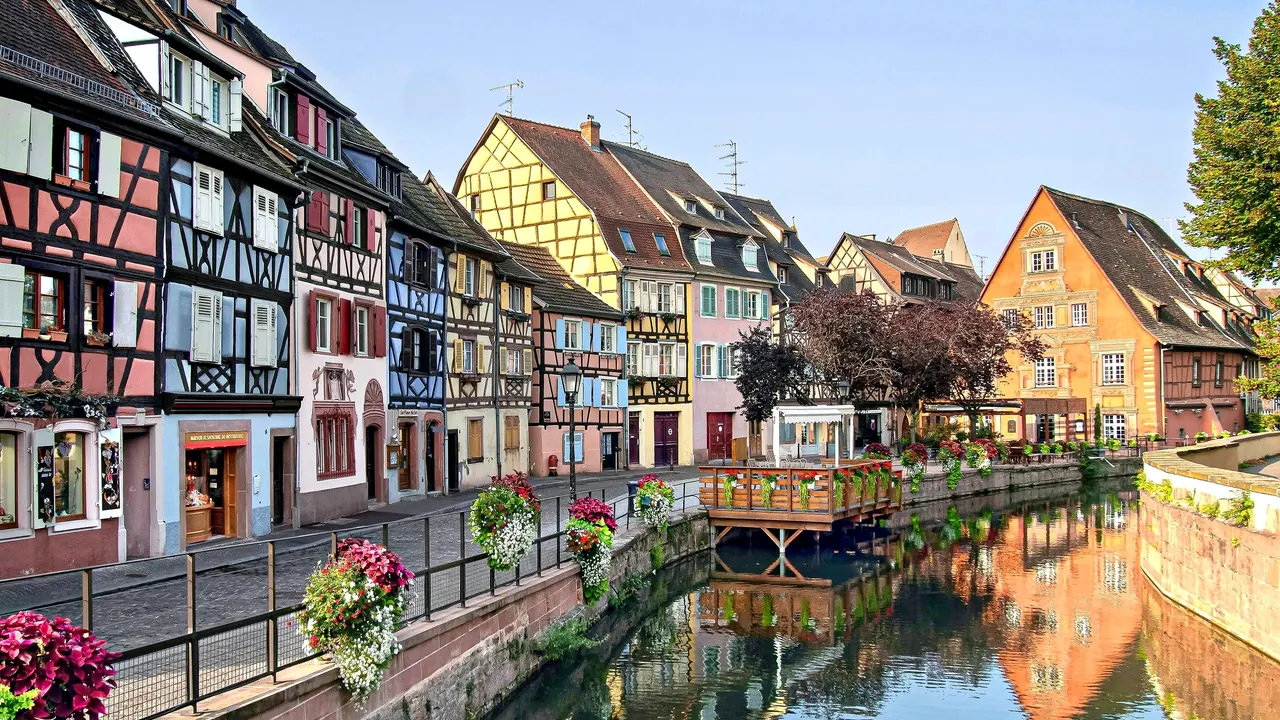
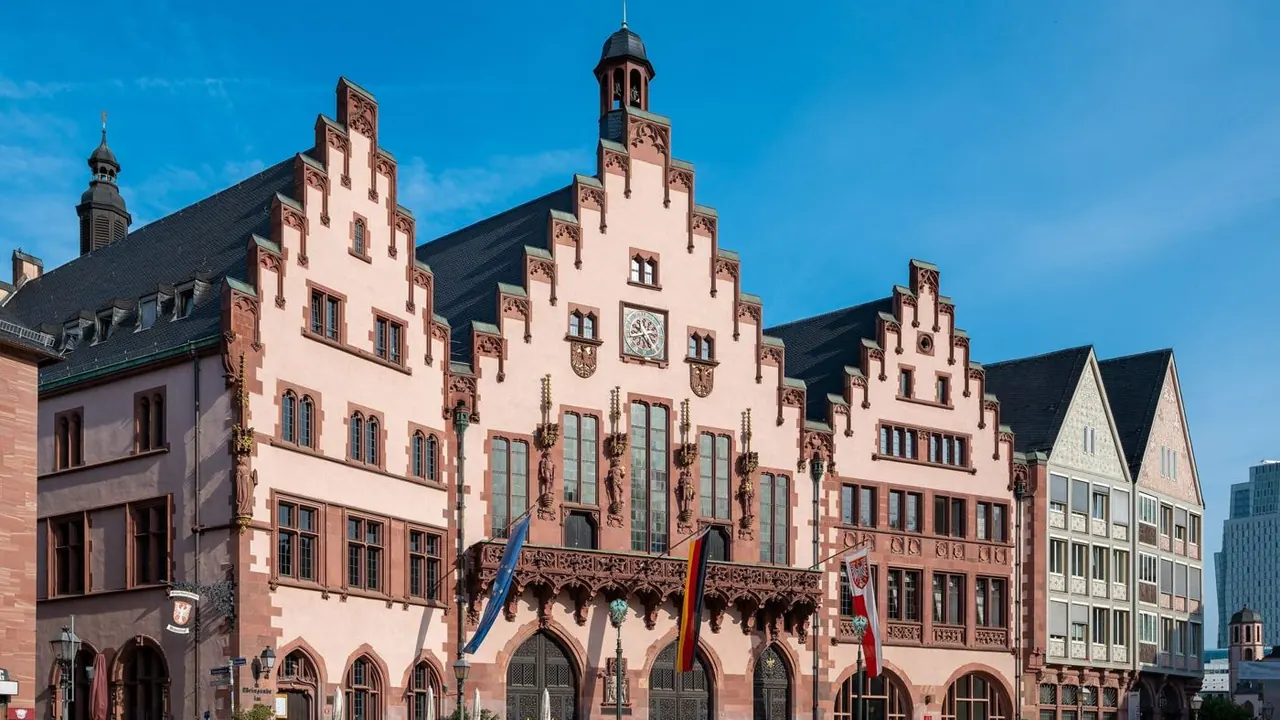
Photos: Colmar by Rolf Kranz, CC BY-SA 4.0, cropped; Frankfurt by Thomas Wolf, CC BY-SA 3.0 DE, cropped.
Colmar or Frankfurt?
Our verdict in twelve categories, each scored against the same fixed benchmark cities, and the climate month by month, so you can choose for your trip.
Choose Colmar for
- food and drink
- nature and the outdoors
- prices
Colmar suits a slower trip built around wine, cooking and countryside. Its painted old town survived the wars largely whole, the Isenheim Altarpiece alone justifies the journey, and within half an hour you can be walking through vineyards between villages or driving up into the Vosges. It is the better pick for couples and walkers who want long lunches, cellar tastings and quiet evenings, and who are happy to hire a car or a bike.
Choose Frankfurt for
- live music and the arts
- nightlife
- wellness
Frankfurt is the choice for travellers who want a proper city that runs without a car. Trains run to the centre from one of Europe's best-connected airports, and from the main station you can reach Heidelberg, Cologne or the Rhine Gorge for the day. Evenings offer opera, serious drama, jazz cellars and a weekend club scene, and the thermal baths of Wiesbaden and Bad Homburg are close by. Its old town is largely a reconstruction, but the museums on both banks of the Main give it real depth.
Scoreboard
Twelve categories on one fixed scale from 0 to 100. The shaded stretch is the gap between the two.
Your match
Pick a travel style or drag the sliders, and both match scores follow your weighting.
Wins on food and drink and nature and the outdoors with your weighting.
Wins on live music and the arts and nightlife with your weighting.
What matters to you?
Category by category
What the scores mean for a trip.
Beaches & swimming
Neither place is anywhere near the sea, so swimming means fresh water in both. Around Colmar that means municipal pools or a small lake up in the Vosges valleys, which takes a drive. Frankfurt has the Langener Waldsee and other gravel-pit lakes on the edge of the city, with sandy shores and warm water in high summer, so a swim fits more easily into a city day.
Food & drink
Colmar is the stronger place to eat. Alsace cooking is generous and varied, from baeckeoffe and choucroute in wood-panelled winstubs to munster cheese and kougelhopf. The wine that goes with it comes from the slopes around town, with tastings in the villages and a fine-dining tier along the wine route. Once you step outside the regional menu, though, the choice is narrow.
Frankfurt's own tradition is smaller: Grüne Soße, Handkäs and tart Apfelwein at the shared tables of Sachsenhausen taverns. Its advantage is range. Turkish, Italian and Asian kitchens and the cheap global food of the Bahnhofsviertel give you plenty of choice once you have tried the local dishes.
Culture & sights
The two are evenly matched, but in very different ways. Colmar's strength is authenticity: a late-medieval and Renaissance townscape that survived largely whole, from the Maison Pfister to Petite Venise, plus the Isenheim Altarpiece at the Unterlinden. It is concentrated, and two days covers it.
Frankfurt offers breadth rather than atmosphere. The Museumsufer lines up more than a dozen museums, led by the Städel, alongside the Senckenberg and the exhibitions at the Schirn. The Römer and the old-town lanes are reconstructions after 1944, set against Germany's only real skyline of towers.
Nightlife
Frankfurt gives you a real night out and Colmar mostly does not. Frankfurt has a club scene rooted in techno and house history, the late, slightly rough bars of the Bahnhofsviertel and neighbourhood bars along Berger Straße, though it only really comes alive on Friday and Saturday.
In Colmar the evening is dinner followed by a glass of Riesling on a terrace by the canals. The streets empty early, and people who want to stay out late take the train to Strasbourg.
Nature & outdoors
Colmar has the more striking landscape on its doorstep. Vineyards climb straight out of the town onto the Vosges, and the valleys of Munster and Kaysersberg lead up to ridge-top views of the Black Forest and sometimes the Alps. There are glacial lakes, summer pastures and a little skiing in winter, though a car helps a great deal.
Frankfurt's countryside is gentler and easier to reach. The Taunus forests and the Großer Feldberg are under an hour by S-Bahn and bus, and the Stadtwald and the Main cycle paths start inside the city.
Day trips
Both are excellent bases, but for different kinds of outing. From Colmar the classic trips are short hops to Riquewihr, Eguisheim and Kaysersberg, a few kilometres apart and best done by car or bike, with Strasbourg, Basel and Freiburg also close.
Frankfurt's trips are longer but all by train. Heidelberg and the castles of the Rhine Gorge are about an hour away, and high-speed trains reach Cologne cathedral and Würzburg's Residenz. Mainz, Speyer and Worms add a run of cathedral cities.
Good for families
Children are well catered for in both, but the attractions are arranged differently. Colmar itself is small and gentle, with boat rides through Petite Venise and storks on the roofs. The big draws, such as the monkeys at Kintzheim, the stork park at Hunawihr and Europa-Park, lie outside town and need a car.
In Frankfurt the highlights are in the city: the Senckenberg dinosaur hall, a central zoo and the Palmengarten. Trams and the S-Bahn take pushchairs easily, though nothing there is as memorable as a day at Europa-Park.
Getting around
Frankfurt is much easier without a car. One integrated network of U-Bahn, S-Bahn, trams and buses reaches the Taunus, Wiesbaden and Mainz, the airport is a short train ride from the centre, and the main station connects straight to the high-speed lines.
Colmar's centre is just as easy on foot, and regional trains to Strasbourg are quick. Buses to the wine villages and the Vosges are infrequent, though, so most visitors hire a car or a bicycle.
Shopping & style
For actual shopping, Frankfurt has much more. The Zeil has the department stores and malls, Goethestraße has luxury fashion and jewellery, and Berger Straße and Schweizer Straße have independent boutiques. Colmar is about things to take home: wine bought from the grower, Soufflenheim pottery, Alsatian table linen and gingerbread. Its Christmas markets are the high point of the year, but fashion is thin.
Affordability
Colmar is the somewhat cheaper stay, though neither is a bargain. Set lunches are fair and village tastings often cost little, but rooms in the old town become expensive and scarce during the Christmas market weeks. Sleeping in a nearby village helps.
In Frankfurt the problem is business-priced hotels, which soar during trade fairs. Weekends and summer bring them down, and cider taverns and Turkish grills keep meals cheap.
Live music & performing arts
Frankfurt is far ahead. It has one of Germany's most respected opera companies, orchestral concerts in the Alte Oper, serious drama at the Schauspiel, contemporary dance at the Mousonturm and jazz cellars that go back to the post-war years. The season runs from autumn to early summer.
Colmar's small Italian-style theatre has a modest programme, so its calendar depends on festivals: classical music in early July, jazz in autumn and the wine fair concerts. That gives it some summer life just when Frankfurt goes quiet.
Wellness & relaxation
Frankfurt has more for a spa trip, though the spas are in the towns around it rather than in the city itself. Wiesbaden's Art Nouveau Kaiser-Friedrich-Therme is fed by hot springs, and Bad Homburg has a spa park and a large thermal complex.
Colmar has no bathing culture beyond hotel spas. What it offers instead is calm: quiet canals once the day visitors have left, and slow walks through the vines.
When should you go?
Pick your month. The climate figures are measured averages, not a forecast.
Colmar in July
Frankfurt in July
Daytime high, °C
Rainfall in the month, mm
Temperature and rainfall are climate normals, averaged over the years shown. Colmar: 1991-2020 normals, Ihringen (21.1 km from centre). Frankfurt: 1991-2020 normals, Frankfurt Westend (2 km from centre).
The two climates are close. Both are at their warmest from June to August, with afternoons around 26°C, warm enough for lake swimming and long evenings outdoors but rarely too hot for walking. The difference is in the rain. Colmar's wettest stretch comes in late spring and summer, peaking at 87mm in May, while its winters are dry. Frankfurt spreads its rain more evenly, gets more sunshine in April, and is damper and greyer in December and January.
For sightseeing, May and September are the most comfortable months in both, with highs near 21°C. September and October are especially rewarding in Colmar, when the harvest is on and the vines turn colour. Midwinter is cold in both, at about 6°C, and short on daylight. That suits Colmar's Christmas markets better than it suits days out in the Frankfurt countryside.
Which traveller are you?
On an outdoors trip, Colmar is the better base. Vineyard paths start just outside town, the Route des Crêtes climbs past the Hohneck to glacial lakes and high pastures, and the plain is fine cycling country. Frankfurt's Taunus is gentler by comparison.
For a short city break, Frankfurt makes far more sense. Trains reach the centre from the airport in about a quarter of an hour, one transport network covers everything, and a weekend can take in the Städel, an opera night and the bars of the Bahnhofsviertel.
On a relaxing and wellness trip, Frankfurt wins because of the spa towns around it: the Art Nouveau Kaiser-Friedrich-Therme in Wiesbaden and the large thermal complex at Bad Homburg. Colmar is peaceful, but its spa options stop at hotel spas.
Before you go
| Measure | Colmar | Frankfurt |
|---|---|---|
| Official language | French | German |
| Currency | Euro (EUR) | Euro (EUR) |
| Sockets | CE230 V, 50 Hz | CF230 V, 50 Hz |
| Driving side | Right | Right |
| Time zone | UTC+1, UTC+2 in summer | UTC+1, UTC+2 in summer |
| Emergency number | 112 | 112 |
| Elevation | 185 m | 101 m |
| Main airport | EuroAirport Basel–Mulhouse–Freiburg (BSL)55 km from centre112 non-stop destinations | Frankfurt Main Airport (FRA)13 km from centre281 non-stop destinations |
| Public holidays this year | 11 days | 10 days |
By the numbers
| Measure | Colmar | Frankfurt |
|---|---|---|
| City population | 66,970 | 760,656 |
| People per km² | 1,006 | 3,063 |
| Museums within 10 km | 9 | 53 |
| UNESCO World Heritage sites within 50 km | 3 | 4 |
Where else could you go?
Every comparison below shares a destination with this one, so you can follow Colmar or Frankfurt somewhere new.
- Baselvs Colmar
- Strasbourgvs Colmar
- Heidelbergvs Frankfurt
- Baden-Badenvs Colmar
- Zurichvs Colmar
- Bernvs Colmar